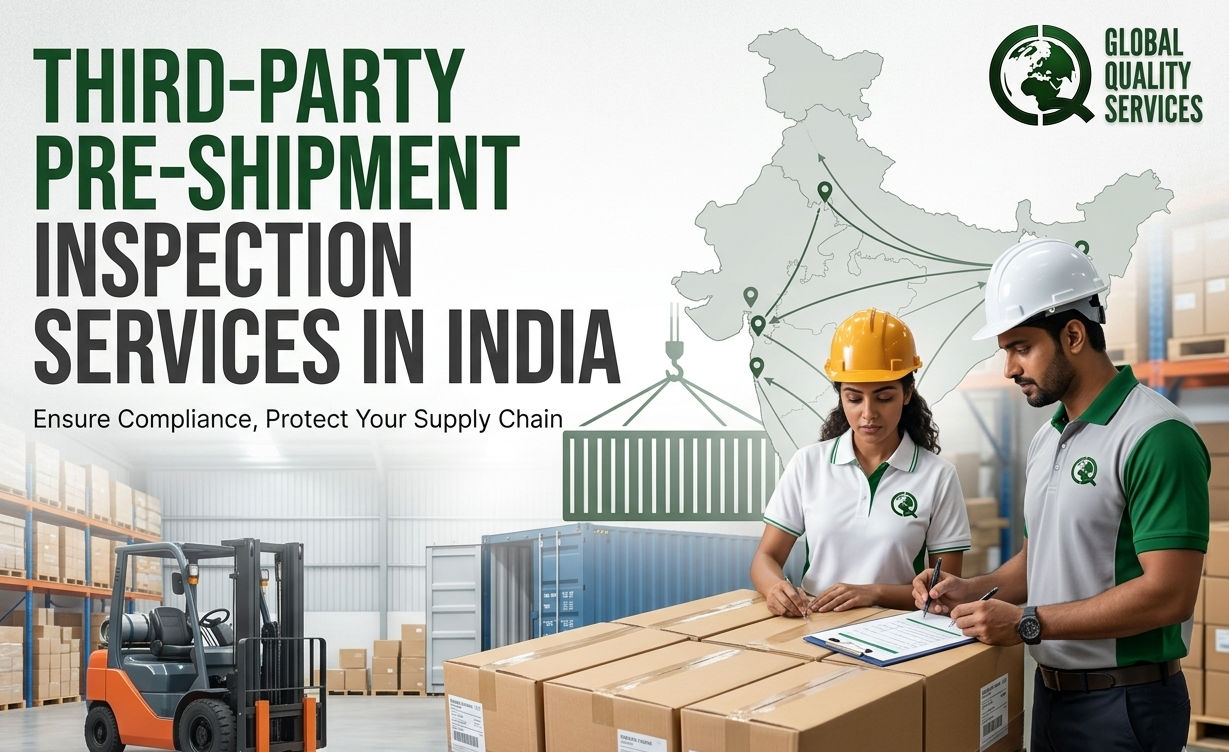
Global supply chains are more complex than ever, and product quality failures can lead to costly recalls, shipment delays, or damaged buyer–supplier relationships. For importers sourcing from India, verifying product quality before goods leave the factory has become a standard risk-management practice. Third-party pre-shipment inspection (PSI) provides an independent assessment of finished products to ensure they meet buyer specifications, regulatory requirements, and packaging standards before shipment.
The need for such inspections continues to grow as international trade expands. According to the World Trade Organization, the US-dollar value of world merchandise trade declined by about 5% in 2023, reaching USD 24.01 trillion, reflecting the massive volume of goods moving across international markets. With such large trade volumes, even small quality issues can create significant financial and operational risks for importers.
Data from the International Organization for Standardization indicates that over one million organizations worldwide are certified under ISO 9001, reflecting the growing emphasis on structured quality management systems across manufacturing sectors.
In this environment, third-party inspection services help importers minimize risks, confirm compliance, and ensure that shipments meet contractual requirements before they are released for export.
What is Third-Party Pre-Shipment Inspection Services?
A Third-Party Pre-Shipment Inspection (PSI) is a systematic verification process conducted when goods are at least 80% to 100% produced and packed. Unlike internal quality checks performed by the factory, a PSI is carried out by an independent, neutral organization. This independence ensures that the evaluation is objective and free from the manufacturer’s internal production pressures.
The primary goal of a PSI is to verify that the shipment matches the purchase order in every detail. This includes checking the quantity, workmanship, safety functions, and packaging. In the context of international trade, the PSI report serves as a critical document that often triggers the final payment under a Letter of Credit. It acts as the final “green light” before goods are loaded into containers and shipped across borders.
Why Importers Use Pre-Shipment Inspection Service in India
India’s manufacturing landscape is vast and diverse, ranging from highly automated facilities to smaller, labor-intensive units. This variance makes third-party oversight essential for several reasons:
- Risk Mitigation: Shipping goods from India to Europe, the US, or the Middle East is expensive. If the quality is found to be poor upon arrival, the cost of returning the goods is often higher than the value of the products themselves.
- Verification of Specifications: It is common for “lost in translation” moments to occur during the manufacturing process. An inspector ensures that the colors, dimensions, and materials used are exactly what was agreed upon in the contract.
- Protection Against Shortages: Importers use PSI to confirm that the factory is actually shipping the correct quantity. This prevents “short-shipping” where a buyer pays for 1,000 units but only receives 900.
- Regulatory Compliance: Many countries require a Certificate of Inspection to allow goods through customs. A third-party agency ensures the products meet specific safety and environmental standards like CE, REACH, or RoHS.
- Supplier Accountability: When a factory knows an independent inspector will visit, they are naturally more diligent about maintaining quality standards throughout the production cycle.
Step-by-Step Pre-Shipment Inspection Process
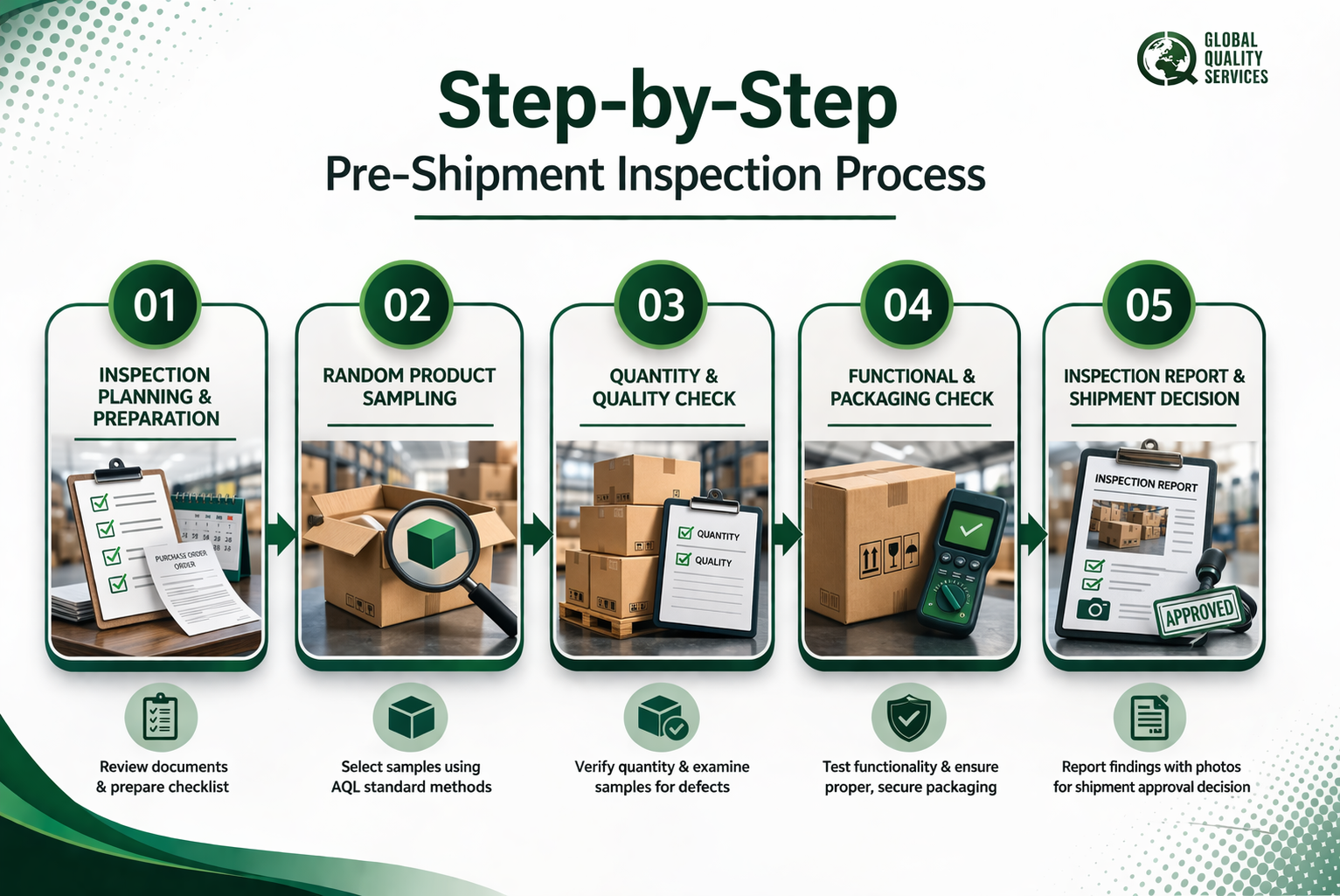
A pre-shipment inspection is conducted when production is finished and most goods are packed. The purpose is to verify that the shipment meets the buyer’s requirements before it leaves the factory. The process usually follows five clear steps.
Step 1: Inspection Planning and Preparation
The inspection is scheduled once production is completed. Before visiting the factory, inspectors review the purchase order, product specifications, packaging instructions, and quality requirements. This helps them understand what needs to be checked during the inspection.
Step 2: Random Product Sampling
Inspectors select product samples using standard sampling methods such as AQL. Samples are taken randomly from different cartons so that they represent the entire batch. This allows inspectors to evaluate product quality without checking every unit.
Step 3: Quantity and Quality Check
Inspectors confirm that the shipment quantity matches the purchase order. They check the number of cartons, units per carton, and total packed quantity. The sampled products are also examined to identify defects such as scratches, poor finishing, incorrect assembly, or size issues.
Step 4: Functional and Packaging Check
If the product has functional features, inspectors test whether it works properly. Packaging is also reviewed to ensure the cartons are strong and the internal packing protects the product during transport. Labels, barcodes, and shipping marks are checked for accuracy.
Step 5: Inspection Report and Shipment Decision
After completing the inspection, a report is prepared with the findings. It includes quantity verification, defects found, test results, and photos from the inspection. The buyer then uses this report to decide whether the shipment can be approved or if corrections are needed before shipping.
Pre-Shipment Inspection Checklist
To maintain consistency, inspectors follow a rigorous checklist. Below is a breakdown of the standard criteria used during a typical Indian export inspection:
| Checklist Category | Key Points of Verification |
| Quantity Verification | Actual carton count vs. Packing list; units per carton check. |
| Workmanship | Surface finish, assembly quality, presence of dust, hair, or debris. |
| Style & Color | Comparison against the “Golden Sample” or approved artwork. |
| Field Tests | Drop tests (for packaging), hi-pot tests (electronics), assembly tests. |
| Measurements | Product dimensions, weight, and thickness using calibrated tools. |
| Markings & Labeling | Correctness of “Made in India” labels, warning labels, and SKU barcodes. |
Industries We Serve that Need Pre-Shipment Inspection
While quality control is vital for all sectors, certain industries in India rely heavily on PSI due to the complexity of their products or the strictness of international regulations:
- Textiles and Apparel: As one of India’s largest export sectors, garment inspections focus heavily on stitching quality, fabric strength, and colorfastness.
- Automotive Components: With the rise of EV manufacturing, inspecting precision parts for tolerances and material integrity is non-negotiable for safety.
- Consumer Electronics: Ensuring electrical safety, battery stability, and software functionality is critical for tech exports.
- Hardlines and Furniture: This includes home decor and industrial tools, where structural stability and material finish are the primary focus.
- Industrial Machinery: Large-scale equipment requires verification of technical specifications, welding quality, and rust-proof packaging for long sea voyages.
Common Quality Issues Found in Inspections
Even the most reliable factories can encounter production slips. PSI commonly identifies the following issues:
- Sub-standard Raw Materials: Using a slightly different grade of plastic or fabric than what was sampled to save on costs.
- Inconsistent Dimensions: Deviations from the approved size charts, which can make products like garments or machine parts unusable.
- Packaging Failures: Using single-wall corrugated boxes when double-wall was specified, leading to damage during transit.
- Functional Malfunctions: High failure rates in electronic components that were not properly stressed during the factory’s internal QC.
- Inaccurate Labeling: Incorrect weight markings or missing country-of-origin labels, which can lead to customs seizures and heavy fines.
Cost of Pre-Shipment Inspection Service in India
The cost of pre-shipment inspection in India varies depending on several factors related to the inspection scope and product complexity. Inspection agencies typically consider multiple variables when determining service pricing.
Key factors influencing PSI costs include:
- Type of product being inspected
- inspection complexity and testing requirements
- location of the manufacturing facility
- number of inspectors required
- inspection duration
- reporting requirements
For example, inspections involving complex machinery or electronics may require additional technical testing, while inspections of simple consumer goods may focus mainly on visual quality checks.
How Global Quality Services Becomes the Right Choice Inspector
Choosing the right inspection partner is critical for ensuring consistent quality and reliable reporting. Global Quality Services supports importers and manufacturers with structured inspection processes designed to provide clear and reliable insights into shipment quality. Key strengths include:
Experienced Inspection Professionals
Inspectors with industry experience understand product specifications and manufacturing processes, allowing them to identify potential defects accurately.
Structured Inspection Methodology
Global Quality Services follows systematic inspection procedures aligned with internationally recognized sampling and reporting practices.
Transparent Reporting
Inspection reports include detailed observations, test results, and photographic evidence to help buyers make informed decisions.
Multi-Industry Inspection Capability
The company supports inspections across a wide range of sectors, enabling importers to maintain consistent quality control across different product categories.
Local Expertise in Indian Manufacturing Regions
Understanding regional manufacturing practices helps ensure inspections are conducted efficiently and accurately.
Ensure Shipment Quality with Global Quality Services
Don’t leave your product quality to chance or trust a factory’s self-assessment. Protecting your brand and your bottom line starts with having independent eyes on the ground. Global Quality Services provides the professional oversight you need to ensure every shipment meets your exact standards.
Ready to verify your next shipment? Contact Global Quality Services today for a tailored inspection plan that secures your Indian sourcing strategy.
Frequently Asked Questions
1. What is the ideal stage to conduct a pre-shipment inspection?
Pre-shipment inspection is typically conducted when production is complete and at least 80% of the goods are packed. This ensures inspectors can verify both product quality and packaging readiness.
2. What standards are used during PSI inspections?
Many inspection agencies follow AQL (Acceptable Quality Limit) sampling standards, which provide a statistical method for evaluating product quality using representative samples.
3. How long does a typical pre-shipment inspection take?
The duration depends on the shipment size, product complexity, and testing requirements. Most inspections are completed within a single day, while complex products may require additional time.
4. Can third-party inspection services support multiple industries?
Yes. Experienced inspection agencies often work across sectors such as consumer goods, electronics, textiles, and industrial equipment. Companies like Global Quality Services provide multi-industry inspection capabilities.
5. What information is included in a pre-shipment inspection report?
Inspection reports usually include product observations, defect classifications, test results, quantity verification details, and photographic documentation.