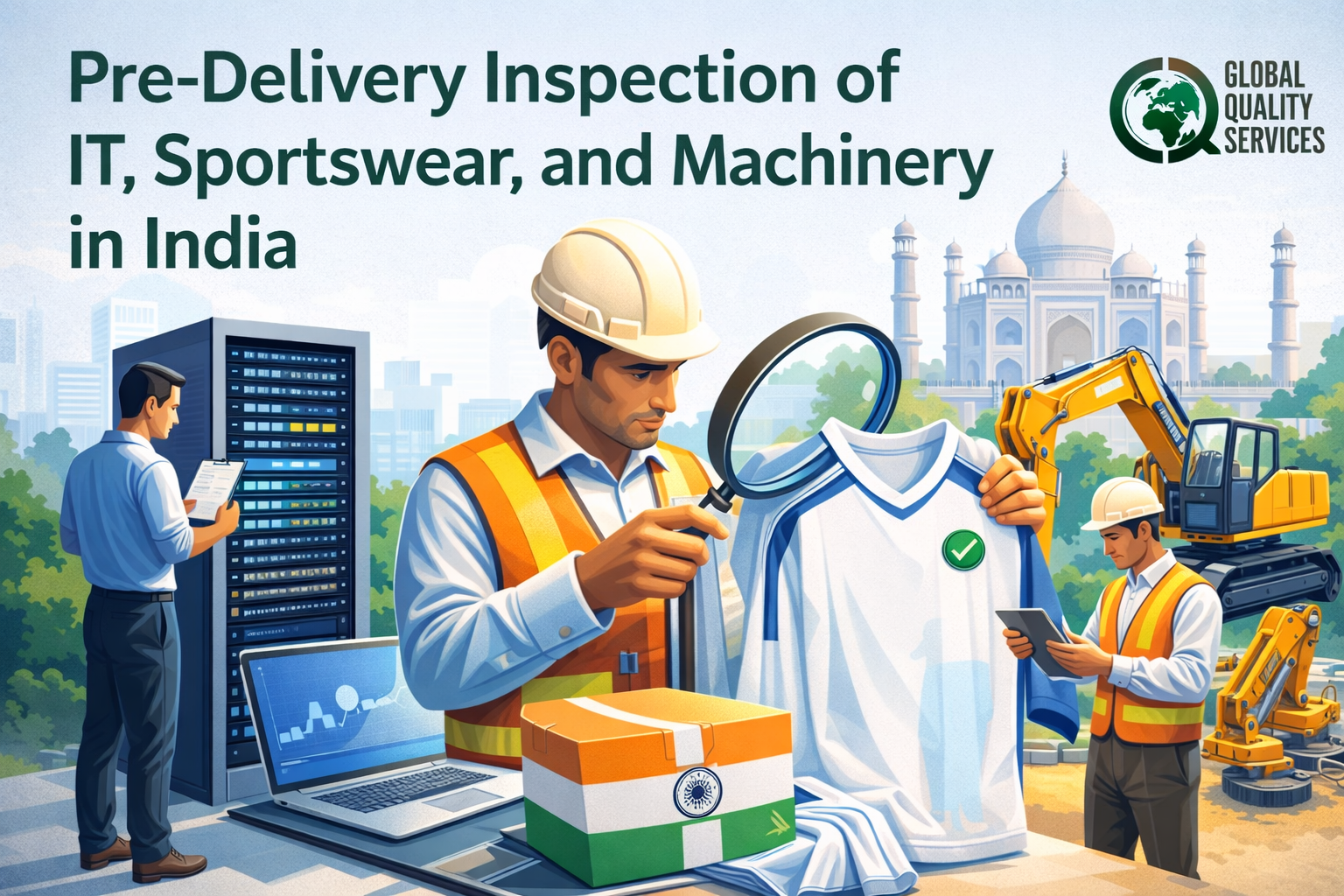
Maintaining a high standard of quality is the backbone of successful international trade. For businesses sourcing from India, the stakes are exceptionally high. Recent data from the Ministry of Commerce & Industry (PIB Release, December 2025) highlights that India’s manufacturing sector is undergoing a massive shift toward high-value production. Engineering goods exports alone saw a 23.76% increase year-on-year, while electronics exports surged by 38.96%.
As production scales, the complexity of quality control scales with it. Relying on a factory’s internal word is no longer enough to protect your margins. A single batch of defective IT hardware or poorly stitched sportswear can lead to expensive recalls, lost shelf time, and irreparable brand damage. This is where a professional Pre-Delivery Inspection becomes your most valuable risk-mitigation tool.
What is Pre-Delivery Inspection in India?
A Pre-Delivery Inspection (PDI), often referred to as a Pre-Shipment Inspection (PSI), is a systematic evaluation of goods conducted when a production order is at least 80% to 100% complete. In the Indian manufacturing landscape, this is the final opportunity for an importer to verify that the products meet the agreed-upon specifications before they leave the factory floor.
The inspection involves a physical check of quantity, workmanship, function, and packaging. In India, where manufacturing hubs are spread across diverse regions like Bangalore, Delhi, and Tirupur, a PDI ensures that the golden sample you approved months ago is exactly what is being loaded into the container today.
Why Importers Require Third-Party Inspection
Many importers wonder why they should invest in a third-party agency like Global Quality Services when the factory already has an internal QC team. The answer lies in unbiased verification.
- Conflict of Interest: Factory QC teams are often under pressure to meet shipping deadlines. They may overlook minor defects to keep the line moving. An independent inspector has no such bias.
- Cost of Rejection: It is significantly cheaper to fix a defect inside a factory in India than to deal with a rejection once the goods have cleared customs in the UK, USA, or Europe.
- Regulatory Shield: Third-party inspectors stay updated on changing Indian export regulations and international standards (like CE, UL, or BIS), ensuring your shipment isn’t held up at the port due to paperwork errors.
- Supplier Accountability: When a factory knows an external auditor is coming, they naturally maintain higher production standards throughout the manufacturing cycle.
Pre-Delivery Inspection for IT and Electronics
The electronics sector in India has reached record-breaking export levels, with mobile phone exports alone hitting ₹2 lakh crore in 2024-25, as per Economic Times. However, electronics are prone to hidden defects that only appear during functional testing.
Our IT-specific PDI focus includes:
- Component Verification: Ensuring the internal hardware (RAM, Processor, Storage) matches the Bill of Materials (BOM).
- DOA (Dead on Arrival) Testing: Power-on tests for 100% of the sampled batch to ensure no units fail out of the box.
- Safety Compliance: Verifying BIS (Bureau of Indian Standards) markings and grounding integrity to prevent electrical hazards.
- Software & Firmware: Checking that the correct OS version and language settings are pre-installed.
Quality Inspection Standards for Sportswear
India is a major exporter of sportswear and performance apparel. In this category, quality is not only about how the product looks. It also needs to perform well during physical activity and remain durable after repeated use and washing.
During a sportswear inspection, several key aspects are checked to make sure the garments meet the buyer’s requirements.
- Seam Strength and Elasticity: Sportswear is designed for movement, so seams must be strong and flexible. Inspectors check stitching quality and may perform simple pull tests to ensure seams do not open or tear during use.
- Colorfastness: The fabric dye should remain stable after sweating or washing. Inspectors check whether colors bleed, fade, or transfer onto other fabrics.
- Sizing Consistency: Each garment size must match the approved measurement chart. Inspectors measure samples to confirm that sizes such as Small, Medium, or Large remain consistent across the production batch.
- Fabric Quality: The fabric is checked for issues such as pilling, snags, or variations in GSM (grams per square meter), which can affect comfort, durability, and the overall feel of the garment.
Machinery Inspection Checklist Before Shipment
Industrial machinery requires the most technical PDI approach. Since these are high-value capital goods, a defect here can stall an entire production plant.
The Essential Machinery Checklist:
| Inspection Area | Key Checks |
| Structure | Rust, welding quality, paint finish |
| Mechanical Parts | Gears, bearings, shafts, lubrication |
| Electrical System | Wiring safety, control panel, emergency stop |
| Operational Test | Trial run to verify performance |
| Documentation | Manuals, safety labels, certificates |
Sampling Methods Used in Indian Factories
In large production batches, inspecting every unit is usually not practical. Instead, inspectors use standard sampling methods to evaluate product quality.
One commonly used method is ISO 2859-1-based AQL (Acceptable Quality Limit) sampling. This system helps determine how many units should be checked from the total shipment to represent the overall batch.
Two main factors are defined during AQL inspection:
- Sample Size: The number of units selected for inspection based on the total order quantity.
- Acceptance Limits: The maximum number of minor, major, or critical defects allowed before the batch is rejected.
Step-by-Step Pre-Delivery Inspection Process
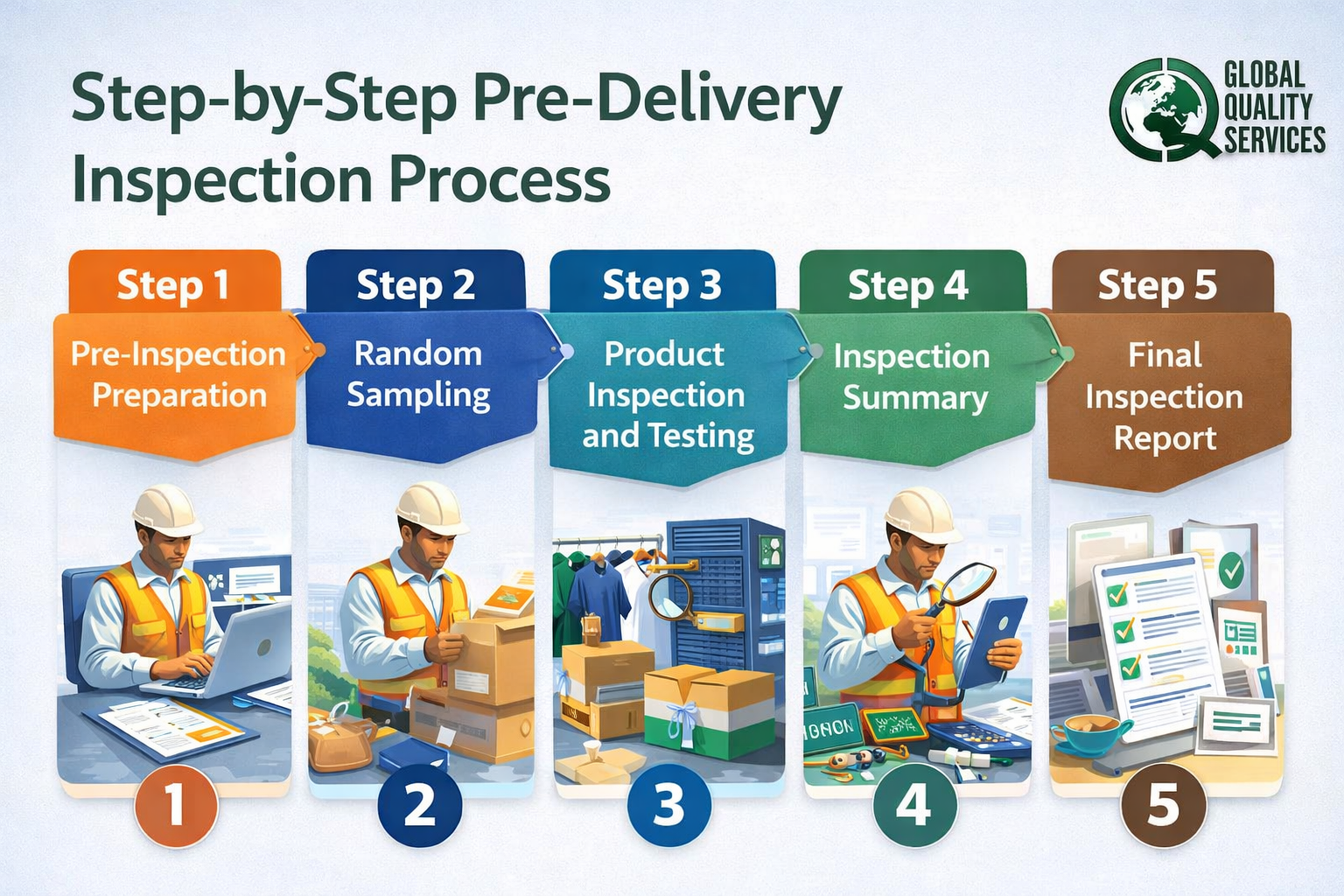
To ensure a consistent and reliable inspection, the PDI process is carried out in a clear step-by-step manner. Each stage helps verify product quality before the shipment leaves the factory.
Step 1: Pre-Inspection Preparation
The inspector reviews the purchase order, product specifications, and approved sample to understand the quality requirements before visiting the factory.
Step 2: Random Sampling
Products are randomly selected from the finished batch using AQL sampling tables to ensure the inspection represents the entire shipment.
Step 3: Product Inspection and Testing
Selected samples are checked for appearance, measurements, functionality, and packaging. Any defects found during testing are documented.
Step 4: Inspection Summary
After the inspection, a preliminary summary of the findings is shared with the buyer and the factory.
Step 5: Final Inspection Report
A detailed report is issued, usually within 24 hours, including inspection results, photographs, and a clear pass or fail recommendation.
Common Manufacturing Defects in India
Understanding common pitfalls helps in preemptive quality management. In the Indian market, we frequently encounter:
- Packaging Weakness: In some cases, export cartons may not be strong enough for long-distance transportation. Weak or thin packaging can lead to crushed boxes and product damage during shipping.
- Aesthetic Inconsistencies: Variations in raw material batches can cause visible differences in finished products. For example, machinery parts may show uneven surface finishes, while garments may have slight thread or color variations.
- Dust Contamination: Electronics assembly areas may not always meet strict clean-room conditions. Dust or small particles can enter devices during assembly, which may affect product performance over time.
- Loose Fasteners in Machinery: During operational tests, inspectors sometimes find bolts or fasteners that are not tightened to the correct torque level. If not corrected, this can affect machine stability during operation.
Pre-Delivery Inspection of IT, Sportswear, and Machinery Consultants in India
Pre-Delivery Inspection Services in Delhi | Pre-Delivery Inspection Services in Bengaluru
Pre-Delivery Inspection Services in Noida | Pre-Delivery Inspection Services in Hyderabad
Pre-Delivery Inspection Services in Ahmedabad | Pre-Delivery Inspection Services in Chennai
Pre-Delivery Inspection Services in Pune | Pre-Delivery Inspection Services in Mumbai
How Global Quality Services Becomes Your Right Choice Inspector
Global Quality Services isn’t just a checklist company. We act as your eyes and ears on the ground in India. We understand the local manufacturing culture and how to communicate firmly but professionally with factory owners.
- Deep Technical Expertise: Our inspectors are engineers and textile specialists, not generalists.
- Pan-India Presence: From the industrial hubs of Gujarat to the tech corridors of Bangalore, we provide rapid deployment.
- Integrity First: We maintain a strict anti-bribery policy, ensuring our reports are 100% honest and untainted.
- Speed of Reporting: In global trade, every hour counts. We deliver comprehensive reports in under 24 hours.
Secure Your Supply Chain with Global Quality Services
Don’t leave your business reputation to chance. A Pre-Delivery Inspection is the most cost-effective insurance policy you can buy for your international trade operations. Whether you are importing high-tech electronics or heavy industrial machinery, Global Quality Services provides the technical rigor needed to ensure your goods arrive exactly as promised.
Contact our India team today for a custom quote on your next inspection.
Frequently Asked Questions
- How long does a typical PDI take in an Indian factory?
For most standard orders, a pre-delivery inspection can be completed within one working day. However, inspections involving complex machinery or large electronics batches that require extensive testing may take two to three days.
- What happens if the factory fails the inspection?
If defects exceed the acceptable limits, the inspection report highlights all issues in detail. The buyer can then ask the factory to correct the problems. After the rework is completed, a re-inspection can be arranged to confirm that the issues have been properly fixed.
- Does Global Quality Services also provide Container Loading Supervision?
Yes. Many buyers choose to combine pre-delivery inspection with container loading supervision. This ensures that the inspected goods are the same ones being loaded into the container and that the shipment is sealed correctly before departure.
- Can inspections be conducted according to European or US safety standards?
Yes. Inspection checklists can be adjusted to include specific regulatory requirements such as REACH, RoHS, CE, or UL standards, depending on the destination market and product category.
- Is a PDI still necessary if I already trust my supplier?
Even reliable suppliers can face occasional production issues due to changes in raw materials, workforce, or equipment. Routine inspections help maintain consistent quality over time and reduce the risk of unexpected shipment problems.