CMMI 2.0 certification in India plays a critical role in helping IT services and software companies strengthen operational maturity and delivery reliability. The framework enables organizations to move away from ad hoc execution toward standardized, measurable, and scalable processes.
For Indian firms serving global clients, CMMI 2.0 demonstrates strong governance, predictable outcomes, and process discipline, key factors in winning international contracts, government tenders, and enterprise projects. Formal appraisals confirm process maturity and enhance credibility in highly competitive global markets.
Benefits for Global Clients — Why Buyers Care
CMMI V2.0 (Capability Maturity Model Integration) is a results-focused framework that helps organizations improve process efficiency, strengthen quality, and enhance operational resilience and security.
CMMI 2.0 certification signals to international customers that Indian organizations operate with structured and dependable processes.
Certified organizations consistently:
- Deliver projects within defined scope, timelines, and budgets
- Minimize delivery risks through standardized governance models
- Maintain quality consistency across distributed and offshore teams
- Meet procurement and compliance expectations of global enterprises
For Indian IT and software firms, CMMI 2.0 certification often improves RFP success rates, vendor credibility, and long-term client trust.
Maturity Levels — Staged Progression Explained
CMMI maturity levels define a structured roadmap for process improvement, helping organizations in India gradually enhance control, consistency, and performance.
Level 1 – Initial
Work practices remain informal and reactive. Project success depends largely on individual skills rather than defined processes, resulting in unpredictable outcomes and limited quality control.
Level 2 – Managed
Teams apply basic project management discipline. Projects are planned, tracked, and monitored, enabling repeatable performance and better control over cost, scope, and schedules.
Level 3 – Defined
The organization establishes standardized processes across all projects. Teams follow documented procedures tailored from organizational standards, ensuring consistency and knowledge sharing.
Level 4 – Quantitatively Managed
Processes are measured and controlled using data-driven techniques. Performance metrics and statistical analysis help predict results and reduce variation.
Level 5 – Optimizing
The organization continuously improves processes through innovation, root-cause analysis, and performance insights, ensuring long-term business agility and excellence.
Appraisal Steps — How a SCAMPI A Appraisal Works
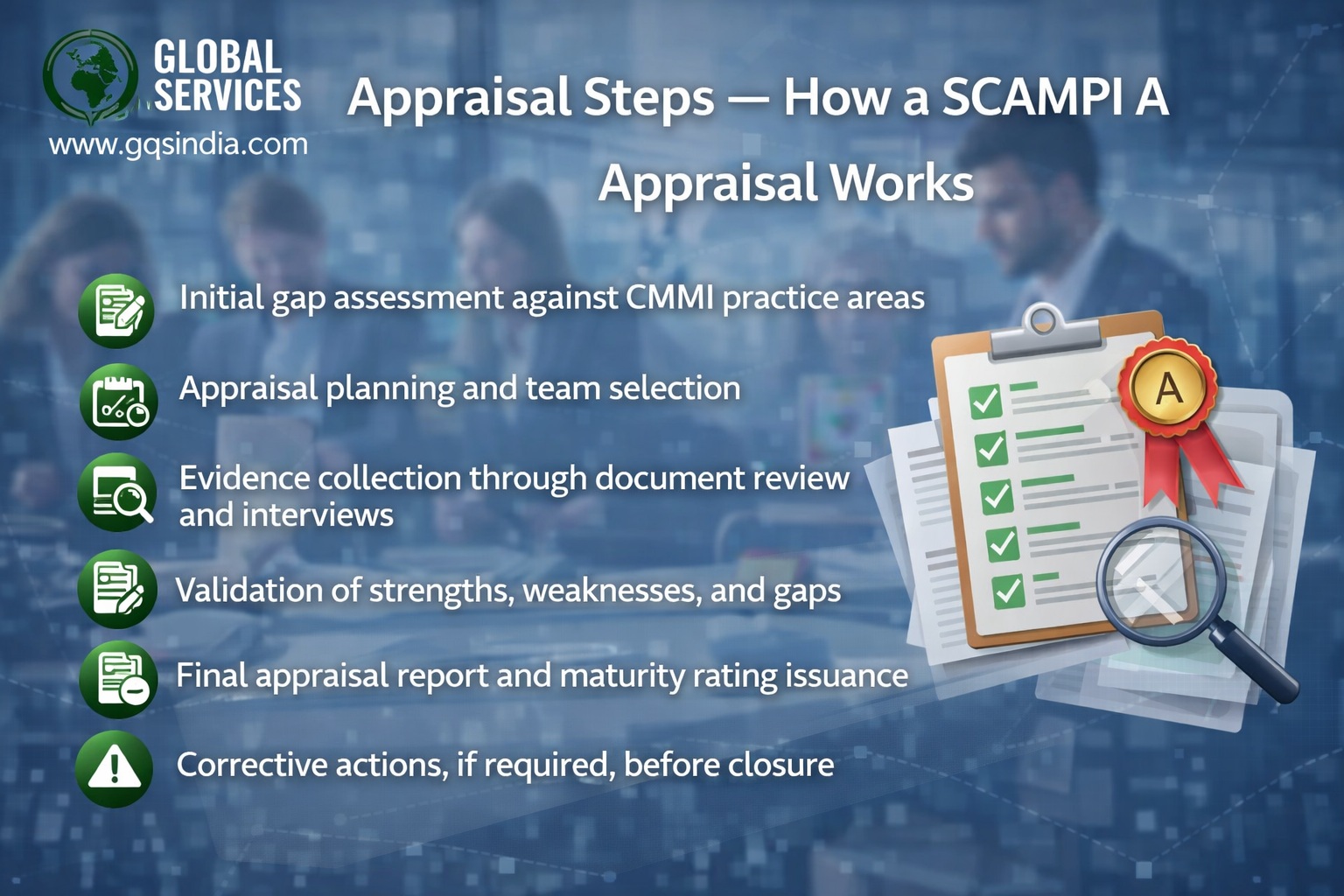
SCAMPI (Standard CMMI Appraisal Method for Process Improvement) is the official appraisal approach used to determine CMMI maturity levels. Among its appraisal classes, SCAMPI A is the formal appraisal that results in an official maturity rating for organizations pursuing CMMI 2.0 certification in India.
Typical SCAMPI A workflow includes:
- Initial gap assessment against CMMI practice areas
- Appraisal planning and team selection
- Evidence collection through document review and interviews
- Validation of strengths, weaknesses, and gaps
- Final appraisal report and maturity rating issuance
- Corrective actions, if required, before closure
This structured appraisal ensures that implemented processes are effective, repeatable, and institutionalized.
Documentation — Required Artifacts & Practical Checklist
CMMI appraisals rely heavily on documented evidence to confirm the actual adoption of processes. Indian IT and software organizations should prepare the following artifacts:
- Policy & governance: organizational policies, roles, responsibilities, and objectives
- Process definitions & procedures: lifecycle, development, testing, QA, supplier management
- Work products & templates: project plans, design records, test cases, change logs
- Records of practice: meeting notes, review logs, defect tracking, performance reports
- Training & competence evidence: training plans, skill matrices, onboarding records
- Measurement data: dashboards, KPIs, baselines, trend analysis
- Supplier & contract artifacts: agreements, SOWs, supplier evaluations
A centralized repository with clear mapping between artifacts and CMMI practices significantly simplifies appraisal readiness.
Audit Process — What Appraisers Evaluate
During the appraisal, authorized lead appraisers assess whether processes are consistently followed and effectively implemented.
Step 1: Process Consistency Review
Appraisers verify that processes are applied uniformly across multiple projects rather than selectively.
Step 2: Artifact Traceability Validation
All documents must align with approved organizational processes and clearly map to relevant CMMI practices.
Step 3: Objective Evidence Assessment
Only factual records, metrics, and logs are accepted as evidence—presentations alone are insufficient.
Step 4: Stakeholder Interviews
Interviews with managers, engineers, QA teams, and leadership confirm real-world adoption and understanding.
Step 5: Measurement & Control Verification
For higher maturity levels, appraisers evaluate quantitative metrics to confirm predictability and control.
Timeline — Realistic Expectations
CMMI implementation timelines in India vary based on organizational size, current maturity, and resource availability.
- Level 1 to Level 2: approximately 3–12 months
- Level 2 to Level 3: typically 12–24 months
- Level 4 and above: an additional 12–24 months or more
A phased approach using pilot projects, internal audits, and readiness assessments improves success rates and reduces appraisal risks.
Summary
Planning to achieve CMMI 2.0 certification in India? Schedule a free 30-minute readiness consultation with our CMMI specialists. Receive a customized roadmap, documentation checklist, and realistic appraisal timeline tailored to your organization. Start your certification journey with confidence and clarity.
FAQ’s
Q1: Why is CMMI 2.0 important for Indian IT companies?
CMMI 2.0 helps Indian organizations demonstrate delivery reliability, process maturity, and compliance readiness demanded by global clients.
Q2: How long does CMMI 2.0 certification take in India?
Timelines depend on current maturity. Level 2 may take months, while Level 3 usually requires 12–24 months.
Q3: What is SCAMPI A in CMMI certification?
SCAMPI A is the formal appraisal method that grants official CMMI maturity ratings through evidence review and interviews.
Q4: What documentation is mandatory for CMMI 2.0 appraisal?
Organizations must maintain policies, defined processes, project records, training evidence, metrics, and supplier documentation.
Q5: Is CMMI suitable for small IT firms in India?
Yes. CMMI scales well for small and mid-sized firms, helping them standardize operations and compete for larger contracts.