

Government and PSU projects operate in a high-accountability environment where process maturity, compliance, and delivery assurance matter as much as technical capability. This is why CMMI for Government & PSU Projects has become a decisive qualification criterion across tenders in IT, engineering, and system integration domains.
CMMI signals that an organization can deliver large-scale, mission-critical projects with predictability, governance, and measurable control, exactly what public sector buyers expect.
Why CMMI is Required for Government & PSU Tenders
Government and PSU tenders prioritize risk mitigation and delivery certainty. They work with public funds, long timelines, and strict audit scrutiny. As a result, they demand vendors with proven process maturity.
CMMI for Government & PSU Projects assures tendering authorities that:
- Project execution follows standardized, documented processes
- Risks are identified and managed proactively
- Outcomes do not depend on individuals but on institutionalized practices
For many departments, CMMI is not just a preference—it is a mandatory eligibility condition in RFPs.
Compliance Steps for Achieving CMMI in the Public Sector Context
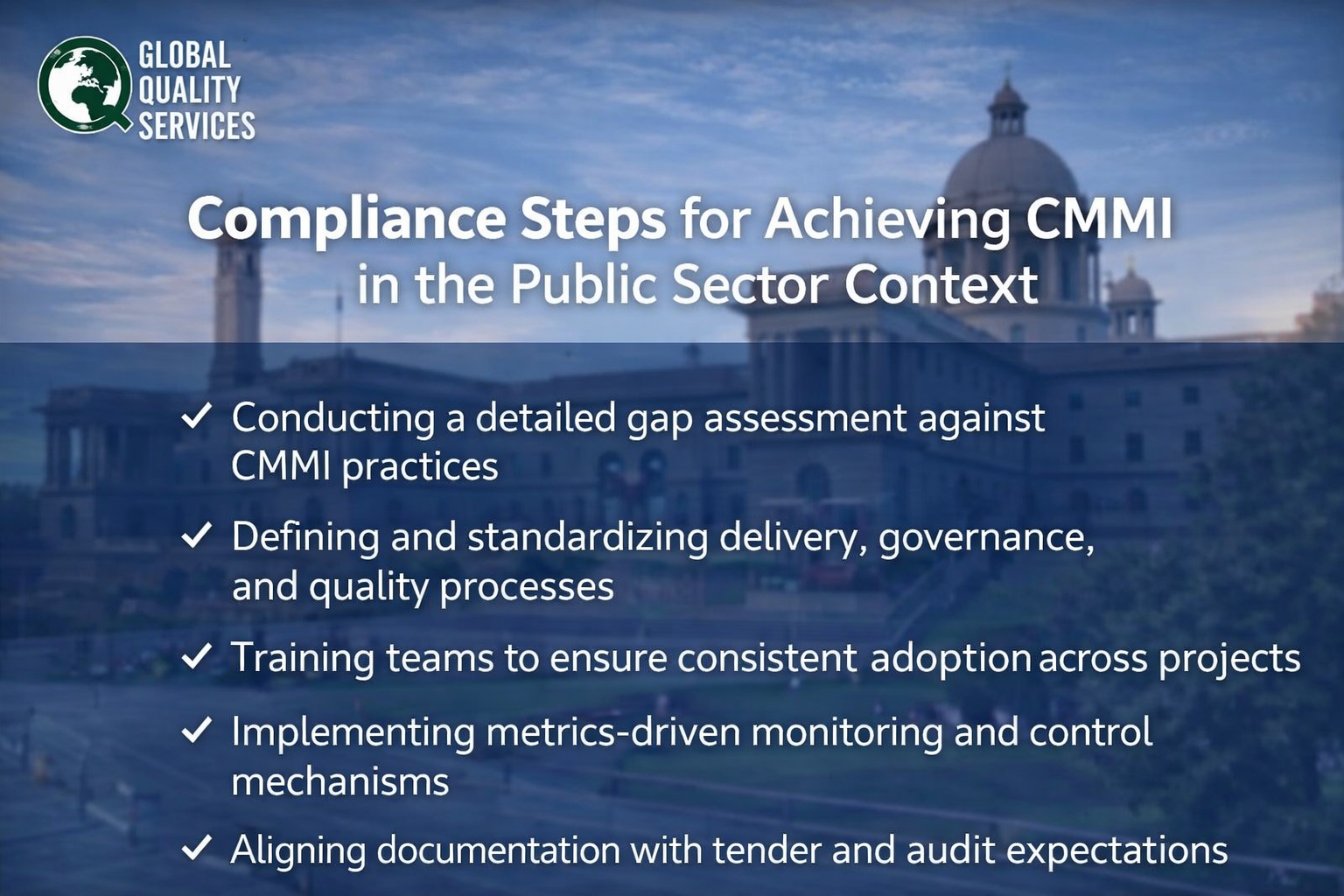
Achieving CMMI for Government & PSU Projects requires a structured, compliance-driven approach rather than ad-hoc documentation.
Key steps include:
- Conducting a detailed gap assessment against CMMI practices
- Defining and standardizing delivery, governance, and quality processes
- Training teams to ensure consistent adoption across projects
- Implementing metrics-driven monitoring and control mechanisms
- Aligning documentation with tender and audit expectations
This approach ensures that compliance is operationally embedded, not just appraisal-focused.
Audit Readiness: Meeting Government Scrutiny with Confidence
Audit readiness is non-negotiable in government and PSU engagements. CMMI strengthens audit preparedness by enforcing evidence-based execution.
With CMMI in place, organizations can:
- Produce traceable project records on demand
- Demonstrate compliance through measurable performance data
- Respond confidently to internal, external, and statutory audits
CMMI for Government & PSU Projects transforms audits from a risk into a controlled, predictable process.
CMMI Level Expectations in Government & PSU Projects
Different projects demand different maturity levels, depending on size, complexity, and criticality.
Typical expectations include:
- CMMI Level 3 for medium to large government IT projects
- CMMI Level 5 for national-scale, defence, infrastructure, or multi-year PSU programs
Higher CMMI levels demonstrate quantitative management, continuous improvement, and innovation-driven delivery, which align closely with long-term public sector initiatives.
Proposal Advantage: Standing Out in Competitive Government Bids
In tightly contested government tenders, technical scores often cluster closely. CMMI becomes a key differentiator that influences both technical evaluation and final selection.
CMMI strengthens proposals by:
- Increasing technical qualification scores
- Enhancing evaluator confidence in delivery capability
- Reducing perceived implementation and governance risk
Many PSUs explicitly award additional weightage to bidders certified under frameworks recognized by bodies such as the CMMI Institute.
Why Investing in CMMI Makes Strategic Sense for PSU-Focused Organizations
For organizations targeting PSU and government contracts, CMMI is not just a certification, it is a long-term strategic investment. It strengthens eligibility, improves execution discipline, and positions the organization as a reliable partner for high-value, compliance-driven public sector projects.
Sustained Tender Eligibility
CMMI ensures consistent compliance with PSU tender requirements, allowing organizations to qualify for recurring and large-scale bids without last-minute process gaps or documentation challenges.
Improved Delivery Predictability
CMMI institutionalizes standardized processes and metrics, enabling predictable timelines, controlled costs, and consistent quality—key expectations in long-duration PSU and government projects.
Stronger Audit & Governance Readiness
With CMMI, organizations maintain structured evidence, traceability, and performance data, making internal, external, and statutory audits smoother and significantly reducing compliance risks.
Enhanced Credibility with PSU Stakeholders
CMMI signals process maturity and governance strength, building trust with PSU evaluators, auditors, and project owners who prioritize risk mitigation and accountability.
Long-Term Operational Efficiency
Beyond tenders, CMMI drives continuous improvement, reduces rework, and strengthens organizational resilience, delivering measurable ROI across current and future government engagements.
Summary
If your organization plans to bid for Government or PSU projects, investing in CMMI is no longer optional; it is strategic. Start your CMMI journey now to strengthen eligibility, improve delivery maturity, and win high-value public sector contracts with confidence.
Partner with experienced CMMI consultants to accelerate compliance while keeping your operations lean and audit-ready.
FAQ’s
1. Is CMMI mandatory for government tenders?
Many government and PSU tenders explicitly mandate CMMI certification, especially for IT, software, and system integration projects. Others strongly prefer it during technical evaluation.
2. Which CMMI level is best for PSU projects?
CMMI Level 3 is commonly required, while Level 5 is preferred for large-scale, long-term, or mission-critical government programs.
3. How long does it take to achieve CMMI?
Most organizations achieve CMMI readiness within 4 to 6 months, depending on size, existing process maturity, and project complexity.
4. Does CMMI help beyond tender qualification?
Yes. CMMI improves delivery predictability, audit readiness, stakeholder confidence, and long-term operational efficiency.
5. Can MSMEs and mid-sized firms get CMMI for government projects?
Absolutely. CMMI is scalable and can be implemented effectively by MSMEs when aligned with business objectives and public sector requirements.