

Managing information security across multiple locations is a major challenge for large IT exporters. Different offices often follow inconsistent processes, increasing risks of data breaches and audit failures. In India, cybersecurity incidents surged from 10.29 lakh in 2022 to 22.68 lakh in 2024, highlighting the growing threat landscape.
To address this, organizations implement a centralized ISMS under an ISO 27001 multi-site implementation. However, ensuring consistency requires expertise, which is why hiring an experienced consultant becomes critical for successful implementation.
What is ISO 27001 Multi-Site Implementation
ISO 27001 multi-site implementation refers to establishing a single Information Security Management System (ISMS) that covers multiple office locations under one certification.
Instead of managing separate systems, organizations implement centralized policies, risk management processes, and controls that apply uniformly across all sites, ensuring consistency and audit efficiency.
Why Multi-Location IT Firms Need a Centralized ISMS
- Consistent Security Across All Locations: When multiple offices operate independently, security gaps naturally arise. A centralized ISMS ensures every location follows the same policies, reducing inconsistencies and strengthening the overall security posture.
- Simplified Audit and Certification: Instead of undergoing separate audits for each location, multi-site certification allows centralized audits with sampling. This significantly reduces audit complexity, time, and cost for large IT exporters.
- Better Risk Visibility: A unified ISMS enables organizations to identify, assess, and manage risks across all locations. This helps leadership gain a clear, organization-wide view of vulnerabilities and take proactive action.
Key Components of ISO 27001 Multi-Site Implementation
Implementing ISO 27001 across multiple locations requires standardized policies, centralized risk management, consistent controls, and unified monitoring to ensure effective security governance.
Centralized Policy Framework
All locations must follow a single set of policies covering access control, data protection, incident management, and compliance. This ensures uniform governance across the organization.
Unified Risk Management Process
Risk assessments should be conducted using a standardized methodology across all sites. This avoids inconsistent risk scoring and ensures better decision-making at the organizational level.
Standardized Controls and Procedures
Security controls must be implemented consistently across locations. Differences in implementation often lead to audit non-conformities in multi-site environments.
Central Monitoring and Reporting
Organizations need centralized dashboards and reporting mechanisms to monitor security incidents, compliance status, and control effectiveness across all sites.
Common Challenges in Multi Site Implementation
Organizations often face challenges like inconsistent processes, weak coordination, limited expertise, and difficulty maintaining uniform security controls across multiple operational locations.
Inconsistent Processes Across Locations
Different locations often follow their own ways of working, which creates inconsistency in security practices. This makes it difficult to standardize controls and policies, ultimately increasing the risk of non-compliance during audits and weakening the overall effectiveness of the ISMS.
Lack of Central Governance
Without strong central governance, managing ISMS across multiple locations becomes disorganized. Teams may interpret policies differently, leading to gaps in implementation. A lack of leadership oversight often results in fragmented processes and reduced control over information security practices.
Communication Gaps
Poor communication between locations slows down implementation and creates confusion around responsibilities. Teams may not stay aligned on policies or updates, leading to inconsistent compliance levels. Strong coordination is essential to ensure smooth execution of ISMS across all sites.
Resource and Training Limitations
Different locations often have varying levels of expertise and awareness about ISO 27001 requirements. Without proper training and resources, teams struggle to implement controls effectively, which impacts compliance and increases the chances of errors during audits.
Step-by-Step Approach to ISO 27001 Multi-Site Implementation
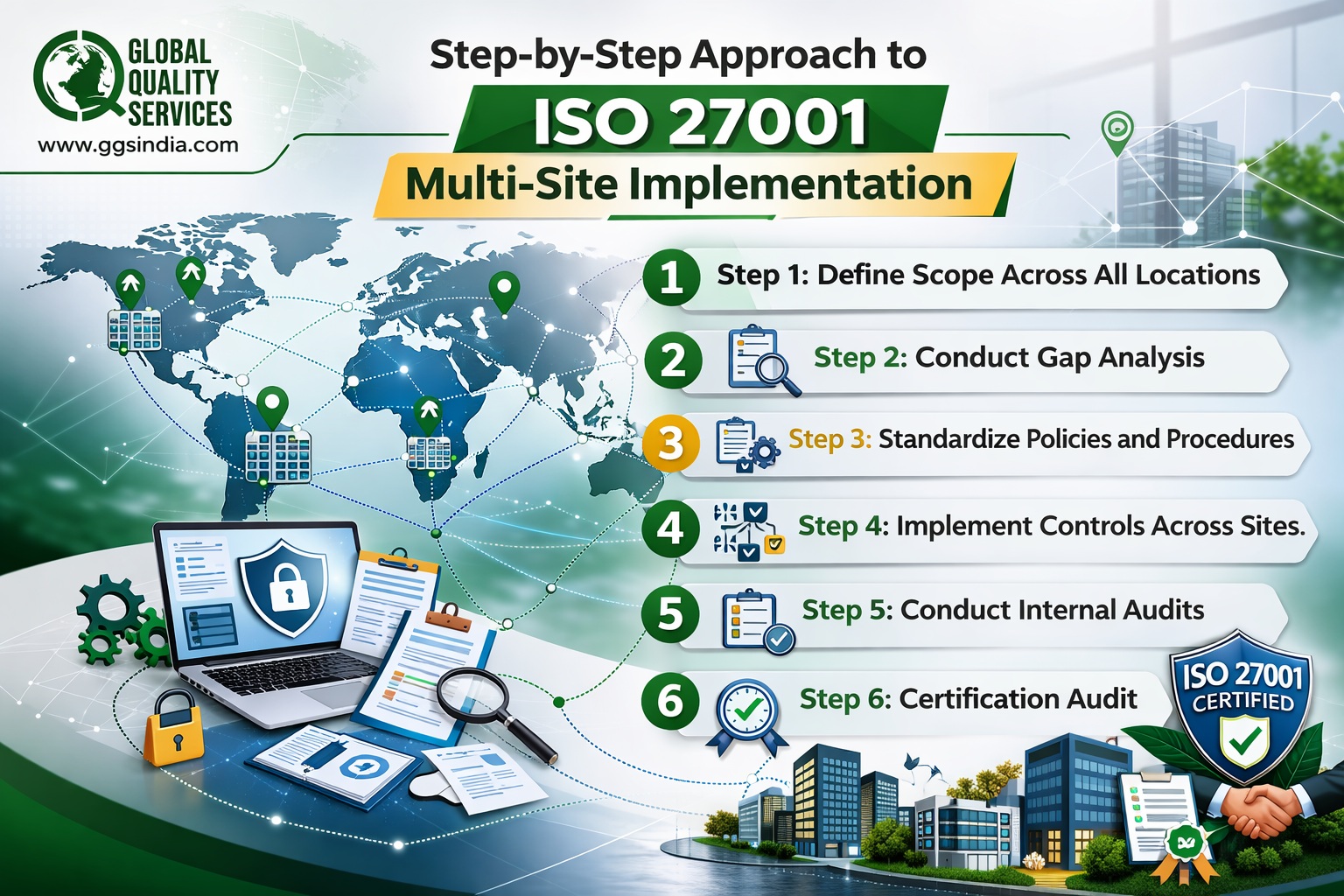
A structured step-by-step approach ensures consistent ISO 27001 multi-site implementation, helping organizations align processes, manage risks effectively, and achieve certification smoothly.
Step 1: Define Scope Across All Locations
Begin by identifying all locations, business functions, processes, and assets that fall under the ISMS. A clearly defined scope ensures no critical operations are excluded and helps maintain consistency across sites, making implementation, monitoring, and audit processes more structured and effective.
Step 2: Conduct Gap Analysis
Assess existing security practices at each location and compare them with ISO 27001 requirements. This helps identify missing controls, weak processes, and compliance gaps. A detailed gap analysis provides a clear roadmap for implementation and ensures resources are focused on critical areas.
Step 3: Standardize Policies and Procedures
Develop centralized policies and procedures that apply uniformly across all locations. This ensures every team follows the same security guidelines, reduces inconsistencies, and simplifies compliance. Standardization is critical for maintaining control effectiveness and ensuring smooth audits across multi-site environments.
Step 4: Implement Controls Across Sites
Roll out security controls systematically across all locations, ensuring consistent implementation. Each site must follow the same control requirements to avoid audit issues. Proper coordination between teams is essential to maintain uniformity and ensure the ISMS functions effectively across the organization.
Step 5: Conduct Internal Audits
Perform internal audits across multiple locations to verify whether controls are implemented correctly. This step helps identify gaps, inconsistencies, and non-conformities before the certification audit. Addressing these issues early improves audit readiness and strengthens the overall effectiveness of the ISMS.
Step 6: Certification Audit
Undergo the final certification audit conducted by an accredited certification body. Auditors assess selected locations, review documentation, and evaluate implementation. Successful completion confirms that the organization meets ISO 27001 requirements and can maintain a consistent ISMS across all sites.
Benefits of ISO 27001 Multi-Site Implementation
ISO 27001 multi-site implementation helps organizations improve efficiency, reduce costs, ensure consistent security practices, and strengthen trust with global clients.
- Operational Efficiency: Centralized processes reduce duplication of efforts and improve operational efficiency across locations.
- Cost Optimization: Multi-site certification reduces audit and compliance costs compared to separate certifications.
- Stronger Client Confidence: Global clients prefer organizations with standardized security practices across all locations.
- Scalability for Growth: A centralized ISMS makes it easier to onboard new locations without rebuilding the system from scratch.
Summary
If you are a large IT exporter managing multiple locations, implementing ISO 27001 through a centralized ISMS is critical for growth, compliance, and global trust. A well-structured approach not only simplifies audits but also strengthens your overall security posture. If you are planning an ISO 27001 multi-site implementation or need expert guidance, contact us today to get started.
FAQ’s
1. What is ISO 27001 multi-site implementation?
ISO 27001 multi-site implementation is the process of establishing a single ISMS that covers multiple locations under one certification. It ensures consistent security practices, centralized control, and uniform risk management across all offices within the organization.
2. Can multiple offices be covered under one ISO 27001 certificate?
Yes, multiple offices can be included under one ISO 27001 certificate if they operate under a centralized ISMS. Organizations must demonstrate consistent policies, controls, and processes across all locations to meet multi-site certification requirements.
3. What are the benefits of multi-site certification?
Multi-site certification helps reduce audit costs and administrative efforts while ensuring consistent security practices across locations. It improves risk management, simplifies compliance, and strengthens client confidence by demonstrating a unified and structured approach to information security.
4. What is the biggest challenge in multi-site ISMS implementation?
The biggest challenge is maintaining consistency across all locations. Differences in processes, team capabilities, and control implementation often create gaps, making it difficult to align policies and ensure uniform compliance during audits and ongoing ISMS management.
5. How long does ISO 27001 multi site implementation take?
ISO 27001 multi-site implementation typically takes around 3 to 6 months. However, timelines may vary depending on the number of locations, complexity of operations, existing security maturity, and how effectively teams coordinate across different sites.