

India’s medical device industry has entered a phase where export growth and compliance pressures move in parallel. More Indian manufacturers now supply hospitals, distributors, and government buyers across global markets. According to Rubix Industry Insights, India’s medical devices market is expected to reach USD 50 billion by 2030, largely driven by export growth and regulatory alignment. Yet growth alone does not open doors in regulated markets. International buyers focus heavily on structured quality systems, clear traceability, and audit readiness before signing supply contracts.
This makes ISO 13485 less of a formality and more of a strategic step. For many exporters, working with the right certification consultant is the difference between slow, compliance-struggling entry and confident global entry.
What is ISO 13485 and Why It Matters for Medical Device Exporters
ISO 13485 is a quality standard for medical device manufacturers. The certification guides the safe design, testing, and delivery of products. In India, exporters often face strict buyer checks. This standard shows your process stays controlled and reliable. Here are the main reasons why it matters:
Helps Enter Regulated Global Markets
Many regions, such as Europe and the US, first review your quality system before examining product features. ISO 13485 shows your factory follows controlled methods. This improves approval chances and makes market entry smoother for Indian exporters.
Builds Strong Buyer Trust and Supplier Credibility
Global distributors prefer working with certified manufacturers because it lowers their risk. A structured quality system shows discipline and accountability. This increases confidence, improves vendor selection outcomes, and supports stable, long-term export relationships.
Improves Product Safety and Batch Consistency
Medical devices directly affect patient health, so even minor defects can cause serious problems. ISO 13485 drives strict validation and risk checks. This helps maintain consistent performance across production batches and reduces the chances of quality failures.
Makes Audits and Regulatory Inspections Easier to Handle
Exporters often face inspections from foreign regulators or notified bodies. When systems already follow the ISO 13485 structure, teams feel more prepared. Clear records and defined processes reduce stress and improve audit outcomes.
Reduces Shipment Delays and Export Compliance Risks
Weak documentation or missing validation often leads to shipment holds or buyer rejections. A certified system helps close these gaps early. This keeps export timelines more stable and prevents unexpected operational disruptions.
Supports Long-Term Growth And Operational Stability
As export volumes rise, informal practices begin to fail. ISO 13485 introduces structured change control, supplier oversight, and training discipline. This creates a stable base for scaling international operations without frequent quality setbacks.
Which Medical Products Require ISO 13485 for Export
ISO 13485 applies to a broad spectrum of regulated healthcare products. Exporters dealing in the following categories commonly require certification to meet international regulatory and buyer expectations:
- Implantable devices
- Patient monitoring systems
- Diagnostic imaging equipment
- Laboratory diagnostic analyzers
- Surgical instruments
- Orthopedic implants
- Dental devices
- Disposable syringes and needles
- Catheters and infusion sets
- Surgical gloves and masks
- Sterilization equipment
- Sterile medical packaging systems
ISO 13485 vs ISO 9001: Comparison for Medical Device Manufacturers
Manufacturers often compare ISO 13485 with ISO 9001 to understand certification relevance. While both address quality management, ISO 13485 integrates regulatory compliance and risk controls specifically required for medical device manufacturing environments.
| Parameter | ISO 13485 (Medical) | ISO 9001 (General) |
| Main Focus | Patient safety and strict regulatory rules. | Customer satisfaction and better business. |
| Risk Handling | Intense focus on how a product might fail a patient. | General focus on business and operational risks. |
| Documentation | Heavy. Every single step must be recorded and traceable. | Moderate. Records are needed but more flexible. |
| Validation | You must prove your process works before you start. | You are encouraged to check, but rules are looser. |
| Market Use | Required if you want to sell medical devices globally. | A great standard for any industry, but not for medical. |
Key ISO 13485 Requirements Indian Exporters Must Understand
Building a compliant system is about more than just checking boxes because it requires a framework that truly protects the business and the end user. ISO 13485 demands a disciplined approach to quality that centers on risk control and strict regulatory compliance throughout the factory. Here are the core areas where a quality system must be strongest to meet international standards:
Quality Management System
A set of clear, repeatable procedures must dictate exactly how every product is manufactured at the facility. This framework ensures quality remains consistent whether the business is shipping ten units or ten thousand to an international buyer.
Risk-Based Approach
Safety has to be baked into every step of the process rather than being an afterthought. The team must actively identify potential hazards during design and production, and put controls in place to prevent problems before a device ever reaches a patient.
Design and Development Control
Reliability starts at the drawing board long before the machines start running. Every design choice and validation test must be documented to prove the device is effective and performs exactly as the technical specifications claim it will in the field.
Supplier Management
The final product is only as reliable as the raw materials sourced from outside vendors. Every supplier must be evaluated and monitored using strict criteria to ensure their materials and outsourced services meet high-quality standards every time.
Traceability Systems
If a problem is discovered after a sale, the business must be able to track that specific unit back to its exact batch and raw material source. This high level of transparency is a non-negotiable part of the standard that ensures a manufacturer is ready to handle a recall or audit at any time.
Validation and Verification
Production processes must be proven to work consistently through rigorous testing and verification. This is especially critical for processes such as sterilization, where a simple visual inspection of the final product is insufficient to confirm compliance with safety requirements.
Post Market Surveillance
The responsibility for the product continues long after it leaves the warehouse. A formal system must be in place to collect user feedback, handle complaints, and report any safety signals to the appropriate regulators, ensuring ongoing compliance.
What Documents Are Required for ISO 13485
ISO 13485 requires companies to develop proper documentation that shows how quality, safety, and regulatory requirements are managed. Prepare to maintain these core files for your audit:
- Quality manual and standard operating procedures
- Operational and compliance records
- Risk management files
- Device master records
- Validation and verification reports
- Supplier evaluation and complaint logs
- Technical documentation
Step-by-Step ISO 13485 Certification Process in India
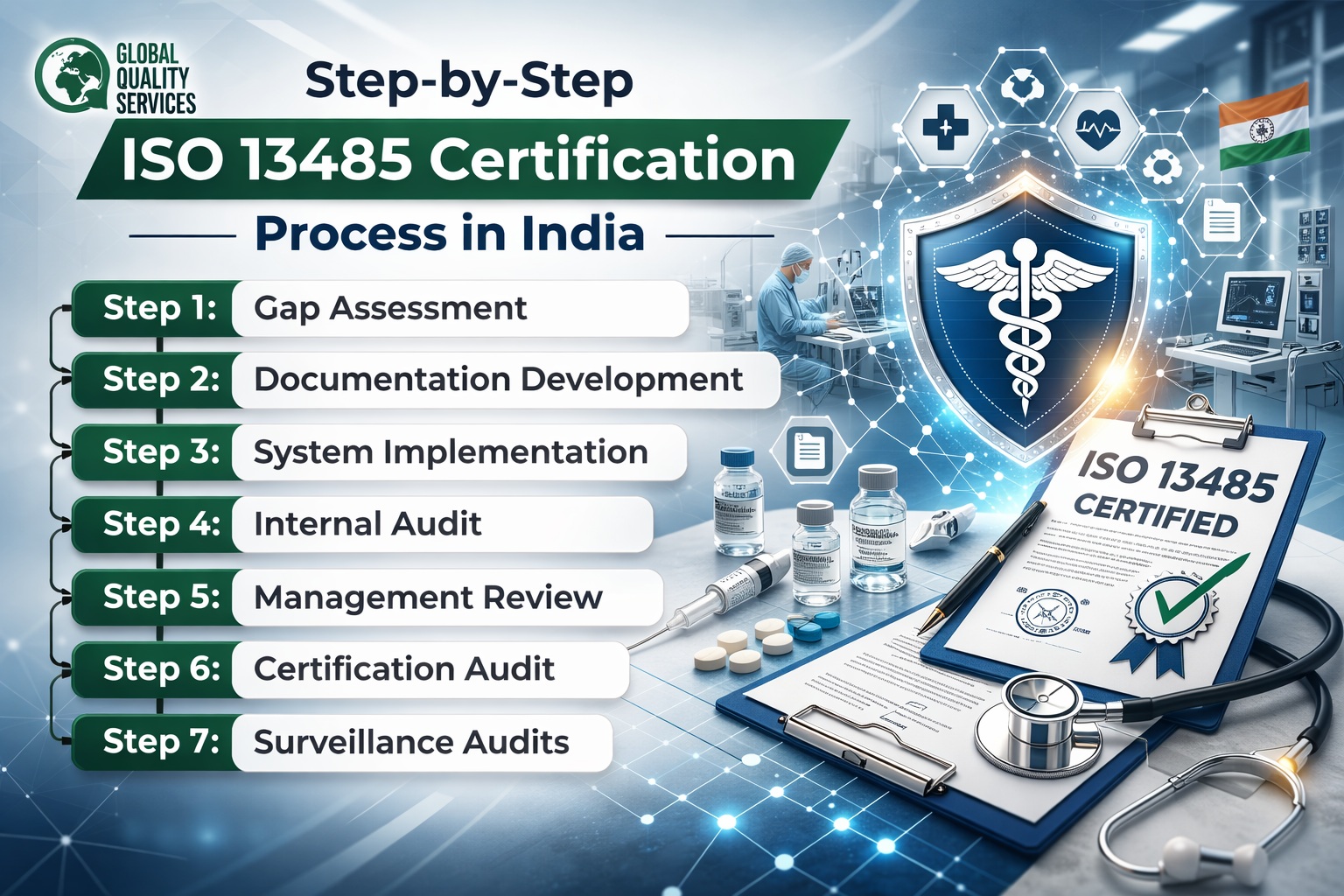
ISO 13485 certification is a step-by-step process that helps companies improve compliance without interrupting production or delivery timelines. For Indian exporters, following a clear sequence makes it easier to connect internal quality practices with global regulatory expectations and audit standards. Here are the key steps to know the ISO 13485 certification process:
Step 1: Gap Assessment
A thorough evaluation identifies where your current shop floor practices differ from the international standard requirements. This process yields a practical roadmap that prioritizes necessary changes to achieve full compliance without wasting company resources.
Step 2: Documentation Development
Your team creates quality manuals and standard operating procedures that reflect how your facility actually operates daily. This step ensures that every department has clear instructions on its roles and responsibilities to meet auditor expectations.
Step 3: System Implementation
The new procedures are implemented through hands-on staff training and real-time monitoring of production lines. The focus is on moving beyond paperwork to ensure quality is actively built into every device you manufacture.
Step 4: Internal Audit
Qualified auditors conduct a full practice run of your quality system to identify and resolve any weak spots or nonconformities. Doing this early allows you to apply corrective actions before the official external inspectors arrive at your facility.
Step 5: Management Review
Management reviews all performance metrics and risk indicators to confirm the organization is fully prepared for the final certification step. This ensures the quality system aligns with your broader business goals and has the necessary resources to succeed.
Step 6: Certification Audit
An independent, accredited body visits your site to verify that your operations and records comply with ISO 13485 requirements. Once they confirm your system is effective and your team is compliant, they will issue the formal certification.
Step 7: Surveillance Audits
Annual checkups are conducted to ensure your quality standards do not slip and that your system remains up to date. These audits prove to global buyers that you are committed to maintaining a high level of manufacturing discipline over the long term.
Summary
For Indian medical manufacturers, ISO 13485 is the bridge between local production and global distribution. It builds the trust necessary to enter high-value markets and ensures that Made in India is synonymous with world-class quality. Partnering with experts like Global Quality Services can help you navigate this transition smoothly, ensuring your system is both compliant and efficient.
FAQ’s
- Is it a legal requirement to have ISO 13485 for exports?
While it might not be the law in every country, it is required by almost all major global distributors. Without it, you will find it nearly impossible to enter the European or American markets or win government contracts. Most buyers view it as the minimum proof that you are a professional and safe manufacturer.
- How long does the whole process usually take?
Most companies in India complete the process in 4 to 8 months, depending on their current level of organization. You need this time to build your documentation, train your team, and collect enough data to show the auditors that your system actually works. It is a marathon, not a sprint, so starting early is always the best move.
- Can a small company or startup handle this certification?
Yes, because the standard is flexible and works just as well for a small team as it does for a giant corporation. Starting early is actually a huge advantage since you can build these habits from day one without having to fix years of outdated or messy manual processes. It immediately levels the playing field by giving a startup the same global credibility as much larger competitors.
- Does ISO 13485 certification help with getting a CE Mark or FDA approval?
No, ISO 13485 certification does not replace those approvals, but it makes getting them much easier. Since the FDA and European regulators use very similar rules, your ISO 13485 paperwork will cover most of what they require.
- How do we make sure we don’t lose the certification?
You have to pass an annual surveillance audit to demonstrate continued compliance with the rules. The certificate itself lasts 3 years, but the yearly visits ensure your standards haven’t slipped.