Summary Points
- ISO 55001 helps organizations manage assets efficiently, improving performance, reliability, and long-term cost control.
- It supports stronger compliance with asset-related regulations and enhances risk prevention across the asset lifecycle.
- Certification boosts transparency, operational consistency, and stakeholder trust, which are critical for infrastructure-heavy and high-investment industries.
- India’s rapid industrial and infrastructure growth makes ISO 55001 a strategic necessity for sustainable, value-driven asset management.
ISO 55001 Certification is becoming popular among Indian organizations because it helps them manage assets better and cut long-term costs. A recent update by BSI Group highlights that the 2024 revision of the ISO asset-management standards now focuses more on lifecycle planning, cost control, risk prevention, and sustainability.
With industries growing and infrastructure expanding, this certification helps businesses improve asset reliability, stay compliant, and build stronger trust with investors. That’s why working with an experienced consultant like Global Quality Services makes the process smoother, faster, and far more effective.
What is ISO 55001 Certification?
ISO 55001 certification is an international standard that helps organizations manage their physical assets like equipment, infrastructure, and machinery in a structured and efficient way.
It ensures you track, maintain, and optimize assets throughout their lifecycle, reducing risks and costs while improving performance. Businesses use ISO 55001 to make smarter decisions, increase reliability, and achieve long-term value from their assets.
Why Should Businesses Consider ISO 55001 Certification?
ISO 55001 offers powerful advantages that improve asset performance, reduce long-term costs, and strengthen operational reliability across industries. Companies can also follow other certifications for better coverage, like ISO 20000, ISO 13485 and more. Let’s explore its key benefits.
1. Improved Asset Performance
It helps organizations control asset-related risks, reduce breakdowns, and improve operational efficiency through planned and proactive management.
2. Reduced Operational Costs
ISO 55001 encourages long-term planning, preventive maintenance, and resource optimization, which lowers repair, replacement, and downtime costs.
3. Stronger Risk Management
The framework identifies potential asset failures and operational risks in advance, enabling businesses to take corrective actions before issues arise.
4. Better Decision-Making
A structured asset management system provides accurate asset data, helping leadership make informed investment, maintenance, and lifecycle decisions.
5. Increased Stakeholder Confidence
Certification boosts trust among clients, investors, and government bodies by ensuring transparency, accountability, and consistent asset performance.
6. Extended Asset Life Cycle
Optimized planning and maintenance extend the life of equipment and infrastructure, improving long-term ROI.
Step-by-Step Process to Get ISO 55001 Certification in India
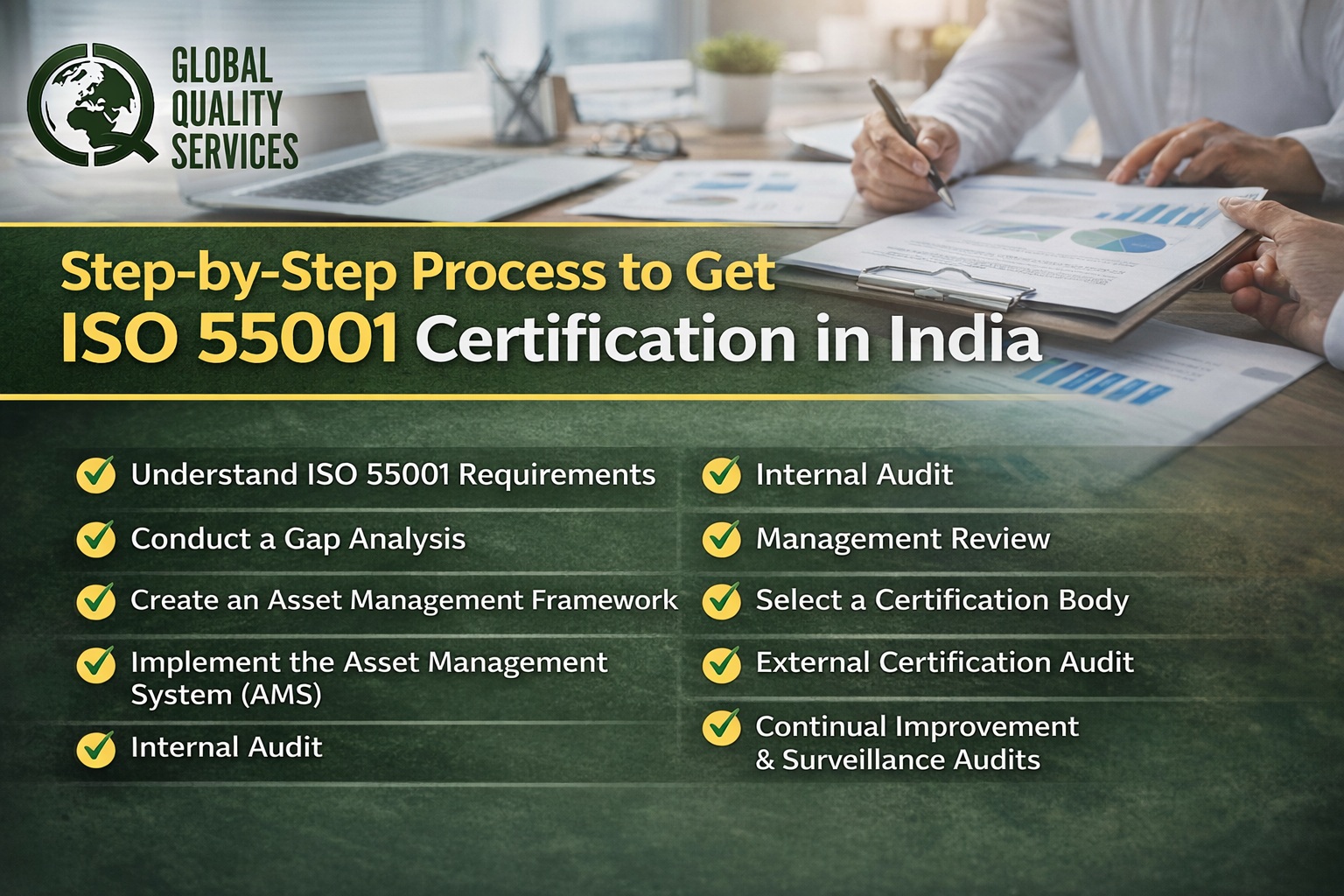
Getting ISO 55001 Certification involves a structured approach that ensures proper planning, system development, and compliance. Here’s how the certification process works step by step.
1. Understand ISO 55001 Requirements
Review the ISO 55001, ISO, and ISO 55002 standards to understand documentation, policies, and system requirements for asset management.
2. Conduct a Gap Analysis
Evaluate your current asset management practices and compare them with ISO 55001 requirements. Identify gaps and areas needing improvement.
3. Create an Asset Management Framework
Develop policies, procedures, asset registers, lifecycle plans, and risk controls aligned with ISO standards.
4. Implement the Asset Management System (AMS)
Roll out the updated processes across departments, train employees, and integrate maintenance, monitoring, and reporting tools.
5. Internal Audit
Conduct an internal audit to check whether the asset management system is working effectively and meeting all ISO requirements.
6. Management Review
Senior management reviews audit findings, assesses performance, allocates resources, and approves the system for certification.
7. Select a Certification Body
Choose an accredited certification body in India, such as TUV, BSI, SGS, or DNV, to carry out the external audit.
8. External Certification Audit
A third-party auditor conducts:
- Stage 1 Audit: Document review
- Stage 2 Audit: On-site evaluation and system verification
Upon successful completion, the organisation receives ISO 55001 Certification.
9. Continual Improvement & Surveillance Audits
After certification, the company must maintain compliance and undergo yearly surveillance audits to keep the certification valid.
Why Choose Global Quality Services for ISO 55001 Certification?
Global Quality Services supports organizations with a practical, data-driven approach to ISO 50001 certification. The focus is on building an Energy Management System that aligns with actual energy consumption patterns, operational realities, and regulatory requirements. From energy reviews and baseline development to implementation, internal audits, and certification readiness, Global Quality Services ensures that organizations achieve certification while establishing a system that delivers measurable, sustained energy performance improvements.
GQS Singapore is a member of the Institute of Asset Management UK (Membership ID – 6149246), SCMC Singapore certified management consultant by TUV SUD, Lead auditor in ISO 55001 and has extensive experience in implementing ISO 55001 Asset management system towards successful certification of the standards across different industries such as Airports, Public transport companies, Manufacturing companies, Asset management holding companies, Facility management companies in Singapore, Indonesia, Malaysia, Philippines, Indonesia, Thailand, South Korea, Vietnam.
Partner with Global Quality Services to make your ISO 55001 journey smooth, accurate, and stress-free. Their experts ensure quick compliance and strong results. For more details, contact us today.
FAQ’s on ISO 55001 Certification
1. What is ISO 55001 certification?
ISO 55001 certification is a globally recognized standard that helps businesses manage their assets in a structured way, improving performance, reducing risks, and ensuring better long-term value from those assets.
2. Who needs ISO 55001 certification?
If your business relies heavily on physical assets like machinery, infrastructure, or equipment, ISO 55001 can really help you streamline operations, improve control, and make smarter asset-related decisions.
3. What are the benefits of ISO 55001 certification?
With ISO 55001, you can boost asset efficiency, cut unnecessary costs, manage risks better, and make informed decisions, all while improving overall operational performance and long-term business sustainability.
4. How long does it take to get ISO 55001 certified?
The certification process usually takes around 3 to 6 months, depending on your organization’s size, asset complexity, and how prepared your current systems and documentation are for the audit.
5. How much does ISO 55001 certification cost in India?
In India, ISO 55001 certification typically costs between ₹1.5 lakh to ₹6 lakh, depending on factors like company size, scope, and the certification body you choose for the audit.