Indian payment cards continue to proliferate, putting payment data protection at the forefront of concerns among companies handling payments involving cardholders’ personal financial details. The most recent RBI figures published in Business Standard indicate that credit card spending stood at ₹2.08 trillion in July 2026. For the period between January and July 2026, the average monthly credit card spending figure came out to be ₹2 trillion.
This means a huge amount of money is moving across digital payment networks and requires robust controls to ensure the security of payment cardholder information and compliance with relevant PCI DSS standards. An assessment reveals vulnerabilities, examines the cardholder data environment, tightens security controls, and provides documentation for compliance certification purposes.
At Global Quality Services, we assist organizations in conducting such assessments based on the specifics of their payment systems. Let’s discuss assessment requirements, the methodology, its associated expenses, and why engaging a qualified consultant matters.
Why PCI DSS Assessment Matters for Businesses in Bangalore
Payment environments encompass much more than checkout pages alone. Cardholder data might interface with applications, databases, APIs, cloud services, internal employee logins, payment processors, third parties, remote work technology, and cybersecurity solutions. Conducting a PCI DSS assessment enables companies to determine whether their various elements are sufficiently safeguarded and their controls ready for inspection. Benefits of undergoing this evaluation process include:
- Identify weaknesses affecting cardholder data security
- Establish an accurate Cardholder Data Environment (CDE) scope
- Understand which PCI DSS requirements apply
- Strengthen access control and authentication
- Review vulnerability management and security testing
- Improve logging, monitoring, and incident response
- Organize compliance evidence
- Prepare for an SAQ or formal assessment
- Address gaps before they become audit findings
- Demonstrate a stronger security posture to customers and business partners
Who Needs a PCI DSS Assessment
PCI DSS may apply to organizations involved in payment card transactions or to service providers whose systems or services can affect cardholder data security. Common examples include:
- Fintech and payment companies
- E-commerce and online marketplaces
- Banks and financial service providers
- Payment service providers
- SaaS and technology companies handling card data
- Retail and hospitality businesses
- Healthcare payment platforms
- Subscription and recurring billing businesses
PCI DSS Assessment Requirements
Effective PCI assessment starts with knowing how payment card data comes into, travels through, and leaves your organization. Key focus areas may include:
- Cardholder Data Protection: Organizations must implement controls that safeguard any stored and transmitted cardholder data from being accessed without permission.
- Access Control: Your organization should limit system access and cardholder data access based on business necessity. Appropriate controls for verification and validation should exist in these situations.
- Vulnerability Management: Your organization should establish procedures for vulnerability management across applicable systems and applications.
- Security Testing: Based on regulatory demands and the environment of operations, security testing may encompass vulnerability assessment, penetration testing, and other tests related to technical verification.
- Logging and Monitoring: There must be suitable systems and controls in place to ensure monitoring of relevant activities, detection of suspicious behavior, and documentation of security events.
- Security Policy and Process Requirements: There should be written policies and procedures supporting the compliance requirements under PCI DSS, including roles and responsibilities.
- Third-Party Security: Payment systems often rely on third parties, such as vendor organizations, cloud providers, payment processors, service providers, and other external entities. The roles and responsibilities of these stakeholders must be clearly identified and articulated.
PCI DSS Assessment Process in Bangalore
Global Quality Services takes a streamlined five-step process for taking an organization from ambiguity to assessment readiness.
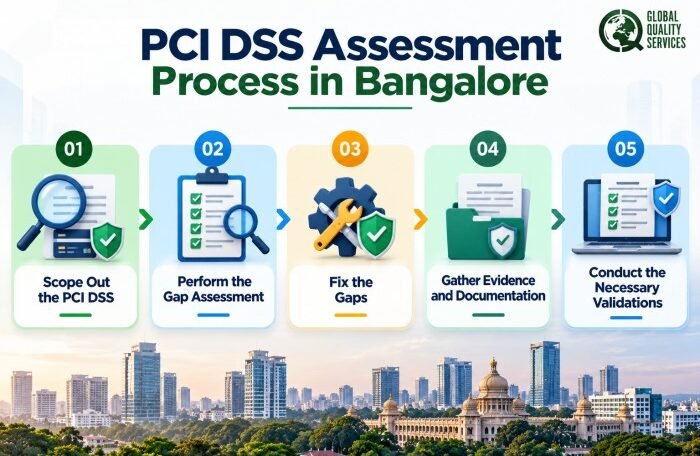
Step 1: Scope Out the PCI DSS
In this phase, GQS identifies the assets, applications, infrastructure, individuals, processes, and external entities that matter in relation to the protection of payment card information. It defines the Cardholder Data Environment (CDE) without overextending the assessment’s scope.
Step 2: Perform the Gap Assessment
Here, the current state of affairs is evaluated relative to the appropriate PCI DSS v4.0.1 standards. The gaps can exist anywhere across the full breadth of controls – from technical controls and access management to vulnerability management, documentation, monitoring, testing, and operations.
Step 3: Fix the Gaps
At this stage, the organization begins remedying its weaknesses, which could entail implementing stronger controls, adjusting settings, refining procedures, updating policies, and addressing any security flaws.
Step 4: Gather Evidence and Documentation
Documentation proves that the necessary controls exist on paper but also are actually implemented and sustained. This process varies widely based on the validation type. Documentation can consist of policies, system configurations, scanning evidence, access reviews, logs, test results, employee training, and incident response reports.
Step 5: Conduct the Necessary Validations
The organization conducts any required PCI DSS validation process according to its own particular situation. This can involve completing an SAQ or going through a full QSASSO validation resulting in ROC and AOC certification. The appropriate path forward depends upon the compliance requirements of the acceptance authority involved.
What is the Difference Between PCI DSS Assessment and PCI DSS Certification
A PCI DSS assessment is the process of reviewing an organization’s payment environment to determine its alignment with the relevant PCI DSS standards.
PCI DSS validation involves providing proof of compliance via the appropriate reporting process, such as an SAQ, ROC, or AOC.
Thus, PCI DSS compliance should never be confused with an ISO-style certification in which an organization receives a certificate based solely on consultancy work without regard to compliance. The type of documentation required varies depending on each organization’s unique compliance needs.
This distinction becomes crucial when choosing a PCI DSS consultant since the goal must always be assessment readiness and legitimate compliance evidence rather than just getting a PCI DSS certificate.
PCI DSS v4.0.1 Assessment
PCI DSS v4.0.1 is the current PCI DSS release listed by PCI SSC. It introduced clarifications and changes intended to make the standard more flexible while strengthening security practices. Organizations preparing for an assessment should pay attention to areas such as:
- Authentication and access controls
- Targeted risk analysis
- Payment page security
- Vulnerability management
- Security testing
- Logging and monitoring
- Incident response
- Third-party service provider responsibilities
- Evidence supporting implemented controls
How Much Does PCI DSS Assessment Cost in Bangalore
The cost of PCI DSS assessment varies according to payment environment size and complexity, not an arbitrary city-fixed rate. Critical variables will include the number of systems within scope, data flow, number of applications, network structure, cloud architecture, third parties involved, transaction environment, tests needed, assessment methodology chosen, and remediation required.
A small organization with minimal payment exposure will likely demand significantly fewer resources compared to a massive fintech firm or payments company. The only way to get a reasonable estimate of the cost is to clarify the PCI DSS scope upfront and determine the necessary validation process. GQS can audit your business and present you with an assessment approach based on your requirements.
PCI DSS Assessment Support Across Prime Bangalore Business Areas
Organizations located in important economic and technological centers such as Whitefield, Electronics City, Koramangala, HSR Layout, Bellandur, Marathahalli, Manyata Tech Park, Outer Ring Road, Indiranagar, and JP Nagar can leverage Global Quality Services assistance.
Common PCI DSS Assessment Challenges
Many organizations do not struggle because they lack security controls. They struggle because their controls are not properly scoped, documented, consistently implemented, or supported by evidence. Common challenges include:
- An unclear Cardholder Data Environment
- Excessive PCI DSS scope
- Poorly documented payment data flows
- Incomplete access reviews
- Missing or inconsistent security evidence
- Weak third-party responsibility mapping
- Vulnerability management gaps
- Inadequate security testing records
- Policies that do not match actual practices
- Last-minute assessment preparation
How Global Quality Services Experts Help You With PCI DSS Assessment
We have more than 26 years of consulting expertise covering quality, compliance, information security, and management systems. We also specialize in conducting PCI DSS assessments, which fall under our primary consulting offerings. Being a reputable consultant, Global Quality Services does not just create compliance documents for the sake of audits; instead, it emphasizes practical compliance assistance. Some important factors that make companies opt for GQS consultancy services are:
- 26+ years of consulting experience
- Experienced compliance and information security professionals
- PCI DSS assessment and audit-readiness expertise
- Practical recommendations aligned with the organization’s actual environment
- Support across technical, operational, and documentation requirements
- Experience across multiple compliance and information security frameworks
- Pan-India consulting capability
- Clear communication and structured project coordination
The GQS framework integrates into other security frameworks as well. This provides organizations with an understanding of areas where current controls and documentation could be leveraged toward a higher-level compliance goal. When establishing an overall information security strategy, organizations should consider obtaining ISO/IEC 27001 certification in addition to PCI DSS compliance.
Start Your PCI DSS Assessment With a Clear Compliance Roadmap
Don’t find out about flaws in your payment security controls when it’s too late. Talk to Global Quality Services about understanding your payment environment, determining the appropriate PCI DSS scope, identifying deficiencies, and developing an effective assessment strategy. Reach out to GQS now for requirement-specific advice and guidance on achieving PCI DSS validation.
Frequently Asked Questions
1. Is PCI DSS the same as ISO certification?
Not quite. PCI DSS is a payment card security framework whose validation process works differently than traditional ISO certification processes. There are several types of PCI DSS validation documentation available, including SAQs, ROCs, and AOCs – organizations choose based on their needs.
2. What is an SAQ?
An SAQ stands for Self-Assessment Questionnaire, which is a form of PCI DSS validation document designed for qualifying merchants and service providers. The first step when working with SAQs is ensuring your business qualifies to use one.
3. When Do I Need to Have a ROC?
A Report on Compliance is needed whenever the validation program of an organization calls for one. This will depend on several factors, including the organization’s function, payment setting, number of transactions, and any other requirement set by the compliance-accepting body concerned.
4. How long will it take to complete a PCI DSS assessment?
There is no set timeline here either. The timing will vary depending on the extent of the assessment, the number of systems involved, the payment environment itself, preexisting controls, the availability of documentation and test data, and the scale of any remediation necessary.
5. Is it possible to perform a PCI DSS assessment concurrently with assessments against other compliance frameworks?
Yes, it is possible. It is up to each organization to determine whether there is overlap between its controls and those associated with other compliance standards, including information security and privacy compliance programs.