
India’s healthcare sector is digitalising rapidly, but with this growth comes increasing cyber risk. According to the FICCI-EY Risk Survey 2026, 51% of Indian organisations now rank cybersecurity breaches as the top operational risk, underscoring the urgency of robust data protection in healthcare.
With hospitals increasingly relying on EHR systems, telemedicine platforms, cloud storage, and integrated billing solutions, patient data protection has become a strategic necessity. In this evolving landscape, HITRUST Certification India offers a structured framework that helps hospitals safeguard sensitive patient data, ensure regulatory compliance, and build long-term trust with patients, partners, and insurers.
Understanding HITRUST Certification in the Indian Healthcare Context
HITRUST certification is based on the HITRUST CSF (Common Security Framework), a globally recognized framework specifically designed to protect sensitive data in highly regulated industries such as healthcare.
For hospitals in India, HITRUST certification offers:
- A unified framework integrating privacy, security, and risk management
- Alignment with standards such as ISO, NIST, HIPAA, and GDPR
- A scalable, risk-based control structure tailored to organizational complexity
- A measurable maturity model with clearly defined compliance benchmarks
Instead of navigating multiple regulatory requirements independently, hospitals can use HITRUST as a consolidated compliance architecture.
Critical Data Security Challenges in Indian Hospitals
Healthcare institutions in India manage vast volumes of Protected Health Information (PHI), making them prime targets for cyberattacks.
Key Security Risks Include:
- Unauthorized access to Electronic Health Records (EHRs)
- Ransomware attacks are disrupting patient care operations
- Weak access controls across departments
- Third-party risks from labs, insurance providers, and SaaS vendors
- Inconsistent security practices across hybrid IT environments
HITRUST Certification India directly addresses these vulnerabilities through standardized controls related to encryption, identity management, audit logging, incident response, and vendor risk governance.
How HITRUST Integrates with Existing Compliance Standards
Many Indian hospitals already implement ISO-based information security practices. HITRUST enhances these efforts rather than replacing them.
Alignment Advantages:
- Maps closely with ISO/IEC 27001 control domains
- Incorporates healthcare-specific risk scenarios beyond ISO
- Provides prescriptive implementation guidance
- Reduces audit fatigue through a single validated certification
For hospitals seeking international credibility and partnerships, HITRUST certification in India acts as a bridge between global regulatory expectations and healthcare-specific security controls.
The HITRUST Certification Lifecycle for Hospitals
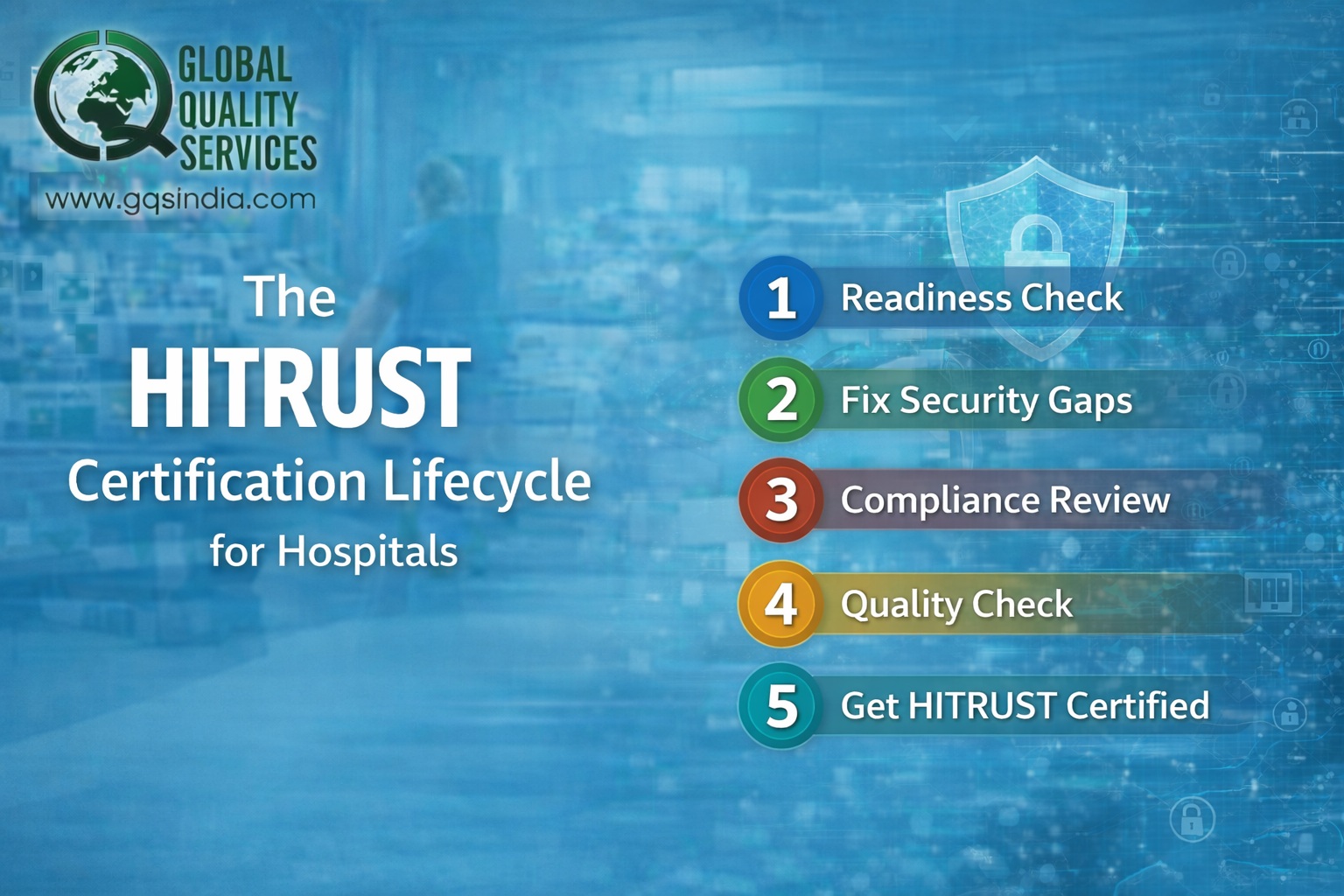
HITRUST certification follows a structured, evidence-driven process designed to validate control maturity and effectiveness.
1. Readiness Evaluation
Hospitals assess existing security policies, technical safeguards, and documentation against HITRUST CSF requirements to identify compliance gaps.
2. Control Enhancement & Remediation
Identified weaknesses are addressed through updated policies, strengthened technical safeguards, process improvements, and documented evidence collection.
3. Validated Assessment
An authorized HITRUST assessor conducts a formal review of implemented controls, evaluating documentation, operational evidence, and control effectiveness.
4. HITRUST Quality Review
HITRUST performs an independent quality assurance review to verify scoring accuracy and compliance interpretation.
5. Certification Issuance
Upon successful validation, HITRUST grants certification, confirming that the hospital maintains a robust, validated data protection framework.
Each phase prioritizes measurable implementation rather than policy documentation alone.
Strategic Preparation for HITRUST Certification India
Hospitals that approach HITRUST as a governance initiative achieve stronger long-term outcomes.
Recommended Preparation Measures:
- Conduct enterprise-wide risk assessments
- Establish formal data ownership and accountability structures
- Strengthen access control and identity governance systems
- Formalize third-party risk management frameworks
- Implement structured employee cybersecurity training programs
Proactive preparation significantly reduces certification timelines and improves audit readiness.
Business and Compliance Advantages for Indian Hospitals
HITRUST certification India delivers both operational resilience and competitive advantage.
Core Benefits:
- Enhanced patient trust through validated data security
- Reduced the likelihood and impact of data breaches
- Improved incident response maturity
- Alignment with global insurers and healthcare partners
- Simplified regulatory inspections and audits
For multi-location hospital networks and digitally enabled healthcare providers, HITRUST becomes a strategic differentiator in both domestic and international markets.
Which Healthcare Organizations Should Consider HITRUST
HITRUST certification is particularly relevant for:
- Multi-specialty hospital chains
- Super-specialty care centers
- Telemedicine and digital health platforms
- Diagnostic laboratories
- Medical billing and healthcare SaaS providers
Any organization processing sensitive patient information at scale can benefit from structured HITRUST compliance.
Summary
As India’s healthcare ecosystem continues to digitize, data protection cannot remain a secondary IT function. Cyber resilience, regulatory alignment, and patient trust now define institutional credibility.
HITRUST Certification India provides hospitals with a comprehensive, risk-based compliance framework that strengthens governance, reduces breach exposure, and supports international expansion.
Hospitals planning long-term growth should evaluate readiness early and engage an experienced HITRUST consultant to ensure structured, efficient certification execution.
FAQ’s
- Is HITRUST certification mandatory for hospitals in India
HITRUST certification is not legally mandatory in India. However, global healthcare partners, insurers, and enterprise clients increasingly require HITRUST certification as evidence of robust healthcare data security practices.
- How long does HITRUST certification take for hospitals
HITRUST certification typically requires four to nine months. The timeline depends on hospital size, system complexity, existing security maturity, and the extent of remediation required after readiness assessment.
- How is HITRUST different from ISO 27001 for hospitals
HITRUST incorporates ISO 27001 controls but adds healthcare-specific privacy and security requirements. It provides prescriptive implementation guidance and measurable maturity scoring tailored specifically for healthcare environments.
- Can small or mid-sized hospitals pursue HITRUST certification
Yes, HITRUST follows a scalable, risk-based framework. Small and mid-sized hospitals can implement proportional controls based on their operational complexity and risk exposure while achieving certification.
- How long is HITRUST certification valid
HITRUST certification remains valid for two years. Organizations must complete interim assessments during the certification cycle to demonstrate continued compliance and control effectiveness.