Customers expect any card data entered into a company’s website, payment gateway, application, or point-of-sale system to remain protected during the transaction. This expectation creates a heavy burden on the shoulders of merchants who have a legal responsibility to protect payment account data within all environments that impact its security – internal processes, employees, or external vendors.
For India, this is especially relevant considering how quickly and widely digital payments are being adopted in the country. According to statistics, 24,508.96 million UPI transactions totalling ₹29,82,355.95 crore were conducted in August 2026 alone.
PCI DSS defines security standards for organizations that store, process, transmit, or impact the security of payment card data. PCI DSS v4.0.1 represents the currently active version of the standard; meanwhile, future-dated v4.x is applicable since March 31, 2025.
Having knowledge about the standards is a starting point, but truly understanding which controls apply to an organization’s particular situation, the type of proof assessors need, and areas where there may be weaknesses is key. This is where proper PCI DSS assessment shines through.
What is PCI DSS Assessment
A PCI DSS assessment entails analyzing an organization’s payment card environment to ensure compliance with relevant provisions under the Payment Card Industry Data Security Standard.
This framework aims to provide a consistent level of technical and operational controls for securing payment account data. The standard applies to organizations handling payment card transactions, such as merchants, payment processors, acquirers, issuers, and service providers.
Assessment processes extend beyond just having security policies on paper. Instead, assessments determine if security controls exist, continue to operate effectively, receive proper monitoring, and have adequate supporting documentation.
PCI DSS v4.0.1: What Indian Businesses Need to Know
For organizations preparing for a PCI DSS assessment in late 2025, PCI DSS v4.0.1 will be the appropriate standard to use.
In June 2024, PCI SSC released PCI DSS v4.0.1, which was a minor revision of PCI DSS v4.0. It included corrections and clarifications but no new or removed requirements. PCI DSS v4.0 expired on December 31, 2024, and PCI DSS v4.0.1 is now the current version under PCI SSC’s control.
There was more to this update than just updating the version number.
PCI DSS v4.x added 64 new requirements, out of which 51 had a future date of applicability. These requirements went into effect on March 31, 2025. Organizations must include them in their assessment scope when conducting a PCI DSS assessment after this date. Important areas introduced or strengthened in PCI DSS v4.x include:
- Greater emphasis on security objectives
- Targeted risk analysis
- More defined roles and responsibilities
- Annual scope confirmation
- Customized approach options
- Stronger payment page security considerations
- Expanded authentication requirements
- More detailed vulnerability management expectations
- Greater focus on ongoing monitoring
- Stronger third-party service provider considerations
Who Needs a PCI DSS Assessment in India
PCI DSS is applicable to any business entity storing, processing, or transmitting cardholder data and those whose system or service could impact the security of the cardholder data environment.
- Banks and Financial Institutions
- E-commerce Businesses
- Payment Gateways and Payment Processors
- Fintech Companies
- SaaS and Technology Service Providers
- BPO and IT Service Providers
- Hospitality and Travel Businesses
- Healthcare Organizations
What Does PCI DSS Actually Protect
The PCI DSS applies to securing payment account information at any stage in its lifecycle. Examples may include:
- Primary Account Number (PAN)
- Cardholder name
- Expiry date
- Service code number
- Sensitive authentication information, if applicable
One specific requirement is that sensitive authentication data, including card verification codes, PINs, and full magnetic stripe data, cannot be stored once authorization is completed, according to PCI DSS standards.
PCI DSS Scope: The Step Many Businesses Get Wrong
It’s common for companies to start with a standard checklist without assessing what is stored within the Cardholder Data Environment. The PCI DSS scope can cover more than just the server or application where card details are held. Some examples of this include:
- Applications processing payment data
- Databases
- Network infrastructure
- Payment systems
- Workstations
- Administrative systems
- Security systems
- Remote access technologies
- Cloud environments
- Connected systems
- Employees with relevant access
- Third-party service providers
- Supporting systems that can affect the security of the CDE
PCI DSS Assessment Process in India
There are 12 critical components of the Payment Card Industry Data Security Standard. According to the PCI Security Standards Council, these elements represent a set of best practices for organizations dealing with payment cardholder information.
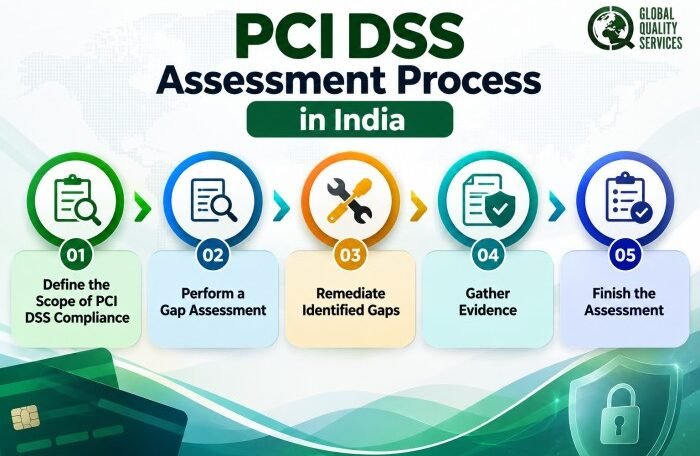
Step 1: Define the Scope of PCI DSS Compliance
Determine where cardholder data is located within the business. This step involves assessing payment systems, applications, networks, cloud environments, and any third-party providers to pinpoint the Cardholder Data Environment (CDE).
Step 2: Perform a Gap Assessment
Compare the CDE to the relevant PCI DSS v4.0.1 requirements. This includes assessing areas like access control, encryption, vulnerability management, logging, monitoring, and security testing to detect gaps in compliance.
Step 3: Remediate Identified Gaps
Remediate the gaps identified as part of the assessment. The remediation may include improving access control, addressing system configuration issues, addressing vulnerabilities, increasing monitoring, policy updates, and implementing necessary security controls.
Step 4: Gather Evidence
Gather evidence to prove the controls are implemented effectively and managed. The evidence may include policies, access control reviews, scan reports, penetration test results, logs, system configurations, training evidence, and incident response.
Step 5: Finish the Assessment
The required validation is finished in accordance with the PCI DSS requirements and validation approach for the organization. In cases where a QSA assessment is needed, the assessor reviews the controls and evidence and generates the necessary compliance documentation, including ROC and AOC.
What is the Difference Between PCI DSS Assessment, Compliance and Certification
These terms may appear to be synonymous on the Internet, but they are not.
PCI DSS Assessment
Assessment refers to the process of testing the environment and controls of the organization against PCI DSS requirements.
PCI DSS Compl£ance
Compliance refers to the accomplishment of the PCI DSS requirements that are applicable to the organization.
Validation under PCI DSS
This is the formal procedure followed to ensure compliance with relevant parties involved with payments.
Certification under PCI DSS
In India, certification under PCI DSS has been referred to as PCI DSS certification, even though PCI DSS is not a typical ISO-type certification system. This framework has a validation process that includes ROC, AOC, or a suitable SAQ, instead of referring to PCI DSS as a certification of PCI SSC.
PCI DSS Assessment: SAQ or QSA
Whether the use of a relevant Self-Assessment Questionnaire (SAQ) is suitable will depend upon the situation facing the organization. Another organization may require a full assessment to be carried out by a Qualified Security Assessor. Determining the correct path to take will depend on considerations like:
- Merchant/Service Provider Status
- Type of Payment Process
- Card Transaction Volume
- Cardholder Data Environment Scope
- Acquirer or Payment Brand Requirements
- Eligibility for Relevant SAQs
PCI DSS Assessment for Service Providers
Service providers deserve special attention because their systems can affect the security of payment card data handled by their customers. Examples include:
- Payment processors
- Payment gateways
- Cloud providers
- Hosting providers
- Managed service providers
- IT service providers
- Data centers
- Security service providers
- SaaS platforms supporting payment environments
Key Benefits of PCI DSS Assessment in India
Here are the key benefits of PCI DSS assessment in India:
- Enhanced Security of Payment Data: It helps to identify risks in relation to the exposure of payment account data and rectify them.
- Improved Awareness About the Payment Environment: There are many organizations that lack visibility into the payment environment in which their business operates. Scoping and data flow analysis would help in discovering new relationships.
- Increased Consumer Confidence: Consumers trust the businesses that handle their payment data to be serious about the security of their data. A well-managed PCI DSS program is an indication of systematic security efforts.
- Simplified Business Relationship: Some enterprise clients, payment processors, merchant acquirers, and other interested parties might require evidence of compliance with the PCI DSS during their vendor assessments or onboarding processes.
- Improved Security Coverage: The PCI DSS standard encompasses such components of payment security as network security, access control, vulnerability management, monitoring, application security, etc.
- Enhanced Security Practices: Periodic reviews, documentation, testing, and monitoring lead to better security practices within the organization rather than occasional payment security projects.
Common PCI DSS Gaps Found During Assessments
Businesses often assume that having a firewall, antivirus software, and encryption is enough. PCI DSS assessments can uncover issues such as:
- Incomplete asset inventories
- Incorrect PCI DSS scope
- Poorly documented data flows
- Excessive user privileges
- Weak authentication practices
- Inadequate access reviews
- Missing or incomplete logs
- Weak log monitoring
- Delayed vulnerability remediation
- Incomplete penetration testing
- Poor change management
- Inadequate incident response documentation
- Unsupported software
- Weak application security practices
- Incomplete third-party documentation
- Missing evidence
- Policies that do not match actual practices
PCI DSS v4.0.1 and the Customized Approach
Some of the notable changes introduced by PCI DSS v4.x include the availability of the Customized Approach as one of the approaches to compliance.
It allows organizations the liberty to achieve the desired security outcome in relation to a particular requirement through customized controls without necessarily following the Defined Approach.
However, liberty does not translate to reduced responsibilities.
According to PCI SSC, organizations using the Customized Approach should be able to define and document their customized controls and conduct a risk assessment showing that the controls offer protection equivalent to that of the defined requirement.
How Long Does PCI DSS Assessment Take in India
There is no single timeline that applies to every organization. The duration depends on:
- Size of the organization
- Number of systems in scope
- Number of locations
- Complexity of the payment environment
- Cloud architecture
- Third-party integrations
- Existing security controls
- Availability of evidence
- Number of identified gaps
- Remediation requirements
- Applicable validation method
What Does PCI DSS Assessment Cost in India
No fixed PCI DSS assessment price applies to every organization. The cost can depend on:
- Size of the CDE
- Number of systems in scope
- Number of applications
- Number of locations
- Transaction environment
- Required testing
- Vulnerability scanning
- Penetration testing
- Third-party dependencies
- Existing security maturity
- Remediation requirements
- Validation method
- QSA involvement, where applicable
PCI DSS Assessment Services Across Major Cities in India
Global Quality Services offers services for the assessment of PCI DSS compliance and related consultancy in important cities within India where businesses and technologies thrive. If you have a fintech venture located in Bangalore, an e-commerce operation based in Mumbai, or an IT firm operating out of Hyderabad, Global Quality Services will be able to assist you with assessing PCI DSS compliance and preparation for audits.
- Bengaluru
- Mumbai
- Chennai
- Hyderabad
- Delhi
- Pune
- Ahmedabad
- Noida
How Global Quality Services Supports PCI DSS Compliance
Our consultants believe in practical, hands-on guidance. Each PCI DSS assessment is customized based on your operations, IT systems, and risk exposure. Here is how our process typically unfolds:
- Experience of 26 Years: Consultancy experience that is proven in compliance and management system standards.
- Help with Understanding PCI DSS Requirements: Receive guidance on what is required from you and what will be assessed.
- Gap Assessment: Identification of real security gaps in your organization and recommendations on how to fix them.
- Documentation Help: Help in policy development, procedures, and evidence gathering necessary for the assessment.
- Readiness for Assessment: Prepare yourself and your organization before the assessment.
- Full Cycle of Services: Global Quality Services helps you at all stages of the process, from identification of the scope to assessment preparation.
Get Your PCI DSS Assessment on the Right Track
Your payment landscape does not require yet another generic PCI DSS compliance checklist. Instead, your organization requires a scope of work, gap analysis, evidence, and action plan that your organization can implement.
With Global Quality Services, your organization will go from simply asking “Are we PCI DSS compliant?” to answering the far more relevant questions of what’s in scope, what must be addressed, what evidence must be provided, and what’s next.
Begin your PCI DSS assessment journey with Global Quality Services and transform your payment security process into one that is more manageable and well-run. Speak with Global Quality Services about PCI DSS Assessment in India
Frequently Asked Questions
1. Who Conducts a PCI DSS Assessment?
A formal PCI DSS assessment is conducted by a Qualified Security Assessor organization accredited by the PCI SSC. Other validation instances can use a suitable Self-Assessment Questionnaire.
2. Is PCI DSS applicable to small business firms?
Yes, PCI DSS applicability does not necessarily pertain only to large organizations. A small merchant who processes card transactions may also be subject to PCI DSS compliance obligations. The type of validation to undertake will depend on the particular situation.
3. How frequently should PCI DSS compliance be validated?
The number of times will depend on the organization’s need to validate as well as that of the respective payment participants involved. Most PCI DSS validation programs entail annual validation as well as other activities like vulnerability assessment and testing.
4. Is PCI DSS capable of lowering risks associated with data breaches?
PCI DSS defines certain security requirements aimed at safeguarding payment account data and minimizing vulnerabilities. Nevertheless, it is impossible to ensure that there will be no data breaches. Good security requires correct implementation of controls.
5. Is PCI DSS v4.0 still valid?
No. PCI DSS v4.0 was retired on December 31, 2024. PCI DSS v4.0.1 is the active version supported by PCI SSC.