Higher education in India continues to grow rapidly, with the number of Higher Education Institutions increasing from 51,534 in 2014-15 to 58,643 in 2022-23, according to data published by the Ministry of Education. In such an environment where many colleges and universities compete for students, teachers, research projects, and recognition as quality providers, there is a need to prove your value based on tangible indicators of performance.
NAAC Accreditation gives HEIs a systematic method of measuring the performance of their academic programs, pedagogical approaches, research initiatives, campus infrastructure, support systems for learners, governance framework, and development activities. Yet, the entire NAAC framework itself is experiencing massive change in the form of moving away from its old CGPA-based system to new concepts like Binary Accreditation and Maturity-Based Graded Levels.
If your college or university plans to get NAAC Accredited for the first time, renew your accreditation, or move to the new system altogether, you should know how this works. Continue reading to learn about NAAC Accreditation, eligibility criteria, advantages, preparations required, the process in five easy steps, and the role of a professional consultant.
What is NAAC Accreditation
The National Assessment and Accreditation Council, commonly known as NAAC, is an autonomous body established by the University Grants Commission (UGC) in 1994 to assess and accredit universities and colleges in India. Its role is to evaluate institutional performance and encourage continuous improvement in higher education.
NAAC Accreditation is an institutional quality assessment and accreditation exercise. It looks beyond individual courses and examines how an institution manages its academic environment, teaching and learning, research, infrastructure, student services, governance, and quality improvement practices.
For an institution, the exercise is not simply about receiving an accreditation status. It creates an opportunity to examine whether its policies are actually being implemented, whether institutional data is reliable, whether academic outcomes are being monitored, and whether quality practices are consistently followed across departments.
The terminology is also important. NAAC provides accreditation, rather than an ISO-style certification. Institutions should therefore use terms such as NAAC Accreditation, NAAC assessment, and NAAC accreditation status in their official communication.
Why is NAAC Accreditation Important for Indian Higher Education Institutions?
NAAC accreditation will assist institutions in developing a more systematic framework for assessing academic excellence and organizational improvement. In addition, it enables stakeholders to understand better how the institution performs relative to certain quality standards.
Strengthens Institutional Credibility
Accreditation offers independent verification of the quality processes employed by an educational institution. The purpose is to provide evidence to prospective students, their parents, faculty members, and other interested parties about maintaining academic standards.
Supports Continuous Quality Improvement
The review prompts organizations to pinpoint weaknesses in their curriculum delivery, research activities, administrative processes, student services, and physical infrastructure. In doing so, it establishes a basis for developing tangible strategies for improvement rather than relying solely on informal assessments.
Improves Institutional Planning
Accurate institutional data will allow managers to see where resource allocation is necessary. Data related to academic achievements, faculty development, research initiatives, student progress, and facilities management could be analyzed simultaneously to inform decision-making processes.
Builds Better Academic Practices
Preparing for accreditation will also result in increased scrutiny of how your courses are delivered, taught, assessed, researched, and developed.
Strengthens Documentation and Evidence Management
Accreditation prep requires proving that the institution backs up its claims through proper documentation. Good documentation systems don’t just pass inspections; they also help prepare for the next round of assessments.
Supports Stakeholder Confidence
Today’s students and parents consider several aspects when choosing between institutions. They include academics, facilities, research, student services, and reputation, among other elements. Accreditation may be one component within this larger assessment process.
NAAC Accreditation Framework and Recent Changes
NAAC accreditation framework is currently going through a major overhaul. The recommendations of the Dr. Radhakrishnan Committee suggested shifting from the conventional CGPA-based NAAC accreditation process to one based on Binary Accreditation and Maturity-Based Graded Levels (MBGL). The NAAC released this reform framework in February 2025. New Framework Structure:
- Binary Accreditation delivers either “Accredited” or “Not Accredited”.
- Maturity-Based Graded Levels (MBGL) were designed as a step-by-step guide for organizations aspiring to achieve greater maturity.
- Data, especially institutional evidence and digital assessment, will carry more weight than before.
- A++, A+, and A are some examples of traditional CGPA grade classifications, which will eventually be phased out as part of the new system.
- Current organizations already accredited under the previous version must take note of relevant transition guidelines.
Implementation of the framework has evolved since its initial introduction. Colleges will need to consult the most recent guidance available through NAAC notices, manuals, and portal requirements before making an application. In 2026, when reviewing the transition process, it becomes apparent that certain operations were still developing, despite having expected deadlines set back in 2025.
What are the Key Areas Evaluated Under NAAC
NAAC’s conventional evaluation framework comprises seven major aspects of institutional functioning. While the methodology continues to change, these criteria provide valuable guidance for assessing the effectiveness of institutional quality frameworks.
- Curricular Aspects: This aspect examines aspects related to curriculum development, flexibility in teaching methodologies, and enrichment. The criteria here assess whether academic programs meet institutional and societal demands.
- Teaching-Learning and Evaluation: It covers areas such as teaching, student admissions, staffing requirements, educational achievements, evaluations, and initiatives to enhance the learning experience.
- Research, Innovations, and Extension: Here, institutions must demonstrate their capacity for conducting high-quality research, publishing articles, innovating technologies/products, collaborating, consulting, extending knowledge to the community, and benefiting society.
- Infrastructure and Learning Resources: This includes classrooms, labs, libraries, technological equipment, infrastructure on campus, learning resources, and any systems that manage these assets.
- Learner Support and Progression: Student wellbeing, scholarships, mentorship programs, career counseling, progression into tertiary education, internships and other forms of support systems fall under this heading.
- Governance, Leadership and Management: This focuses on institutional leadership, strategic planning processes, financial management, faculty development, administrative management and quality management.
- Institutional Value and Practice: It is expected that institutions should showcase significant practice in the realm of value-based, socially responsible, inclusive, and sustainable institutional development.
Who Can Apply for NAAC Accreditation
NAAC primarily assesses higher education institutions such as universities, colleges, and other eligible HEIs covered by the applicable assessment framework. Eligibility requirements can differ according to the institution type and the accreditation framework applicable at the time of application. Since NAAC is transitioning to a new accreditation model, institutions should verify the current eligibility requirements directly against the latest NAAC instructions before beginning their application.
Older eligibility rules and historical guidance should not be copied into a new accreditation strategy without checking whether they still apply. This is particularly important for:
- Universities
- Autonomous colleges
- Affiliated colleges
- Constituent colleges
- Deemed universities
- Institutions covered under specialised higher education categories
- Institutions preparing for their first accreditation
- Institutions planning re-accreditation or transition from an existing accreditation status
NAAC Accreditation for Colleges and Universities in India
NAAC preparation needs to reflect the institution’s size, academic structure, governance model and available evidence.
A university may have to coordinate information across multiple schools, departments, centres and administrative units. A college may need to consolidate data from academic departments, student services, administration, examination systems, placement activities and institutional committees.
The challenge is often not a lack of work. Many institutions already conduct faculty development programmes, student activities, research projects, extension activities and quality initiatives. The difficulty is presenting reliable evidence in a consistent and verifiable manner.
What Documents and Evidence are Needed for NAAC Accreditation
NAAC preparation involves extensive institutional information and supporting evidence. The exact requirements depend on the applicable framework and current NAAC documentation. Common areas of evidence may include:
- Institutional profile and statutory information
- Vision, mission and strategic plans
- Academic calendars
- Curriculum and course-related records
- Faculty qualification and experience records
- Student enrolment and progression data
- Teaching-learning records
- Examination and assessment information
- Research publications and project records
- Innovation and consultancy records
- Infrastructure details
- Library and learning resource records
- Student support activities
- Placement and progression records
- Scholarship and financial assistance records
- Faculty development activities
- Governance and committee records
- IQAC documentation
- Feedback and action-taken reports
- Extension and outreach activities
- Institutional best practices
- Policies, procedures and supporting photographs or other evidence where applicable
NAAC Accreditation Process in India
The exact procedure depends on the framework applicable to the institution. For a practical consultancy roadmap, GQS can structure preparation around five major stages.
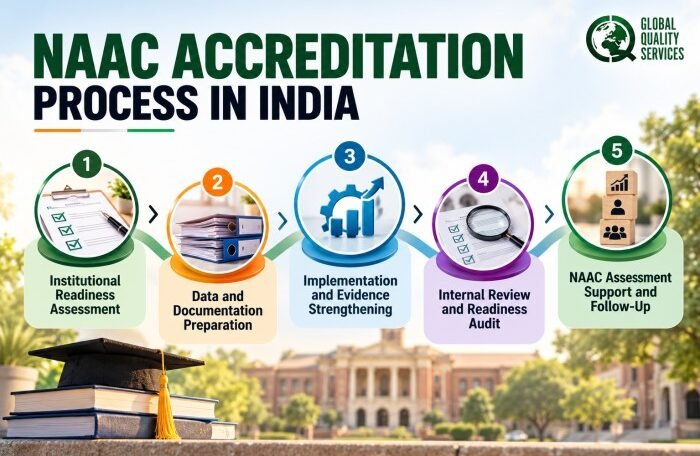
Step 1: Institutional Readiness Assessment
The first stage is a detailed review of the institution’s existing academic, administrative, quality, and evidence systems. Gaps are identified across the relevant NAAC requirements, with attention to missing records, inconsistent data, and areas requiring improvement.
Step 2: Data and Documentation Preparation
The institution organises its existing information into the required formats. The institution reviews and prepares policies, reports, records, supporting documents, and institutional data according to the applicable NAAC requirements.
Step 3: Implementation and Evidence Strengthening
Where gaps are identified, the institution works on implementing suitable practices and strengthening supporting evidence. Faculty members, administrators, and responsible teams are guided on their respective quality responsibilities.
Step 4: Internal Review and Readiness Audit
A structured internal review is conducted before the institution moves towards formal assessment. Data consistency, documentation, implementation, and evidence availability are checked so that weaknesses can be addressed in advance.
Step 5: NAAC Assessment Support and Follow-Up
The institution receives support in preparing for the applicable NAAC assessment and responding to observations or requirements. The focus remains on maintaining accurate evidence and continuing quality improvement after the assessment.
Why Choose GQS India for NAAC Accreditation Consultancy
Global Quality Services has been providing certification, accreditation, and consultancy support across India for more than two decades. GQS states that it has specialised in NAAC and NABET accreditation and works with experienced professionals, including professors on its panel, for accreditation-related assignments.
26+ Years of Consulting Experience
GQS brings more than 26 years of experience across quality, certification, compliance, and accreditation-related consultancy. This wider experience helps the team understand how quality systems need to work within real institutions rather than exist only as documentation.
Experienced Academic and Quality Professionals
NAAC requires an understanding of academic systems as well as institutional quality management. GQS has experience working with professionals and experienced faculty members who can bring relevant academic and quality perspectives to the assignment.
Practical, Institution-Specific Guidance
Every college and university has a different structure. GQS focuses on developing guidance around the institution’s actual departments, responsibilities, existing records, and operational practices rather than relying on one generic documentation set.
End-to-End Consultancy Support
Support can extend across readiness assessment, documentation, implementation guidance, training, internal review, and assessment preparation. The objective is to keep the institution prepared throughout the assignment instead of concentrating all work immediately before assessment.
NAAC Accreditation and Quality Management in Educational Institutions
NAAC focuses specifically on institutional quality in higher education, while management system standards can help institutions structure particular operational areas.
For institutions looking to strengthen their wider quality management practices alongside accreditation preparation, ISO 9001 Certification in India can provide a structured quality management framework that supports consistent processes and continual improvement.
NAAC and ISO certification serve different purposes, so institutions should select the framework based on their specific objectives.
Common NAAC Accreditation Mistakes Institutions Should Avoid
Here are common NAAC accreditation mistakes that you must avoid:
- Starting Documentation Too Late: Trying to create several years of records immediately before assessment can create inconsistencies and unnecessary pressure.
- Treating NAAC as a Documentation Exercise: Documents alone cannot demonstrate institutional quality. Policies should be implemented, monitored and supported by appropriate evidence.
- Using Generic Templates Without Institutional Relevance: A policy copied from another institution may not reflect the actual structure, responsibilities, or practices of the institution using it.
- Ignoring Data Consistency: Student numbers, faculty information, research data, and other institutional figures should remain consistent across relevant records and reports.
- Keeping Evidence Across Multiple Uncontrolled Locations: Scattered files can make evidence retrieval difficult. Institutions benefit from a clear ownership and document management structure.
- Leaving IQAC Involvement Until the End: The Internal Quality Assurance Cell plays an important role in institutional quality practices. It should be involved throughout the preparation cycle rather than only during final documentation.
- Waiting for the Assessment Notification: With NAAC’s accreditation framework undergoing reform, institutions should use the preparation period to strengthen data, evidence, and quality systems instead of waiting for the final assessment requirements.
How Much Does NAAC Accreditation Consultancy Cost in India?
There is no single consultancy fee applicable to every institution. The cost of NAAC consultancy can depend on factors such as:
- Type of institution
- Number of departments
- Student strength
- Existing accreditation status
- Current quality systems
- Volume of historical data
- Documentation readiness
- Number of locations or campuses
- Level of training required
- Internal audit and readiness requirements
- Extent of consultancy support required
How Long Does NAAC Accreditation Preparation Take
The preparation period depends on the institution’s readiness, availability of data, quality systems, documentation, and the applicable NAAC framework. Institutions with well-maintained records and an active IQAC may require less preparation than institutions starting from an unstructured documentation system. Rather than following an arbitrary timeline, the preparation schedule should be based on:
- Current institutional readiness
- Availability of historical data
- Documentation gaps
- Implementation gaps
- Evidence quality
- Applicable NAAC submission requirements
Prepare Your Institution for NAAC Accreditation With Global Quality Services
NAAC preparation becomes easier when academic quality, institutional data, and supporting evidence are managed together. GQS provides consultancy support to help colleges and universities understand their requirements, identify gaps, strengthen documentation, prepare evidence and build greater readiness for assessment.
Talk to our team for a customised NAAC readiness assessment, documentation support and accreditation consultancy. Call +91 9845313910 or +91 9845078743, or email us to discuss your institution’s requirements and receive a suitable consultancy plan.
Frequently Asked Questions
1. Have there been any changes to NAAC’s accreditation process?
Yes. NAAC has introduced changes following the committee of Dr. Radhakrishnan’s recommendations, introducing a new Binary Accreditation system and Maturity-Based Graded Levels in place of the old CGPA grading system.
2. What is Binary Accreditation?
Binary Accreditation refers to the upcoming accreditation system at NAAC where institutions receive either ‘Accredited’ or ‘Not Accredited ‘. The existing CGPA-based grading structure will be replaced with this format. For institutions currently applying for accreditation, refer to the NAAC guidelines and portal.
3. What does MBGL mean in NAAC?
MBGL refers to Maturity-Based Graded Levels. This is essentially a framework that was established to evaluate the level of maturity and development of higher education institutions, going above and beyond the accreditation process. There have been some changes in the way it works throughout its evolution, and it is recommended to verify with NAAC resources.
4. What are the seven NAAC criteria?
The standard NAAC evaluation framework has seven criteria: Curricular Aspects; Teaching-Learning and Evaluation; Research, Innovations and Extension; Infrastructure and Learning Resources; Student Support and Progression; Governance, Leadership and Management; and Institutional Values and Best Practices.
5. What is the difference between NAAC Accreditation and ISO Certification?
NAAC Accreditation assesses the quality and performance of higher educational institutions. ISO certification depends on the criteria set out in an ISO management system standard. While both are assessments, they serve distinct purposes and cannot be used interchangeably.