
A busy commercial kitchen handles dozens of food safety responsibilities every day. Staff receive raw ingredients, prepare different dishes, operate cooking equipment, store prepared food, and serve customers within tight schedules. When these activities lack proper controls, the risk of contamination, unsafe food temperatures, and poor hygiene increases. ISO 22002-2:2025 addresses these concerns through specific prerequisite programme requirements for catering and foodservice operations.
For businesses looking for ISO 22002-2:2025 Consultants in India, Global Quality Services provides consultancy support to help them understand and implement the standard. India’s food sector is also seeing changes in food business regulation. From April 1, 2026, FSSAI revised its turnover thresholds for food business registration and licensing.
Registration now covers businesses with turnover up to ₹1.5 crore, while State and Central License categories apply to higher turnover brackets. These changes make it important for food businesses to review their compliance arrangements. Read ahead to understand the standard, its requirements, and how our consultants can help your catering business.
What Is ISO 22002-2:2025
ISO 22002-2:2025 is an international food safety standard that specifies prerequisite programme requirements for catering and foodservice businesses. It explains the hygiene and operational conditions organizations must maintain to control food safety hazards during food preparation, storage, and service.
Published on July 29, 2025, the standard replaces ISO/TS 22002-2:2013. It forms part of the revised ISO 22002 series and is intended to be used alongside ISO 22002-100:2025, which covers common prerequisite programme requirements across the food, feed, and packaging supply chain.
The standard applies to businesses that prepare food on-site for direct consumer consumption or takeaway. This includes restaurants, hotels, food trucks, vending machines, institutional kitchens, workplace cafeterias, and certain retail food operations.
Why Do Catering and Foodservice Businesses in India Need ISO 22002-2:2025
Food safety problems can start with something as simple as incorrect storage or poor hand hygiene. Raw and cooked food may come into contact, refrigerators may not maintain the required temperatures, or employees may follow different cleaning practices across shifts. These problems become harder to control when a business operates several kitchens or serves hundreds of meals every day.
ISO 22002-2:2025 gives catering businesses a common set of requirements for managing these activities. It helps management establish clear hygiene rules and check whether employees follow them during actual operations. For Indian catering businesses, the standard can help with:
- Better kitchen hygiene: Establishing suitable cleaning and sanitation practices for preparation areas, cooking equipment, utensils, and food contact surfaces.
- Safe food handling: Setting clear procedures for receiving, preparing, cooking, cooling, storing, and serving food.
- Temperature management: Monitoring hot and cold holding conditions to reduce the risk of microbial growth.
- Cross-contamination prevention: Keeping raw and ready-to-eat food separate during storage and preparation.
- Employee hygiene: Establishing clear expectations for handwashing, protective clothing, personal cleanliness, and illness reporting.
- Allergen control: Identifying food allergens and preventing accidental cross-contact during preparation.
- Customer confidence: Giving customers and business partners greater assurance that the organization follows a recognized food safety framework.
- Consistent operations: Helping management maintain the same food handling practices across kitchens, outlets, and work shifts.
Understanding the ISO 22002-2:2025 Framework
The 2025 revision reorganized the ISO 22002 series. Common prerequisite programme requirements now sit in ISO 22002-100:2025, while individual parts address specific industry sectors. For catering businesses, the framework has two relevant layers:
Tier 1: ISO 22002-100:2025, Common Requirements
This standard covers common hygiene and operational requirements that apply across relevant food, feed, and packaging supply chain activities.
It provides the foundation for maintaining suitable premises, equipment, utilities, cleaning arrangements, and other basic food safety conditions.
Tier 2: ISO 22002-2:2025, Catering Sector Addendum
This part addresses additional requirements for catering and foodservice operations.
It considers the conditions found in commercial kitchens, including food preparation, handling, cooking, reheating, storage, and service. These requirements help businesses deal with risks that arise when employees prepare exposed food for direct consumer consumption or takeaway.
Both parts must be considered when establishing the relevant prerequisite programmes for a catering operation.
Core Requirements of ISO 22002-2:2025 for Catering & Foodservice
Catering businesses must maintain proper hygiene and food handling practices throughout their kitchen operations. The requirements cover the conditions in which employees work, the way they handle ingredients, and how the business prepares and serves food.
1. Commercial Kitchen Hygiene
Kitchen floors, walls, ceilings, work surfaces, and food preparation areas must remain suitable for food handling. Businesses need to maintain facilities in a condition that supports effective cleaning and prevents contamination. Kitchen layouts should also allow employees to handle food safely.
2. Personal Hygiene and Employee Health
Employees who handle food must follow appropriate hygiene practices. Businesses should establish handwashing procedures, suitable protective clothing requirements, and rules for reporting illness. Staff must understand when they should avoid handling food to prevent contamination.
3. Food Receiving and Inspection
Incoming ingredients need proper inspection before they enter the kitchen. Employees should check packaging conditions, product quality, delivery conditions, and relevant supplier information. Damaged or unsuitable food should be handled according to established procedures.
4. Safe Food Storage
Raw materials, prepared food, and ready-to-eat products require suitable storage conditions. Businesses must organize storage areas to prevent contamination and maintain the required temperature conditions. Stock rotation procedures also help employees manage product shelf life and reduce the use of unsuitable ingredients.
5. Separation of Raw and Ready-to-Eat Food
Raw ingredients can carry microorganisms that may contaminate cooked or ready-to-eat food. Kitchens should use suitable separation arrangements during storage, preparation, and handling. Employees must also use appropriate utensils, containers, and work surfaces to reduce cross-contamination.
6. Hot and Cold Temperature Holding
Food must remain within appropriate temperature limits during storage, cooking, cooling, reheating, and service. Businesses need suitable monitoring methods and records to check whether equipment and food holding conditions remain within the required limits. Temperature controls should reflect the food safety risks and applicable requirements.
7. Safe Food Preparation and Cooking
Food preparation activities such as washing, thawing, cutting, mixing, cooking, and reheating require suitable controls. Employees must follow established handling procedures to prevent contamination. Cooking and reheating practices should also achieve the required food safety conditions for the products being prepared.
8. Cooling and Reheating Controls
Prepared food that requires cooling or reheating needs careful handling. Businesses should establish suitable procedures to prevent food from remaining under unsafe conditions for extended periods. Employees must monitor the relevant temperatures and follow the organization’s approved methods.
9. Cleaning and Sanitation
Kitchen equipment, utensils, preparation surfaces, and food contact areas require regular cleaning and sanitation. Businesses should maintain cleaning schedules that identify the areas to be cleaned, the frequency, and the methods to be followed. Employees must use suitable cleaning materials and store them safely.
10. Pest Prevention and Control
Commercial kitchens must prevent pests from entering food preparation and storage areas. Businesses should maintain suitable waste arrangements, inspect facilities, and address conditions that may attract pests. Pest control activities should also be documented where required.
11. Water and Ice Safety
Water and ice used in food preparation, cooking, cleaning, and service must be suitable for their intended use. Businesses should maintain safe water supplies and take appropriate action if they identify contamination or quality concerns.
12. Food Waste Management
Food waste must be collected and removed in a way that does not contaminate ingredients, equipment, or preparation areas. Kitchens should use suitable waste containers and maintain proper disposal arrangements. Waste storage areas also need regular cleaning.
13. Allergen Identification and Control
Food businesses need to know which allergens are present in their ingredients and menu items. Employees should understand how to handle allergenic ingredients and prevent accidental cross-contact. The business must also communicate relevant allergen information accurately to customers.
14. Food Packaging and Takeaway Handling
Businesses that prepare takeaway food must maintain suitable hygiene during packing and handling. Packaging materials should be appropriate for food contact, and employees should follow procedures that prevent contamination after preparation.
15. Food Transportation and Service
Food prepared for service or takeaway must remain protected during handling and movement. Businesses should use suitable containers and maintain appropriate temperature conditions where required. Employees must follow hygiene practices when transferring and serving prepared food.
Which Businesses in India Should Implement ISO 22002-2:2025
According to the standard’s scope, the following businesses fall within its application when they carry out open, exposed food preparation activities on-site for direct consumer consumption or takeaway:
- Restaurants
- Hotels
- Food trucks
- Vending machine foodservice operations
- Institutional foodservice facilities
- Workplace cafeterias
- School cafeterias
- Factory cafeterias
- On-board passenger foodservice operations
- Retail food operations involving slicing, portioning, or reheating
The standard applies to organizations of all sizes and levels of complexity, provided their activities meet these scope conditions.
ISO/TS 22002-2:2013 vs. ISO 22002-2:2025: What Has Changed
ISO 22002-2:2025 replaces the earlier ISO/TS 22002-2:2013 technical specification. The revised edition is now an International Standard and forms part of the reorganized ISO 22002 series. The main change is the separation of common prerequisite programme requirements from catering-specific requirements. Businesses must now consider ISO 22002-100:2025 alongside the catering standard:
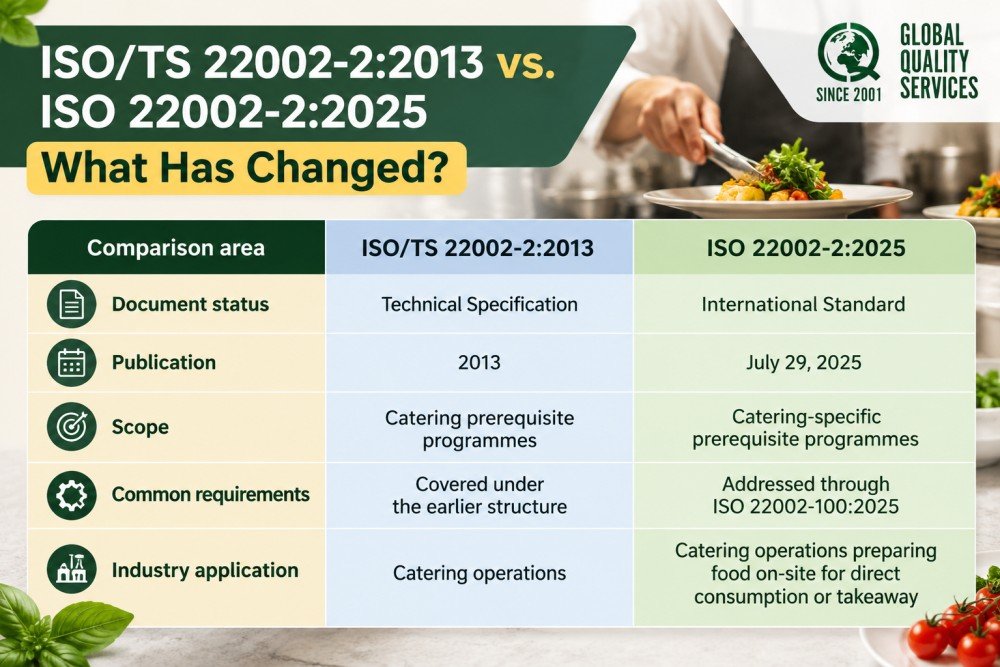
Businesses that used the earlier technical specification should review their existing food safety arrangements against the 2025 edition. They may need to revise their procedures, records, and operational controls to address the revised requirements.
ISO 22002-2:2025 Implementation Process: 5 Steps to Certification
The time required to prepare for certification depends on your existing food safety practices, the number of kitchens, employee strength, and the condition of your facilities. Global Quality Services follows a five-step approach to help catering businesses prepare for the requirements:
Step 1: Initial Assessment and Gap Analysis
Our consultants review your kitchen operations, existing hygiene practices, food handling arrangements, and available documentation. We compare the current arrangements with ISO 22002-100:2025 and ISO 22002-2:2025 to identify the areas that need attention.
Step 2: Documentation Development
Once the gaps are clear, we help prepare the necessary documents for your food safety system. These may include hygiene procedures, cleaning schedules, food handling instructions, temperature monitoring records, pest control arrangements, and other applicable documents.
Step 3: Implementation and Employee Training
The documented procedures need to work during actual kitchen operations. We guide employees on the practices relevant to their responsibilities. Training may cover hand hygiene, safe food preparation, temperature checks, allergen handling, cleaning, and cross-contamination prevention.
Step 4: Internal Audit and Corrective Actions
An internal audit helps determine whether employees are following the established procedures and whether the system meets the applicable requirements. Our consultants assist with identifying nonconformities and planning corrective actions before the certification audit.
Step 5: Certification Audit Preparation
Before the external audit, we help your team review the required documents, records, and implementation evidence. We also assist with coordination with the selected certification body. The certification body conducts the independent audit and makes the final certification decision.
ISO 22002-2:2025 and Its Relationship with Other Food Safety Standards
ISO 22002-2:2025 covers prerequisite programmes for catering operations. It works alongside ISO 22002-100:2025 and supports the wider food safety management system established under ISO 22000:2018. Businesses should understand the difference between these standards before deciding which requirements apply to their operations.
- ISO 22000:2018 establishes the requirements for a food safety management system.
- ISO 22002-100:2025 covers common prerequisite programme requirements across the relevant supply chain.
- ISO 22002-2:2025 covers the additional prerequisite requirements for catering.
- ISO 22002-1:2025 covers prerequisite programmes for food manufacturing.
A restaurant preparing meals for immediate consumption has different operational needs from a central manufacturing kitchen supplying packaged food to several outlets. The applicable standard should reflect the actual activities performed at the facility.
How Global Quality Services Helps You with ISO 22002-2:2025 in India
A catering business needs a consultant who understands the way commercial kitchens work. Preparing documents is one part of the assignment. The consultant must also understand how food moves through the kitchen, how employees handle ingredients, and where hygiene practices may fail during a busy shift. Global Quality Services is a reputed consultant with a background in ISO management system consultancy, food safety, and industry-specific compliance.
Our company has been working in ISO consultancy and training since 2001. Its food and pharma consulting work includes support for organizations in the food processing, hospitality, and related sectors.
What makes Global Quality Services a reputed consultant:
- Experience in ISO consultancy and auditor training since 2001.
- Qualified professionals and ISO Lead Auditors across several management system standards.
- Food safety consultancy experience covering ISO 22000 and FSSC 22000.
- Previous foodservice consultancy work involving restaurant kitchens and multiple outlets.
- Experience supporting organizations across food and pharma industries.
- A consulting team that understands documentation, implementation, internal audits, and certification preparation.
- Consultancy support for businesses across India.
Our consultants work with your management team to understand the existing food safety arrangements before recommending changes. This keeps the implementation relevant to your kitchen activities and avoids unnecessary paperwork.
Get ISO 22002-2:2025 Consultancy in India from Global Quality Services
If your restaurant, hotel, commercial kitchen, or catering business is preparing for ISO 22002-2:2025, speak with Global Quality Services about your requirements.
Our consultants can review your existing food safety arrangements, explain the applicable standard requirements, and help you plan the work needed before certification. We provide consultancy support across India, with a presence in Delhi, Ahmedabad, Noida, Bangalore, Mumbai, Pune, Chennai, and Hyderabad.
Share your business details and the type of foodservice activities you carry out. Our team will discuss the applicable requirements and provide a consultancy proposal based on your operations.
Contact Global Quality Services today to discuss your ISO 22002-2:2025 requirements and get expert guidance for your catering and foodservice business in India.
Frequently Asked Questions
1. Is ISO 22002-2:2025 applicable to restaurants in India?
Yes. Restaurants in India that prepare exposed food on-site for direct consumer consumption or takeaway fall within the standard’s scope.
2. Is ISO 22002-2:2025 a standalone certification?
No. ISO 22002-2:2025 specifies prerequisite programme requirements. It is intended to be used with ISO 22002-100:2025 and supports the broader food safety management system requirements of ISO 22000:2018. It is not a standalone management system certification standard.
3. Does ISO 22002-2:2025 apply to central kitchens?
It depends on the kitchen’s activities. The standard excludes off-site catering kitchens and industrial kitchens that prepare food for supply to other establishments. ISO 22002-1:2025 may be relevant to those operations.
4. Is FSSAI licensing still required after implementing ISO 22002-2:2025?
Yes. ISO implementation does not replace FSSAI licensing or registration obligations. Food businesses must continue to comply with applicable Indian food safety laws and regulations.
5. How long does ISO 22002-2:2025 implementation take?
The time depends on the size of the business, number of kitchens, current hygiene practices, employee awareness, and documentation requirements. A gap assessment helps determine how much preparation is needed before the certification audit.