
India has rapidly transformed into a global manufacturing powerhouse with total exports reaching $790.86 billion between April 2025 and February 2026. As the Make in India initiative pushes domestic goods into stricter international markets, the role of protective packaging has never been more vital.
Current industry data for 2026 indicates that the Indian paper and flexible packaging market is estimated to exceed $43 billion, driven largely by a 151% year-on-year surge in e-commerce and electronics fulfillment. In this high-stakes trade environment, a single damaged shipment or a labeling error can lead to expensive rejections and damaged brand reputations.
By verifying packaging quality before dispatch, businesses can ensure shipments meet buyer requirements and reach their destination safely. Understanding how packing inspection works begins with recognizing why it is critical before shipment.
Why Packing Inspection Service is Critical Before Shipment
Shipping goods across borders involves multiple touchpoints, from humid warehouses to turbulent sea freight and rough manual handling. Without a verified packing protocol, the risk of product loss increases significantly:
- Minimizing Financial Liability: Damaged goods result in insurance claims and return shipping costs, along with replacement production. Inspection identifies weak packaging before these costs accrue.
- Ensuring Regulatory Compliance: Different countries have specific mandates for wood packaging and plastic recycling symbols or hazardous material warnings. Non-compliance often leads to immediate port seizure.
- Protecting Brand Integrity: For B2B clients, the condition of the outer box is the first impression of quality. A crushed or poorly taped box suggests a lack of professionalism.
- Optimizing Logistics Costs: Overpackaging leads to higher shipping fees, while underpackaging leads to damage. Inspection ensures the balance is perfect.
What Does a Packing Inspection Service Checklist Include
A comprehensive inspection follows a standardized checklist to ensure no detail is overlooked. Our inspectors utilize a multi-point verification system tailored to the specific nature of your cargo:
| Category | Inspection Points |
| Quantity Verification | Matching unit counts against the packing list and checking the mix of sizes or colors. |
| Shipping Marks | Checking for accurate destination addresses and handling symbols like fragile or keep dry signs. |
| Packaging Materials | Verifying the strength of corrugated boxes and the thickness of bubble wraps or strapping bands. |
| Retail Packaging | Inspecting the inner polybags, hangtags, or barcodes for print quality and alignment. |
| Weight and Dimensions | Measuring gross and net weight to ensure they match the bill of lading to avoid customs issues. |
Step-by-Step Packing Inspection Process
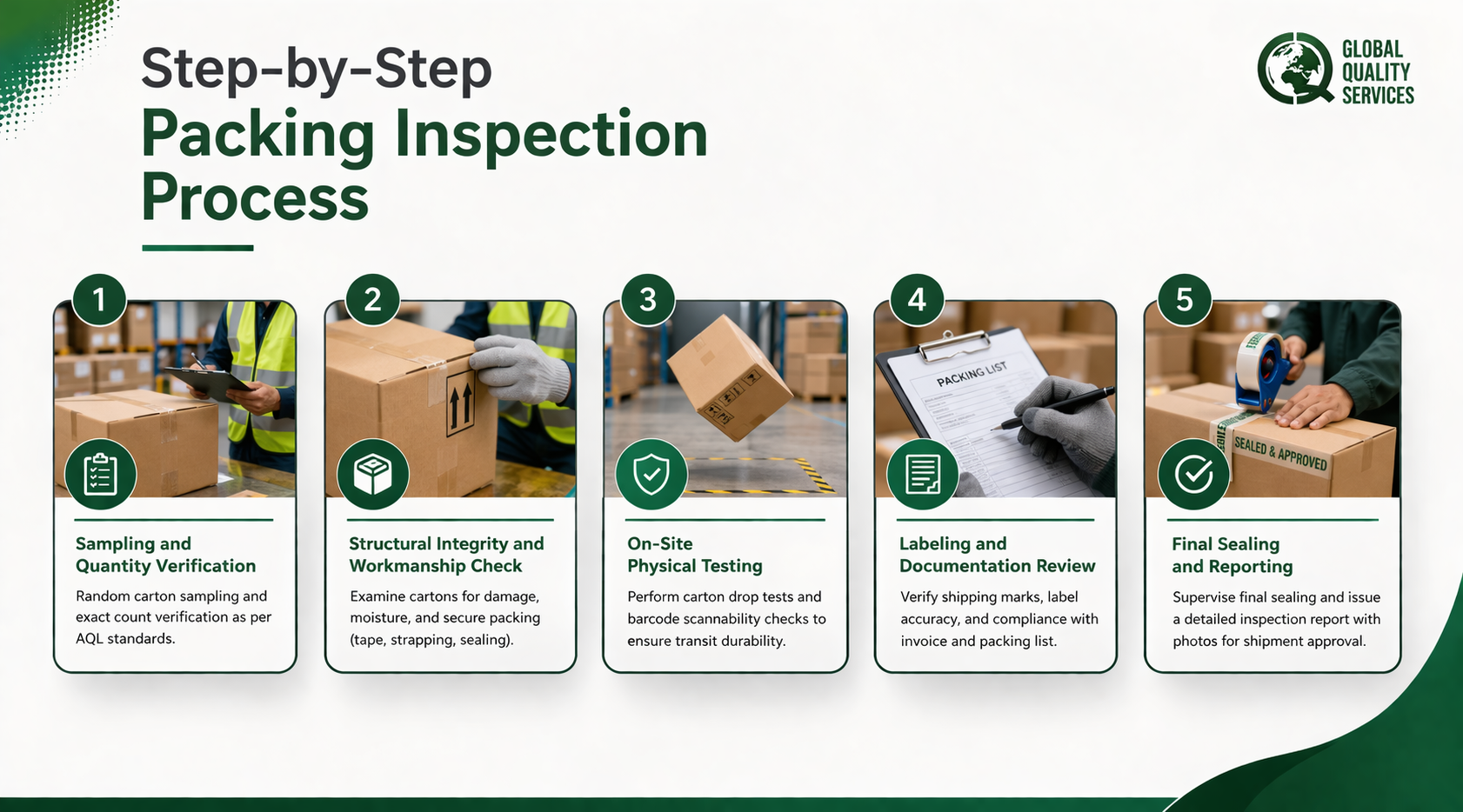
The inspection process is executed with precision to ensure your shipment is resilient and ready for the sea.
Step 1: Sampling and Quantity Verification
The process begins with selecting a random sample of cartons based on the international AQL standard. We verify that the total number of finished and packed units matches your purchase order exactly. This prevents short shipping or over shipment errors that complicate customs clearance.
Step 2: Structural Integrity and Workmanship Check
Inspectors examine the physical condition of the outer shipping containers. We look for signs of moisture, crushing, or previous tampering. This step also includes checking the workmanship of the packing, such as whether the tape is applied securely and if the strapping is tight enough to hold without cutting into the box.
Step 3: On-Site Physical Testing
We perform rigorous field tests to simulate transit stress. The most common is the Carton Drop Test, where a packed sample is dropped from a specific height on its corners and edges. If the inner product or the outer box breaks, the packing fails. We also conduct barcode scannability tests to ensure your logistics partners can track the shipment easily.
Step 4: Labeling and Documentation Review
Every shipping mark is cross-referenced with the invoice and packing list. We ensure that font sizes meet maritime requirements and that country of origin labels are permanently affixed. For specialized goods, we verify that safety warnings and batch numbers are visible and accurate.
Step 5: Final Sealing and Reporting
Once the inspection is successful, our team supervises the final closing of the cartons. In many cases, we apply specialized tape to prevent unauthorized access during transit. A detailed report with high-resolution photographs of every step is then issued for final shipment approval.
Common Packaging Defects Found During Inspection
Identifying defects at the factory level allows for immediate corrective action. Common issues we encounter include the following:
- Inadequate Cushioning: Insufficient material that allows the product to move inside the box.
- Mismatched Barcodes: The barcode on the retail pack does not match the product inside.
- Poor Palletization: Boxes overhanging the edge of the pallet, which leads to collapsed stacks during loading.
- Incorrect Shipping Marks: Old shipping marks from previous shipments or handwritten labels that are not weather-resistant.
- Mold and Humidity: High moisture content in wooden pallets or corrugated boxes can ruin textiles and electronics.
When Should Packing Inspection Be Conducted
The ideal time for a packing inspection is when at least 80% to 100% of the shipment is fully packed and ready for dispatch. Conducting the check at this stage allows the inspector to see the final presentation of the goods. If an inspection is done too early, there is no guarantee that the remaining goods will be packed with the same care.
Industries That Need Packing Inspection Services
While every exporter benefits from quality checks, certain sectors in India have a higher risk profile.
- Consumer Electronics: Requires anti-static packaging and extreme shock protection.
- Pharmaceuticals: Mandates temperature-controlled packaging and tamper-evident seals for global compliance.
- Textiles and Garments: Focuses on moisture protection and needle detection verification.
- Handicrafts and Furniture: Needs specialized crating to protect fragile materials like glass or stone and polished wood.
- Automotive Components: Heavy-duty packaging to prevent corrosion and structural damage during sea transit.
Packing Inspection Services Consultants in India
Packing Inspection Services in Delhi | Packing Inspection Services in Bengaluru
Packing Inspection Services in Noida | Packing Inspection Services in Hyderabad
Packing Inspection Services in Ahmedabad | Packing Inspection Services in Chennai
Packing Inspection Services in Pune | Packing Inspection Services in Mumbai
Why Global Quality Services is a Trusted Choice for Packing Inspection
Selecting the right inspection partner helps reduce shipment risks and ensures packaging standards are met consistently. Global Quality Services focuses on providing clear, reliable inspection support for businesses involved in manufacturing and export.
Experienced Inspection Professionals
The inspection team has practical experience across different industries and understands the packaging requirements involved in export shipments.
Structured Inspection Process
Each inspection follows a detailed checklist covering packaging materials, packing methods, labeling accuracy, and pallet preparation. This approach helps ensure that shipments are reviewed carefully.
Transparent Inspection Reports
Inspection findings are shared through clear reports that include observations and supporting evidence. This allows buyers and suppliers to quickly understand the condition of the shipment.
Focus on Preventing Shipping Risks
The goal of inspection is to identify packaging issues before goods leave the factory. Detecting problems early helps businesses avoid shipment delays and rejected deliveries.
Secure Your Shipments with Global Quality Services
Do not leave your global reputation to chance. A minor packing error today can lead to a major financial loss tomorrow. Partner with Global Quality Services to ensure your products reach their destination in pristine condition.
Our professional inspection team is ready to safeguard your interests across every manufacturing hub in India. Contact our experts today for a customized quote and take the first step toward a resilient and compliant supply chain.
Frequently Asked Questions
- What is the difference between packing inspection and pre-shipment inspection?
Packing inspection focuses mainly on packaging quality, labeling, and carton preparation. Pre-shipment inspection usually includes product quality checks along with packaging verification.
- How long does a packing inspection usually take?
The inspection time depends on shipment size. For most shipments, the process can be completed within a few hours once packaging is finalized.
- Can packing inspection be combined with container loading inspection?
Yes. In many cases, inspectors also observe container loading to confirm cartons are stacked properly and secured for transport.
- Why do international buyers request packing inspection?
Buyers often require independent inspections to verify that packaging meets their specifications and to reduce the risk of shipment damage.
- What information is included in a packing inspection report?
Inspection reports typically include packaging observations, labeling checks, carton conditions, and photographic evidence.