India’s food processing sector is growing rapidly. According to the USDA Foreign Agricultural Service, the Indian food processing industry is expanding from $355 billion to an expected $535 billion.
Data from the Agricultural and Processed Food Products Export Development Authority (APEDA) shows that processed food exports total over $ 7,886.62 million annually. Domestic and international buyers expect verified quality systems. Meeting these buyer standards requires a management system that goes beyond legal minimums. Global Quality Services offers specialized FSSC 22000 consulting across India to help processors, manufacturers, and packaging suppliers meet these global rules and grow their market presence.
What Is FSSC 22000 Certification?
FSSC 22000 stands for Food Safety System Certification. It is a complete food safety benchmark framework approved by the Global Food Safety Initiative (GFSI). The scheme combines three core parts into one audit structure:
- ISO 22000 Standard: This sets the base management system requirements for handling food safety risks.
- Sector-Specific Prerequisite Programs (PRPs): Technical standards like ISO/TS 22002-1 for food manufacturing or ISO/TS 22002-4 for packaging that control hygiene and operational conditions.
- FSSC Additional Requirements: Specific rules covering food defense, food fraud prevention, allergen management, and environmental testing.
FSSC 22000 gives you an internationally recognized certification that satisfies strict vendor audits from top supermarket chains and global importers.
Why FSSC 22000 Certification Is Important for Food Businesses in India
- Unlock High Value Export Channels: Buyers across North America, Europe, and the Middle East require GFSI-recognized certification before buying products.
- Exceed Local Regulatory Rules: While FSSAI licenses cover basic Indian legal requirements, FSSC 22000 expands on FSSAI Schedule IV standards to eliminate hidden facility risks.
- Prevent Food Fraud and Contamination: Documented risk management plans guard production lines against intentional tampering, fake raw materials, and accidental batch contamination.
- Build Direct Commercial Trust: Retail buyers and B2B clients choose suppliers that hold verified third-party safety credentials.
- Reduce Repeated Client Audits: Obtaining one universally accepted certificate replaces multiple custom audits from different buyers, saving time and money.
Industries We Serve Across India
We provide targeted implementation and audit readiness services for businesses across the entire food supply network:
- Food Manufacturing and Processing: Plants handling dairy, meat, seafood, bakery, spices, packaged snacks, and beverages.
- Food Packaging Material Manufacturers: Suppliers making plastic, paper, glass, or metal packaging for direct food contact.
- Animal Feed and Pet Food Facilities: Manufacturers producing processed animal feeds and domestic pet foods.
- Food Logistics and Cold Storage Units: Temperature-controlled warehouses, distribution hubs, and transport operations.
- Food Ingredient and Bio-Chemical Producers: Companies manufacturing food additives, flavorings, enzymes, and bio-cultures.
Key Benefits of FSSC 22000 Certification
FSSC 22000 certification provides food manufacturers, processors, and packaging suppliers with a complete framework to manage food safety risks, build client trust, and streamline factory operations.
- Global Market Access: Opens doors to high-value export markets in North America, Europe, and the Middle East because major international retailers and brands require GFSI-recognized certification.
- Fewer Buyer Audits: Replaces multiple custom client audits with one universally accepted certificate, saving your team time and financial resources.
- Lower Product Recall Risk: Sets up strong hazard controls and daily hygiene routines that prevent contamination, product non-conformities, and expensive batch recalls.
- Food Fraud and Defense Protection: Requires structured threat assessments that safeguard your production lines against deliberate product tampering, fake ingredients, and mislabeling.
- Competitive B2B Edge: Gives your sales team a clear advantage when bidding for contract manufacturing deals, supply agreements, and corporate tenders.
- Seamless Legal and ISO Integration: Fits smoothly alongside your FSSAI compliance and existing management systems like ISO 9001 and ISO 14001.
Our FSSC 22000 Certification Process
We follow a clean five-step framework that gets your facility certified without interrupting your daily production output:
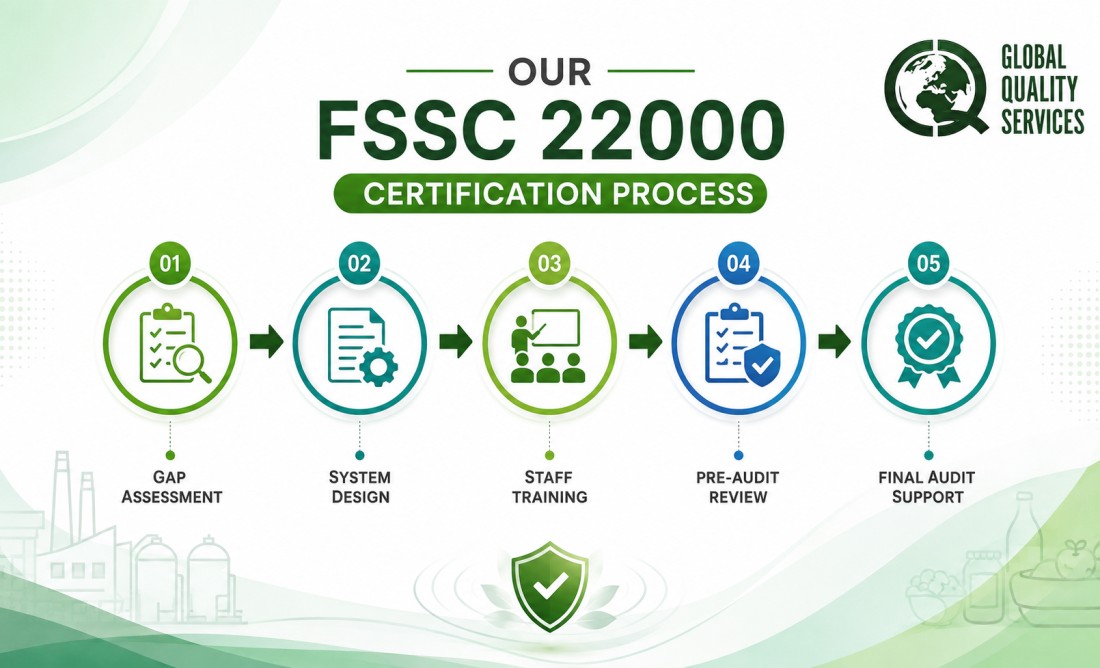
- Gap Assessment: Our team reviews your plant layout, hygiene protocols, and paperwork to identify gaps against the FSSC standard.
- System Design: We create customized SOPs, HACCP plans, food defense procedures, and allergen control steps fitted to your exact plant layout.
- Staff Training: We train your supervisors, plant engineers, and floor workers on daily record-keeping, hygiene control, and monitoring practices.
- Pre-Audit Review: We conduct a full mock audit to close operational gaps before external auditors inspect your facility.
- Final Audit Support: We assist your team through Stage 1 and Stage 2 audits conducted by accredited certification bodies until final approval.
Documents Required for FSSC 22000 Certification
Organizing these core records early makes the evaluation process smooth and efficient:
- Food Safety Manual: Scope definitions, management responsibilities, and statements of plant commitment.
- HACCP Study and Hazard Analysis Plans: Process flow diagrams, hazard tables, Critical Control Points (CCPs), and verification schedules.
- Prerequisite Program Records: Logs for water safety testing, pest control inspections, equipment maintenance, and personnel health checks.
- Threat and Vulnerability Plans: Documented assessments covering Food Defense and Food Fraud prevention strategies.
- Operational SOPs: Written procedures for handling recalls, managing allergens, approving raw material vendors, and environmental sampling.
Secure Your FSSC 22000 Certification and Scale Your Business Today
An audited food safety system gives your business a clear edge, protects your market reputation, and opens doors to global contracts.
- Get complete hands-on support from initial gap check to final certificate delivery.
- Receive custom compliance frameworks tailored to your product lines and facility size.
- Eliminate audit stress with clear timelines and practical floor-level preparation.
Ready to prepare your factory for international certification? Contact our lead consultants at Global Quality Services to schedule your plant assessment and receive a detailed project proposal.
Migration or FSSC 22000 from Version 6 to Version 7
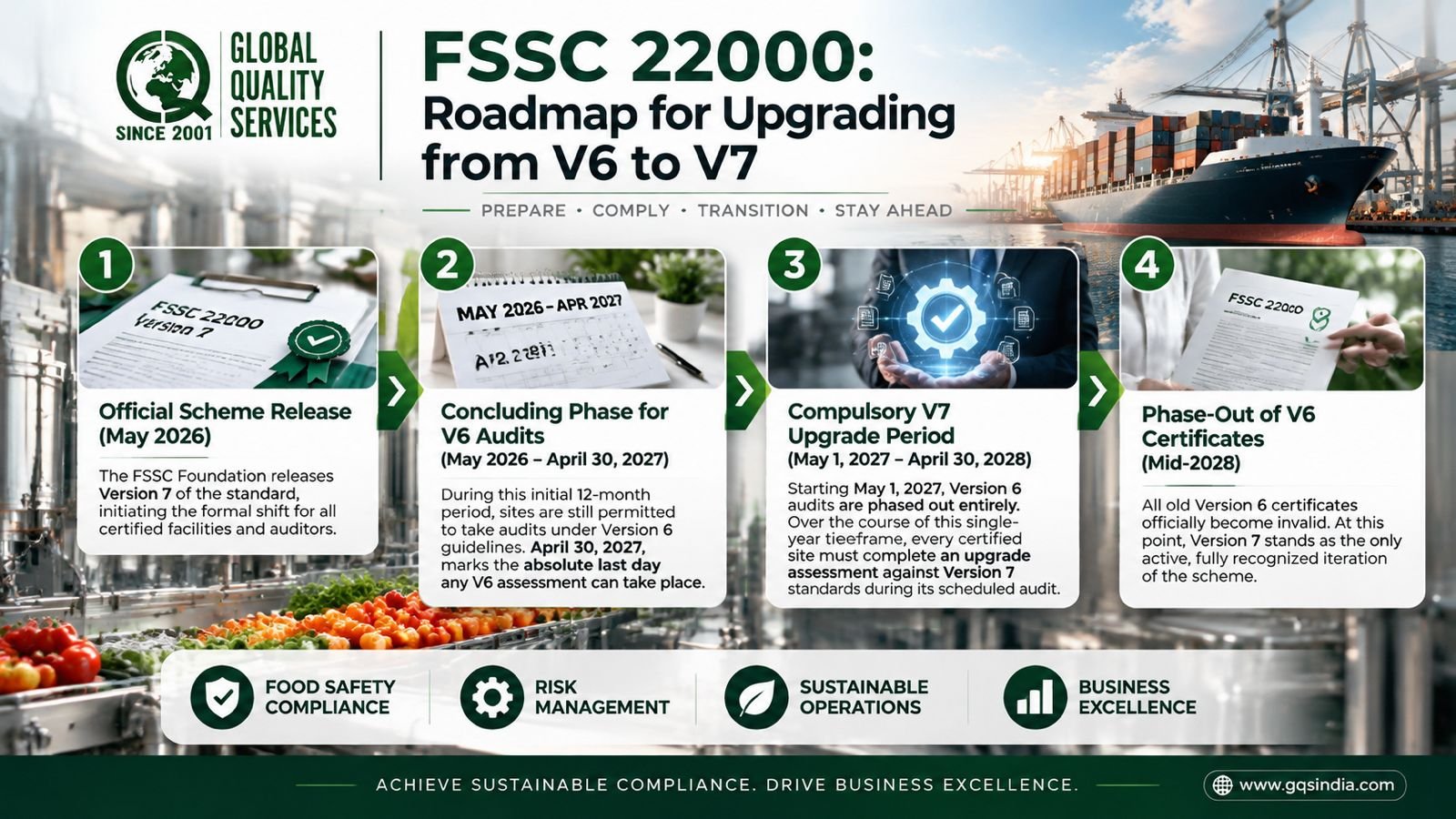
FSSC 22000 Version 7 was officially released on May 1 2026. Food manufacturers, processors, packaging producers and other certified organizations must prepare their food safety management systems for the updated scheme within the prescribed transition period.
Global Quality Services provides transition, migration, and upgrade support for organizations moving from FSSC 22000 Version 6 to Version 7. Our services focus on identifying gaps in existing systems, updating relevant documentation, reviewing prerequisite programs (PRPs), and preparing teams for the Version 7 upgrade audit.
What Has Changed in FSSC 22000 Version 7?
The latest version updates the scheme’s technical framework and aligns it with international food safety requirements.
- Updated prerequisite programs: Version 7 incorporates the ISO 22002-x:2025 series, including ISO 22002-100:2025 for common PRP requirements and the applicable sector-specific standards.
- Alignment with GFSI requirements: The scheme has been updated to align with the Global Food Safety Initiative (GFSI) Benchmarking Requirements Version 2024.
- Food loss and waste reduction: Version 7 includes Save Food Packaging design principles for organizations involved in packaging design, strengthening the scheme’s contribution to sustainability goals.
- Clearer food chain categories: The revised structure provides a more defined division of food chain categories and subcategories.
- Updated auditor competency requirements: Auditor qualification and competency requirements have been revised to reflect the updated scheme and applicable sector-specific standards.
Organizations should review the official Version 7 scheme documents to determine which changes apply to their certification scope and operations.
FSSC 22000 Version 6 to Version 7 Transition Timeline
Version 7 adopts the updated ISO 22002-x:2025 series for prerequisite programs, with a common foundation and additional requirements for specific industry sectors. The structure below shows how the standards are organized.
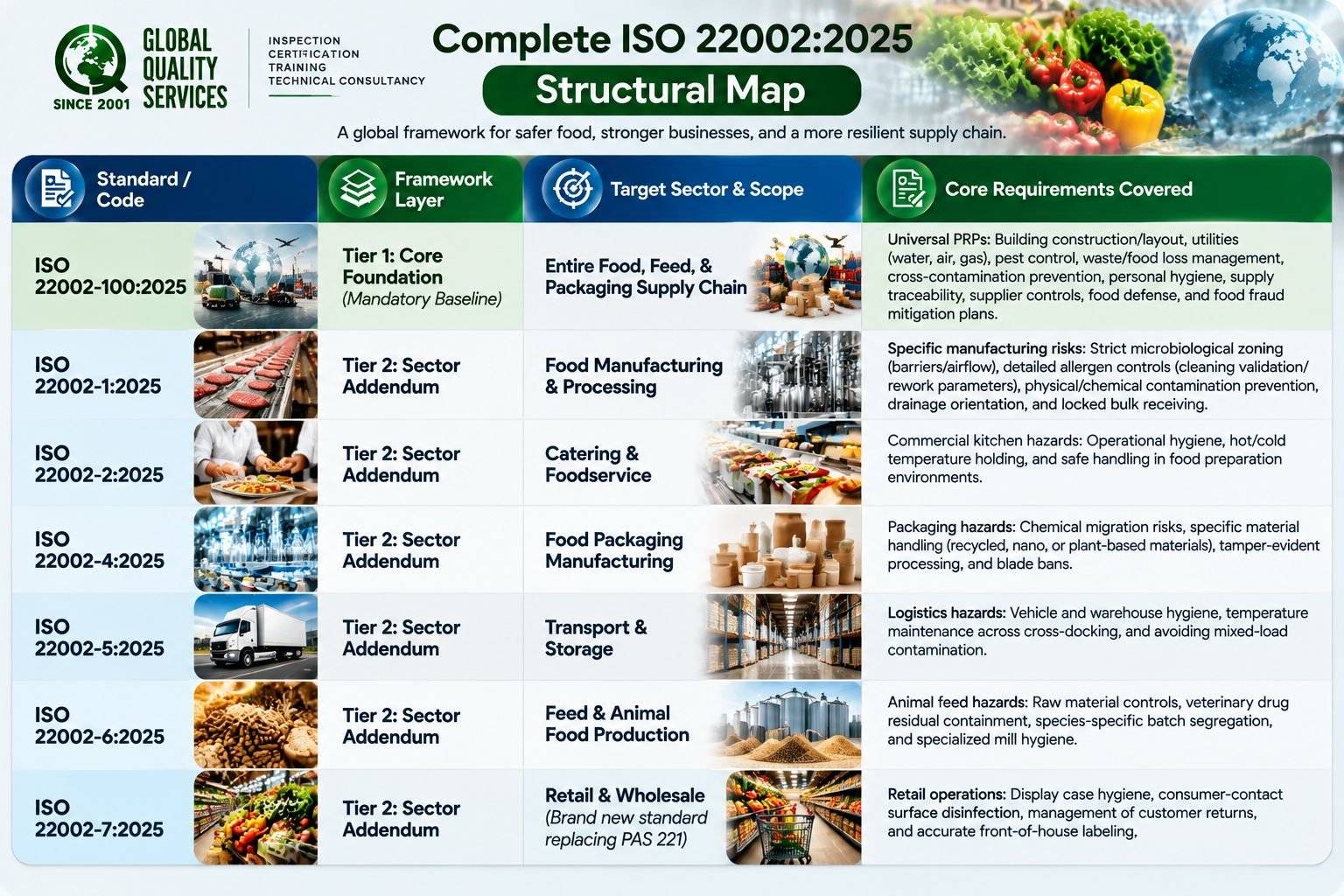
1. ISO 22002-100:2025 – Prerequisite Programs for Food Safety
Establishes the foundational hygiene and food safety requirements applicable across the food, feed, and packaging supply chains. It covers facility design, sanitation, pest control, personal hygiene, traceability, and contamination prevention.
2. ISO 22002-1:2025 – Food Manufacturing and Processing
Defines prerequisite programs for food manufacturing facilities to maintain hygienic production conditions. It addresses microbiological zoning, allergen management, contamination prevention, cleaning, and safe material handling.
3. ISO 22002-2:2025 – Catering and Foodservice
Specifies food safety and hygiene requirements for catering operations, commercial kitchens, and foodservice establishments. It covers safe food preparation, temperature control, operational hygiene, and cross-contamination prevention.
4. ISO 22002-4:2025 – Food Packaging Manufacturing
Establishes hygiene and safety requirements for facilities manufacturing food packaging materials. It addresses packaging contamination risks, material handling, chemical migration, and processes designed to protect food-contact packaging.
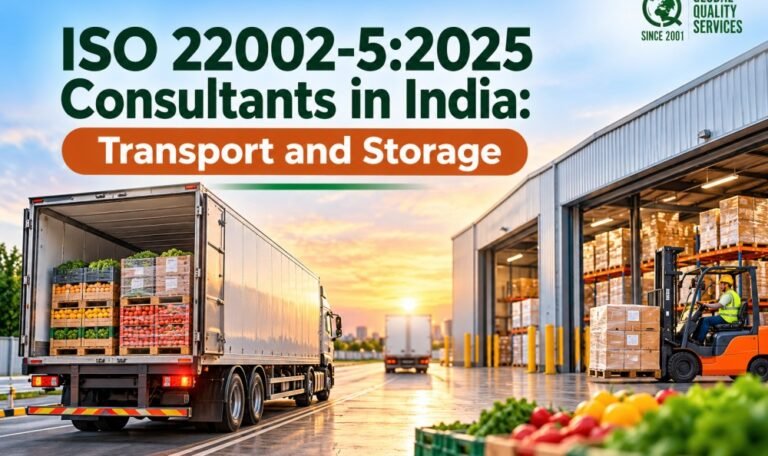
5. ISO 22002-5:2025 – Transport and Storage
Defines prerequisite programs to maintain food safety during transport and storage. It covers vehicle and warehouse hygiene, temperature control, cross-contamination prevention, and safe handling during loading and unloading.
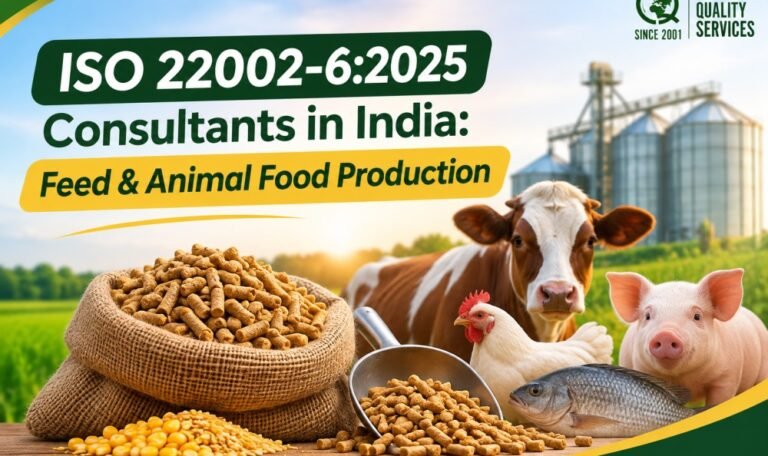
6. ISO 22002-6:2025 – Feed and Animal Food Production
Establishes hygiene and safety requirements for facilities producing animal feed. It addresses raw material control, contamination prevention, batch segregation, and hygienic manufacturing practices.
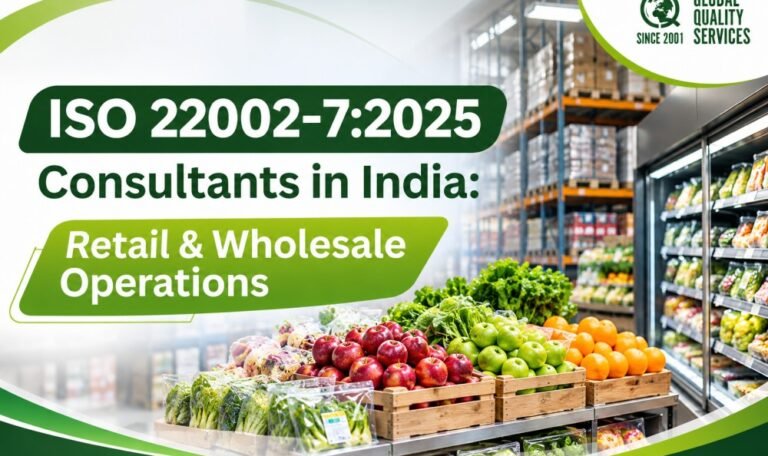
7. ISO 22002-7:2025 – Retail and Wholesale
Specifies food safety and hygiene requirements for retail and wholesale operations involving food products. It covers display-area hygiene, cleaning and disinfection, product handling, customer returns, and accurate food labeling.
The FSSC 22000 Version 6 to Version 7 transition timeline outlines the key dates for organisations to upgrade their food safety management systems to the latest scheme requirements. Version 7 was published on 1 May 2026, with Version 6 audits permitted until 30 April 2027. The mandatory upgrade audit period runs from 1 May 2027 to 30 April 2028, and all remaining Version 6 certificates are scheduled for withdrawal after 30 June 2028. Organisations should plan their transition early to meet the updated requirements and maintain certification.
With more than two decades of experience in management system consulting, Global Quality Services (GQS) supports organisations transitioning from FSSC 22000 Version 6 to Version 7 through gap assessments, documentation reviews and identification of updated scheme requirements. We help businesses develop a practical migration plan, address compliance gaps and prepare their food safety management systems for the Version 7 upgrade audit. Our experience enables us to provide structured, practical support tailored to each organisation’s existing system and certification requirements.
FSSC 22000 Certification Consultants
FSSC 22000 Certification in Delhi | FSSC 22000 Certification in Bengaluru
FSSC 22000 Certification in Noida | FSSC 22000 Certification in Hyderabad
FSSC 22000 Certification in Ahmedabad | FSSC 22000 Certification in Chennai
FSSC 22000 Certification in Pune | FSSC 22000 Certification in Mumbai
How Does Global Quality Services Support FSSC 22000 Certification Across India
Navigating complex compliance frameworks needs direct plant experience. Global Quality Services delivers simple, practical solutions that transform rigid international rules into manageable daily plant routines.
- Certified Lead Auditors: Our team brings decades of sector experience to guide your plant through complex technical audit checks.
- Complete Project Support: We manage the process end to end, including layout reviews, document creation, staff training, and audit coordination.
- Plain Language Guidance: We avoid confusing technical jargon and give your plant teams clear, actionable work instructions.
- Fast Implementation: Our structured planning shortens certification timelines while keeping your operations compliant.
GQS consultant is a Singapore Certified Management Consultant SCMC by TÜV SÜD and a PCQI Certificate holder 9c9fxxxx who is the right person to validate your Food safety plan and guide your company to sign off the documents required for submission to your customer seeking US FDA approval. GQS has extensive experience in implementing the FSMA requirements for food ingredients that go to the US market for further processing
Frequently Asked Questions
1. What is the validity period of an FSSC 22000 certificate?
An FSSC 22000 certificate remains valid for three years from the date of issuance. To maintain validity, your factory must pass annual surveillance audits in years one and two, followed by a full recertification audit in year three.
2. Can small and medium food processors in India get FSSC 22000 certified?
Yes, small and medium enterprises can get certified. The standard applies to operations of all sizes and scales its requirements based on your facility size, product risk level, and manufacturing complexity.
3. What is the difference between an announced audit and an unannounced audit?
Announced audits are scheduled in advance with your certification body. Unannounced audits happen without prior warning during normal working hours. FSSC rules require at least one unannounced audit during every three-year certification cycle.
4. How does FSSC 22000 help control food fraud and food defense risks?
FSSC 22000 requires your site to conduct vulnerability and threat assessments. You must maintain a Food Defense Plan to stop intentional contamination, along with a Food Fraud Plan to prevent economically motivated ingredient substitution or mislabeling.
5. Is an FSSAI license enough to start the FSSC 22000 certification process?
Yes, holding a valid FSSAI license shows basic legal compliance in India. FSSC 22000 builds on those basic regulatory requirements by adding international technical standards and additional safety controls needed for global commercial trade.
6. Which version of FSSC 22000 must food businesses currently comply with?
As of April 1, 2024, compliance with Version 6 is mandatory. Every initial April 1cation, renewal, and surveillance audit carried out after this date is evaluated against the updated Version 6 standard.
7. What is PCQI?
A Preventive Controls Qualified Individual (PCQI) is a trained expert responsible for creating and managing a facility’s FDA-compliant food safety plan under US FSMA regulations.
8. What is CFR?
CFR stands for Code of Federal Regulations—the official set of US government rules. Food safety standards are found in 21 CFR Part 117.
9. What is the Role of a PCQI?
A PCQI drafts food safety plans, conducts hazard analyses, validates preventive controls, reviews safety records, and performs mandatory periodic system re-evaluations.