Food safety across India is transforming at an unprecedented pace. Driven by government backing through the Production Linked Incentive (PLI) Scheme for Food Processing, which has generated over ₹9,207 crore in cumulative investment and disbursed more than ₹3,271 crore in incentives, food processing capacity in the country has expanded rapidly. At the same time, exports managed by APEDA and MoFPI continue reaching new international benchmarks, making strict food safety compliance essential for growth.
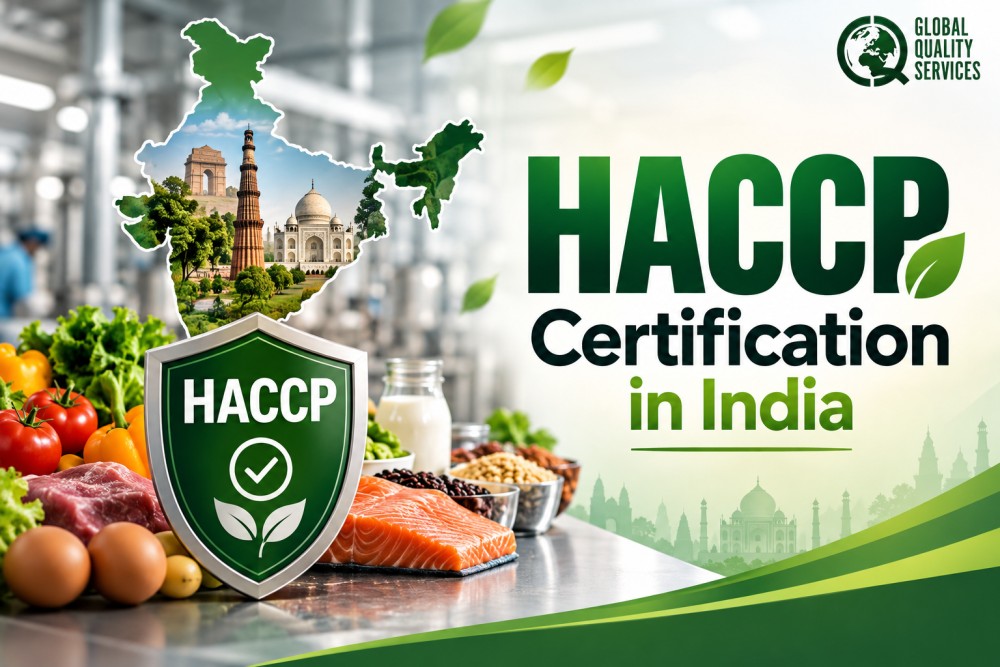
Whether you operate a processing plant, a cloud kitchen chain, or a cold storage facility, earning a HACCP certification in India guarantees that your operations meet strict global safety metrics while remaining compliant with national food safety authorities.
Why HACCP Certification Matters for Indian Food Businesses
Building a reputable food brand in India requires a steady focus on consumer trust, supply chain stability, and regulatory compliance. The Hazard Analysis and Critical Control Points (HACCP) system provides a preventive operational framework that protects your business from costly product recalls and operational downtime.
- Streamlined Regulatory Audits: HACCP alignment simplifies state and central inspection processes under Indian food safety regulations.
- Minimized Operational Risk: A preventive system helps catch biological, chemical, and physical hazards before products ever leave your processing facility.
- Access to Premium Retailing: Major supermarket chains, institutional buyers, and quick-service restaurant (QSR) brands require their vendors to maintain certified food safety protocols.
- Stronger Consumer Trust: Displaying certified safety credentials gives domestic buyers confidence in the hygiene and safety of your products.
Who Needs HACCP Certification in India?
Any business involved in the food supply chain benefits from HACCP implementation:
- Primary food manufacturers and secondary processing plants
- Commercial bakeries, dairy processors, and beverage bottlers
- Cloud kitchens, central kitchens, and catering providers
- Cold storage, warehousing, and logistics operators
- Spices, grains, and specialty food exporters
- Packaging material manufacturers for food-contact applications
HACCP Certification Requirements in India
Before inviting an external certification auditor, your facility must establish baseline operational hygiene. HACCP cannot function effectively without a solid foundation of prerequisite safety programs.
- Prerequisite Programs (PRPs): You must actively run Good Manufacturing Practices through GMP Certification and Sanitation Standard Operating Procedures within your facility to build a compliant hygiene baseline.
- Infrastructure Readiness: Proper plant layout, smooth workflow separation (raw vs. cooked areas), cleanable surfaces, pest control, and dedicated waste management systems.
- Calibrated Equipment: All thermal processing units, chillers, metal detectors, and weighing balances must have current calibration reports.
- Staff Hygiene and Training: Mandatory health checkups for food handlers, along with documented training logs on personal hygiene and cross-contamination control.
HACCP Certification Process in India
Getting certified involves a clear, 5-step journey that transitions your facility from routine operations to an internationally verified system.
- Gap Analysis & PRP Setup: Review your existing infrastructure, equipment, and sanitation processes to identify missing hygiene protocols and operational gaps.
- HACCP Plan Development: Form an internal team, map out precise process flow diagrams, conduct a hazard analysis, and establish your critical control parameters.
- Implementation & Record Generation: Run the HACCP plan live in your facility for several weeks to generate daily logs, temperature charts, and deviation reports.
- Stage 1 & Stage 2 External Audits: Undergo a documentation review (Stage 1) followed by an on-site physical inspection (Stage 2) by an accredited certification body auditor.
- Certification Issuance & Surveillance: Resolve any non-conformances identified during the audit to receive your 3-year certificate, maintained via annual surveillance reviews.
The 7 Principles of the HACCP Concept
Every HACCP system relies on seven internationally recognized core principles established by the Codex Alimentarius Commission:
- Conduct a Hazard Analysis: Map out every processing step to pinpoint potential biological, chemical, or physical hazards.
- Determine Critical Control Points (CCPs): Locate the exact points in production where a control measure can be applied to eliminate or reduce a hazard to safe levels.
- Establish Critical Limits: Define maximum or minimum biological, chemical, or physical parameters (such as cook temperature or storage pH) that must be met at each CCP.
- Establish Monitoring Procedures: Create regular measurement tasks and schedules to track every CCP continuously or in routine batches.
- Establish Corrective Actions: Write out step-by-step protocols for isolating and handling products whenever a critical limit is breached.
- Establish Verification Procedures: Schedule routine internal audits, lab testing, and instrument calibration to prove that your HACCP plan functions as intended.
- Establish Record-Keeping Procedures: Maintain organized documentation covering your hazard analysis, CCP monitoring logs, staff training, and corrective action histories.
HACCP Certification and FSSAI Requirements in India
The Food Safety and Standards Authority of India (FSSAI) enforces the Food Safety and Standards Regulations across all states. While an FSSAI license is the mandatory legal permit required to manufacture or sell food in India, HACCP is the operational management framework that keeps your facility compliant with FSSAI Schedule 4 hygiene guidelines. Many facilities also integrate ISO 9001 certification alongside FSSAI protocols to maintain consistent quality management across operational teams.
A well-implemented HACCP system gives your business the exact documentation, trace-back records, and sanitary controls needed to clear routine FSSAI officer inspections and third-party food safety audits without penalties or operational closures.
HACCP Certification for Food Exporters in India
Indian food exporters face strict import checks from foreign agencies such as the US FDA, European Food Safety Authority (EFSA), and Gulf Health Council. Earning a HACCP certification serves as your baseline entry ticket into these international markets.
- Faster Customs Clearance: Cargo backed by accredited HACCP documentation experiences fewer port rejections and detention delays.
- Global Market Alignment: Overseas importers prefer suppliers whose processing facilities match international Codex standards.
- Export Board Mandates: Agencies like the Agricultural and Processed Food Products Export Development Authority (APEDA) and the Spices Board favor certified facilities for high-value export quotas.
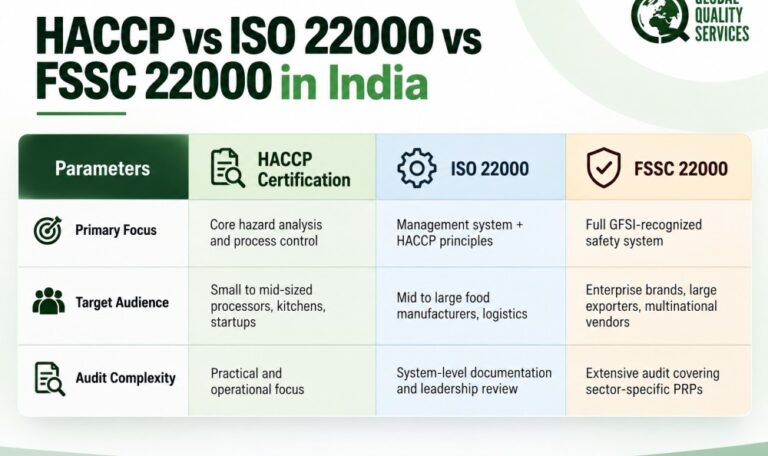
HACCP vs ISO 22000 vs FSSC 22000 in India
Understanding the differences between key food safety standards helps you select the right certification pathway for your business size and client expectations.
HACCP Certification Cost in India
HACCP certification pricing in India depends entirely on your specific facility footprint and operational scope. Key factors that determine your overall investment include the size of your facility, the number of active production lines, your total employee headcount across shifts, and the current maturity of your prerequisite hygiene programs.
Facilities with multiple product categories or complex supply chains require a broader audit scope, whereas single-category operations require less time on-site during the assessment phase.
Documents Required for HACCP Certification in India
- Business registration certificate and FSSAI license copy
- Factory layout diagram showing raw material and finished goods movement
- Production process flowcharts verified on-site
- Comprehensive Hazard Analysis and CCP determination sheets
- Equipment calibration certificates and maintenance logs
- Water testing reports from an NABL-accredited laboratory
- Employee health checkup cards and pest control service contracts
- Standard Operating Procedures (SOPs) and daily monitoring logs
How Does Global Quality Services Support HACCP Certification Across India
Navigating certification requirements while keeping daily production running smoothly requires dedicated expertise. Global Quality Services delivers practical, end-to-end consulting and implementation support tailored to Indian food processing environments.
- On-Site Gap Assessments: Experienced food safety professionals evaluate your facility infrastructure and highlight non-conformances before external auditors arrive.
- Customized HACCP Documentation: We build clear, usable manuals, flowcharts, and monitoring logs tailored to your exact production methods rather than providing generic templates.
- Hands-On Staff Training: We conduct practical, bilingual training sessions for your line operator teams and hygiene managers so everyone understands their daily compliance role.
- Audit Defense and Closure Support: Our consultants guide your team through the final Stage 1 and Stage 2 certification audits, helping you address any auditor findings quickly.
Partner with Global Quality Services for Fast-Track HACCP Certification in India
Securing your HACCP certification does not have to slow down your manufacturing operations. When you partner with Global Quality Services, you gain a dedicated technical consultant who simplifies compliance, structures your documentation, and prepares your facility for a successful audit from day one.
- Turnkey Support: Complete guidance from initial site layout review to final certificate issuance.
- Proven Track Record: Decades of hands-on compliance consulting across Indian manufacturing, export, and hospitality sectors.
- Practical Systems: We design simple, easy-to-maintain recording logs that your staff can use without operational friction.
Ready to elevate your food safety standards and unlock new business opportunities? Contact our expert team at Global Quality Services today to discuss your project requirements and receive a customized certification roadmap.
Frequently Asked Questions
1. How long does it take to complete HACCP certification for a plant in India?
Most food processing facilities in India complete the implementation and audit process within 3 to 6 weeks. The exact timeline depends on your facility readiness, how quickly prerequisite programs are established, and the time needed to generate mandatory monitoring logs.
2. Is HACCP certification mandatory for all small food businesses in India?
HACCP certification itself is not legally mandatory for small domestic food businesses, but compliance with basic FSSAI hygiene guidelines is required. However, many commercial buyers, supermarket chains, and food delivery aggregators demand HACCP certification as a vendor onboarding condition.
3. What is the validity period of a HACCP certificate in India?
A standard HACCP certificate is valid for three years from the date of issue. To maintain validity, your facility must undergo an annual surveillance audit at the end of Year 1 and Year 2 to verify ongoing compliance.4
4. Can an Indian cloud kitchen or catering unit get HACCP certified?
Yes. Central kitchens, cloud kitchens, and industrial caterers can easily achieve HACCP certification. The focus remains on controlling cross-contamination, maintaining hot and cold holding temperatures, and managing ingredient receiving checks.
5. What happens if an auditor finds a non-conformance during the certification audit?
If the auditor identifies a non-conformance, they will issue a formal finding report detailing the gap. Your business is given a specific timeframe (usually 15 to 30 days) to implement corrective actions and submit evidence to close the finding before the certificate is granted.