ISO/IEC 17024 Certification in India provides a framework for organizations that certify individual professionals’ competence. The standard applies to personnel certification bodies, rather than organizations seeking certification of their own management systems.
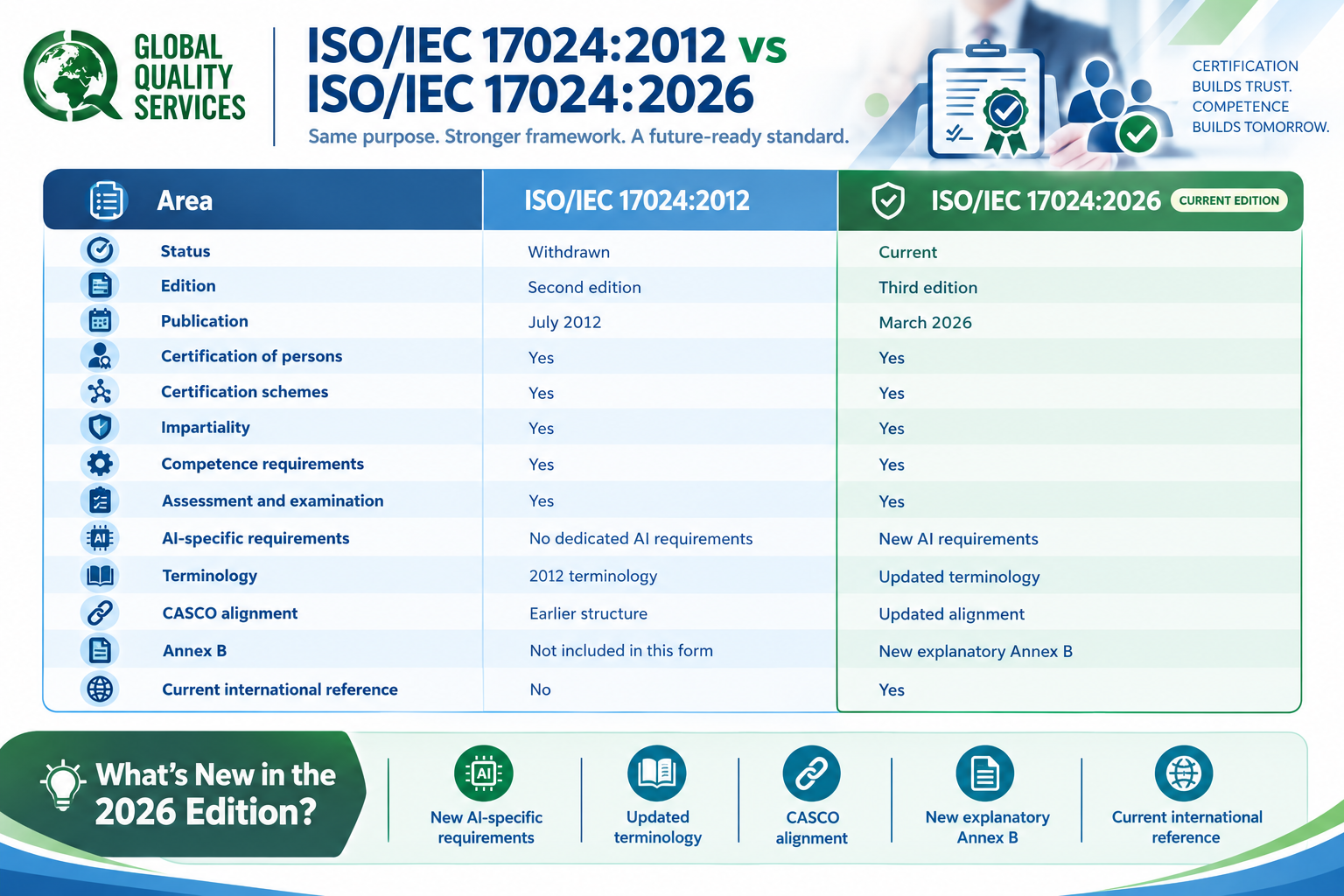
The latest edition is ISO/IEC 17024:2026, published in March 2026. It replaces ISO/IEC 17024:2012 and introduces updated requirements for certification of persons, including specific considerations for the use of artificial intelligence in certification processes.
In India, organizations establishing or operating personnel certification schemes should also consider the relevant accreditation framework and the applicable requirements of the National Accreditation Board for Certification Bodies (NABCB).
What Is ISO/IEC 17024 Certification?
ISO/IEC 17024:2026, titled Conformity assessment – General requirements for bodies operating certification of persons, establishes requirements for bodies that certify individuals against defined competence requirements.
The purpose is to ensure that personnel certification is carried out in a consistent, impartial, reliable and credible manner.
The standard addresses the certification body’s operations, certification schemes, assessment processes, personnel competence, impartiality, confidentiality, complaints, appeals, information security, and other activities involved in certifying persons.
It is specifically relevant to bodies that determine whether individuals meet defined competence requirements and issue personnel certificates within established certification schemes.
Latest Update: ISO/IEC 17024:2026
The most important development for organizations working with ISO/IEC 17024 in India is the publication of the 2026 edition. ISO/IEC 17024:2026 was published on 31 March 2026 as Edition 3. It cancels and replaces ISO/IEC 17024:2012.
New Requirements for Artificial Intelligence
The 2026 edition introduces requirements relating to the use of AI in certification processes. This is particularly relevant where AI-based tools are used for activities such as assessment, examination, evaluation, or other certification-related processes. Certification bodies are expected to consider the reliability and appropriate use of AI-generated outcomes and maintain suitable human oversight.
Updated Terminology
The standard updates and revises terminology and definitions used within personnel certification. This helps provide greater consistency between ISO/IEC 17024 and other conformity-assessment standards.
Alignment With CASCO Requirements
The revised standard aligns with common elements used in standards developed by the ISO Committee on Conformity Assessment (CASCO). This supports greater consistency across the international conformity-assessment framework.
New Annex B
ISO/IEC 17024:2026 includes a new Annex B that explains how key elements such as certification activities, processes, assessments, applications, examinations, and certification schemes fit together. This is intended to make the standard’s structure easier to understand and apply.
ISO/IEC 17024:2012 vs ISO/IEC 17024:2026
ISO/IEC 17024 in India: Current Accreditation Position
NABCB, operating under the Quality Council of India, accredits personnel certification bodies.
NABCB’s current public personnel-certification pages still list accreditation against ISO/IEC 17024:2012, and its published scheme documents include accreditation criteria and forms referencing the 2012 edition.
This creates an important distinction for Indian organizations.
ISO/IEC 17024:2026 is now the latest international standard, but organizations should check NABCB’s applicable transition requirements and accreditation arrangements before claiming accreditation to the 2026 edition in India.
GQS can help organizations monitor the applicable transition requirements and prepare their certification processes for the new edition without making premature claims about accreditation status.
Who Needs ISO/IEC 17024 Certification?
ISO/IEC 17024 is relevant to organizations that certify people against defined competence requirements.
Personnel Certification Bodies
Organizations that independently evaluate and certify professionals can establish their certification processes against ISO/IEC 17024.
Professional Certification Organizations
Bodies offering professional credentials in areas such as project management, auditing, safety, information technology, quality, or specialist technical fields can consider the standard.
Industry Certification Bodies
Industry organizations may establish personnel certification schemes for defined occupations or technical competencies.
Technical Certification Organizations
Bodies that certify individuals in engineering, inspection, testing, welding, non-destructive testing, and other technical disciplines may use personnel certification frameworks.
Training and Professional Development Organizations
Training organizations that also run independent personnel certification schemes should clearly separate training from certification and establish appropriate impartiality controls.
Sector-Specific Certification Bodies
Organizations developing certification schemes for specialized professions can use ISO/IEC 17024 as the framework for their certification operations.
What Does ISO/IEC 17024:2026 Cover?
The standard addresses the key elements required for credible certification of persons.
Certification Scheme
A certification body needs an appropriate certification scheme that defines what competence is being certified and how it will be evaluated. The scheme establishes requirements such as competence criteria, assessment methods, certification requirements and, where applicable, recertification requirements.
Impartiality
Certification decisions need to be made impartially. The certification body must identify and manage risks to impartiality arising from its activities, relationships and other sources.
Confidentiality
Information obtained during certification activities needs to be protected appropriately. This is particularly important for examination materials, candidate information, assessment results and certification decisions.
Competence of Personnel
Personnel involved in certification activities need appropriate competence for their assigned responsibilities. This can include examiners, assessors, decision-makers, and other personnel involved in certification processes.
Assessment
The certification body establishes appropriate assessment methods for determining whether candidates meet defined competence requirements. Assessment methods may vary by certification scheme and professional discipline.
Examination Security
Where examinations are used, the certification body needs appropriate controls to protect examination integrity. This becomes particularly important for remote and technology-enabled examinations.
Certification Decision
Certification decisions must be based on sufficient objective evidence that the candidate meets the defined requirements. The person who makes the certification decision should operate under the required impartiality and competence arrangements.
Complaints and Appeals
Candidates and other relevant parties need access to appropriate processes for submitting complaints or appeals relating to certification activities.
Recertification
Where a certification scheme requires ongoing competence, the certification body needs defined arrangements to maintain or renew certification.
Use of Certification and Marks
The certification body needs controls governing how certified persons can represent their certification and how certification marks or references are used.
ISO/IEC 17024:2026 and Artificial Intelligence
AI is one of the most significant new areas in the 2026 edition.
Certification bodies increasingly use digital platforms, automated assessment technologies, and AI-supported tools. ISO/IEC 17024:2026 recognizes this changing environment and introduces specific requirements concerning AI.
A certification body using AI should consider issues such as:
- Reliability of AI-generated assessment outputs
- Human oversight
- Competence of personnel using AI
- Validation of AI-supported processes
- Fairness and consistency
- Security and confidentiality
- Protection of candidate information
- Monitoring of AI performance
- Appropriate controls over AI-generated decisions or outputs
AI should not be introduced merely because it speeds up an assessment process. The certification body must demonstrate that the technology does not compromise the validity, reliability, impartiality, or security of certification.
ISO/IEC 17024 and Online Examinations
Remote and online examinations are increasingly important for personnel certification. Organizations operating online assessment systems should establish appropriate controls for candidate identification, examination security, confidentiality, monitoring and prevention of unauthorized assistance.
Technology should support the integrity of the certification process, not weaken it. Where AI-based proctoring or assessment tools are used, the requirements introduced in ISO/IEC 17024:2026 become particularly relevant.
ISO/IEC 17024 Certification Scheme Development
A credible personnel certification system begins with a clearly defined certification scheme.
Define the Profession or Competence Area
The certification body identifies the occupation, professional role, or technical competence for which it will offer certification.
Define Competence Requirements
The knowledge, skills and abilities required for competent performance are established.
Establish Eligibility Requirements
The scheme defines applicable education, training, experience or other eligibility requirements.
Define Assessment Methods
Establish appropriate methods to evaluate whether candidates meet the competence requirements.
Establish Examination Requirements
Where an examination is required, the certification body defines the examination structure, content, scoring, and security controls.
Define Certification Decision Rules: Establish clear criteria for making certification decisions based on objective evidence.
Establish Recertification Requirements
Where continuing competence is required, the scheme establishes appropriate recertification or renewal arrangements.
ISO/IEC 17024 Certification Process in India
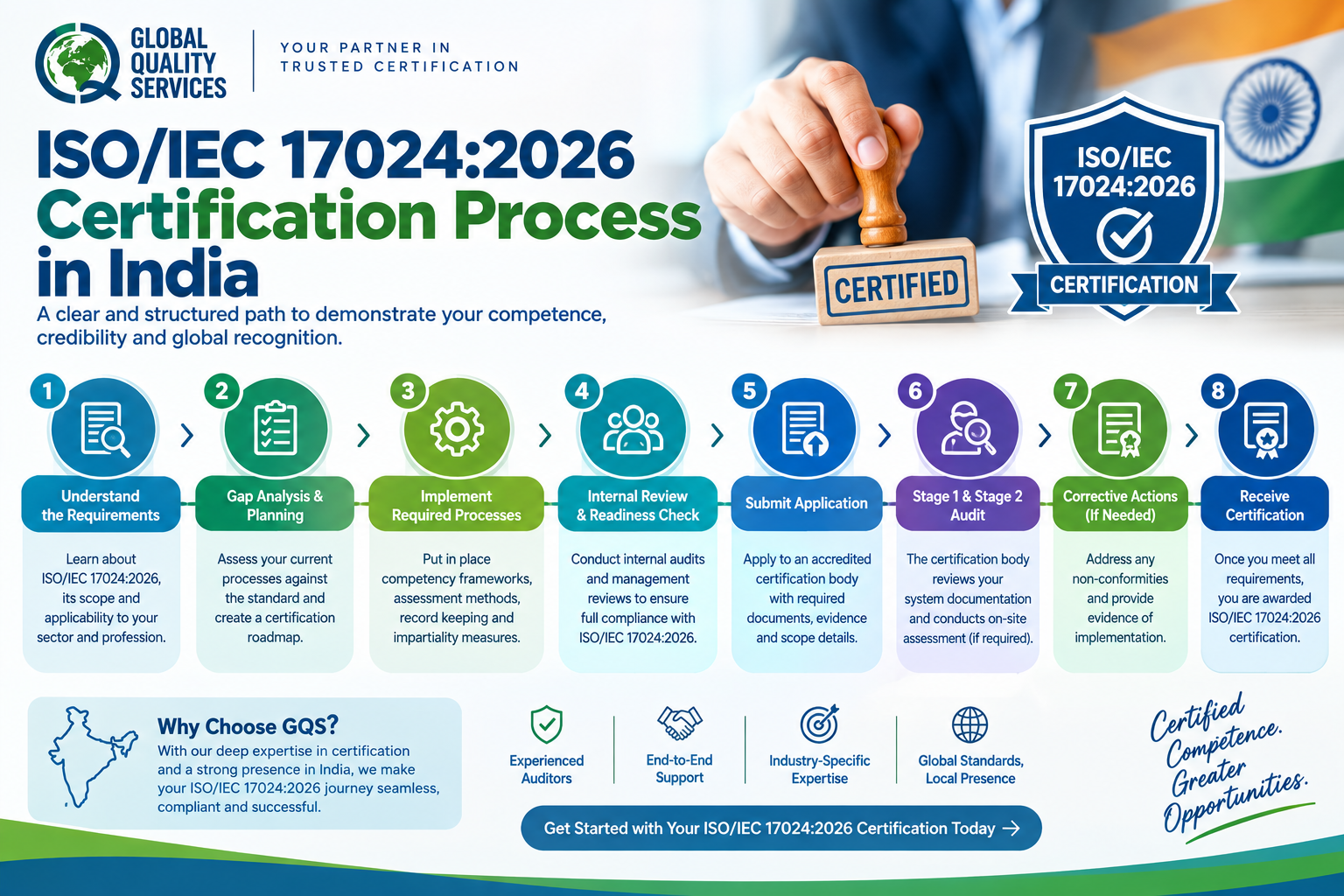
The certification process for a personnel certification body should be systematic and evidence-based.
Step 1: Define the Certification Scope
The organization identifies the professional categories and competence areas for which it intends to operate certification schemes.
Step 2: Review ISO/IEC 17024 Requirements
The organization evaluates its existing certification arrangements against the applicable requirements of ISO/IEC 17024. For new projects in 2026, the organization should consider the latest ISO/IEC 17024:2026, along with the applicable accreditation requirements.
Step 3: Develop the Certification Scheme
The organization defines competence requirements, eligibility criteria, assessment methods, examination requirements, and certification rules.
Step 4: Establish Governance and Impartiality Controls.
The organization establishes responsibilities, decision-making authority, and mechanisms for identifying and managing impartiality risks.
Step 5: Develop Certification Procedures
Documented processes are established for application, assessment, examination, certification decisions, complaints, appeals, suspension, withdrawal and recertification where applicable.
Step 6: Establish Competence Requirements
The organization establishes competence requirements for examiners, assessors, decision-makers, and other certification personnel.
Step 7: Implement Assessment and Examination Controls
The organization establishes secure and reliable arrangements for candidate assessment and examination.
Step 8: Implement Information and Security Controls
The organization appropriately protects candidate records, examination materials, certification decisions, and other sensitive information.
Step 9: Conduct Internal Review
The organization evaluates whether its certification system is operating as intended and identifies areas requiring corrective action.
Step 10: Accreditation Assessment
Where accreditation is being pursued, the certification body undergoes assessment by the relevant accreditation body against the applicable accreditation requirements. In India, NABCB is the relevant national accreditation body for its personnel-certification accreditation scheme.
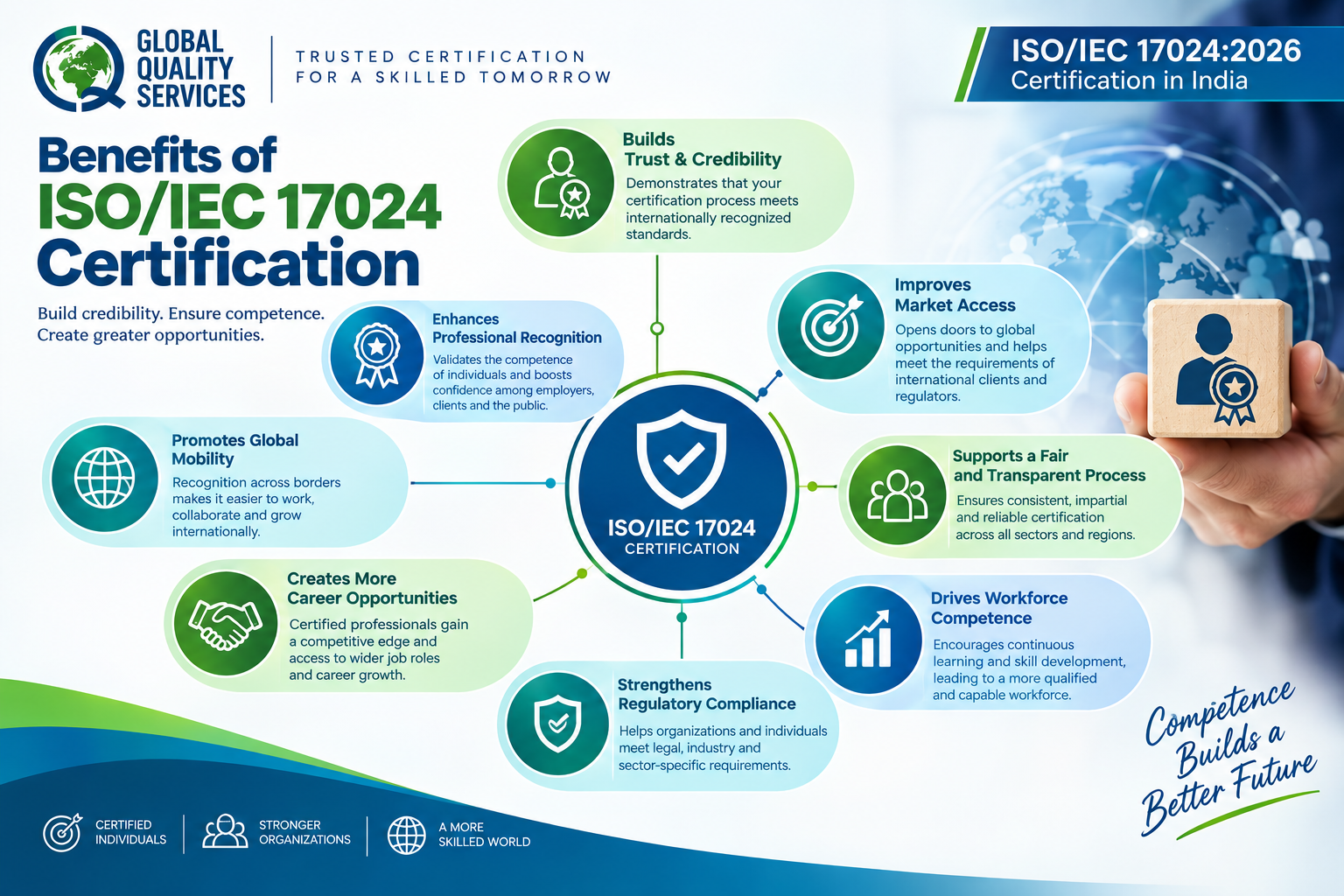
Benefits of ISO/IEC 17024 Certification
Greater Confidence in Professional Competence
ISO/IEC 17024 provides a structured basis for demonstrating that certified persons have met defined competence requirements.
Improved Credibility of Certification Schemes
A well-controlled certification process can increase confidence among employers, professionals, regulators, and other stakeholders.
Stronger Impartiality
The standard requires certification bodies to address risks that could compromise impartiality.
Reliable Assessment
Defined assessment and certification processes help ensure that certification decisions are based on objective evidence.
Better International Recognition
ISO/IEC 17024 is an internationally recognized benchmark for personnel certification and supports greater confidence in certification schemes across countries and sectors.
Support for Workforce Mobility
Credible personnel certification can help demonstrate professional competence across organizations, sectors,s and geographical markets.
Stronger Examination Security
Defined controls can help protect examination content and reduce risks of unfair or unauthorized assistance.
Better Digital Certification Controls
The 2026 edition is particularly relevant to organizations using digital and AI-enabled technologies in certification.
How Can Global Quality Services Help With ISO/IEC 17024 in India?
Global Quality Services can help organizations preparing to establish or strengthen a personnel certification system by reviewing the proposed certification scope, assessing existing processes against applicable ISO/IEC 17024 requirements, supporting certification-scheme development, identifying impartiality risks, reviewing assessment and examination processes, supporting documentation, strengthening competence criteria, evaluating digital and AI-related controls, ls and preparing the organization for the applicable accreditation assessment.
With 26 years of experience, Global Quality Services provides consultancy and certification-readiness support across different conformity-assessment and management-system requirements.
For ISO/IEC 17024 projects, GQS can take a scheme-focused approach rather than treating personnel certification like a conventional management-system certification.
Frequently Asked Questions About ISO/IEC 17024 Certification in India
What is ISO/IEC 17024 certification?
ISO/IEC 17024 is an international conformity-assessment standard that specifies requirements for bodies that certify persons. It focuses on the reliability, impartiality, and consistency of personnel certification processes.
What is the latest version of ISO/IEC 17024?
The latest version is ISO/IEC 17024:2026, Edition 3, published in March 2026. It replaces ISO/IEC 17024:2012.
What are the major changes in ISO/IEC 17024:2026?
The major changes include updated terminology, alignment with common CASCO elements, a new Annex B, and specific requirements addressing the use of artificial intelligence in certification processes.
Is ISO/IEC 17024:2012 still the current standard?
No. ISO/IEC 17024:2012 has been withdrawn internationally and replaced by ISO/IEC 17024:2026.
Does NABCB accredit ISO/IEC 17024 certification bodies in India?
Yes. NABCB operates a personnel-certification accreditation scheme. However, its publicly available 2026 information still references ISO/IEC 17024:2012, so organizations should verify the applicable transition and accreditation requirements before claiming accreditation to the 2026 edition.