Food safety is not limited to food manufacturing. Supermarkets, grocery stores, food distributors, and wholesale warehouses also need proper controls to protect products during receiving, storage, handling, and sale. A poorly maintained display case, incorrect product label, or mishandled customer return can put consumers at risk and affect business reputation. India’s retail and wholesale sector is growing, increasing the need for consistent food safety practices.
According to the Ministry of Statistics and Programme Implementation, India’s unincorporated sector had 7.92 crore establishments in 2025, while the trade sector recorded 16.77% growth in Gross Value Added compared with the previous survey period. This growth makes reliable food handling and storage practices increasingly important.
Global Quality Services provides consultancy for businesses seeking ISO 22002-7:2025 Consultants in India. We help retailers and wholesalers understand the standard, address operational gaps, and establish food safety controls suited to their activities. Read ahead to understand the requirements and how our consultants can support your business.
What Is ISO 22002-7:2025 for Retail and Wholesale Operations
ISO 22002-7:2025 is an international standard that specifies prerequisite program (PRP) requirements for food safety in retail and wholesale operations. Published in July 2025, it applies to businesses involved in the retail stage of the food chain, including supermarkets, wholesalers, food banks, and other relevant organizations, regardless of their size.
The standard addresses everyday practices that help prevent food contamination during storage, handling, display, and distribution. These include premises hygiene, equipment maintenance, cleaning, sanitation, pest control, employee hygiene, and product handling.
ISO 22002-7:2025 does not replace ISO 22000:2018. It provides sector-specific prerequisite programs that support the wider food safety management system. Businesses must also consider ISO 22002-100:2025, which establishes common prerequisite program requirements across the food supply chain.
Why Do Retail and Wholesale Businesses in India Need ISO 22002-7:2025?
Food retail and wholesale businesses handle products at several stages before they reach consumers. These activities include checking incoming supplies, storing perishable goods, maintaining display areas, managing returned products, and ensuring correct product information. Implementing ISO 22002-7:2025 helps businesses establish consistent food safety practices and manage these risks more effectively. Key business benefits include:
- Better hygiene and sanitation across stores and warehouses.
- Improved control over chilled and frozen food storage.
- Reduced risk of contamination during food handling.
- Clear procedures for damaged goods and customer returns.
- More accurate product and allergen information.
- Better supplier checks and incoming product inspections
- Improved batch identification and product traceability.
- Clearly defined food safety responsibilities for employees.
- Consistent food safety practices across multiple outlets.
- Greater confidence among customers, suppliers, and business partners.
Key Requirements of ISO 22002-7:2025 for Retail and Wholesale Operations
ISO 22002-7:2025 focuses on food safety controls that suit the activities of retail and wholesale businesses. Organizations must identify the requirements relevant to their products, facilities, and handling practices. The framework combines common prerequisite programs under ISO 22002-100:2025 with additional controls for retail and wholesale operations. Some important areas include:
1. Display Case Hygiene and Maintenance
Refrigerated display cases, freezers, food counters, and storage shelves must remain clean and suitable for food products. Businesses should maintain cleaning schedules, assign responsibilities, and inspect equipment regularly. Temperature checks are also important for protecting chilled and perishable food.
2. Consumer-Contact Surface Disinfection
Counters, weighing equipment, serving utensils, and other surfaces used during food handling require appropriate cleaning and disinfection. Employees should know which cleaning products to use, how to apply them, and how often surfaces need attention. Cleaning chemicals must be handled carefully to prevent food contamination.
3. Management of Customer Returns
Retailers need clear arrangements for handling returned food products. Employees should inspect returned items and separate damaged or potentially unsafe products from saleable stock. Businesses must maintain suitable records and decide whether products can be retained, returned to suppliers, or disposed of safely.
4. Accurate Front-of-House Labeling
Product information displayed to customers must be correct and easy to understand. Businesses should check product names, ingredient details, allergen declarations, date markings, and storage instructions. They must also follow applicable FSSAI requirements, including the Food Safety and Standards (Labelling and Display) Regulations, 2020, and subsequent amendments.
5. Temperature Control and Cold Storage
Businesses handling chilled and frozen food must maintain suitable storage and transportation conditions. Regular temperature checks, equipment maintenance, proper stock arrangement, and corrective action records help protect products from unsafe conditions.
6. Receiving, Stock Rotation, and Traceability
Incoming products should be checked for packaging damage, contamination, labeling accuracy, and storage conditions. Businesses should maintain supplier information, batch details, receiving records, and stock movement records. These arrangements help identify affected products when a food safety issue occurs.
7. Employee Hygiene and Pest Control
Employees handling food must follow appropriate hygiene practices, including handwashing, suitable protective clothing, and illness reporting. Businesses must also maintain pest monitoring, waste disposal, housekeeping, and preventive maintenance arrangements.
Which Businesses Need ISO 22002-7:2025 Consultancy in India
The following businesses can benefit from ISO 22002-7:2025 consultancy:
- Supermarkets and Hypermarkets
- Grocery Stores and Food Retailers
- Food Wholesale Distributors
- Food Importers and Trading Companies
- Fresh Food Markets
- Frozen and Chilled Food Businesses
- Food Banks
- Specialty Food Store
ISO 22002-7:2025 Implementation and Consultancy Process in India
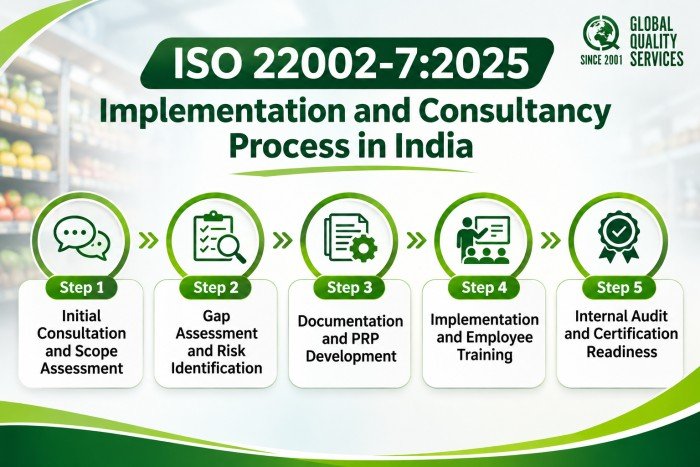
Step 1: Initial Consultation and Scope Assessment
We understand your business activities, food categories, facilities, storage arrangements, and distribution practices to determine the implementation scope.
Step 2: Gap Assessment and Risk Identification
Our consultants review existing food safety practices against the applicable requirements and identify gaps in hygiene, labeling, temperature control, customer returns, and traceability.
Step 3: Documentation and PRP Development
We help prepare or update procedures, cleaning schedules, hygiene instructions, inspection formats, temperature records, and other supporting documents.
Step 4: Implementation and Employee Training
We guide your team in applying the required controls and provide training on food handling, sanitation, product inspections, and record maintenance.
Step 5: Internal Audit and Certification Readiness
We review the implemented system, identify nonconformities, recommend corrective actions, and help prepare your organization for an independent certification assessment.
Related Food Safety Standards and Consultancy Support
Businesses involved in different stages of the food supply chain may need additional food safety requirements depending on their activities.
Organizations involved in food packaging manufacturing can also explore ISO 22002-4:2025 Consultants in India for sector-specific prerequisite program requirements. To learn more about the food safety and pharmaceutical consulting experience of Global Quality Services, visit our Food and Pharma Consultancy page.
How Global Quality Services Helps You with ISO 22002-7:2025 Consultancy in India
Over the years, our team has worked with organizations across different industries, including food and pharmaceutical businesses. Our experience includes work with recognized names such as AstraZeneca, Pepsi, Coca-Cola, Indo Nissin Noodles, Jagdale Group, and Orange County Resorts.
Global Quality Services also has a history of early NABET and NRBPT QCI approval. Our team includes qualified Lead Auditors and technical professionals with experience in food safety and other management system standards. Here are key reasons why you should choose Global Quality Services as your consultant:
- Over 25 years of consultancy and industry experience.
- Early NABET and NRBPT QCI approval history.
- Qualified Lead Auditors and experienced technical professionals.
- Established experience in ISO 22000, FSSC 22000, and HACCP frameworks.
- Experience working with recognized food and pharmaceutical organizations.
- Practical understanding of food retail and wholesale operations.
- Customized documentation based on actual business activities.
- Industry-specific guidance instead of generic documentation.
- Support with internal audits and corrective actions.
- Assistance with certification audit preparation.
- Consultancy for single-location and multi-location businesses.
- Nationwide consulting support across India.
Get Expert ISO 22002-7:2025 Consultancy in India from Global Quality Services
Food safety requirements should protect consumers while allowing your business to operate smoothly. Global Quality Services helps retail and wholesale organizations understand ISO 22002-7:2025, address food safety gaps, and establish controls that suit their operations.
Whether you manage a supermarket chain, grocery business, wholesale warehouse, food distribution company, or specialty food store, our consultants can help you prepare a suitable implementation plan.
We provide consultancy support across India, with a presence in major business centers, including Delhi, Ahmedabad, Noida, Bangalore, Mumbai, Pune, Chennai, and Hyderabad.
Contact Global Quality Services today to discuss your ISO 22002-7:2025 consultancy requirements. Speak with our experienced consultants, understand the requirements applicable to your business, and take the next step toward a stronger food safety management system.
Frequently Asked Questions
1. Is ISO 22002-7:2025 applicable to online grocery and food delivery businesses?
It can apply when an organization performs activities covered by the retail and wholesale scope. Its storage, handling, and distribution activities should be assessed.
2. Can a company implement ISO 22002-7:2025 across multiple retail outlets?
Yes. A common set of food safety procedures can cover multiple outlets, provided each location addresses its own facilities, products, and operational risks.
3. Does ISO 22002-7:2025 require businesses to replace existing refrigeration equipment?
No. Existing equipment can remain in use if it is suitable, properly maintained, and capable of maintaining the required food storage conditions.
4. How should retailers handle food products recalled by suppliers?
Retailers should identify affected batches, stop further sales, separate the products, maintain records, and follow applicable withdrawal or disposal instructions.
5. Is ISO 22002-7:2025 a standalone certification standard?
No. It specifies prerequisite program requirements for retail and wholesale operations. It supports ISO 22000:2018 and is not a replacement for the food safety management system standard.