
The aerospace and defense manufacturing industry in India is currently experiencing exponential growth. According to the Ministry of Defence, India has produced its record-breaking yearly defense output, reaching ₹1.78 lakh crore during FY 2025-26. While this represents immense potential for manufacturers, engineers, and suppliers, it also sets new standards when it comes to quality assurance and process control.
If you manufacture products meant for use in aerospace or defense applications, simply producing a quality item isn’t sufficient anymore. Your customers need assurances about how your item was designed, risk assessment measures taken along the way, and whether your processes ensure repeatable results. This is where AS 9145 comes in, via Advanced Product Quality Planning (APQP) and the Production Part Approval Process (PPAP). Continue reading to find out how AS 9145 impacts your business and how GQS supports compliance preparations.
What is AS 9145
AS 9145 is an aerospace standard that defines requirements for Advanced Product Quality Planning (APQP) and Production Part Approval Process (PPAP).
In simple terms, it gives aerospace and defense organizations a more disciplined way to take a product from an initial requirement to an approved production part.
The standard is built around an important idea: quality should be considered while a product and its manufacturing process are being developed, rather than waiting until something goes wrong during production.
AS 9145 brings together product planning, risk assessment, design activities, manufacturing planning, validation, and production approval. It is particularly useful for organizations dealing with complex products where a design change, manufacturing error, or missed requirement can have serious consequences.
Why is AS 9145 Becoming Important for Indian Businesses
The Indian aerospace manufacturing ecosystem no longer consists solely of a few big firms. Increasingly, private manufacturers, engineering firms, component manufacturers, and specialists find themselves integrated into the global aerospace value chain. That poses new challenges.
A customer within the aerospace industry could demand confirmation that its supplier comprehended its needs prior to manufacturing commencing. Furthermore, the customer could ask for risk assessment documentation, production planning documents, validation findings, and assurance that the manufacturing process is capable of delivering conforming components. In such cases, AS 9145 proves invaluable. The application of APQP and PPAP allows the supplier to:
- Understand customer requirements before development begins
- Identify product and manufacturing risks earlier
- Improve communication between engineering and production teams
- Reduce avoidable changes during manufacturing
- Establish clearer product and process validation records
- Demonstrate production readiness to customers
- Improve control over new or modified products
- Build greater confidence among aerospace and defense buyers
What Does AS 9145 Cover
AS 9145 follows a product development structure based around five APQP phases. Each phase deals with a different part of product and production planning.
Phase 1: Plan and Define the Program
The first step includes reviewing customer specifications, contractual requirements, applicable regulations, product expectations, project objectives, timelines, and responsibilities.
Phase 2: Product Design and Development
Once requirements are established, attention moves toward the product itself. The organization evaluates design requirements, technical characteristics, risks, design reviews, verification activities, and other factors that can influence product performance.
Phase 3: Process Design and Development
A product may look perfect on paper but still be difficult to manufacture consistently. This phase focuses on developing a production process that can reliably produce the required product. Manufacturing methods, equipment, inspection arrangements, process risks, controls, and resources are considered here.
Phase 4: Product and Process Validation
Before regular production begins, the organization needs evidence that both the product and the production process work as intended.
Testing, inspection, process validation, sample production, and other forms of objective evidence may be required depending on the product and customer requirements.
Phase 5: Feedback, Assessment and Corrective Action
The work does not end when the product enters production.
What is APQP under AS 9145
APQP stands for Advanced Product Quality Planning. This term refers to the main planning approach outlined in AS 9145. The concept behind APQP is simple. Organizations should address manufacturing and quality considerations during the product development process rather than dealing with them after introducing the product into manufacturing operations.
For instance, the engineering department might realize that a particular product feature may pose challenges when inspected at a manufacturing stage. The issue can be solved beforehand, avoiding ongoing problems in inspection.
This collaboration makes a significant difference. Engineering, manufacturing, quality control, purchasing, project management, and other departments involved in development can collaborate around common criteria and deadlines.
What is PPAP in AS 9145
PPAP, which stands for Production Part Approval Process, is the name of the procedure through which manufacturers prove their ability to manufacture parts according to certain specifications. There’s flexibility regarding what constitutes sufficient proof since it depends on various factors such as customer demands and product complexity. Some examples include:
- Design records
- Engineering specifications
- Process flow information
- Risk analysis
- Control plans
- Inspection and test results
- Process validation records
- Measurement results
- Production samples
- Material or performance test results
- Customer-specific documentation
- Approval records
AS 9145 Requirements at a Glance
The exact requirements applicable to a business depend on its products, customers, contractual arrangements, and scope. However, organizations implementing AS 9145 generally need to address areas such as:
- Customer Requirements: Customer specifications and other applicable requirements need to be identified, reviewed, understood, and incorporated into product development.
- Product Development Planning: Projects need appropriate planning, responsibilities, resources, milestones, reviews, and controls.
- Risk Management: Potential risks associated with the product and manufacturing process should be identified and addressed during development.
- Design Development: Product design activities should be controlled and reviewed against established requirements.
- Manufacturing Process Development: The organization needs to establish manufacturing processes that can consistently produce the required product.
- Validation: The product and process must be evaluated to establish that requirements can be met before production is fully released.
- Production Part Approval: Relevant evidence needs to be prepared and submitted to demonstrate production readiness and conformity.
- Feedback and Corrective Action: Information from production and customers should be used to correct problems and improve future work.
What Are the Benefits of AS 9145 Compliance
Here’s how AS 9145 brings quality processes upstream. This distinction is important, as quality concerns identified early in product development tend to be significantly easier to solve than those discovered when the product reaches manufacturing.
- Less Revisiting: Manufacturing risks are thought about at the beginning rather than midstream, when changes become much more complex.
- Clearer Risk Awareness: There’s now a formalized process for identifying risks prior to becoming manufacturing concerns.
- Improved Customer Relations: Suppliers are able to prove their development and approvals will be in better shape for addressing potential client concerns regarding quality.
- Greater Standardization in Product Development: Various initiatives use standardized criteria rather than solely relying on experience.
- Greater Clarity Around Manufacturing Preparedness: APQP and PPAP make it easy to know whether everything, including product, process, resources, and control plans, is prepared for manufacturing.
- Less Waste and Repetition: Solving design and process problems upstream means less rework, scrap, delay, and duplication of effort.
How AS 9145 Supports AS 9100 Certification
AS 9145 and AS 9100 are complementary, not competing standards. AS 9100 establishes the overall aerospace quality management system, while AS 9145 provides a structured approach to Advanced Product Quality Planning (APQP) and the Production Part Approval Process (PPAP).
When an aerospace customer requires AS 9145, these practices can be integrated into the organization’s AS 9100-based quality system to strengthen product development, risk management, process validation, and production readiness. In simple terms:
- AS 9100: Overall aerospace quality management system
- AS 9145: APQP and PPAP for product and production planning
AS 9145 is not a replacement for AS 9100, nor is it automatically required for every AS 9100-certified organization. Its applicability depends on customer, contractual, product, and industry requirements.
How Does AS 9145 Compliance Work
Every aerospace company operates under its own implementation framework. Here is how a compliance implementation process usually looks:
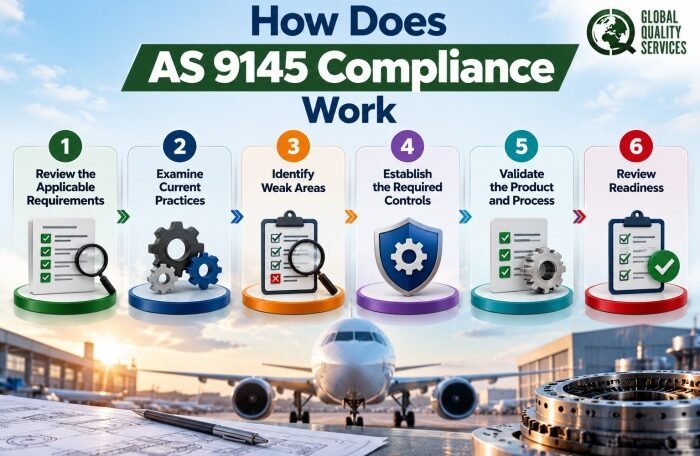
Step 1: Review the Applicable Requirements
Start by identifying customer specifications, contractual requirements, product requirements, regulatory obligations, and applicable standards.
Step 2: Examine Current Practices
Review how your organization currently manages product development, risk, manufacturing planning, validation, and production approval.
Step 3: Identify Weak Areas
Compare existing practices against the applicable AS 9145 requirements and identify missing controls, records, responsibilities, or evidence.
Step 4: Establish the Required Controls
Develop or improve the APQP and PPAP arrangements needed for your products and customer requirements.
Step 5: Validate the Product and Process
Generate the necessary evidence to show that the product and production process meet defined requirements.
Step 6: Review Readiness
Conduct an internal review, address outstanding issues, and make sure relevant personnel understand their responsibilities.
Documents Commonly Associated With AS 9145
Documentation provides evidence of what was planned, what was reviewed, what was tested, and what was approved. Depending on the business and customer requirements, records may include:
- Customer requirement reviews
- Product development plans
- Project schedules
- Design review records
- Design risk analysis
- Process risk analysis
- Process flow diagrams
- Control plans
- Inspection plans
- Testing records
- Product and process validation records
- Measurement results
- Production samples
- PPAP submissions
- Customer approvals
- Corrective action records
- Lessons learned
How Global Quality Services Experts Help You With AS 9145 Compliance
Global Quality Services provides consulting support to businesses working toward management system and industry-specific compliance. Our focus is on making the requirements understandable and practical for the organization instead of handing over generic documents and leaving the implementation to the client.
As a reputed consultant, GQS brings together consulting experience, industry knowledge, documentation support, and implementation guidance for businesses of different sizes.
Why Businesses Work With GQS:
- Experienced quality management consulting team
- Support for small, medium, and large organizations
- Practical understanding of aerospace and defense requirements
- Customized consulting based on business scope and customer expectations
- Strong focus on usable documentation
- Experienced guidance on APQP and PPAP requirements
AS 9145 Compliance Support Across India
India has an ecosystem of mature aerospace & defense manufacturing hubs and budding industry clusters. GQS assists companies looking to achieve AS 9145 compliance in cities such as Bengaluru, Hyderabad, Chennai, Pune, Mumbai, Delhi, Ahmedabad, Noida, among others. Our consultancy model is flexible depending on company size, product portfolio, current quality system, client requirements, and maturity level of APQP & PPAP processes.
Get Expert AS 9145 Compliance Support From Global Quality Services
Talk to our team today about your AS 9145 requirements. Our consultants can review your current practices, identify key gaps, and guide your business toward a practical compliance framework built around your products and customer expectations.
Frequently Asked Questions
1. Is AS 9145 mandatory in India?
AS 9145 is not a universally applicable legal requirement across all Indian organizations. However, the standard could apply as part of a contract or customer requirement for aerospace and defense industry suppliers.
2. Is AS 9145 a certification standard?
AS 9145 is mainly a requirement standard for the application of APQP and PPAP processes, and not a traditional QMS certification standard. Compliance assessment will depend on the specific customer requirements.
3. What is the distinction between APQP and PPAP?
APQP refers to the overall product development planning process, while PPAP consists of documentation proving that both the product and manufacturing process can fulfill certain criteria.
4. Does AS 9145 supercede AS 9100?
Not at all. The two standards tackle distinct aspects. Whereas AS 9100 talks about the quality management system of aerospace, AS 9145 pertains to the APQP and PPAP process within product and production planning.
5. Is there any scope for GQS in helping achieve AS 9145 compliance in India?
Yes, definitely. GQS offers consultancy assistance for firms that need guidance in comprehending AS 9145 guidelines, assessing weaknesses in APQP and PPAP, documenting processes, and getting ready for evaluations.