Workplace safety becomes easier to manage when it becomes part of everyday operations rather than a set of precautions. Bengaluru’s expanding industrial and logistics activity makes safety practices important. The Times of India reported that warehouse leasing in Bengaluru rose 78% year-on-year in H1 2026, reflecting strong demand for industrial space.
ISO 45001 helps organisations identify hazards, control OH&S risks, involve workers, prepare for emergencies, and improve safety performance. For businesses in Peenya, Bommasandra, Jigani, and Devanahalli, hiring a consultant can simplify implementation, identify gaps, and prepare teams for certification.
What is ISO 45001 Certification
ISO 45001 is an international standard for occupational health and safety management systems. It gives organisations a practical structure for identifying hazards, controlling risks, meeting legal requirements, and improving workplace safety.
The standard applies to organisations of different sizes and industries. A manufacturing plant, construction company, technology business, hospital, logistics provider, or engineering organisation can develop an OH&S management system based on ISO 45001.
Certification involves an independent certification body assessing whether the organisation has implemented and maintains a management system that meets ISO 45001 requirements. ISO itself does not issue certificates to companies. Independent certification bodies carry out certification audits.
Why Is ISO 45001 Important for Bangalore Businesses?
Safety challenges can look very different from one workplace to another.
A manufacturing facility may deal with machinery, chemicals, electrical systems, noise, and moving equipment. A construction company may face work-at-height, excavation, equipment, and site-related risks. Even an office-based company needs to consider ergonomics, emergency preparedness, electrical safety, and employee wellbeing.
ISO 45001 gives businesses a systematic way to identify these risks instead of waiting for an accident or incident to expose them.
For Bangalore organisations, certification can help to:
- Create a structured approach to workplace safety
- Identify hazards before they cause incidents
- Improve employee participation in safety activities
- Strengthen emergency preparedness
- Track incidents, near misses, and corrective actions
- Meet applicable occupational health and safety obligations
- Improve safety awareness across departments
- Demonstrate commitment to employees, customers, and other stakeholders
ISO highlights hazard identification, risk assessment, worker participation, legal compliance, emergency planning, incident investigation, and continual improvement as important parts of the standard.
Who Should Consider ISO 45001 Certification in Bangalore?
ISO 45001 is not limited to factories or high-risk workplaces. Any organisation that wants to systematically manage occupational health and safety can use the standard.
Manufacturing Companies
Manufacturers often deal with machinery, production equipment, raw materials, chemicals, electrical systems, and workplace movement. ISO 45001 helps them organise safety controls around these activities.
Construction Companies
Construction sites can involve work at height, heavy equipment, temporary structures, excavation, electrical work, and multiple contractors. A structured OH&S system helps companies manage these risks more consistently.
Aerospace and Engineering Companies
Bangalore has a strong aerospace and engineering ecosystem. These businesses may manage specialised equipment, production processes, testing environments, and technical operations where safety controls need close attention.
Automotive and Component Manufacturers
Automotive operations can involve machinery, welding, assembly lines, material handling, chemicals, and maintenance activities. ISO 45001 can help companies bring these safety activities under one management system.
IT and Technology Companies
Technology companies generally face different workplace risks from manufacturing businesses. Ergonomics, electrical safety, emergency response, workplace facilities, contractor management, and employee wellbeing can still form part of their OH&S system.
Hospitals and Healthcare Organisations
Healthcare workers may face biological, chemical, physical, ergonomic, and emergency-related risks. ISO 45001 can help healthcare organisations take a systematic approach to workplace safety.
Logistics and Warehousing Companies
Warehouses and logistics operations involve vehicles, loading activities, lifting equipment, storage systems, and material handling. A structured safety system can help organisations control these risks.
What Does ISO 45001 Require?
ISO 45001 does not simply ask a company to create a safety policy and stop there. It expects the organisation to establish, operate, monitor, and continually improve its OH&S management system.
Some important areas include:
- Understanding the organisation and its context
- Identifying the needs of workers and other relevant parties
- Demonstrating leadership commitment
- Encouraging worker participation
- Identifying hazards
- Assessing OH&S risks and opportunities
- Determining applicable legal and other requirements
- Setting occupational health and safety objectives
- Providing appropriate resources and competence
- Managing operational controls
- Preparing for emergencies
- Investigating incidents
- Monitoring safety performance
- Conducting internal audits
- Reviewing the system through management review
- Taking corrective action
- Continually improving the OH&S management system
The ISO 45001 structure covers context, leadership and worker participation, planning, support, operation, performance evaluation, and improvement.
How Does ISO 45001 Help Control Workplace Hazards?
A useful way to understand ISO 45001 is to think about what happens before, during, and after a workplace risk appears.
- First, the organisation identifies potential hazards.
- Next, it assesses the associated risks and decides which controls are necessary.
- The organisation then implements those controls and communicates responsibilities to employees and relevant workers.
- After that, it monitors whether the controls are actually working.
- If an incident, near miss, or nonconformity occurs, the organisation investigates what happened and takes corrective action.
- This creates a continuous cycle rather than a one-time safety exercise.
ISO 45001 follows the Plan-Do-Check-Act approach, which helps organisations manage OH&S risks and improve their safety performance over time.
ISO 45001 Certification Process in Bangalore
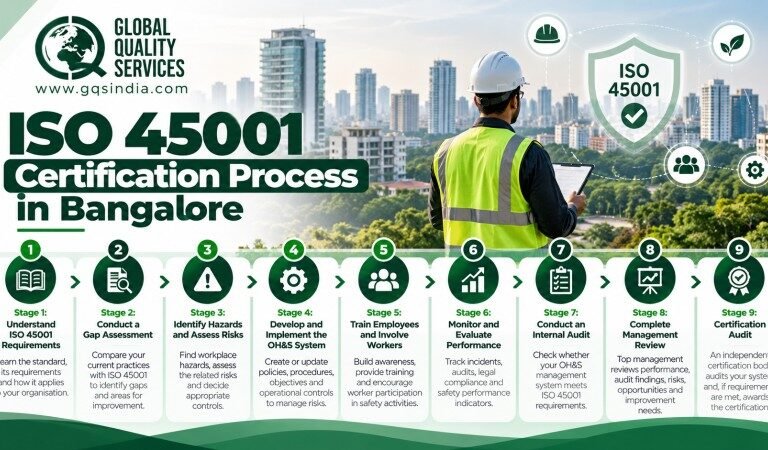
Getting certified does not happen overnight. Businesses normally move through several stages before an independent certification audit.
Stage 1: Understand ISO 45001 Requirements
Start by understanding the standard and determining how its requirements apply to your organisation, workplaces, activities, employees, contractors, and operations.
Stage 2: Conduct a Gap Assessment
Compare your existing safety practices with ISO 45001 requirements. This helps identify missing processes, documentation gaps, weak controls, and areas requiring improvement.
Stage 3: Identify Hazards and Assess Risks
Review workplace activities and identify potential hazards. Assess the related risks and determine appropriate controls based on the organisation’s operations.
Stage 4: Develop and Implement the OH&S System
Create or update policies, procedures, objectives, operational controls, emergency arrangements, training processes, monitoring methods, and other required elements.
Stage 5: Train Employees and Involve Workers
Employees need to understand their responsibilities. Worker participation also plays an important role in developing and improving the OH&S management system.
Stage 6: Monitor and Evaluate Performance
Track incidents, near misses, inspections, objectives, legal compliance, corrective actions, and other relevant performance indicators.
Stage 7: Conduct an Internal Audit
An internal audit helps the organisation check whether its OH&S management system meets ISO 45001 requirements and works effectively in practice.
Stage 8: Complete Management Review
Top management reviews the system, performance results, audit findings, risks, opportunities, and improvement requirements.
Stage 9: Certification Audit
An independent certification body conducts the certification audit. If the organisation meets the applicable requirements and resolves any findings appropriately, certification can be granted.
What Documents Are Needed for ISO 45001?
Documentation depends on the organisation’s activities, risks, size, and OH&S system.
Common information and records may include:
- OH&S policy
- OH&S objectives
- Hazard identification and risk assessment records
- Legal and regulatory compliance information
- Roles and responsibilities
- Worker competence and training records
- Operational control procedures
- Emergency preparedness plans
- Incident and near-miss records
- Inspection and monitoring records
- Corrective action records
- Internal audit reports
- Management review records
- Supplier and contractor safety information
The important point is not to create documents simply to satisfy an audit. Your documented information should reflect how safety is actually managed inside the organisation.
Benefits of ISO 45001 Certification for Bangalore Companies
A well-implemented ISO 45001 system can create practical improvements across the organisation.
Better Hazard Awareness: Employees become more aware of workplace hazards and the controls used to manage them.
- Stronger Safety Practices: The standard helps organisations move from reactive safety measures toward a more planned and preventive approach.
- Improved Worker Participation: ISO 45001 gives worker participation an important role, helping employees contribute to safety discussions and improvements.
- Better Emergency Preparedness: Organisations can prepare procedures for responding to foreseeable emergency situations instead of creating responses only after an incident occurs.
- More Consistent Safety Monitoring: Businesses can track incidents, near misses, inspections, objectives, and corrective actions through a structured system.
- Greater Stakeholder Confidence: Certification can demonstrate to customers, employees, suppliers, and other stakeholders that the organisation takes occupational health and safety seriously.
ISO 45001 and OHSAS 18001: What Changed?
Many businesses still compare ISO 45001 with OHSAS 18001 because they previously used the older occupational health and safety standard.
ISO 45001 replaced OHSAS 18001 and introduced a stronger focus on leadership, worker participation, organisational context, and risk-based thinking.
It also follows the common ISO management system structure, which can make integration with standards such as ISO 9001 and ISO 14001 more practical.
If your Bangalore organisation still operates an older OHSAS-based system, reviewing your current practices against ISO 45001 can be a useful starting point.
Can ISO 45001 Be Integrated With Other ISO Standards?
Yes. ISO 45001 can work alongside other management system standards.
For example, an organisation may integrate:
- ISO 9001 for quality management
- ISO 14001 for environmental management
- ISO 45001 for occupational health and safety
- This approach can reduce duplication because several management system activities can share common processes for documentation, audits, corrective actions, management review, and continual improvement.
For Bangalore businesses already certified to ISO 9001 or ISO 14001, an integrated management system can be a practical way to manage multiple requirements together.
What Is the Current Status of ISO 45001?
ISO 45001:2018 remains the current published standard as of October 2026, and ISO confirmed it remains current after its 2024 review. ISO also published Amendment 1:2024, which introduced climate action changes.
At the same time, ISO is working on a revised edition. ISO/DIS 45001 is currently under development and is expected to replace ISO 45001:2018 after the revision process is completed. ISO currently expects publication in the first half of 2027.
Therefore, Bangalore businesses planning certification should discuss the current certification requirements and upcoming revision with their consultant and certification body before finalising their certification strategy.
Why Choose Global Quality Services for ISO 45001 Certification in Bangalore?
Global Quality Services helps Bangalore organisations prepare for ISO 45001 certification with practical, business-focused support.
Our team can help you understand the standard, assess your existing safety practices, identify gaps, develop required documentation, support hazard and risk assessment activities, prepare employees, conduct internal audit support, and prepare your organisation for the certification audit.
We can support organisations across Bangalore’s major industrial and business locations, including Peenya, Bommasandra, Jigani, Kumbalgodu, Aerospace Park, Hardware Park, and other areas.
The focus is simple: build an OH&S management system that fits the way your organisation actually works rather than creating unnecessary paperwork for certification.
Frequently Asked Questions
- What is ISO 45001 certification in Bangalore?
ISO 45001 certification confirms that an organisation has implemented an occupational health and safety management system that meets applicable ISO 45001 requirements and supports continual improvement.
- Which industries in Bangalore need ISO 45001 certification?
Manufacturing, construction, aerospace, automotive, engineering, healthcare, logistics, technology, and other organisations can adopt ISO 45001 when they want systematic occupational health and safety management.
- How long does ISO 45001 certification take?
The timeline depends on organisation size, operational complexity, existing safety practices, documentation, employee participation, and audit readiness. Smaller systems generally require less preparation than complex operations.
- Is ISO 45001 certification mandatory for businesses?
ISO 45001 certification is generally voluntary. However, customers, supply chains, tenders, or specific business requirements may request certification as evidence of effective occupational health and safety management.
- Can a consultant help with ISO 45001 certification?
Yes. A consultant can assess existing practices, identify gaps, develop documentation, support risk assessment, guide implementation, prepare employees, and help the organisation get ready for certification audits.