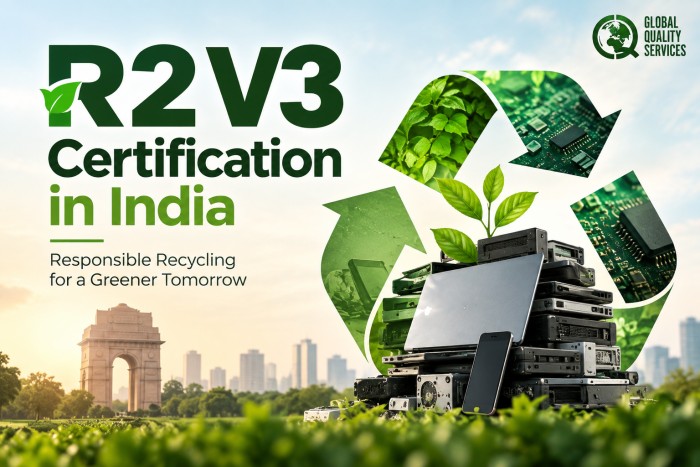
The Indian electronics recycling industry is growing due to increasing concerns about the proper disposal and recycling of electronic waste. According to data published on March 5, 2026, by the Government of India, India has 386 registered e-waste recyclers who have managed 28.75 lakh tonnes of e-waste using EPR.
R2 Version 3 Certification offers a standardized approach for electronics recyclers, refinishers, repair shops, ITADs, data destruction services, and reuse providers. It covers topics ranging from environmental management and health and safety practices to data security, regulatory compliance, documentation control, reuse practices, material recovery, and downstream responsibility. This certification scheme is managed by Sustainable Electronics Recycling International (SERI) through an independent auditing and certification process.
Global Quality Services supports Indian facilities in preparing themselves for R2v3 certification. They assist in determining relevant requirements, identifying gaps, developing policies and procedures, maintaining documentation, performing internal audits, and preparing for the certification audit.
What is R2v3 Certification
R2 V3 Certification is third-party certification for facilities that reuse, refurbish, repair, recycle, process, or otherwise manage used electronics. R2 means Responsible Recycling, whereas V3 indicates the latest iteration of the R2 Standard.
The standard is maintained by Sustainable Electronics Recycling International (SERI). Its purpose is to ensure responsible management of used electronic equipment at electronics facilities, taking into account environmental, occupational health and safety, data security, regulatory compliance, and downstream process considerations.
R2 V3 uses an adaptable framework. Its requirements fall into two categories—Core Requirements, which apply universally to all R2-certified facilities, and Process Requirements, which only apply when a particular activity is conducted. The result is that the scope of certification can align precisely with the business activities conducted by the facility.
Why is R2v3 Certification Important for Businesses in India
The significance of R2 V3 extends far beyond displaying the certification logo. There exists a defined process in place for managing electronic equipment beginning from when it enters any premises, until disposal or recovery through reuse, refurbishment, recycling, or proper transfer to a qualified downstream partner who is qualified.
Promotes Responsible E-Waste Disposal
India’s E-Waste Management Rules of 2022 introduced the Extended Producer Responsibility regime for e-waste and mandated registration for all manufacturers, producers, refurbishers, and recyclers on the CPCB website.
Boosts Data Security
Obsolete devices may contain confidential business data, private consumer data, employee data, or even personal data. R2 V3 has specifications about data security and sanitization, allowing facilities to implement controlled procedures for managing data-bearing devices. According to SERI, data security is considered one of the critical areas covered under R2 V3.
Enhances Downstream Control
Electronic facilities usually depend on their downstream processors for further handling of electronics. These include processing, refurbishment, recycling, or disposal services. R2 V3 emphasizes the need to understand and control the downstream recycling stream.
Establishes Trust with Customers
An R2 certification enables customers, OEMs, vendors, and partners to find locations that have been independently audited against R2 criteria. According to SERI, R2 certification can enable organizations to establish customer trust as well as enter markets that require operations to hold an R2 certification.
Facilitates Reuse and Recycling of Resources
Unlike frameworks that view every electronic product equally as waste once they reach end-of-life status, R2 takes a comprehensive approach to electronics management that considers responsible reuse, repair, refurbishing, resource recovery, and recycling of devices.
Who Needs R2v3 Certification in India
R2 V3 can apply to a wide range of electronics reuse and recycling operations, depending on their activities and certification scope.
- E-Waste Recycling Companies
- Electronics Refurbishers
- IT Asset Disposition Companies
- Data Destruction Companies
- Electronics Repair and Resale Companies
- Collection and Reverse Logistics Companies
What Does R2 V3 Certification Cover
R2v3 is built around Core Requirements and specialized Process Requirements. All R2 facilities must meet the applicable Core Requirements, while Process Requirements apply according to the activities performed by the facility.
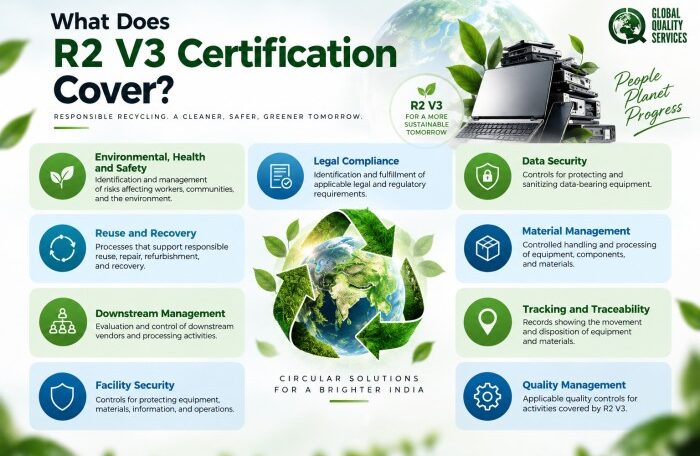
What Does R2v3 Certification Cover
R2v3 relies on two categories of requirements: Core Requirements and Process Requirements. Facilities seeking R2 certification must satisfy the relevant Core Requirements regardless of type. The specific Process Requirements vary based on facility operations.
R2v3 Certification Requirements
Environmental, Health & Safety Management
R2 facilities require an approved Environmental, Health and Safety Management System to support R2 compliance. This includes assessing risks posed by operations within the facility and demonstrating controls in place to mitigate those risks. There may already be an existing ISO 14001 EMS system within an organization. If this is the case, then the existing EMS framework could be used to help manage environmental impacts, controls, compliance considerations, and continuous improvement under R2 V3 guidelines. Similarly, any organizational experience managing occupational health and safety according to ISO 45001 standards might apply.
Data Security & Sanitization
Facilities working with data-bearing equipment require a process to protect information assets and ensure effective data sanitization efforts.
Legal and Regulatory Requirements Compliance
The facility should recognize the legal and regulatory compliance requirements related to its operations. If the facility operates in India, some examples of relevant regulatory compliance could be those relating to environmental, waste management, occupational health & safety, transport, privacy/data protection, among others.
Reuse, Repair and Recovery
Facilities engaged in testing, repair, refurbishing, reusing, and recovering must have procedures to comply with applicable R2 V3 requirements for these processes.
Material Tracking & Traceability
In order to qualify as an R2 facility, there must be evidence of where material goes at each step of the process. Tracking documentation could include:
- What equipment entered the facility
- What processing was performed
- What was reused or recovered
- What materials were sent downstream
- Where applicable, materials ultimately went
Downstream Vendor Management
Downstream vendors play a crucial role in responsible electronic processing. There must be proper control measures for assessing and managing downstream vendors to show compliance with relevant standards through the entire recycling process chain.
Equipment, Material, and Data Device Storage Security
This involves installing adequate security measures at the facility level when storing and processing equipment, materials, and data-bearing devices.
Documenting Activities
The R2 standard requires documentation. According to SERI, records could include, but are not limited to, test records, data destruction records, equipment/material tracking records, monitoring records, and transboundary shipment records.
5 Steps to Get R2v3 Certification in India
Here is how to achieve the R2v3 certification in India:
Step 1: Submit Application and Determine Certification Scope
Define which locations, processes, equipment, and operational activities will be certified. The facility must fill out the SERI License Application Form. Before hiring the Certification Body, SERI requires that prospective facilities submit the license application form.
Step 2: Understand Requirements and Prepare Facility
Familiarize yourself with the updated R2v3 Standard and Code of Practices along with Equipment Categorization guidelines. Facilities need to pinpoint the Core and Process requirements related to them.
Step 3: Implement the Requirements of R2v3
Implement the policies, procedures, recordkeeping, training, and operational control requirements specific to your facility’s needs and any gaps.
Step 4: Perform Internal Audit
Conduct an internal audit to review your system, find nonconformities, resolve them, and get ready with the necessary documentation before certification.
Step 5: Conduct Certification Audit
Stage 1 and Stage 2 certification audits will be performed by a certified body, which evaluates your documentation, operations, recordkeeping, and compliance. Successful completion leads to R2v3 certification.
How Long Does R2v3 Certification Take in India
Time required varies according to the size of the facility, scope, current management systems, documentation, legal compliance, operational controls, and audit preparedness.
According to SERI, most facilities require about 8 to 12 months to complete the R2 certification process. However, this duration can differ from one organization to another based on various factors such as initial conditions and operational complexities.
What Is the Cost of R2v3 Certification in India
There is no single fixed R2 certification price for every Indian facility. The overall cost can depend on:
- Facility size
- Certification scope
- Number of locations
- Number and type of processes
- Existing management systems
- Documentation requirements
- Audit duration
- Certification Body fees
- SERI licensing fees
- Consultant support
- Training requirements
- Downstream vendor arrangements
Benefits of R2v3 Certification for Indian Businesses
Here are the key benefits of R2v3 certification for Indian businesses:
- Earn Your Clients’ And Business Partners’ Trust: Certification to R2 offers proof of an assessment against the R2 Standard.
- Enhances Your Data Security Practices: Processes in place to ensure proper handling of confidential data stored on refurbished products can minimize the risks involved.
- Increases Accountability In The Downstream Supply Chain: With R2 V3, there is a framework to manage the downstream processes involved in recycling.
- Embraces Environmental Stewardship: Environmental considerations related to the refurbishment process are covered under the R2 Standard.
- Operational Consistency: Process standardization through established processes, documentation, monitoring, auditing, and corrective measures allows for increased consistency during routine operations.
- Global Trade: According to SERI, market access for operations requiring certification is one of the possible advantages of R2 certification.
- Showcases Proper Electronic Stewardship Practices: The certification process allows organizations to articulate how they manage their products responsibly after initial use.
Why Choose Global Quality Services for R2v3 Certification
Certifying your organization under R2v3 goes beyond simply documenting everything correctly. The systems must operate effectively within your business environment to produce documentation that will stand up to scrutiny during a third-party audit. Global Quality Services, a reputed consultant, can help organizations achieve R2v3 certification through:
Step 1: R2v3 Gap Assessment
Analyzing current practices in relation to relevant R2v3 requirements and determining gaps where improvements should be made.
Step 2: Scope and Requirement Mapping
Identifying the specific Core and Process Requirements that apply to your organization’s operations.
Step 3: Documentation and SOP Creation
Producing the necessary documents, including policies, procedures, forms, records, and controls, needed for compliance.
Step 3: Implement R2v3 Requirements
Create necessary policies, procedures, documentation, training, and controls, and implement them in related processes.
Step 4: Perform Internal Audit
Conduct an internal audit of the system, detect any nonconformances, conduct necessary corrections, and maintain proper documentation for the certification audit.
Step 5: Conduct Certification Audit
A qualified Certification Body will perform both stages of the audit. Once nonconformities are corrected, R2v3 certification may be granted to your facility.
Get Started on Your R2v3 Certification with the Proper Preparation
R2v3 certification involves actual implementation of practices, documented evidence, operational controls, and showing proof of conformity to standards during an unbiased audit process. With over 26 years of experience, Global Quality Services is capable of guiding your business throughout this entire process, from R2v3 gap assessment to certification audit preparation.
As you consider pursuing R2v3 certification at your facility in India, assess your existing procedures, scope of certification, legal requirements, data security controls, downstream agreements, and audit preparedness in consultation with an experienced R2 consultant.
Contact Global Quality Services regarding your needs for R2v3 certification and develop a realistic certification strategy for your business.
Frequently Asked Questions
1. Is it possible to get ready for R2v3 certification without engaging a consultant?
Yes, it is feasible. SERI permits organizations to become prepared internally for certification purposes. However, consultants are optional; most organizations opt for consultants who assist them in conducting gap analysis, implementing processes, performing internal audits, and preparing for external audits.
2. Can an organization receive a single R2v3 certification for multiple facilities?
No, this isn’t feasible since certification applies only to particular facilities. Any organization that intends to obtain certification at another facility will need to apply for a new SERI license for every additional facility address.
3. Can the R2v3 requirements be outsourced to another organization?
Outsourcing is possible, but just because something gets outsourced doesn’t mean the R2 facility can pass off responsibility. There are actually R2v3 requirements related to downstream processes and third-party management. This means there must be control and documentation around any outsourced processes falling under the certification scope.
4. Is there a way for an existing ISO management system to help meet the requirements of R2v3?
Yes. In fact, R2 V3 can leverage existing management systems when applicable. According to SERI, some examples of acceptable reference standards include ISO 14001, ISO 45001, ISO 9001, and RIOS.
5. Is re-certification necessary following the initial certification audit for R2v3?
Yes. Certified facilities are expected to demonstrate continued compliance with the R2 standard through regular audits. This means continuing to meet the relevant R2 standards and completing any audits mandated by the R2 certification program.