Food manufacturing requires more than good ingredients and modern processing equipment. Every stage, from receiving raw materials to packaging finished products, must operate under controlled food safety conditions. A single failure in hygiene, allergen management, contamination prevention, or production handling can affect product safety, customer confidence, and business continuity. This makes a structured prerequisite program essential for food manufacturers in India.
The ISO 22002-1:2025 standard provides specific prerequisite program requirements for food manufacturing organizations. It addresses the practical conditions needed to prevent contamination and maintain hygienic production environments. According to India’s Ministry of Food Processing Industries, the food processing sector recorded a gross value added of ₹2.24 lakh crore in 2023-24, highlighting its growing economic importance.
With Global Quality Services, organizations seeking ISO 22002-1:2025 Consultants in India receive expert guidance to establish manufacturing-specific food safety controls. Read ahead to understand the standard, its requirements, and how our reputed consultants can help strengthen your food safety practices.
What Is ISO 22002-1:2025 for Food Manufacturing
ISO 22002-1:2025 is an international standard that specifies prerequisite programs (PRPs) for food manufacturing organizations. Published in July 2025, it replaces the earlier ISO/TS 22002-1:2009 technical specification.
The standard works alongside ISO 22002-100:2025, which establishes common prerequisite program requirements applicable across relevant food chain activities. ISO 22002-1:2025 adds requirements specific to manufacturing environments. These requirements help organizations control the conditions that can introduce food safety hazards into their products. They cover areas such as:
- Facility design, construction, and maintenance.
- Equipment suitability and hygienic design.
- Cleaning and sanitation practices.
- Personnel hygiene and employee facilities.
- Pest prevention and control.
- Waste handling and disposal.
- Storage and transportation conditions.
- Prevention of physical, chemical, and microbiological contamination.
- Allergen management and cross-contact prevention.
Why Do Indian Food Manufacturers Need ISO 22002-1:2025?
India’s food manufacturing industry serves domestic consumers and international markets. Manufacturers must maintain consistent production conditions while meeting customer expectations, applicable food safety regulations, and supply chain requirements.
A general hygiene policy may not address the risks of manufacturing activities. For example, a dairy processing plant, a frozen food manufacturer, and a packaged snack production facility face different contamination risks. Each requires controls suited to its products, equipment, production layout, and handling conditions.
ISO 22002-1:2025 helps manufacturers address these differences through sector-specific prerequisite programs. Here is why the standard matters for Indian food businesses:
1. Better Control Over Manufacturing Contamination
The standard helps organizations establish controls against microbiological, chemical, and physical contamination. This includes suitable zoning, hygienic equipment design, cleaning validation, and controlled material movement.
2. Stronger Allergen Management
Manufacturers handling milk, peanuts, soy, gluten, nuts, and other allergens need reliable controls to prevent cross-contact. The standard supports clear yooxblnoo dsn allergen handling, cleaning, storage, and production.
3. Consistent Production Hygiene
Defined hygiene requirements help employees follow consistent cleaning, sanitation, maintenance, and personal hygiene practices across production areas.
4. Improved Customer and Buyer Confidence
Food safety controls supported by documented procedures and records make it easier to demonstrate operational discipline to customers, suppliers, business partners, and auditors.
5. Better Support for International Food Safety Requirements
Manufacturers supplying international markets often face detailed food safety expectations from buyers. A well-established prerequisite program supports the wider food safety management system and helps organizations prepare for relevant assessments.
Key Requirements of ISO 22002-1:2025 for Food Manufacturing
ISO 22002-1:2025 works with ISO 22002-100:2025. Manufacturers must address the common prerequisite requirements while applying the additional controls relevant to food manufacturing operations. The following areas deserve particular attention:
1. Manufacturing Facility Design and Zoning
Food manufacturing facilities must have a layout that supports hygienic operations and reduces the possibility of cross-contamination. Organizations need to consider:
- Separation of raw material handling and finished product areas.
- Controlled movement of employees, materials, and equipment.
- Hygienic barriers between high-risk and low-risk production zones.
- Suitable airflow arrangements to prevent contamination transfer.
- Appropriate drainage direction and floor design.
- Cleanable walls, ceilings, floors, and production surfaces.
2. Allergen Management and Cross-Contact Prevention
Allergen contamination can occur through shared equipment, production lines, storage areas, utensils, and employee handling practices. Manufacturers should establish controls for:
- Identifying and separating allergenic ingredients.
- Maintaining dedicated or properly controlled equipment.
- Validating cleaning procedures between production runs.
- Establishing allergen changeover requirements.
- Controlling rework containing allergenic ingredients.
- Maintaining accurate ingredient and product labeling.
3. Prevention of Physical and Chemical Contamination
Foreign materials and chemical residues can enter food products through raw materials, equipment, packaging, cleaning activities, or poor maintenance. Manufacturing facilities should establish suitable controls for:
- Glass and brittle plastic management.
- Metal detection and foreign material prevention.
- Lubricant and chemical storage.
- Cleaning agent handling.
- Equipment inspection and preventive maintenance.
- Safe handling of packaging materials.
4. Raw Material Receiving and Storage
Incoming materials can introduce biological, chemical, and physical hazards into production. Organizations must establish controlled receiving and storage arrangements, including:
- Supplier approval and incoming material checks.
- Defined acceptance criteria for raw materials.
- Temperature checks where applicable.
- Protection against damaged or contaminated packaging.
- Separation of incompatible materials.
- Suitable stock rotation and traceability.
5. Cleaning, Sanitation, and Drainage Management
Cleaning must address the specific equipment, surfaces, and contamination risks present in a manufacturing facility. Organizations should define cleaning frequencies, approved chemicals, responsibilities, and verification methods.
Drainage systems must also support hygienic production. Drain orientation and flow should prevent wastewater from moving from contaminated areas into cleaner production zones. Standing water, damaged drains, and poorly maintained floor surfaces can create conditions that encourage microbial growth.
6. Personnel Hygiene and Employee Practices
Employees play an important role in maintaining food safety throughout production. Manufacturers should establish requirements covering:
- Handwashing and personal cleanliness.
- Suitable protective clothing.
- Access to production areas.
- Illness reporting.
- Employee movement between production zones.
- Food handling practices.
- Hygiene training and awareness.
7. Pest Control, Waste Management, and Utilities
Manufacturers must maintain controls for pests, waste, water, air, and other essential utilities.
This includes suitable pest monitoring, waste segregation, safe disposal practices, water quality monitoring, and maintenance of utility systems. The controls should protect products, ingredients, equipment, and production environments from contamination.
How ISO 22002-1:2025 Works with ISO 22002-100:2025
ISO 22002-100:2025 establishes common prerequisite program requirements for food chain organizations, while ISO 22002-1:2025 adds specific requirements for food manufacturing. Together, they help manufacturers address general hygiene controls as well as production-specific risks, including microbiological zoning, allergen management, contamination prevention, and hygienic facility design. Both standards should be applied together to establish effective prerequisite programs for food manufacturing operations.
Which Food Manufacturing Industries Benefit from ISO 22002-1:2025?
ISO 22002-1:2025 applies to food manufacturing organizations regardless of their size or operational complexity. Its requirements can support businesses across different food production categories.
- Dairy and milk processing
- Meat and poultry processing
- Seafood processing
- Bakery and confectionery
- Packaged food manufacturing
- Frozen food processing
- Beverage manufacturing
- Ready-to-eat food production
- Snacks and processed food manufacturing
- Fruit and vegetable processing
ISO 22002-1:2025 Implementation Process in India
Implementing ISO 22002-1:2025 requires a clear understanding of manufacturing activities and the food safety risks associated with each operation. Global Quality Services follows a structured approach that helps organizations establish suitable prerequisite programs without adding unnecessary operational complexity.
Step 1: Initial Assessment and Gap Analysis
We review the existing manufacturing environment, food safety practices, facility layout, hygiene controls, and documentation. This helps identify gaps against ISO 22002-100:2025 and ISO 22002-1:2025 requirements.
Step 2: Manufacturing Risk and PRP Planning
We assess the risks associated with raw materials, processing activities, equipment, employee movement, allergen handling, and finished product storage. Based on the findings, we help establish suitable prerequisite programs.
Step 3: Documentation and Control Development
We help prepare or update the necessary procedures, work instructions, cleaning schedules, allergen controls, inspection records, and other supporting documents.
Step 4: Implementation and Employee Training
We guide your team in applying the required controls across manufacturing operations. Relevant employees receive guidance on hygiene practices, contamination prevention, cleaning procedures, and their responsibilities.
Step 5: Internal Audit and Certification Readiness
We review implementation, assess the effectiveness of established controls, identify remaining gaps, and help your organization prepare for the applicable external assessment.
How Global Quality Services Experts Help You with ISO 22002-1:2025 in India
Global Quality Services is a reputed consultant supporting organizations with international management system standards, food safety requirements, and compliance initiatives. Our consultancy background, practical approach, and experience across different industries help businesses establish systems that support their actual operational needs. Our key strengths include:
- 26 years of management consultancy experience.
- Experience supporting organizations across multiple countries and industries.
- Specialist guidance on ISO standards and food safety management systems.
- Manufacturing-focused risk assessment and prerequisite program expertise.
- Practical documentation and implementation support.
- Experienced consultants with a focus on operational compliance.
- Customized solutions for small, medium, and large manufacturing facilities.
- Employee training and internal audit support.
- Assistance with external audit preparation and corrective actions.
- Continued guidance to help organizations maintain their systems.
Our experience with food safety-related standards also extends to international consultancy assignments. Organizations can explore our ISO 22000 Certification in India and FSSC 22000 Certification in India pages to learn more about our work in food safety management and certification support.
Benefits of Implementing ISO 22002-1:2025
A properly implemented prerequisite program can improve food safety practices while supporting production efficiency and customer requirements. Key business benefits include:
1. Reduced Food Contamination Risks
Defined controls for microbiological, chemical, and physical hazards help reduce contamination risks throughout manufacturing.
2. Improved Manufacturing Hygiene
Consistent sanitation, equipment maintenance, employee hygiene, and facility controls support cleaner production environments.
3. Stronger Allergen Controls
Documented allergen management and cleaning validation help prevent cross-contact and protect consumers with food allergies.
4. Better Supplier and Customer Confidence
A structured food safety system demonstrates that your organization takes manufacturing hygiene and product safety seriously.
5. Improved Audit Preparedness
Maintained procedures, monitoring records, and corrective action records make it easier to demonstrate that your food safety controls are working.
6. Support for the Wider Food Safety Management System
The standard strengthens prerequisite programs that form an important part of the organization’s broader food safety management arrangements.
ISO 22002-1:2025 and ISO 22000: Understanding the Difference
Although both standards address food safety, they serve different purposes:
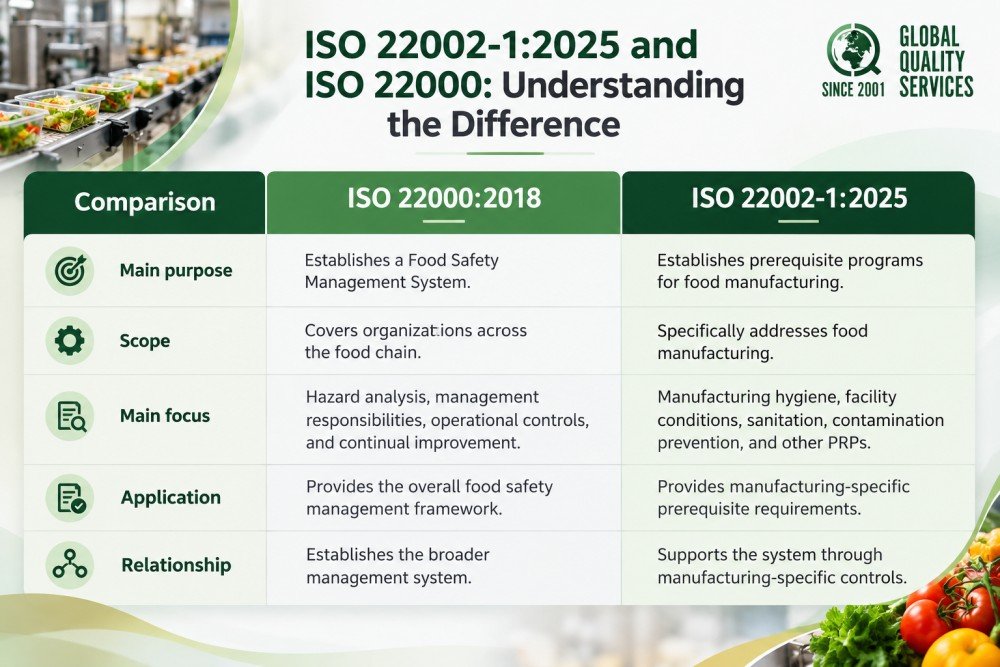
ISO 22002-1:2025 does not replace ISO 22000. Instead, it provides more detailed prerequisite program requirements that food manufacturers can apply alongside ISO 22002-100:2025 within their wider food safety management arrangements.
Get Expert ISO 22002-1:2025 Consultancy in India from Global Quality Services
Strengthen your food manufacturing operations with prerequisite programs designed around your actual production risks. Partner with Global Quality Services for expert guidance on ISO 22002-1:2025 implementation, manufacturing hygiene, allergen management, contamination prevention, and audit preparation.
Our presence extends across multiple Indian business centers, including Delhi, Ahmedabad, Noida, Bangalore, Mumbai, Pune, Chennai, and Hyderabad. We support food manufacturing organizations with practical consultancy that helps them establish reliable food safety controls and prepare for independent certification assessments.
Contact Global Quality Services today to discuss your manufacturing requirements, request a consultancy proposal, and take the next step toward a stronger food safety management system.
Frequently Asked Questions
1. What is the difference between ISO 22002-1:2025 and ISO 22002-100:2025?
ISO 22002-100:2025 establishes common prerequisite program requirements, while ISO 22002-1:2025 adds specific requirements for food manufacturing operations. Both standards work together to address general and manufacturing-specific food safety risks.
2. Does ISO 22002-1:2025 replace ISO/TS 22002-1:2009?
Yes. ISO 22002-1:2025 replaces the earlier ISO/TS 22002-1:2009 technical specification. Organizations using the earlier version should review their existing prerequisite programs against the updated requirements.
3. Can small food manufacturing companies implement ISO 22002-1:2025?
Yes. The standard applies to food manufacturing organizations regardless of size or complexity. Small manufacturers can establish suitable controls based on their products, production activities, facility conditions, and food safety risks.
4. What are the main food safety requirements under ISO 22002-1:2025?
The main areas include facility design, hygienic equipment, cleaning and sanitation, personnel hygiene, pest control, waste management, allergen controls, contamination prevention, and suitable storage and handling conditions.
5. How does ISO 22002-1:2025 support ISO 22000?
ISO 22002-1:2025 provides manufacturing-specific prerequisite programs that support the wider ISO 22000 Food Safety Management System. It helps organizations establish the hygienic conditions needed to control food safety hazards during production.