
For Indian manufacturers and exporters intending to introduce their qualified products in Europe, the Indian CE certification process is one of the significant steps toward meeting the appropriate requirements of Europe concerning those products. Known as the CE Marking process, it ensures that the product has been tested against the appropriate requirements of the EU with regard to safety, health, and environmental protection.
The European Union continues to be an important export destination for Indian businesses, with India’s merchandise exports to the EU reaching USD 75.85 billion in 2024–25, according to the Government of India. Government of India trade data. This creates significant opportunities for manufacturers, but also makes it essential to understand the product-specific compliance requirements for entering the European market.
CE marking procedure may differ based on the nature of the goods, the EU regulation that applies to the specific product, and the degree of assessment that needs to be done. In order to be able to apply the CE mark correctly, a manufacturer should conduct the proper procedure.
What is CE Certification
The CE Certification, which is also called the CE Marking, is a mandatory conformity marking for some products that enter the European Economic Area (EEA) market. When placing the CE mark on its product, the manufacturer indicates that it complies with the relevant European Union requirements regarding such aspects as safety, health, and environmental protection.
It is very important to note that the CE marking is not a universal certificate that is issued for all products by an authorized organization. In each particular case, the requirements, testing procedure, and conformity assessment process depend on the product type and EU legislation. In some cases, the manufacturer performs the conformity assessment independently, but in other cases, the help of a special Notified Body should be requested.
For Indian producers and exporters, getting CE conformity can be a critical requirement for gaining access to the European market with products regulated by CE legislation.
Importance of CE Certification for Indian Manufacturers
CE marking plays an important role in helping manufacturers meet the needs arising out of trade relations between Europe and India, as the trade ties between India and Europe will increase in the coming years.
Why CE Marking Matters for Indian Manufacturers
- Supports access to the European market for products covered by CE legislation.
- Demonstrates conformity with applicable EU requirements relating to safety, health, and environmental protection.
- Helps meet customer and importer expectations for regulated products.
- Reduces the risk of compliance-related delays before market entry.
- Provides a structured approach to product assessment and documentation.
- Strengthens confidence among European buyers, distributors and business partners.
- Helps manufacturers identify product risks and compliance gaps before placing products on the market.
Benefits of CE Certification in India
There are several advantages of CE marking for businesses that manufacture eligible products and market them in Europe. Nonetheless, the benefits come from adherence to the applicable conformity assessment procedure, and not from acquiring a document associated with the CE marking.
Key Benefits of CE Certification
- Access to the EEA market: Eligible CE-marked products can be placed on the European market when all applicable requirements are met.
- Improved product compliance: The assessment process helps manufacturers evaluate applicable safety and performance requirements.
- Better market acceptance: European importers and distributors can verify whether the necessary conformity procedures and documentation are available.
- Greater customer confidence: Demonstrating compliance can strengthen trust among buyers and business partners.
- Improved product documentation: CE compliance requires organised technical information and supporting evidence.
- Early identification of compliance gaps: Manufacturers can address issues before products reach the market.
- Support for international business growth: CE compliance can help Indian manufacturers prepare products for European business opportunities.
Documents Required for CE Certification
Documents that are needed for CE marking differ depending on the product, EU legislation, and conformity assessment process. Common documents include:
- Product description and intended use
- Product specifications and technical details
- Product drawings and design information
- Manufacturing process details
- Applicable standards and regulatory requirements
- Risk assessment and risk analysis
- Product test reports, where applicable
- Safety-related documentation
- Quality control records, where applicable
- User manuals and operating instructions
- Installation and maintenance instructions, where applicable
- Details of product labels and markings
- Technical file or technical documentation
- EU Declaration of Conformity
- Details of the manufacturer and authorised representative, where required
How to Obtain CE Marking in India
The CE marking process varies according to the product and the EU legislation that applies to it. However, the process generally follows these five key stages:
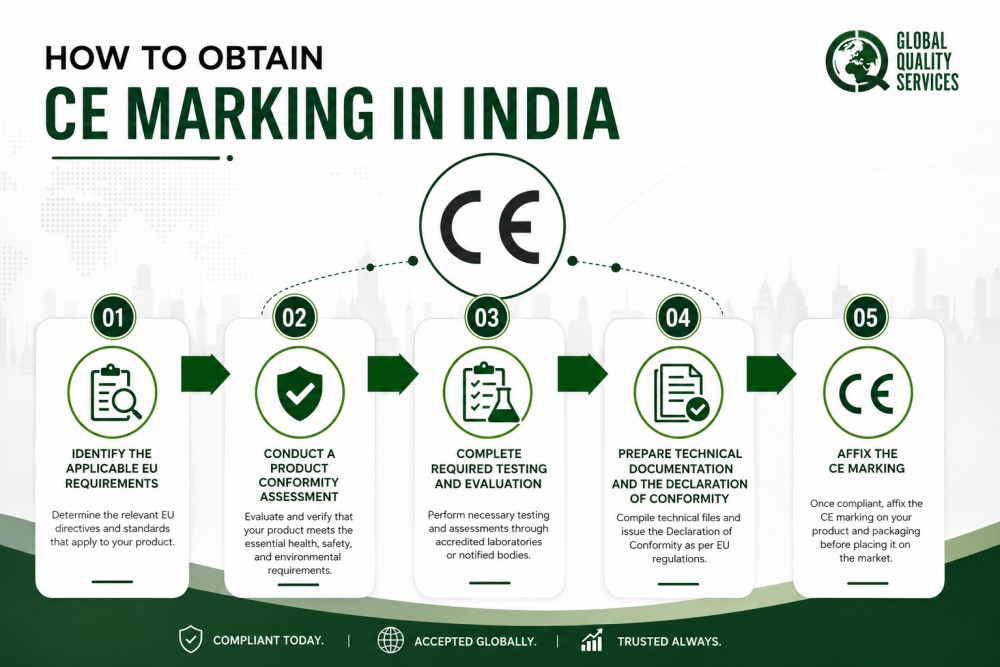
Step 1: Identify the Applicable EU Requirements
The initial stage involves determining whether the item under consideration falls under the purview of legislation that requires CE marking. The next step would be identifying the directive/regulation, essential requirement, and standard involved.
Step 2: Conduct a Product Conformity Assessment
The product will be evaluated in terms of its compliance with the requirements. This process may vary depending on the product type and can include design evaluation, risk assessment, and testing against appropriate harmonized standards.
Step 3: Complete Required Testing and Evaluation
If testing is needed, then it should be tested using the right method that will ensure compliance. The method used for testing varies greatly depending on whether the product being tested is an electrical appliance, machine, medical device, personal protective equipment, or any other regulated product.
Step 4: Prepare Technical Documentation and the Declaration of Conformity
The company compiles necessary technical documentation that serves as proof of product compliance. The European Union Declaration of Conformity is compiled where necessary, with the company being responsible for compliance with legislation.
Step 5: Affix the CE Marking
After fulfilling the conformity assessment requirements that apply to the product, the CE marking can be placed based on the relevant legal requirements. In cases where third-party assessment is necessary, a Notified Body may be required prior to placing the marking.
Challenges Related to CE Certification
Achieving CE compliance may prove difficult in some instances since there are no universal requirements for each type of product. Some of the most common problems faced by Indian manufacturers in trying to establish conformity to EU regulations include:
- Identifying whether CE marking is mandatory for a particular product
- Determining which EU directives or regulations apply
- Understanding relevant harmonised standards
- Identifying whether a Notified Body is required
- Conducting appropriate product testing
- Preparing complete technical documentation
- Performing adequate product risk assessments
- Managing changes in European product regulations
- Preparing the correct EU Declaration of Conformity
- Ensuring product labels, instructions and safety information meet applicable requirements
What are the Testing Areas Covered Under the CE Conformity Assessment
The testing and assessment areas covered under CE conformity assessment depend entirely on the product category and applicable EU legislation. Common areas may include:
- Electrical safety testing
- Electromagnetic Compatibility (EMC) testing
- Radio and wireless performance testing
- Mechanical safety assessment
- Machinery safety evaluation
- Risk assessment and hazard analysis
- Chemical and hazardous substance compliance
- Environmental performance requirements
- Energy efficiency requirements
- Pressure and structural safety testing
- Personal protective equipment performance testing
- Medical device safety and performance evaluation
- Noise and vibration assessment
- Fire safety requirements, where applicable
What is the CE Marking ISO Certification Service
CE marking is a product conformity requirement under applicable EU legislation, whereas ISO certifications generally demonstrate that an organisation follows the requirements of a particular international management system standard.
For example, ISO 9001:2026 Certification focuses on a quality management system, while CE marking focuses on whether a specific product meets applicable European requirements. For medical device manufacturers, ISO 13485 Certification may also support the implementation of a quality management system designed specifically for the medical device sector.
Depending on the product and business operations, an organisation may benefit from both CE compliance support and relevant ISO certification, but one does not automatically replace the other.
What is CE Marking of Electronic and Electrical Equipment
The CE mark is especially important for various classes of electronic and electrical products marketed in Europe. Requirements for compliance depend on the type of product and relate to electrical safety, electromagnetic compatibility, radio apparatus, and restrictions on hazardous substances, among others.
The precise requirements will vary depending on the nature and purpose of the product. The manufacturer has to determine which legislation is applicable and carry out the relevant conformity assessment before affixing the CE mark.
How Global Quality Services Supports Your CE Certification Requirements
Global Quality Services assists manufacturers and businesses in comprehending the CE mark regulations that apply to their product range. Our methodology involves assisting companies in identifying pertinent legislation, understanding conformity assessment needs, and preparing for the documentation process. Our CE mark certification services can include:
- Identifying applicable CE requirements for the product
- Reviewing relevant EU legislation and standards
- Supporting product gap assessment
- Guidance on conformity assessment requirements
- Assistance with technical documentation requirements
- Support for risk assessment and product compliance documentation
- Guidance on testing and evaluation requirements
- Assistance with preparation of the required conformity documentation
- Coordination and guidance throughout the compliance process
Get Started with CE Certification in India with Global Quality Services
If you manufacture products for the European market, understanding the correct CE requirements at the beginning can help avoid unnecessary testing, documentation gaps, and delays. Global Quality Services can help you assess your product’s applicable requirements and take a structured approach towards CE conformity and market readiness.
Frequently Asked Questions
1. How long does CE Certification take in India?
The time required depends on the product category, applicable EU requirements, testing needs, and whether a Notified Body is involved. Simple products with complete documentation may take less time than complex or higher-risk products requiring extensive testing and third-party assessment.
2. Can I sell my product in Europe without CE marking?
If your product falls under EU legislation that requires CE marking, it must meet the applicable requirements before being placed on the EEA market. However, not every product category requires CE marking, so the first step is determining whether your product falls within the scope of relevant legislation.
3. Is CE marking valid throughout Europe?
CE marking applies to products covered by relevant EU harmonisation legislation and supports their placement on the European Economic Area market when all applicable requirements are met. Manufacturers should still check any additional country-specific obligations that may apply to their product.
4. Do imported products also require CE marking?
Yes. Products manufactured outside the EU are subject to the same applicable product requirements when placed on the EEA market. Importers must also verify that manufacturers have completed the necessary conformity procedures and that required documentation is available.
5. What happens if a product is incorrectly CE marked?
Incorrectly affixing CE marking can result in compliance action by market surveillance authorities. Depending on the circumstances, the manufacturer or responsible economic operator may need to correct the issue, bring the product into compliance, withdraw it from the market or take other corrective action.