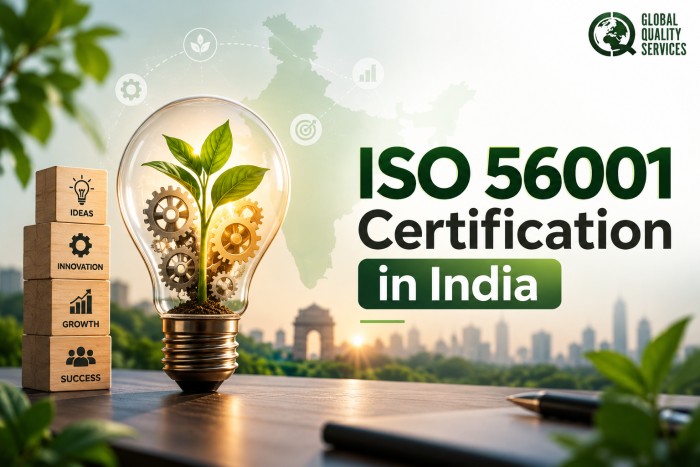
Innovation is not confined to bringing out innovative products anymore. There is increasing pressure on businesses in India to convert ideas into useful inventions, improvements, innovations, and opportunities that are profitable. The increased emphasis on innovation can be seen from the increase in ranking of India to rank 38 in the Global Innovation Index 2025, up from 66 in 2019, as reported by the Government of India.
This is where the need for ISO 56001 Certification in India can benefit organizations. It is a standard that can assist organizations in setting up an innovation management system for idea generation, evaluation, development, and implementation.
Organizations that are interested in developing innovation capability and competitiveness through a systematic approach to innovation may find it beneficial for them. However, what are the requirements for ISO 56001, who needs to be certified, and how can the process of ISO 56001 Certification take place in India?
What is ISO 56001?
ISO 56001 is a global framework that defines how innovation should be managed as a strategic, repeatable, and measurable business system. It ensures innovation is not random creativity—rather, a structured, documented, and continuously improving management cycle aligned with organizational goals.
Why ISO 56001 Matters for Companies
Innovation can directly impact growth, competitiveness, and market positioning for Indian enterprises. ISO 56001 enables firms to provide better organization in managing ideas, innovation activities, resources, and outcomes.
- Manages innovation: Provides a framework that helps organizations manage their ideas throughout the process.
- Promotes business growth: Aligns innovation efforts with business objectives and opportunities in the market.
- Optimizes resource management: Enables firms to assess ideas and allocate resources, such as time, finance, and manpower, to relevant innovations.
- Fosters collaboration: Offers different teams a framework through which they collaborate to undertake innovation initiatives.
- Measures innovation outcomes: Facilitates performance measurement in order to know whether innovation efforts are successful.
- Boosts market confidence: Enables certification of a systematic approach to innovation to the public.
The ISO 56001 standard can run concurrently with other standards like the ISO 9001 and ISO 14001 standards. The ISO 9001 standard concentrates on quality, while ISO 14001 is for environmental management. On the other hand, ISO 56001 introduces a systematic method of innovation.
Key Requirements of ISO 56001 Innovation Management System
Leadership Commitment
Top management must define policies, set direction, and allocate resources for innovation.
Strategic Alignment
Innovation goals must support the organization’s long-term strategy and market vision.
Governance & Risk Management
Clear roles, responsibilities, approvals, project gates, and risk control are essential.
Performance Measurement
KPIs and evaluation criteria must be defined to measure progress and outcomes.
Capability & Knowledge Management
A systematic approach for skill development, idea capture, research integration, and knowledge sharing.
Continuous Improvement
Periodic review, lessons learned, and improvement cycles to strengthen the innovation system over time.
Our ISO 56001 Certification Support Services
India Global Quality Services provides:
-
Gap assessment & system maturity analysis
-
Documentation support (policies, process maps, risk registers, KPI frameworks)
-
Internal auditor training for Innovation Management
-
Implementation support & technical guidance
-
Pre-audit readiness evaluation
-
Certification audit support through accredited bodies
-
Post-certification improvement support
Who Should Implement ISO 56001?
Recommended for:
-
Technology companies
-
Manufacturing & engineering firms
-
Research-driven companies
-
Pharmaceutical & biotech
-
Automotive & EV sector
-
Aerospace & defence
-
IT/software & digital platforms
-
Large groups pursuing future-ready transformation
Any organization seeking structured, high-impact innovation can benefit.
Steps to Get ISO 56001 Certification
Here are the key steps to receive ISO 56001 certification in India:
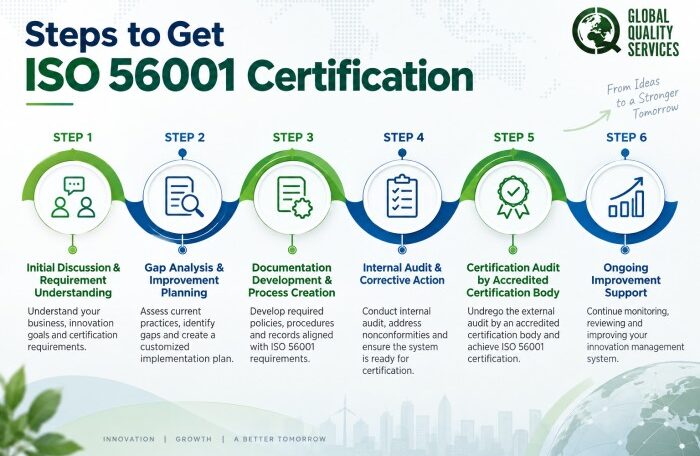
Step 1: Initial Discussion & Requirement Understanding
Consultants first understand the organization’s nature of business, current innovation maturity level, challenges, and strategic objectives. This helps identify whether the focus is incremental innovations, breakthrough innovations, new product development, digital transformation, or new business models. The scope of certification is also defined here.
Step 2: Gap Analysis & Improvement Planning
A structured assessment is conducted to compare existing practices against ISO 56001 requirements. Gaps are identified in terms of processes, leadership roles, KPI definition, knowledge management, idea pipeline structure, risk management, and documentation. Based on this, a customized action plan and implementation roadmap is prepared.
Step 3: Documentation Development & Process Creation
Policies, frameworks, process maps, procedures, templates, KPIs, and innovation governance structures are created or refined. This includes — innovation policy, strategic alignment framework, innovation portfolio model, idea evaluation criteria, project ranking templates, risk registers, decision gate checklists, and learning capture structures. Adequate documentation ensures innovation becomes systematic, repeatable, and auditable.
Step 4: Internal Audit & Corrective Action
Before certification, an internal audit is performed to verify implementation. Deviations are captured, root causes are identified, and corrective actions are planned and implemented. This step ensures the system is practically working — not just documented — and ready for external evaluation.
Step 5: Certification Audit by Accredited Certification Body
An external accredited certification body conducts the official audit. Auditors evaluate documentation, process consistency, strategic alignment, performance measurement, knowledge management, and leadership commitment. Upon compliance, ISO 56001 certification is awarded.
Step 6: Ongoing Improvement Support
Post-certification, periodic reviews and system upgrades are done to refine innovation capability. Lessons learned, KPI results, new challenges, and new market directions are used to enhance performance continuously. Continuous improvement keeps the system relevant and helps sustain competitive advantage.
Benefits of ISO 56001 Certification in India
Many operational and strategic benefits are associated with the successful implementation of the ISO 56001 Certification. Some of the benefits that organizations based in India could enjoy through the certification process include:
Innovation Management System
The organization is provided with a systematic approach to innovation management rather than leaving it in the hands of various teams within the organization.
Effective Resource Utilization
Projects and ideas are analyzed through the set criteria, making sure that management uses its resources effectively.
Sound Decision Making
Evaluation criteria and methods, along with performance measurements, make decision-making easier for management.
Better Cross-functional Collaboration
Innovation often requires cooperation of many departments. It will be beneficial to have a common management model to foster better collaboration among research, product development, operations, marketing, finance, and leadership departments.
Lower Innovation Risks
Innovation always carries an element of risk. Knowing about the risks and opportunities that exist at various stages can be helpful for making more informed decisions and eliminating avoidable mistakes.
Measurable Innovation Performance
Organizations can determine appropriate metrics for monitoring the process and results of innovation rather than evaluating the results only after the project is over.
ISO 56001 Documents Required for Certification
The exact documentation depends on the organization and its certification scope. However, key documents and records generally include:
- Innovation Management System scope
- Innovation policy
- Innovation objectives and plans
- Innovation process and governance framework
- Innovation risk and opportunity records
- Innovation project and idea evaluation records
- Performance evaluation records
- Internal audit records
- Management review records
- Corrective action and improvement records
ISO 56001 Certification Assistance by Global Quality Services in India
With 26 years of experience, Global Quality Services, a reputed consultant, makes the implementation of ISO 56001 much more realistic and compatible with an organization’s way of doing business. The assistance is aimed at developing a practical innovation management system.
- Industry-specific assistance: GQS analyzes the industry of the organization, its innovations, goals, and practices to provide relevant ISO 56001 advice.
- Documentation assistance: The team helps in preparing and polishing necessary documents while keeping them concise and relevant to the company’s practices.
- Management assistance: GQS helps managers understand their duties according to ISO 56001 and set directions for the innovation management system.
- Employee assistance: Relevant employees can get assistance regarding ISO 56001 requirements and duties of the innovation management system implementation.
- Assistance for audit preparation: GQS analyses the system implementation before the certification audit and provides information about any possible areas of concern.
- Professional certification assistance: From choosing the right certification approach to preparation of the external audit, GQS provides professional assistance during the whole process.
Contact Global Quality Services
Frequently Asked Questions
1. What is the purpose of ISO 56001 Certification?
ISO 56001 provides a structured framework to manage innovation in a systematic and measurable way. It ensures innovation is linked to business strategy, not just random idea generation.
2. How long does it usually take to achieve ISO 56001 Certification?
Timelines depend on existing maturity. Organizations that already have structured R&D or innovation initiatives may take 2–4 months. Companies starting from scratch may need more time for documentation, process setup and internal training.
3. Is ISO 56001 only for technology companies?
No. Any organization that values continuous improvement can implement it — manufacturing, pharma, automotive, services, research-based firms, digital businesses, and even government sector organizations.
4. What resources are needed to implement ISO 56001?
Leadership involvement, clarity in innovation strategy, documentation, risk management approach, internal auditors, and a culture that supports experimentation and knowledge sharing.
5. Does ISO 56001 help in new product/solution development?
Yes. ISO 56001 creates a structured pathway for idea collection, evaluation, project prioritization, risk assessment, and commercial value creation — which leads to more successful products, services, and improvement outcomes.