Food packaging manufacturers play an important role in protecting the safety and quality of packaged food. Poor material selection, chemical migration, contaminated production equipment, and improper storage can expose food products to serious safety risks. ISO 22002-4:2025 Consultants in India help manufacturers establish the prerequisite programs (PRPs) needed to identify these risks and maintain safe packaging production practices.
According to the India Brand Equity Foundation (IBEF), India’s packaging industry crossed ₹7.36 lakh crore in September 2024, making it the world’s third-largest packaging market. This growth creates greater demand for reliable packaging materials and controlled manufacturing practices. Global Quality Services provides specialized consultancy to help Indian manufacturers understand the revised standard, strengthen production controls, and prepare for certification requirements.
Whether you manufacture plastic containers, flexible packaging, paper products, or food-grade glass packaging, our consultants can help you build a system suited to your operations. Read ahead to understand the requirements and how we can support your business.
What Is ISO 22002-4:2025 for Food Packaging Manufacturing
ISO 22002-4:2025 is an international standard that specifies prerequisite program requirements for organizations manufacturing food and feed packaging. Published in July 2025, it replaces the previous ISO/TS 22002-4:2013 edition.
The standard establishes the hygiene, operational, and contamination prevention measures manufacturers need to control food safety hazards during packaging production. It applies to organizations of all sizes and levels of complexity involved in food and feed packaging manufacturing.
An important change in the 2025 edition is the introduction of ISO 22002-100:2025, which establishes common prerequisite program requirements across the food, feed, and packaging supply chain. Manufacturers must use ISO 22002-4:2025 together with ISO 22002-100:2025 to address both common and packaging-specific food safety requirements.
The standard supports food safety management systems based on ISO 22000 and helps manufacturers establish suitable controls for raw materials, production environments, equipment, storage, and contamination risks.
Why Food Packaging Manufacturers in India Need ISO 22002-4:2025
Packaging manufacturers supplying food processors, beverage companies, dairy businesses, snack brands, and retail companies must demonstrate that their production practices do not introduce food safety hazards. ISO 22002-4:2025 helps Indian manufacturers address these expectations through controls covering:
- Food contact material safety: Ensure packaging materials are suitable for their intended applications and do not introduce harmful substances into food.
- Chemical migration prevention: Control the transfer of printing inks, adhesives, coatings, solvents, and other substances to food contact surfaces.
- Production hygiene: Maintain clean manufacturing areas, machinery, equipment, and employee facilities.
- Foreign material control: Prevent metal fragments, broken equipment parts, blades, and other unwanted materials from contaminating packaging.
- Supplier and material management: Verify purchased raw materials against approved specifications and food safety requirements.
- Storage and transportation: Protect packaging materials from contamination, moisture, pests, and physical damage.
- Customer and regulatory requirements: Demonstrate that manufacturing practices follow recognized food safety controls.
Manufacturers looking to strengthen their wider food safety management system can also explore ISO 22000 Certification in India.
ISO 22002-4:2025 Framework: Tier 2 Sector Addendum
ISO 22002-4:2025 serves as the sector-specific prerequisite program standard for food and feed packaging manufacturing. Within the framework structure used on this page, it represents Tier 2: Sector Addendum.
ISO 22002-100:2025 provides the common prerequisite program requirements, while ISO 22002-4:2025 addresses the additional requirements relevant to packaging manufacturing.
This distinction is important because packaging manufacturers face risks that differ from those in food processing, catering, and food distribution. They must control material suitability, printing chemicals, surface contamination, production equipment, and risks that could affect the food contact side of finished packaging.
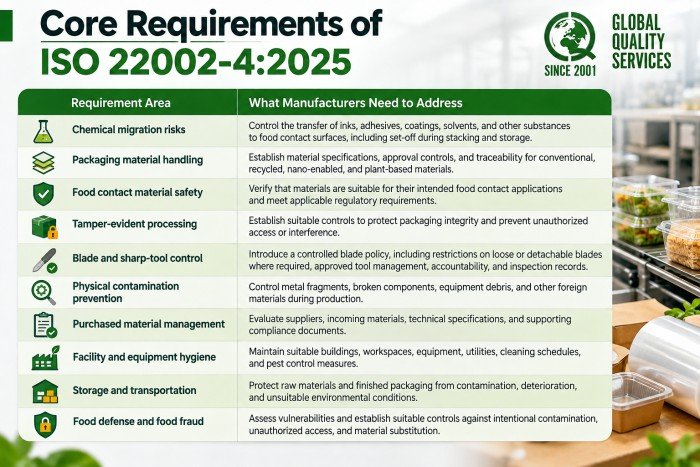
Core Requirements of ISO 22002-4:2025
Here are the core requirements of ISO 22002-4:2025:
Special Attention to Recycled and Alternative Packaging Materials
Food packaging manufacturers are increasingly using recycled plastics, plant-based materials, and advanced materials. However, changing the material does not remove the need to establish suitable food safety controls. Manufacturers should pay particular attention to:
- Recycled materials: Verify the source, processing history, suitability, and regulatory compliance of recycled materials.
- Nano-enabled materials: Assess the safety and suitability of nanomaterials, including potential migration and their intended applications.
- Plant-based materials: Check coatings, additives, adhesives, and other components that may affect food contact safety.
- Printing inks and adhesives: Evaluate migration and set-off risks, particularly where printed surfaces may come into contact with food contact surfaces.
India’s Food Safety and Standards Authority of India (FSSAI) maintains packaging regulations and has issued specific guidelines for recycled PET used as food contact material. Manufacturers must consider these requirements alongside their food safety management system controls.
Who Should Implement ISO 22002-4:2025 in India?
ISO 22002-4:2025 applies to organizations involved in manufacturing food and feed packaging. It is not limited to large packaging factories. Small and medium-sized manufacturers must also establish suitable prerequisite programs based on their activities and associated risks. The following businesses can benefit from implementation:
- Plastic packaging manufacturers
- Flexible packaging manufacturers
- Paper and paperboard manufacturers
- Glass packaging manufacturers
- Metal packaging manufacturers
- Packaging printing companies
- Biodegradable packaging manufacturers
- Packaging conversion units
How ISO 22002-4:2025 Benefits Food Packaging Manufacturers
Implementing ISO 22002-4:2025 can improve manufacturing controls and help businesses meet the expectations of customers, regulators, and supply chain partners. Key business benefits include:
- Better food safety control: Identify and manage contamination risks before they affect finished packaging.
- Improved customer confidence: Demonstrate a structured approach to food safety when supplying packaging to established food brands.
- Stronger supplier management: Establish clear purchasing and material approval criteria for raw materials and packaging components.
- Reduced production risks: Improve housekeeping, equipment maintenance, cleaning, and foreign material prevention.
- Better export readiness: Support customer and supply chain requirements in international markets.
- Regulatory alignment: Strengthen packaging safety controls in line with applicable Indian food contact regulations.
- Consistent production practices: Establish documented controls that employees can follow across shifts and production units.
ISO 22002-4:2025 Consultancy and Implementation Process
Global Quality Services follows a five-step approach to help food packaging manufacturers prepare their management systems for the applicable requirements.
Step 1: Initial Consultation and Scope Assessment
We understand your manufacturing activities, packaging materials, production processes, customer requirements, and existing food safety controls.
Step 2: Gap Assessment and Risk Identification
Our consultants review your current practices against ISO 22002-4:2025 and ISO 22002-100:2025 to identify missing controls, compliance gaps, and packaging-related hazards.
Step 3: Documentation and System Development
We help establish the required policies, procedures, material specifications, operational controls, risk assessments, and supporting records.
Step 4: Implementation and Internal Audit Preparation
We guide your employees through the required controls, review implementation records, and help your team conduct internal audits and address identified nonconformities.
Step 5: Certification Audit Support
We assist with audit preparation, corrective action guidance, and coordination with the selected certification body. The certification decision remains the responsibility of the independent certification body.
How Global Quality Services Experts Help You with ISO 22002-4:2025 Consultancy in India
Global Quality Services is a reputed consultant providing ISO consultancy, management system implementation support, auditor training, and compliance guidance to organizations across different industries.
Our experience in the ISO consultancy field dates back to 2001. We were among the early consulting organizations to receive NABET and NRBPT QCI approvals, as stated in our company background. Our team includes qualified professionals, Lead Auditors, and consultants with experience across food safety, quality management, aerospace, environmental management, and other international standards.
Why businesses choose Global Quality Services:
- Established ISO consultancy background since 2001.
- Early NABET and NRBPT QCI approval history.
- Qualified Lead Auditors and industry-experienced consultants.
- Experience with ISO 22000, FSSC 22000, HACCP, and related food safety frameworks.
- Customized documentation based on actual manufacturing activities.
- Practical guidance for chemical migration, material handling, hygiene, and contamination controls.
- Industry-specific implementation and audit preparation support.
- Assistance with internal audits, corrective actions, and certification body coordination.
- Nationwide consulting support across India.
- Continued assistance beyond initial implementation.
Businesses looking for related food safety support can also explore HACCP Consultancy and Certification from Global Quality Services.
Get Expert ISO 22002-4:2025 Consultancy in India from Global Quality Services
Prepare your food packaging manufacturing business for stronger food safety controls with expert guidance from Global Quality Services. Our consultants help you understand the latest requirements, address packaging-related hazards, improve production practices, and prepare for certification audits.
Whether you manufacture plastic containers, flexible packaging, paper-based products, glass bottles, or other food contact materials, we provide consultancy support based on your actual business requirements.
Our consulting presence extends across major Indian business centers, including Delhi, Ahmedabad, Noida, Bangalore, Mumbai, Pune, Chennai, and Hyderabad.
Contact Global Quality Services today to discuss your ISO 22002-4:2025 consultancy requirements. Speak with our consultants, understand your implementation needs, and get a clear roadmap for preparing your organization for certification.
Frequently Asked Questions
1. Is ISO 22002-4:2025 applicable to small food packaging manufacturers?
Yes. The standard applies to food and feed packaging manufacturers regardless of their size or operational complexity. Requirements should reflect the organization’s activities and associated food safety risks.
2. Can a manufacturer use recycled plastic for food packaging under this standard?
Yes, provided the material meets applicable food contact regulations and suitability requirements. Manufacturers must assess its source, processing, safety, and intended use.
3. Does ISO 22002-4:2025 cover packaging printing and lamination activities?
Yes. Relevant food safety controls apply to printing, lamination, coating, and other packaging conversion activities where they can affect packaging safety.
4. How often should food packaging manufacturers review their prerequisite programs?
Organizations should review their programs at planned intervals and whenever changes in materials, equipment, processes, suppliers, or identified hazards may affect food safety.
5. Does ISO 22002-4:2025 automatically establish compliance with FSSAI packaging regulations?
No. Implementing the ISO requirements does not automatically establish regulatory compliance. Manufacturers must separately evaluate and meet applicable FSSAI packaging regulations and other relevant legal obligations.