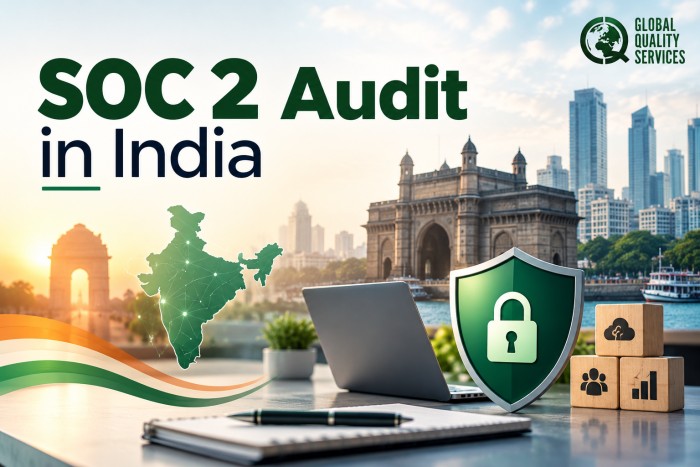
The Indian tech industry’s influence within the global digital economy ecosystem continues to grow. Based on figures released by the Ministry of Electronics & IT in the Annual Report 2025-26, India’s IT-ITeS sector employed 5.8 million workers and contributed 7.3 percent of India’s GDP. With the increasing number of SaaS, IT, cloud computing, fintech, and technology firms serving overseas clients, being able to prove the security of both customer information and the business process has become critical within enterprise-level relationships.
SOC 2 audits assist service organizations in validating their internal controls that safeguard information assets and facilitate effective business operations according to the criteria established by the American Institute of CPAs (AICPA) Trust Services Principles – namely, security, availability, processing integrity, confidentiality, and privacy.
At Global Quality Services, we help prepare service organizations for SOC 2 audits through assistance with scope definition, gap analysis, documentation development, evidence preparation, internal test planning, and coordination with external auditors.
What is a SOC 2 Audit
A SOC 2 audit is an independent examination of controls used by a service organization to protect information and operate its systems. It is particularly relevant to businesses that provide technology, software, cloud, data processing, or other outsourced services to customers.
SOC 2 is technically an attestation engagement rather than a certification scheme. A CPA firm performs the examination and issues the resulting SOC 2 report. The AICPA describes SOC services as assurance reports that help customers and other interested parties assess risks associated with outsourced services.
SOC 2 Audit vs SOC 2 Readiness
SOC 2 audit readiness focuses on preparing the organization for the examination. It can involve identifying gaps, developing policies, implementing controls, collecting evidence, and testing whether controls are working as intended.
The SOC 2 attestation is the independent examination that results in the SOC 2 report.
A readiness consultant can help prepare the organization, but the independent attestation must be performed by an appropriately qualified CPA firm.
Who Should Consider a SOC 2 Audit in India
SOC 2 audit is mainly relevant to organizations that provide services to customers and handle customer information through their systems. Businesses that may pursue SOC 2 include:
- SaaS companies
- Software product companies
- Cloud service providers
- IT service providers
- Managed service providers
- FinTech companies
- HealthTech companies
- Data processing businesses
- BPO and KPO providers
- Companies handling sensitive customer information
- Technology companies selling services to enterprise customers
SOC 2 Type 1 vs SOC 2 Type 2: Which Report Do You Need
SOC 2 has two commonly used report types. The main difference is what the examination evaluates and over what period.
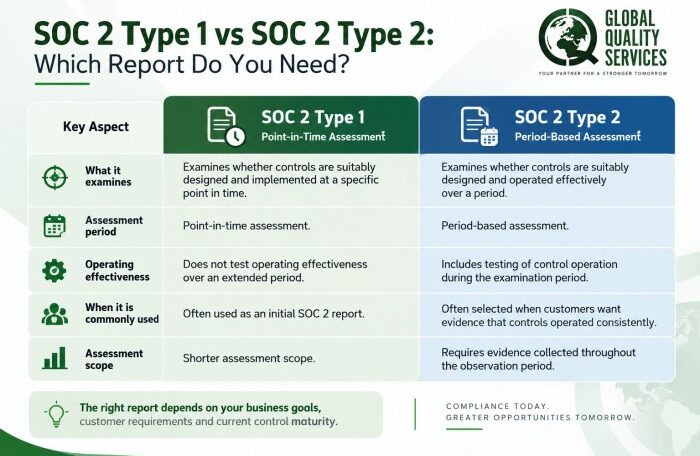
The appropriate report depends on your customer requirements, existing control maturity, audit scope and business objectives. A Type 1 report should not automatically be treated as a substitute for Type 2. The customer’s procurement requirements should be checked before selecting the engagement type.
Understanding the Five SOC 2 Trust Services Criteria
The AICPA Trust Services Criteria provide the foundation for evaluating controls related to systems and information. The five criteria are Security, Availability, Processing Integrity, Confidentiality, and Privacy.
Security
Security focuses on protecting systems and information against unauthorized access, use, disclosure, modification or destruction. Controls may cover:
- Access management
- Authentication
- Network security
- Security monitoring
- Incident response
- Vulnerability management
Availability
Availability relates to whether systems and services are available for operation and use as agreed. Relevant controls may include:
- System monitoring
- Backup procedures
- Disaster recovery
- Capacity management
- Business continuity
Processing Integrity
Processing integrity focuses on whether system processing is complete, valid, accurate, timely and authorized. This can be relevant to businesses where customers depend on automated systems to process transactions or other critical information.
Confidentiality
Confidentiality concerns information that is designated for restricted access. Controls may address:
- Data classification
- Access restrictions
- Encryption
- Information handling
- Secure disposal
Privacy
Privacy focuses on how personal information is collected, used, retained, disclosed, and disposed of. The relevance of this criterion depends on the nature of the organization’s services and the personal information it handles.
What Controls Are Reviewed During a SOC 2 Audit
The controls examined during a SOC 2 engagement depend on the organization’s scope and selected criteria. Common control areas include:
Access Control and Identity Management
The auditor may examine how users receive, change, and lose access to systems. User reviews, privileged access, authentication, and access removal are common areas of review.
Change Management
This covers how changes to applications, infrastructure, and systems are requested, approved, tested, and deployed.
Risk Management
Organizations should have a defined approach for identifying security and operational risks and deciding how those risks will be addressed.
Incident Response
Incident procedures should define how security incidents are identified, reported, investigated, escalated and resolved.
Vendor Management
Third-party providers can introduce security and operational risks. Vendor assessments, contracts, reviews and ongoing monitoring may therefore form part of the control environment.
Data Protection and Security Monitoring
Controls can cover how sensitive information is protected and how security events are monitored and reviewed.
Business Continuity
Organizations may need controls covering backups, recovery procedures, disaster recovery testing and continuity planning, depending on their scope.
SOC 2 Audit Requirements in India
SOC 2 requirements are based on the organization’s systems, services, and selected Trust Services Criteria rather than a single checklist that applies to every company. Preparation commonly involves:
- Information security policies
- Access management procedures
- Employee onboarding and offboarding controls
- Security awareness training
- Risk assessments
- Incident response procedures
- Change management procedures
- Vendor management controls
- Business continuity procedures
- Data protection measures
- Security monitoring
- Documented evidence that controls are being followed
Indian companies should also consider applicable Indian cybersecurity, privacy, and sector-specific requirements alongside SOC 2. SOC 2 does not replace legal or regulatory obligations.
CERT-In remains India’s national agency for responding to computer security incidents and publishes cybersecurity advisories, guidelines, and incident response information.
What Evidence is Required for a SOC 2 Audit
Evidence demonstrates that controls are not only documented but are being followed. Depending on the audit scope, evidence may include:
- User access reviews
- Employee security training records
- Onboarding and offboarding records
- Password and MFA configurations
- Change requests and approvals
- Incident records
- Vulnerability assessment reports
- Security monitoring records
- Backup records
- Disaster recovery test results
- Vendor assessment records
- Risk assessment documents
- Policy review records
- System configuration information
The amount and type of evidence required will vary according to the organization’s systems, controls, selected criteria and report type.
SOC 2 Audit Process in India
Here is a clear audit process to receive a SOC 2 audit in India:
Step 1: Define the SOC 2 Scope
Identify the services, systems, infrastructure, locations, and business processes that will fall within the SOC 2 scope. The applicable Trust Services Criteria are also determined at this stage.
Step 2: Assess Controls and Identify Gaps
Review existing policies, processes, and technical controls against the selected SOC 2 requirements. This identifies areas that need to be created, improved, or documented.
Step 3: Implement Controls and Prepare Evidence
Address identified gaps and establish the required controls. Documentation is prepared and evidence collection begins so the organization can demonstrate that its controls are operating as expected.
Step 4: Complete Testing and Independent Audit
Controls and evidence are reviewed before the independent examination. The CPA firm then performs the SOC 2 engagement and requests supporting evidence as required.
Step 5: Address Findings and Receive the SOC 2 Report
Any issues identified during the engagement are reviewed and addressed where applicable. Once the examination is completed, the CPA firm issues the applicable SOC 2 report.
How Long Does a SOC 2 Audit Take in India
The timeline depends on the organization’s existing controls, audit scope, selected Trust Services Criteria, system complexity, and report type.
A Type 1 engagement can generally move faster because it assesses controls at a specific point in time. A Type 2 engagement requires controls to be observed and tested over an agreed period, so it takes longer. Factors that can extend the timeline include:
- Major control gaps
- Incomplete documentation
- Large or complex technology environments
- Multiple systems or business units
- Weak evidence collection processes
- Additional Trust Services Criteria
- Delays in responding to audit requests
SOC 2 Certification Cost in India
SOC 2 audit costs vary from one organization to another, so there is no single price that applies to every business. The overall cost can depend on:
- Type 1 or Type 2 engagement
- Size and complexity of the organization
- Number of systems within scope
- Selected Trust Services Criteria
- Existing security controls
- Amount of remediation required
- Documentation and evidence readiness
- Observation period for Type 2
- Independent audit fees
- Readiness and implementation support
SOC 2 vs ISO 27001: What Is the Difference
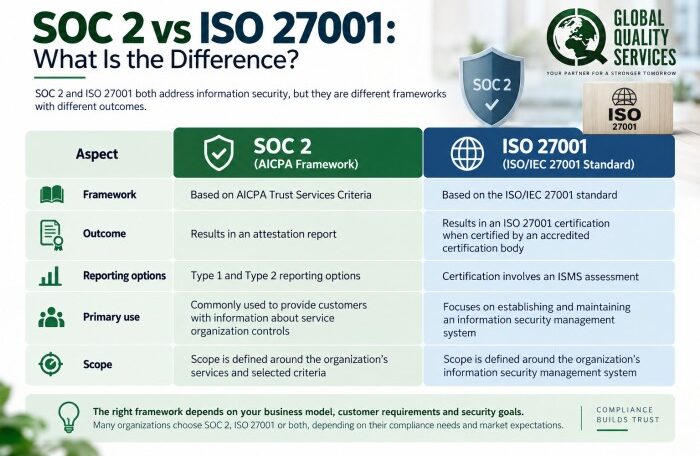
SOC 2 and ISO 27001 both address information security, but they are different frameworks with different outcomes.
Why Choose Global Quality Services for SOC 2 Audit in India
Preparing for SOC 2 involves more than creating policies. Your organization needs controls that fit its actual operations and evidence that shows those controls are being followed. Global Quality Services, a reputed consultant can support your SOC 2 preparation through:
- SOC 2 readiness assessment
- Control gap identification
- Documentation and policy support
- Control implementation guidance
- Evidence preparation
- Internal audit support
- Corrective action guidance
- Audit preparation
- Coordination with the independent audit team
- Support for Type 1 and Type 2 engagements
Start Your SOC 2 Audit Preparation With Global Quality Services
Global Quality Services has been helping companies with compliance and certification services for 26 years, which means we know exactly how to prepare your company for a SOC 2 engagement. We can assist you in determining the scope of the audit, evaluating controls, filling any gaps, preparing documentation, and ensuring that everything is in order before the SOC 2 examination takes place. If you need assistance with SOC 2 compliance, reach out to us today.
Frequently Asked Questions
1. Can a startup pursue SOC 2 without having an established compliance team?
Yes. A startup does not necessarily need a dedicated compliance department to begin SOC 2 preparation. The important requirement is to establish appropriate controls, assign responsibility for them, and maintain reliable evidence.
2. Can third-party cloud platforms and vendors be included in a SOC 2 audit?
Third-party services can affect the systems and controls within the SOC 2 environment. Their role, associated risks, and available assurance information should therefore be considered when defining the audit scope.
3. What happens when a SOC 2 control does not operate as expected?
The issue is reviewed to determine its nature, frequency, and effect on the control environment. Depending on the circumstances, additional evidence, remediation, or auditor evaluation may be required.
4. Can an organization change its SOC 2 scope after the engagement begins?
Changes may be possible, but they can affect the audit procedures, evidence requirements, timeline, and report scope. Defining the scope carefully before the engagement starts helps avoid unnecessary changes later.
5. Does having ISO 27001 already in place make SOC 2 preparation easier?
An established ISO 27001 information security management system can provide useful policies, processes, and controls that may support SOC 2 preparation. However, ISO 27001 certification does not automatically satisfy every SOC 2 requirement.