According to data released by the Press Information Bureau (PIB) and the Ministry of Commerce and Industry, India achieved a record USD 52.55 billion in agricultural export earnings in FY 2025–26. In parallel, official estimates from the Ministry of Agriculture and Farmers Welfare project India’s total horticulture production to reach 3,777.76 lakh tonnes in FY 2025–26 across 301.51 lakh hectares.
As India and the broader Western Uttar Pradesh agricultural belt emerge as vital supply hubs for commercial crop processing, cold storage infrastructure, and international trade, farm operators face growing pressure to standardize quality control.
Implementing the ISO 22006:2009 quality management framework helps agricultural producers, greenhouse operators, and farm enterprises across India structure field operations, manage input risks, and prepare systematically for ISO 9001 Quality Management System certification.
What is ISO 22006:2009 Crop Production Quality Management?
ISO 22006:2009 is an international guidance standard that adapts general ISO 9001 quality management principles specifically for crop production. It provides farm managers and corporate agribusinesses with a structured methodology to manage processes throughout the entire crop lifecycle, from seed selection and soil preparation to harvest and post-harvest handling.
Key Distinction: Guidance Framework vs Certification Standard
- ISO 22006:2009 is a guidance framework, not an independent certificate.
- Farms implement ISO 22006 guidelines to design their crop quality management systems.
- The formal audit and resulting certificate issued to the farm is ISO 9001 Quality Management System (QMS) certification.
Why Agribusinesses in India Need ISO 22006 Guidelines
India sits at a strategic point connecting diverse regional farming districts to major domestic retail chains and overseas buyers. Implementing ISO 22006 helps farm operators tackle core operational challenges while aligning with broader sustainability standards like ISO 14001 Environmental Management:
- Yield Consistency: Standardizing soil prep and irrigation controls reduces crop quality variations across harvest cycles.
- Chemical Input Control: Logging fertilizer and chemical applications prevents harvest rejections and ensures sanitary compliance.
- Export Readiness: Documented field workflows align farm outputs with international buyer requirements.
- Lean Operations: Standardized field SOPs cut resource waste, lower seed loss, and minimize post-harvest decay.
ISO 22006:2009 vs ISO 22000:2018
Agricultural producers often confuse crop quality management guidelines with food safety management standards. The two standards address distinct operational needs:
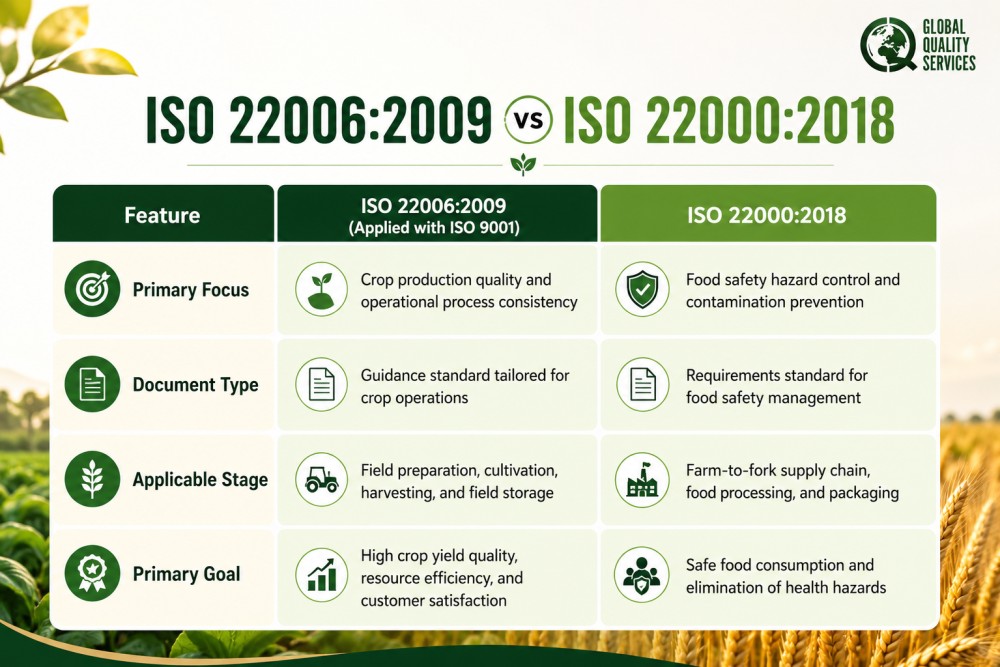
ISO 22006:2009 vs ISO 22000 vs ISO 22005 in India
These standards address different business needs and should not be treated as interchangeable.
ISO 22006:2009: Crop Production Quality Management Guidance
Focuses specifically on identifying and controlling food safety hazards across the food chain. You can explore our complete guide on ISO 22000 Food Safety Certification to learn how it applies to processing facilities.
ISO 22000: Food Safety Management System
ISO 22000 focuses on food safety management across organisations in the food chain. It is more relevant when the organisation’s objective is managing food safety hazards and related food safety processes.
Crop Categories Covered Under ISO 22006
The ISO 22006 framework applies to all types of crop production operations, regardless of farm size or cultivation methods:
- Seasonal and Row Crops: Grains, pulses, oilseeds, sugarcane, and field vegetables.
- Perennial and Plantation Crops: Fruit orchards, sugarcane, tea, coffee, and long-term plantations.
- Horticulture and Floriculture: Greenhouse cultivation, high-value commercial flowers, and exotic vegetables.
- Wild Harvest Collection: Systematic gathering and quality assurance for non-cultivated natural produce.
Benefits of Applying ISO 22006:2009 Guidance in Indian Agriculture
A properly applied quality management approach can help an agricultural organisation create better control without making everyday work unnecessarily complicated. The main benefits can include:
- Better process consistency: Employees have a defined way of carrying out important activities.
- Clearer responsibilities: People understand who is responsible for planning, monitoring, recording and reviewing activities.
- Improved record management: Important production information is easier to retrieve and review.
- Better control of production activities: Management has a clearer view of how crop production is being carried out.
- Faster identification of problems: Records and monitoring make it easier to identify areas where performance is falling short.
- Better corrective action: Problems can be investigated and addressed rather than repeatedly handled as isolated incidents.
- Improved customer confidence: A structured system gives buyers stronger evidence that production processes are being managed consistently.
Step-by-Step ISO 22006 Implementation Process
Implementing ISO 22006 guidelines follows a systematic, field-tested sequence:
Step 1: Initial Farm Audit and Gap Analysis
Evaluating current field practices, irrigation logs, soil treatment records, and worker safety protocols against ISO 9001 guidelines to identify compliance gaps.
Step 2: Practical Documentation Design
Creating straightforward Standard Operating Procedures (SOPs) and log sheets for field supervisors, ensuring administration remains light and practical for daily farm use.
Step 3: Field Supervisor and Labor Training
Training farm hands, field managers, and greenhouse supervisors on standardized planting techniques, chemical handling logs, and quality inspection points.
Step 4: Internal Audit and Trial Runs
Executing internal field audits during an active cultivation cycle to verify that workers follow written procedures and log records accurately.
Step 5: Certification Audit Assistance
Guiding your organization through the final independent audit conducted by an accredited certification body to secure your ISO 9001 certificate.
Who Can Apply ISO 22006:2009 Guidance in India?
ISO 22006 can be relevant to organisations involved in a wide range of crop production activities.
Farms and Commercial Crop Producers
Commercial farms can use the guidance to establish more consistent methods for planning, cultivation, monitoring and harvesting.
Horticulture and Vegetable Producers
Vegetable and horticultural operations can use quality management practices to improve control over planting, crop care, harvesting and related records.
Fruit and Plantation Crop Producers
Fruit and perennial crop operations often manage production over longer cycles. Documented processes can help maintain consistency across seasons.
Grain, Pulse and Oilseed Producers
Producers of wheat, rice, maize, pulses and oilseeds can use structured controls to manage crop production activities and review performance.
Spice and Herb Producers
Spice and herb producers can benefit from clearly documented cultivation, harvesting and quality control processes.
Agricultural Cooperatives and Producer Organisations
Cooperatives and producer organisations can use common procedures to create greater consistency across participating farms or production units.
Greenhouse and Controlled Crop Production Operations
Controlled crop production operations can use quality management practices to define responsibilities, monitor activities and maintain records across the production cycle.
Documents and Records Relevant to ISO 22006:2009 Implementation
The exact documentation depends on the size, crop type and complexity of the operation. There is no single universal document list that applies to every farm. Depending on the organisation, relevant information may include:
- Quality policy and objectives
- Crop production procedures
- Production planning records
- Seed or planting material records
- Agricultural input records
- Irrigation or water-related records
- Pest and disease management records
- Training and competence records
- Equipment maintenance records
- Crop monitoring records
- Harvesting records
- Nonconformity records
- Corrective action records
- Customer feedback and complaint records
- Internal review records
What Should Indian Crop Producers Check Before Choosing an ISO 22006 Service Provider?
Before engaging a consultant or service provider, agricultural organisations should ask several practical questions.
- First, confirm whether the provider understands that ISO 22006:2009 is guidance and is not intended for standalone certification. This helps prevent confusion later.
- Ensure the work reflects actual field routines rather than pre-packaged, generic paperwork templates.
- Clarify whether your buyers require ISO 9001 quality certification, ISO 22000 food safety certification, or comprehensive FSSC 22000 Food Safety Standards.
- Verify that the provider offers on-site field staff training, internal trial audits, and active support during the final certification assessment.
How Global Quality Services Supports FSSC 22000 Certification Across India
For agricultural businesses in India that process, store, or supply crops to international food manufacturers, quality management often extends into advanced food safety standards like FSSC 22000. Global Quality Services provides end-to-end consulting support to help Indian facilities achieve FSSC 22000 certification:
- Comprehensive Facility Gap Analysis: Evaluating crop storage, washing, sorting, and primary processing areas against FSSC 22000 requirements to detect hygiene and structural gaps.
- Prerequisite Program (PRP) Implementation: Establishing robust baseline controls for pest control, sanitation, cross-contamination prevention, and personal hygiene across field packhouses and India processing sites.
- HACCP Plan Development: Identifying biological, chemical, and physical hazards specific to crop handling and defining critical control points with clear monitoring limits.
- Tailored System Documentation: Structuring food safety manuals, traceability protocols, and recall plans without cluttering daily operations with excessive paperwork.
- Staff and Internal Auditor Training: Educating floor supervisors and quality teams on daily hygiene monitoring, root cause analysis, and internal audit procedures.
- Pre-Assessment and Audit Facilitation: Conducting thorough mock audits before the final certification review to ensure full compliance and zero major non-conformities.
Partner with Global Quality Services for Farm Quality Excellence
Ready to build an international-grade quality management system for your farm or crop export business in India? Global Quality Services delivers practical, hands-on consulting tailored to your exact crop cycles and operational needs.
Contact our team today to schedule your on-site farm gap analysis and begin your journey toward ISO 9001 certification.
Frequently Asked Questions
1. What is the difference between ISO 22006 and Good Agricultural Practices (GAP)?
Good Agricultural Practices focus on specific field techniques for safety and environmental care. ISO 22006 provides the overarching management system framework that plans, documents, and continuously improves how those field practices are executed.
2. How long does it take for a farm in India to implement ISO 22006 guidelines?
The complete implementation process typically takes between 45 to 90 days. The timeline depends on farm acreage, crop variety, and whether implementation aligns with an active planting or harvesting cycle.
3. Can small family-owned farms or greenhouses implement ISO 22006?
Yes. ISO 22006 is fully scalable. It works equally well for small greenhouse setups, mid-sized horticulture units, and large corporate farming operations.
4. Does ISO 22006 cover organic crop production?
Yes. ISO 22006 provides the quality management framework that helps track and document organic farm inputs, soil health measures, and harvest segregation to maintain organic integrity.
5. What records must farm managers maintain under ISO 22006 guidelines?
Farm managers maintain simple logs for seed purchasing, fertilizer and pesticide applications, irrigation schedules, equipment maintenance, worker training, and harvest yield inspections.