BRC IOP certification helps businesses demonstrate that their products, processes, and operations meet recognized requirements for safety, quality and compliance.
As India’s food processing sector continues to grow, meeting recognized standards is becoming increasingly important. The Ministry of Food Processing Industries reported that processed food accounted for 20.4% of India’s agri-food exports in 2024–25.
For food manufacturers, packaging producers and suppliers, BRCGS provides a structured framework to manage critical risks, strengthen operational controls and meet the expectations of customers, retailers and brand owners. Working with an experienced BRC Consultant can also help businesses understand the applicable standard, identify gaps and prepare their systems for certification.
What is the British Retail Consortium (BRC)
BRC standards were designed to enable retailers and suppliers to sustain product safety and quality at consistent levels within their supply chains. With time, BRC standards have been transformed into BRCGS or Brand Reputation through Compliance Global Standards.
Put simply, BRCGS involves recognized standards that help companies set up proper systems of product safety, quality, legality, and operational control.
There are different standards of BRCGS which are suitable for different industries and activities of business. For instance, food producers may consider the BRCGS Food Safety Standard, whereas producers of packaging materials may need to pursue the BRCGS Packaging Materials Standard. Certification to BRCGS is recognized by retailers, manufacturers, and brand owners.
The Importance and Advantages of British Retail Consortium (BRC)
Companies working in the current supply chain environment must adhere to certain levels of safety, quality, and compliance standards. Consumers and retail chains are increasingly looking for ways to ensure that suppliers are using reliable systems to manage risks and retain the integrity of their products. The BRCGS certification allows firms to achieve these goals in an organized manner.
Key advantages of BRCGS certification include:
- Improved control over product safety and quality
- Greater confidence among customers and brand owners
- Better management of operational and supply chain risks
- Stronger control over suppliers and raw materials
- Improved traceability and documentation
- Better preparation for customer and third-party audits
- Enhanced business credibility and market acceptance
- A structured approach to continual improvement
BRCGS Standards and Their Applications
BRCGS has various standards tailored to suit the needs of particular sectors and supply chain processes. Selecting an appropriate standard will be dependent on the type of business you run, the goods you trade in, and customer expectations. Among some of the well-known BRCGS standards are:
BRCGS Food Safety
This is a standard meant for companies producing food products. The standard involves creating an effective system for managing food safety, quality, legality, and operational risk management.
BRCGS Packaging Materials
The BRCGS Packaging Materials Standard applies to those who manufacture and process packaging materials. It helps organizations put in place proper controls in relation to the safety, quality and manufacturing of the packaging material. The standard is more relevant to organizations that manufacture packaging material that may have an impact on the product being packaged.
Other BRCGS Standards
There are BRCGS standards which cover various aspects including warehousing and distribution, consumer products, agents & brokers and many others. Prior to undertaking the process of certification, one needs to choose the most appropriate standard for their business operations.
BRC/IOP Global Standard for Packaging and Packaging Materials
The BRC / IOP Global Standard for Packaging & Packaging Materials (also referred to as the BRCGS Packaging Materials Standard) is aimed at companies that are engaged in the manufacture and processing of packaging materials.
The BRCGS Packaging Materials Standard is a set of guidelines that will enable companies to manage these risks and set up uniform control measures. The standard applies to companies that engage in such activities as:
- Manufacturing packaging materials
- Packaging conversion and processing
- Printing packaging materials
- Producing food-contact packaging
- Manufacturing primary, secondary or tertiary packaging
- Producing packaging for consumer products
- Processing and handling packaging materials
How to Implement BRCGS, BRCGS Food and BRCGS Packaging Standards
Adoption of a BRCGS benchmark needs a pragmatic and systematic approach. It should not be the mere preparation of documentation for certification purposes but an adoption of systems that will operate efficiently in practice. Adoption of a BRCGS benchmark entails the following steps:
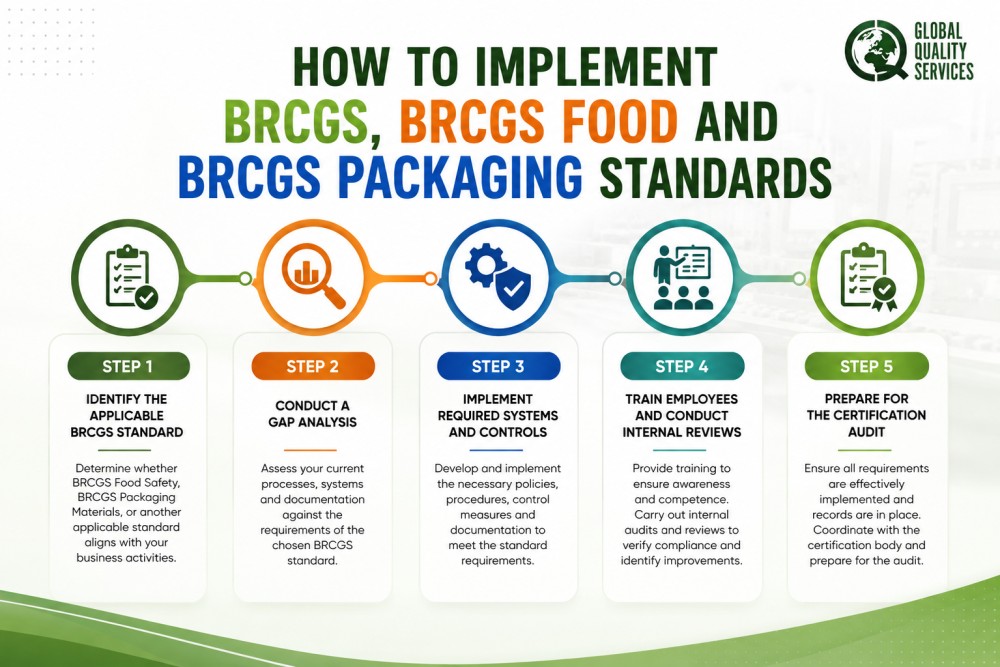
Step 1: Identify the Applicable BRCGS Standard
The first step is determining the BRCGS standard that relates to your organization. It all depends on what your products or operations are, among other things.
Step 2: Conduct a Gap Analysis
Gap analysis will help you compare your current processes and systems with those required by the relevant BRCGS standard.
Step 3: Implement Required Systems and Controls
On the basis of the results obtained from the gap analysis, the organization sets up the required procedures, policies, controls, and records.
Step 4: Train Employees and Conduct Internal Reviews
Implementation is greatly dependent on the employees. The employees must be aware of their roles and adhere to the procedures set out.
Step 5: Prepare for the Certification Audit
Once all the necessary systems have been installed and evaluated, the company can prepare itself for the audit process. Depending on the nature of a business and its operations, other certifications such as ISO 22000, FSSC 22000 and ISO 9001:2026 may also be relevant. These standards can support broader food safety, quality management and operational objectives, with the most suitable certification depending on the organisation’s industry, activities and customer requirements.
BRC IOP Scope and Application
BRC IOP Packaging Standard, which now goes by the name of the BRCGS Packaging Materials Standard, is meant for companies working with manufacturing and processing packaging materials. The standard may be applied to organizations dealing with:
- Manufacturing flexible or rigid packaging
- Producing food-contact packaging materials
- Packaging conversion and processing
- Printing and finishing packaging materials
- Manufacturing packaging components
- Producing packaging for food and consumer products
- Processing and handling packaging materials within controlled operations
The guideline assists in setting up uniform controls during the entire manufacturing process, which shows that the packaging materials are manufactured as per the safety and quality standards.
BRC IOP Certification Requirements
Certification according to the BRCGS Packaging Materials requires that an organization develops and sustains appropriate systems that satisfy the needs of the relevant standard. Although the exact requirements vary based on the relevant standard, the following issues normally feature:
Senior Management Commitment
Management needs to actively help implement and sustain the certification process and make sure that the necessary resources are in place.
Product Safety and Quality Management
The organisation should set up a system for managing the risks that might affect the safety, quality and integrity of its packaging materials.
Risk Assessment and Process Controls
Businesses have to find out the possible threats within their business and take proper measures to control them.
Supplier and Raw Material Management
It is important for suppliers and incoming materials to be appropriately controlled so that the purchased materials comply with the specified criteria.
Product Specifications and Traceability
Effective specification and good traceability processes ensure that companies remain in control of their products and can easily access necessary information.
Site and Production Controls
The production environment, equipment, and operational processes should be appropriately managed to prevent contamination, errors, and quality issues.
Employee Training and Competence
Employees must understand the procedures relevant to their responsibilities and have the necessary knowledge to carry out their work effectively.
Internal Audits and Continual Improvement
Regular internal reviews help businesses identify weaknesses, address non-conformities, and continuously improve their systems.
BRC IOP Benefits
BRC IOP certification, which is usually linked to the BRCGS Packaging Material Standard today, can potentially offer a lot to packaging manufacturers who want to build better processes and gain customer trust. The certification process itself allows organizations to set up a more structured approach to packaging safety and quality management. Key benefits include:
- Improved control over packaging safety and quality
- Better management of manufacturing risks
- Increased confidence among customers and brand owners
- Stronger supplier and raw material controls
- Improved traceability and documentation
- Better consistency across production processes
- Greater readiness for customer and certification audits
- Enhanced business credibility
- Improved opportunities within demanding supply chains
- A structured approach to continual improvement
What is the Difference Between BRCGS, FSSC 22000, SQF, IFS and GFSI
BRCGS, FSSC 22000, SQF, and IFS are various food safety and related certification schemes and standards, and all have their own structure and scope of applications.
On the contrary, GFSI is not a certification scheme itself. It is a body that benchmarks and recognizes eligible food safety certification schemes.
BRCGS is the widely accepted food safety and packaging scheme, whereas FSSC 22000 is a food safety management system that is based on ISO standards and requirements. Also, SQF and IFS are food safety certification schemes.
How to Check BRCGS Certificate Status Online?
The information on the BRCGS certificates can be verified via the official BRCGS Directory and other certification documents.
While verifying the certificate, companies must ensure that critical information like the name of the certified company, location, certification scope, appropriate standard, and validity period of the certificate is cross-checked.
It is imperative not to solely depend on the copies of the certificate supplied by the supplier. Verification of the certificate would help in confirming its relevance to the particular organization and activities/products.
Industries We Serve for BRCGS Certification
Global Quality Services supports businesses across a range of industries in preparing for the applicable BRCGS certification standard, with BRC Consultancy for Packing, Manufacturing, Distribution and other operations that need structured support for safety, quality and supply chain controls:
- Food and Beverage Manufacturing – Food safety and quality management for manufacturers and processors.
- Packaging and Packaging Materials – Support for packaging manufacturers, converters and printers.
- Food Processing – Structured systems for food safety, traceability and process control.
- Food Ingredients and Raw Materials – Quality and safety controls for ingredient manufacturers and suppliers.
- Consumer Products – Certification support based on applicable BRCGS requirements.
- Storage and Distribution – Controls for businesses handling and managing products across the supply chain.
- Retail and Private Label Suppliers – Support for meeting retailer and customer certification requirements.
How Global Quality Services Supports Your BRCGS Certification Journey
Getting ready for BRCGS can feel complicated, especially for companies that need to understand intricate requirements and identify operational gaps to ensure the new system works properly.
At Global Quality Services, we focus on making this process as practical as possible. Thanks to our 26 years of experience, we know that each company has its own way of operating and needs a customized implementation approach. We can help you with:
- Understanding the applicable BRCGS standard
- Identifying the appropriate certification scope
- Conducting a detailed gap assessment
- Reviewing existing systems and processes
- Supporting documentation development
- Helping implement practical operational controls
- Providing employee awareness and implementation support
- Conducting internal readiness assessments
- Preparing the organisation for the certification audit
Strengthen Your Market Position with Globally Recognised BRCGS Certification
BRCGS certification is an effective means of ensuring that you can gain better control over the safety, quality and efficiency of your products, as well as increased confidence from both your clients and supply chain members.
Global Quality Services offers assistance in helping businesses recognize the relevant requirements and necessary gaps that will ensure successful preparation for certification.
Develop your system, increase your credibility, and plan your certification path with Global Quality Services.
Frequently Asked Questions
1. How long does it take to get BRCGS Packaging Materials certification in India?
The timeline depends on your organisation’s size, existing systems, and readiness. Businesses with established controls can typically prepare faster.
2. What documents are required for BRCGS Packaging Materials certification?
Common requirements include documented procedures, risk assessments, product specifications, supplier records, traceability documents, and employee training records.
3. How much does BRC IOP certification cost in India?
The cost depends on factors such as your facility size, business operations, certification scope, and audit requirements. A customised quotation provides the most accurate estimate.
4. How often does a BRCGS Packaging Materials certificate need to be renewed?
Organisations must undergo regular audits to maintain their certification. The audit frequency depends on the applicable BRCGS certification programme and audit requirements.
5. Can a small packaging manufacturer get BRCGS Packaging Materials certification?
Yes. Small packaging manufacturers can pursue certification if their operations fall within the applicable standard and they can meet its relevant requirements.