Road safety has moved beyond individual motorists’ concerns and road authority regulations. Organizations engaged in the operation of commercial vehicles, logistics activities, fleet management, or road-based transportation are increasingly realizing the significance of managing road accidents as part of good corporate practice. Such considerations cannot be ignored in the Indian context. As per data published by the Ministry of Road Transport & Highways, 1,77,175 lives were lost due to road accidents in India during 2024.
ISO 39001 Certification in India offers an opportunity to establish a robust Road Traffic Safety Management System framework aimed at identifying road safety hazards, controlling them, and continuously improving road safety performance levels within organizations. This approach allows systematic management of risk factors such as driver behavior, vehicles, roads/routes, emergencies, and many others that may result in road accidents.
In transport and logistics-related businesses, ISO 39001 Certification can be a valuable tool for demonstrating commitment to safe operations and continuous improvements thereof. Read further to get detailed insights into the requirements, benefits, certification process, and more.
What is ISO 39001 Certification
ISO 39001 Certification means that the organization has put in place a systematic Road Traffic Safety Management System (RTSMS), which involves hazard identification, risk prevention measures, and enhanced road safety performance.
Among other things, the system facilitates effective control over driver behavior, safe vehicle operation, proper trip planning, accident preparedness and response, and various traffic hazards. There is also a focus on establishing safety targets, educating staff members, assessing performance results, and ongoing improvements.
Understanding ISO 39001:2012
ISO 39001 is the International Standard on Road Traffic Safety Management Systems. The standard offers a framework for risk identification, control, monitoring, and mitigation to decrease the chances of major incidents on roads.
- Mitigate risks in road safety: Identify and manage any hazards related to accidents.
- Enhance safety for drivers and fleets: Enhance training, maintenance, and safe driving procedures.
- Maintain legal compliance: Keep road traffic procedures up to date with relevant legislation.
- Lower operating expenses: Prevent accidents, minimize downtime, and reduce losses.
- Enhance reputation among clients: Communicate your dedication to safer transportation services.
- Continuously improve: Track safety performance and enhance controls regularly.
Why ISO 39001 Matters for Modern Organisations
Road traffic risk goes far beyond drivers. Road accidents may cause property damage, disruption of supply chains, worker injuries, litigation, and unforeseen expenses. ISO 39001 encourages companies to adopt proactive strategies toward road traffic risk management rather than reacting to incidents. It embeds road safety considerations within routine organizational decision-making processes related to fleet operations, driver behavior, journey planning, and emergency preparedness.
Some of the key benefits of implementing ISO 39001 include:
- Improved risk management: You can anticipate risky behaviors, routes, vehicles, and driving patterns that may eventually cause significant incidents by identifying them ahead of time.
- Enhanced transport operations: Standardized processes for drivers, vehicles, and trips allow for safer processes throughout your company.
- Less disruption: Improved road safety management leads to fewer accidents, vehicle breakdowns, failed deliveries, and disruptions to business operations.
- Better accountability: With assigned roles and clear goals for road safety performance, managers find it easier to monitor progress.
- More stakeholder trust: Certification demonstrates to customers, staff members, contractors, and other business partners that road safety management is taken seriously as a strategic concern within your organization.
Industries That Benefit from ISO 39001 Certification
ISO 39001 can benefit any organisation where road travel, fleet operations, or transport activities are a regular part of business. It is particularly useful for:
- Logistics and transport companies managing commercial vehicles and long-distance journeys.
- Taxi and ride-hailing services where driver and passenger safety are central to daily operations.
- Public transport organisations operating buses and other passenger vehicles.
- Delivery and courier companies handling frequent, time-sensitive vehicle movements.
- Construction and infrastructure companies using heavy vehicles, equipment, and transport fleets.
- Corporate organisations with large employee transport systems or frequent business travel.
- Fleet-based businesses that depend on multiple vehicles for sales, service, distribution, or field operations.
Key Requirements of ISO 39001 Certification
The standard outlines essential organisational, operational, and monitoring requirements that help you build a safer and more accountable traffic management framework.
Main Requirements Include
- RTS policy defines your commitment
- Risk assessment and performance planning
- Measurable safety indicators
- Driver training and awareness
- Vehicle maintenance protocols
- Data monitoring and accident reporting
- Regular audits and continuous improvement
Documentation Needed
- RTS manual
- Policy statements
- Legal compliance records
- Accident and incident data
- Training and competency records
- Monitoring and evaluation reports
ISO 39001 Certification Audit
An ISO 39001 certification audit evaluates if an organization’s Road Traffic Safety Management System complies with the relevant requirements of the standard and has been properly implemented. In practice, this involves reviewing documentation, road traffic safety objectives, risk management measures, operations, performance results, employee awareness, and findings from internal audits.
A certification audit is performed by an accredited certification body. Should any nonconformities be found, organizations need to correct them according to the certification body’s requirements before proceeding with certification.
What Happens After ISO 39001 Certification
Road safety management certification does not conclude the process but requires continuous maintenance and improvement during the entire certification period. Continuous improvement refers to:
- Monitoring road traffic safety objectives and performance indicators
- Conducting internal audits at planned intervals
- Reviewing accidents, incidents, and identified risks
- Implementing corrective actions where required
- Conducting management reviews
- Maintaining relevant records and documented information
- Preparing for surveillance audits
- Updating controls when operations, risks, or applicable requirements change
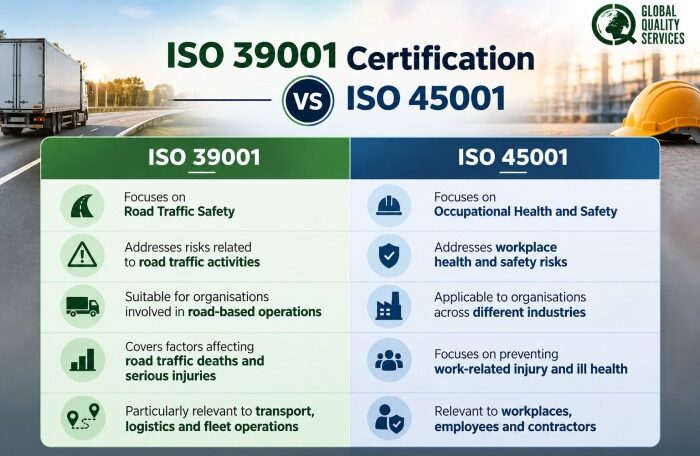
ISO 39001 Certification vs ISO 45001
ISO 39001 and ISO 45001 both address safety, but they have different areas of focus:
Step-by-Step ISO 39001 Certification Process
Here are the five stages of the process. The certification process under ISO 39001 starts by evaluating the current practices around road traffic safety within your organization, putting in place controls that meet those standards, and getting ready for an external certification audit. The steps are:
Step 1: Gap Assessment and Road Traffic Safety Risks Evaluation
Evaluates existing road traffic safety practices compared to the requirements under ISO 39001. Identifies important risks in relation to drivers, vehicles, routes, trips/journeys, and organizational activities.
Step 2: RTSMS Documentation and Implementation
Develops documentation including policy statements, procedure documents, objectives, risk control measures, and record-keeping systems based on organizational activities.
Stage 3: Training & Employee Awareness
Driving personnel and employees are trained regarding road safety policies, responsibilities, procedures, emergency action, and the organisational goals of the Road Traffic Safety Management System.
Stage 4: Internal Audit & Management Review
The implemented Road Traffic Safety Management System undergoes internal audits to determine any weaknesses or nonconformities. Afterward, the management performs reviews of the effectiveness and improvements needed within the system.
Stage 5: Certification Audit & Certification Decision
A certification body independently performs the audit process in order to assess conformity against the criteria set out in ISO 39001. Upon completing these processes successfully and making the certification decision, the organisation obtains its ISO 39001 Certification.
Benefits of ISO 39001 Certification
This certification enables safer roads, cost savings, and improved risk management while strengthening your organisation’s operational reliability.
Key Advantages
- Reduced road accidents and injuries
- Lower vehicle downtime and repair expenses
- Better driver accountability
- Higher compliance with traffic regulations
- Stronger insurance negotiations
- Improved stakeholder trust
Common Challenges and How to Overcome Them
Organisations often struggle with implementation, training, or data tracking, but these challenges can be resolved with the right approach and expertise.
Typical Challenges
- Poor data collection
- Inconsistent driver behaviour
- Limited internal resources
- Weak documentation
- Lack of continuous monitoring
Practical Solutions
- Use digital tools for tracking
- Conduct frequent training
- Align internal teams early
- Establish strong reporting workflows
- Hire consultants for expert guidance
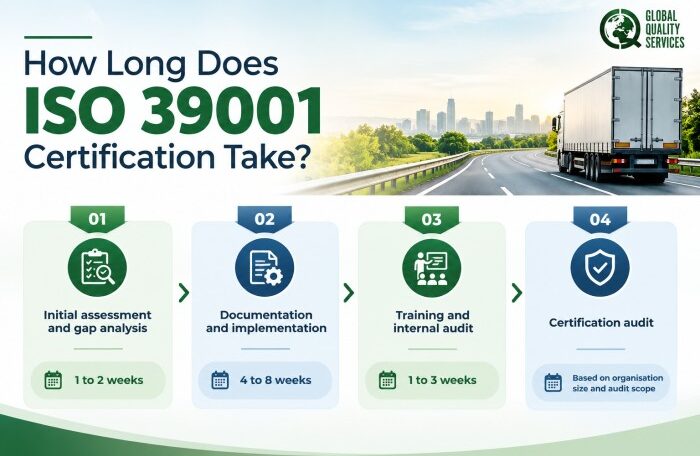
How Long Does ISO 39001 Certification Take
ISO 39001 certification process duration varies widely depending on organisational size, number of sites, fleets, current safety management approach, documentation readiness, and audit scope. For organisations with an already-existing management system, the implementation phase will be shorter compared to those without. Implementation activities include:
Cost of ISO 39001 Certification in India
The cost of ISO 39001 Certification in India is not fixed. It depends on the scope and complexity of the organisation’s road traffic safety operations. Key factors include:
- Number of employees and drivers
- Fleet size and type of vehicles
- Number of operating locations
- Complexity of transport activities
- Existing management systems
- Certification audit duration
- Consultant and implementation requirements
- Certification body fees
ISO 39001 Certification Validity
ISO 39001 Certification occurs after a series of surveillance audits within a three-year certification period. The certification expires at the end of the three years unless there is successful surveillance and compliance with the standard throughout the certification period.
If the organization maintains its certification after the three-year certification period ends, then it goes through a recertification process.
Can ISO 39001 Be Integrated With Other ISO Standards
Absolutely. There is potential overlap between ISO 39001 and other management systems in organizations when the processes involved intersect. For example, the organization can use its internal audit process, document management process, management review process, corrective and preventive process, risk management process, and continuous improvement process across all of them.
Organizations could combine ISO 39001 with:
- ISO 9001 for quality management.
- ISO 14001 for environmental management.
- ISO 45001 for occupational health and safety management.
- ISO 27001 for information security management.
ISO 39001 Certification in Major Indian Cities
ISO 39001 Certification is a service offered by Global Quality Services that assists businesses across various industries and regions of India. Here are some examples of organizations we assist:
- Delhi
- Noida
- Hyderabada
- Mumbai
- Pune
- Chennai
- Ahemdabad
- Bengaluru
Summary Points
- ISO 39001 Certification establishes a structured Road Traffic Safety Management System that helps organisations reduce accidents and improve transport safety performance.
- It strengthens driver behaviour, vehicle safety, and operational discipline through risk assessments, defined safety objectives, and continuous monitoring practices.
- Certification boosts compliance with road safety regulations and enhances credibility with clients, regulators, and insurers.
- It reduces operational disruptions, accident-related costs, and long-term liabilities by controlling high-risk traffic activities.
- In a world prioritising safe mobility, ISO 39001 helps organisations create safer roads, protect lives, and build a responsible, future-ready safety culture.
Why Work with Global Quality Services for ISO 39001 Certification
ISO 39001 implementation becomes much simpler when there’s someone guiding you through the process who actually understands the practical application of management systems within organizations instead of simply following what’s written on paper. The consulting experience provided by Global Quality Services has been accumulated over decades while gaining practical insights into a variety of industries.
- Over 26 years of Expertise: Many years advising companies on ISO consulting services within various sectors.
- Expert Consultants: Advisors who know ISO requirements and understand what it takes to obtain ISO certifications.
- Sector Insights: Recommendations tailored to suit different company structures, risk profiles, and sector-specific requirements.
- Down-to-earth Consulting: Practical advice about how to implement ISO policies that can work in practice.
- Nationwide Reach: Consulting services provided throughout the country for leading organizations.
- Straightforward Advising: ISO regulations demystified for easy understanding.
- Respected ISO Consultants: An established brand for any organization looking for professional ISO certification advice.
Get Professional ISO 39001 Certification Support in India
ISO 39001 Certification is not just about getting your documentation ready for an audit. For ISO 39001 Certification, your organization must have a Road Traffic Safety Management System tailored to your specific drivers, fleet, routes, risks, and operational environment. Global Quality Services offers full consultancy and support for ISO 39001 Certification from gap analysis through documentation, implementation, training, internal audit, corrective action, and certification audit preparation. Professional help for building a systematic approach to road traffic safety and achieving ISO 39001 Certification becomes much easier.
Frequently Asked Questions
1. Is ISO 39001 limited to businesses that operate fleets of vehicles?
No, not necessarily. Whether ISO 39001 applies to your business depends upon its operations, interaction with the road traffic environment, and capacity to impact safety performance outcomes.
2. Can a small transportation firm seek ISO 39001 Certification?
A: Yes. You can implement ISO 39001 even if you’re a small operation. The key is to make sure that your management system aligns appropriately with your organizational context, size, risks, and certification objectives.
3. Is ISO 39001 a replacement for driver training programs?
A: No. ISO 39001 doesn’t replace existing legislative requirements regarding licensing or statutory training courses. Instead, it establishes a management framework for assessing competencies, setting up proper controls, and measuring road safety performance.
4. Does ISO 39001 mandate the elimination of all road accidents within an organization?
No, this cannot be guaranteed by any management system. ISO 39001 gives organizations a structure to identify risks associated with road traffic safety, set goals around these risks, track performance against those goals, and mitigate risks of severe road traffic accidents.
5. Can an organization with an existing ISO certification adopt ISO 39001?
Yes. Organizations with existing management systems based on other ISO standards may adopt ISO 39001 clauses within their management systems wherever applicable. Existing practices related to auditing, management review, correction of problems, and continuous improvement may form a base for implementation.