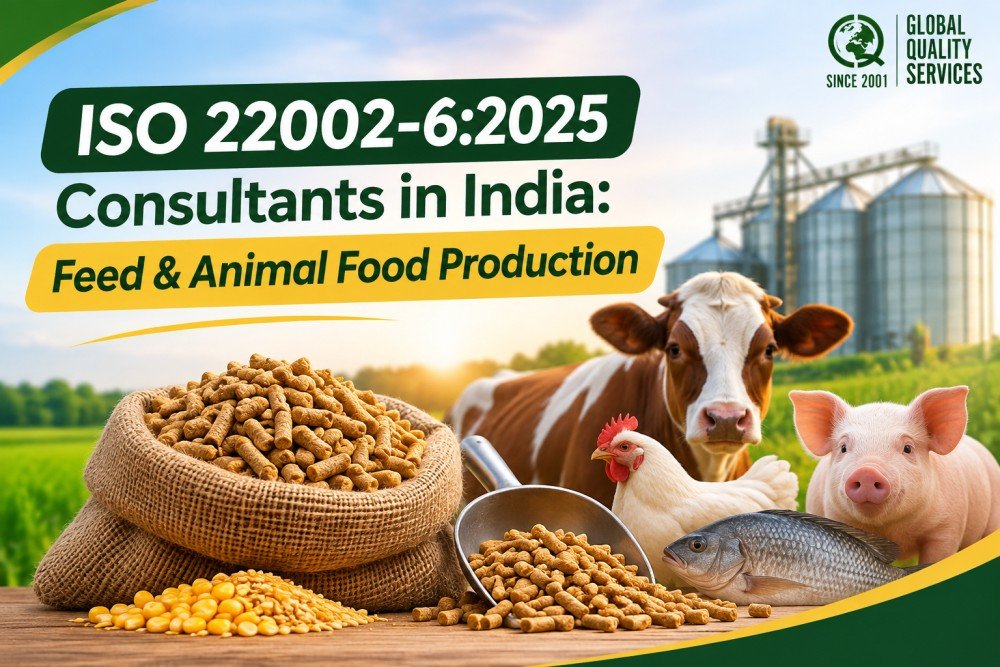
Animal feed manufacturers must ensure their products are safe for livestock. Contaminated ingredients, poor storage, incorrect formulations, and unhygienic equipment can affect animal health and create risks across the food supply chain. ISO 22002-6:2025 sets out prerequisite program requirements for organizations involved in feed and animal food production.
According to the Alltech Agri-Food Outlook 2026, India produced 57.729 million metric tons of compound feed in 2025, a 4.5% increase over the previous year. As the industry grows, manufacturers need better control over raw materials, production hygiene, and finished feed. Global Quality Services helps businesses understand and implement these requirements as ISO 22002-6:2025 consultants in India. Read on to learn what the standard covers and how our consultants can help your business prepare for compliance.
What Is ISO 22002-6:2025
ISO 22002-6:2025 is an international standard titled Prerequisite Programmes on Food Safety: Part 6: Feed and Animal Food Production. Published in July 2025, it specifies the prerequisite programs (PRPs) that feed and animal food manufacturers need to control production-related safety hazards.
The standard replaces ISO/TS 22002-6:2016 and works alongside ISO 22002-100:2025, which covers common prerequisite program requirements.
It addresses practical production concerns such as raw material handling, equipment hygiene, contamination prevention, storage, and product traceability. Manufacturers use these requirements alongside ISO 22000 to establish suitable food safety controls.
ISO 22002-6:2025 is a supporting standard for prerequisite programs, not a standalone management system certification.
Why Do Feed Manufacturers in India Need ISO 22002-6:2025
India’s dairy, poultry, livestock, and aquaculture industries depend on a steady supply of safe animal feed. Manufacturers must control the quality of ingredients and maintain suitable production conditions to protect animals and meet customer expectations. Such problems can lead to rejected products, customer complaints, animal health concerns, and financial losses. Implementing ISO 22002-6:2025 helps manufacturers:
- Control the quality of incoming feed ingredients.
- Reduce contamination during manufacturing and storage.
- Separate batches intended for different animal species.
- Manage veterinary drug residues and chemical hazards.
- Improve hygiene across feed mills and production equipment.
- Maintain batch records and product traceability.
- Meet the safety expectations of domestic and international buyers.
Which Businesses Need ISO 22002-6:2025 in India
The standard applies to organizations involved in feed and animal food production, regardless of their size or production capacity.
- Animal feed manufacturers
- Poultry feed manufacturers
- Dairy and cattle feed producers
- Aquaculture feed manufacturers
- Pet food manufacturers
- Feed ingredient processors
Key Requirements of ISO 22002-6:2025 for Feed Production
ISO 22002-6:2025 covers sector-specific prerequisite programs for feed and animal food production. Manufacturers must apply these requirements with the common PRPs specified in ISO 22002-100:2025. The main areas include:
1. Facility Design and Production Layout
Production facilities must support hygienic operations. The layout should allow suitable movement of raw materials, employees, and finished products while reducing contamination risks.
2. Equipment Cleaning and Maintenance
Manufacturers must maintain mixers, conveyors, silos, grinders, and other production equipment. Regular cleaning and maintenance help prevent material buildup and contamination.
3. Raw Material and Supplier Controls
Organizations need suitable checks for incoming grains, oilseeds, protein sources, minerals, additives, and other ingredients. Supplier approval, material specifications, and acceptance checks help prevent unsafe ingredients from entering production.
4. Animal Feed Hazard Management
Manufacturers must identify and control biological, chemical, and physical hazards. These may include mycotoxins, harmful microorganisms, pesticide residues, heavy metals, veterinary drug residues, and foreign materials.
5. Veterinary Drug Residue and Chemical Controls
Businesses must assess the risk of veterinary drug residues and other chemical contaminants entering feed. Supplier checks, ingredient specifications, segregation, and equipment cleaning help control these risks.
6. Species-Specific Batch Segregation
Different animal species require different feed formulations. Manufacturers must prevent unwanted mixing between batches through suitable production planning, identification, segregation, and equipment cleaning.
7. Specialized Feed Mill Hygiene
Feed mills need cleaning arrangements that address dust, pests, moisture, and leftover materials. Silos, mixers, conveyors, and transfer points require particular attention.
8. Storage, Transportation, and Traceability
Raw materials and finished feed must remain protected during storage and transportation. Manufacturers also need batch records that connect incoming ingredients with finished products so they can trace materials when a safety issue occurs.
9. Employee Hygiene and Training
Employees involved in production, cleaning, maintenance, and storage must understand the hygiene practices relevant to their work. Regular training helps them follow the required procedures.
Understanding the Framework: Tier 2 Sector Addendum
The prerequisite program framework has two connected layers. ISO 22002-100:2025 covers common requirements, while ISO 22002-6:2025 adds controls specific to feed and animal food production.
Tier 1: Common Prerequisite Programs
ISO 22002-100:2025 covers general requirements such as facility hygiene, cleaning, pest management, personnel hygiene, equipment maintenance, and storage.
Tier 2: Sector-Specific Addendum
ISO 22002-6:2025 addresses the additional requirements that apply to feed manufacturers. The main areas include:
- Animal feed hazards: Identification and control of biological, chemical, and physical hazards.
- Raw material controls: Supplier approval, ingredient specifications, and incoming inspections.
- Veterinary drug residue containment: Measures to prevent unwanted residues and chemical contamination.
- Species-specific batch segregation: Separation and identification of feed batches for different animal species.
- Specialized mill hygiene: Dust control, equipment cleaning, pest prevention, and production area hygiene.
Manufacturers must address both layers when developing their prerequisite programs.
How to Implement ISO 22002-6:2025 in Your Organization
Global Quality Services follows a five-step approach to help food manufacturers review their existing practices and implement the applicable requirements:
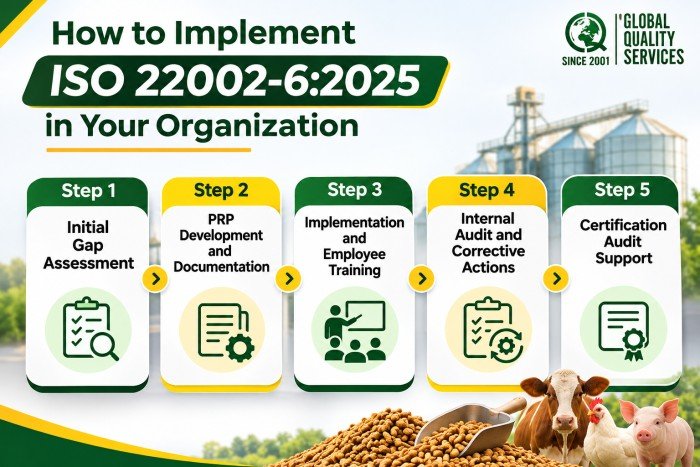
Step 1: Initial Gap Assessment
Our consultants review your facility, raw material handling, production equipment, storage practices, and existing hygiene controls. We identify areas that need improvement against the standard.
Step 2: PRP Development and Documentation
We help prepare or update procedures for supplier approval, raw material inspection, cleaning, pest control, equipment maintenance, batch segregation, and traceability.
Step 3: Implementation and Employee Training
We guide your team in applying the documented procedures during daily production and train employees according to their responsibilities.
Step 4: Internal Audit and Corrective Actions
Our consultants help review the implemented controls through internal audits. We identify nonconformities and guide your team in taking corrective actions.
Step 5: Certification Audit Support
We help your organization prepare for the relevant external assessment by reviewing records, checking audit readiness, and guiding your team on corrective action responses.
ISO 22002-6:2025 and Other Food Safety Standards
ISO 22002-6:2025 works alongside other food safety standards. ISO 22000:2018 establishes the food safety management system requirements, while ISO 22002-100:2025 covers common prerequisite programs and ISO 22002-6:2025 addresses feed and animal food production.
Businesses looking for a wider food safety certification framework can also explore FSSC 22000 Certification Consultants in India.
Organizations interested in the common prerequisite program requirements can refer to ISO 22002-100:2025 Consultants in India.
How Global Quality Services Experts Help You with ISO 22002-6:2025
Global Quality Services is a reputed consultant in India with experience in ISO certification, food safety management, and compliance consulting. Our team works with businesses across different industries and understands the requirements involved in management system implementation. Our consulting strengths include:
- Over 26 years of experience in ISO consultancy and compliance support.
- Early consultant approvals under NABET and NRBPT programs associated with the Quality Council of India, as stated in our company history.
- Experience with international standards, including ISO 22000 and FSSC 22000.
- Qualified professionals and lead auditors with management system experience.
- Practical knowledge of food safety documentation and internal auditing.
- Industry-specific guidance based on each organization’s production activities.
- Support from the initial assessment through implementation and audit preparation.
- Nationwide consulting support for businesses across India.
We help your employees understand the requirements and follow the necessary practices during production. This gives management a clearer way to monitor compliance and maintain the system.
Get ISO 22002-6:2025 Consultancy for Your Feed Manufacturing Business
Global Quality Services helps feed and animal food manufacturers understand the requirements of ISO 22002-6:2025, review their existing practices, and prepare for implementation and assessment. Our consulting presence extends across several Indian cities, including Delhi, Ahmedabad, Noida, Bangalore, Mumbai, Pune, Chennai, and Hyderabad.
Contact Global Quality Services to discuss your facility’s requirements and arrange a consultation. Our team will help you identify compliance gaps and plan the necessary steps for your feed safety management system.
Frequently Asked Questions
1. Is ISO 22002-6:2025 a certification standard?
No. It specifies prerequisite program requirements for feed and animal food production. Organizations use it alongside ISO 22002-100:2025 within their wider food safety management arrangements.
2. Does ISO 22002-6:2025 apply to small feed manufacturers?
Yes. It applies to organizations of different sizes and production capacities. Requirements should reflect the activities and risks involved.
3. How should manufacturers manage feed for different animal species?
Manufacturers should assess cross-contamination risks and use suitable production planning, batch identification, segregation, and equipment cleaning procedures.
4. Does ISO 22002-6:2025 cover pet food manufacturing?
Yes. Its scope includes relevant animal food production activities, including pet food manufacturing.
5. Can an ISO 22000-certified manufacturer implement ISO 22002-6:2025?
Yes. An existing ISO 22000-certified manufacturer can review its current prerequisite programs and update them to address the applicable requirements of ISO 22002-100:2025 and ISO 22002-6:2025.