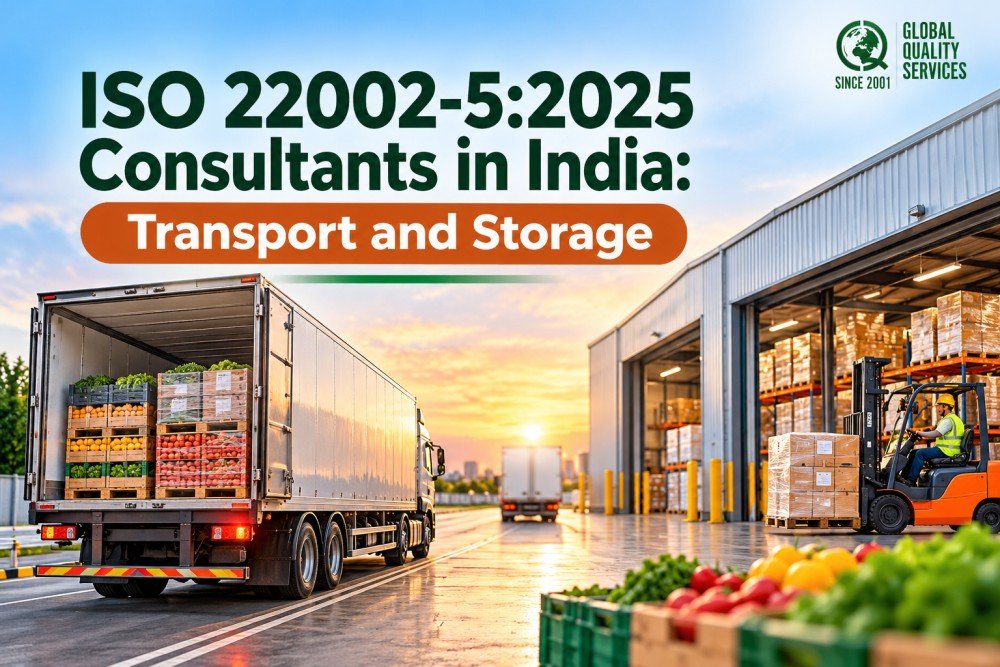
Food safety does not end when products leave the manufacturing facility. Transportation, warehousing, cross-docking, and distribution all create risks that can affect product quality and consumer safety. A poorly maintained vehicle, incorrect storage temperature, pest activity, or contact between incompatible loads can compromise an entire shipment.
This makes a structured food safety system essential for businesses handling food products across India. ISO 22002-5:2025 Consultants in India help organizations establish the right prerequisite programs (PRPs) for controlling these risks throughout transport and storage activities. According to the Ministry of Food Processing Industries, India had approved 404 integrated cold chain projects under the PMKSY scheme, of which 300 had been completed as of December 5, 2025.
This growing infrastructure makes consistent food safety controls even more important. Read ahead to understand the standard’s requirements and how Global Quality Services can help your business meet them.
What Is ISO 22002-5:2025 for Transport and Storage
ISO 22002-5:2025 is an international standard that specifies prerequisite program requirements for controlling food safety hazards during transportation and storage activities. It covers organizations that handle food, ingredients, raw materials, and food packaging materials while these products are in their custody.
The standard addresses food safety risks that can arise during loading, unloading, transportation, warehousing, cross-docking, and transshipment. Its purpose is to ensure that products remain protected from contamination and other hazards until they reach the next stage of the supply chain.
ISO 22002-5:2025 works alongside ISO 22000 and ISO 22002-100:2025. While ISO 22000 establishes the overall food safety management system, ISO 22002-100 provides common prerequisite requirements, and ISO 22002-5 addresses the specific needs of transport and storage operations.
Organizations must consider the requirements according to their activities, products, facilities, and operational risks.
Why Do Indian Transport and Storage Businesses Need ISO 22002-5:2025
India’s food distribution network depends on transporters, cold storage operators, warehouses, logistics providers, and distribution companies. These businesses play an important role in protecting food products between manufacturing and consumption.
However, food safety risks can arise at several points during this journey. ISO 22002-5:2025 helps organizations establish consistent controls for these situations. Here is why adopting the standard matters:
- Better Control Over Food Safety Hazards: Identify and control biological, chemical, and physical hazards during storage and transportation.
- Improved Temperature Management: Maintain suitable storage and transportation conditions for products that require temperature control.
- Reduced Cross-Contamination Risks: Prevent contact between incompatible products, contaminated materials, allergens, and food items.
- Stronger Warehouse Hygiene: Establish suitable cleaning, sanitation, pest management, and housekeeping practices.
- Improved Supply Chain Confidence: Demonstrate that your organization follows recognized food safety practices when handling customer products.
- Better Customer and Buyer Confidence: Meet the food safety expectations of manufacturers, retailers, food processors, and international supply chain partners.
- Stronger Operational Controls: Maintain consistent procedures across vehicles, warehouses, loading areas, and distribution facilities.
Who Needs ISO 22002-5:2025 Compliance in India?
ISO 22002-5:2025 applies to organizations involved in food transportation and storage, regardless of their size or operational complexity. The following businesses can benefit from implementing its requirements:
- Food Transportation Companies
- Cold Storage Facilities
- Third-Party Logistics Providers
- Food Warehouses
- Refrigerated Transport Operators
- Distribution Centers
- Cross-Docking Facilities
- Food Importers and Exporters
- Food Supply Chain Companies
Key Requirements of ISO 22002-5:2025 for Transport and Storage
ISO 22002-5:2025 establishes sector-specific prerequisite program requirements to address food safety risks during transportation and storage. Organizations must apply controls according to the products they handle, their operating conditions, and the activities performed at each facility.
The standard works alongside ISO 22002-100:2025, which establishes common prerequisite program requirements. The following are important areas that transport and storage businesses must address:
1. Logistics Hazard Identification
Organizations must identify biological, chemical, and physical hazards that may affect food products during transportation, storage, loading, unloading, and distribution. They should assess risks associated with vehicle conditions, handling practices, storage environments, and product movement.
2. Vehicle Hygiene and Maintenance
Vehicles, containers, and equipment must remain clean, suitable, and properly maintained. Organizations should establish cleaning schedules, inspect vehicles before loading, and prevent contamination from residues, pests, chemicals, and previously transported materials.
3. Warehouse Hygiene and Sanitation
Storage facilities must maintain suitable hygiene conditions to protect food products. This includes regular cleaning, proper housekeeping, suitable drainage, effective waste management, and appropriate sanitation practices. Organizations must also ensure that warehouse structures and storage arrangements do not create contamination risks.
4. Temperature Control During Transportation and Storage
Businesses handling chilled, frozen, or temperature-sensitive products must maintain suitable temperature conditions throughout transportation and storage. Temperature monitoring should cover loading, transit, unloading, temporary storage, and cross-docking activities. Organizations must also establish appropriate responses to temperature deviations.
5. Prevention of Mixed-Load Contamination
When transporting different products together, businesses must prevent contamination between incompatible loads. Food products should be appropriately segregated from chemicals, waste, allergens, and other materials that may affect their safety. Suitable separation and handling arrangements help protect product integrity.
6. Loading and Unloading Controls
Organizations must establish suitable procedures for loading and unloading food products. These activities should protect goods from environmental exposure, damaged packaging, contaminated surfaces, and improper handling. Loading areas and handling equipment must also remain suitable for food-related operations.
7. Cross-Docking and Transshipment Controls
Cross-docking facilities must protect food products during transfers between incoming and outgoing vehicles. Businesses should minimize unnecessary exposure, maintain required temperature conditions, and prevent product mix-ups or contamination during temporary holding and handling.
8. Pest Management
Warehouses, storage areas, vehicles, and loading facilities must have suitable pest prevention and monitoring arrangements. Organizations should identify possible pest entry points, maintain clean surroundings, and take corrective action when pest activity is detected.
9. Product Protection and Storage Conditions
Food products must be protected from contamination, physical damage, moisture, unsuitable environmental conditions, and improper handling. Organizations should establish suitable storage arrangements based on product characteristics, packaging, and handling requirements.
10. Personnel Hygiene and Training
Employees involved in food transportation, warehouse operations, loading, unloading, and product handling must follow suitable hygiene practices. Organizations should provide relevant training so workers understand contamination risks and their responsibilities in maintaining food safety.
11. Cleaning and Sanitation Procedures
Businesses must establish suitable cleaning and sanitation arrangements for vehicles, containers, equipment, storage areas, and handling surfaces. Cleaning activities should be performed at appropriate intervals, with records maintained where required.
12. Traceability and Operational Records
Organizations should maintain relevant records for product identification, storage conditions, temperature monitoring, cleaning, vehicle inspections, and other applicable food safety controls. Proper records help businesses investigate issues and demonstrate that established procedures are being followed.
Understanding the Framework Layer: Tier 2 Sector Addendum
ISO 22002-5:2025 serves as the Tier 2 sector addendum for transport and storage. It builds on the common prerequisite program requirements established under ISO 22002-100:2025.
This structure allows organizations to address general food safety conditions while adding controls that reflect the risks of their specific operations.
For example, a food warehouse must maintain suitable storage conditions and prevent pest activity. A refrigerated transport company must also monitor temperature conditions throughout the journey. Similarly, a cross-docking facility must prevent product exposure and contamination during short-term transfers between vehicles.
The combination of common and sector-specific requirements helps organizations establish a food safety system that addresses the actual risks within their logistics operations.
How to Implement ISO 22002-5:2025 in Your Organization
Implementing ISO 22002-5:2025 requires organizations to establish suitable prerequisite programs and integrate them with their existing food safety management arrangements. Global Quality Services follows a structured five-step consultancy approach to help businesses address the applicable requirements:
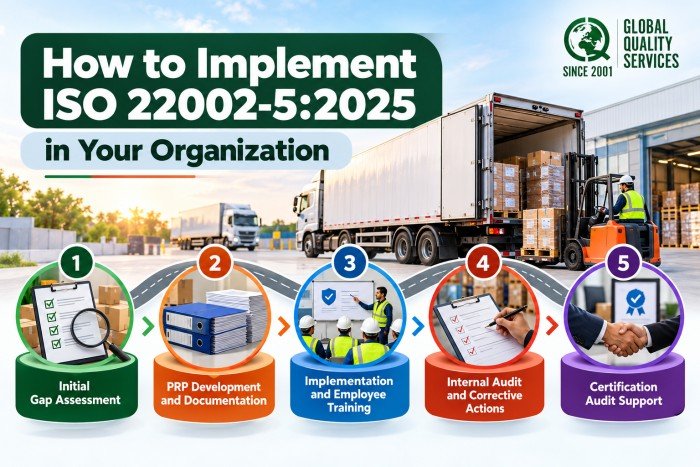
Step 1: Initial Gap Assessment
Our consultants review existing transportation, warehouse, hygiene, temperature, and contamination controls against the applicable standard requirements. This helps identify areas that need attention before implementation.
Step 2: PRP Development and Documentation
We help prepare relevant procedures, operating controls, monitoring formats, and supporting records based on your organization’s activities and food safety risks.
Step 3: Implementation and Employee Training
We guide your team in applying the required controls across vehicles, storage facilities, loading areas, and distribution operations. Employee training helps ensure that staff understand their responsibilities.
Step 4: Internal Audit and Corrective Actions
Our consultants support internal audits to identify gaps and nonconformities. We guide your team in developing corrective actions and addressing outstanding issues before the external assessment.
Step 5: Certification Audit Support
We help prepare your organization for the applicable certification assessment and support communication with the selected certification body. The certification decision remains the responsibility of the independent certification body.
The implementation period depends on the organization’s size, number of facilities, operational complexity, existing food safety arrangements, and readiness.
How Global Quality Services Experts Help You with ISO 22002-5:2025 Consultants in India
Global Quality Services is a reputed consultant with over 26 years of experience in ISO consultancy, management system implementation, compliance, and auditing support. Since 2001, we have supported organizations across different industries in establishing and improving systems that meet international requirements.
Our experience in food and pharmaceutical consultancy, combined with our work in ISO management system standards, gives us a strong foundation for supporting businesses handling food products across the supply chain.
Why choose Global Quality Services:
- Over 26 years of experience in ISO consultancy and compliance support.
- Established consulting background since 2001.
- Experience supporting food and pharmaceutical industry organizations.
- Previous consultancy engagements involving recognized organizations such as Pepsi, Coke, AstraZeneca, and Indo Nissin, as listed in our company portfolio.
- Industry-focused consultants with practical knowledge of food safety management systems.
- Customized documentation based on actual business operations.
- Focus on practical compliance rather than unnecessary paperwork.
- Support for management system implementation, employee training, internal audits, and audit readiness.
- Consultancy support for businesses operating across different locations in India.
- Continued assistance focused on maintaining and improving management system performance.
Our objective is to help your organization establish food safety controls that work in everyday operations, not just during an audit. We focus on understanding your business requirements and providing the guidance needed to build a reliable and effective system.
Related Food Safety Standards and Consultancy Pages
Businesses involved in food transportation and storage may also need to consider other food safety management requirements, depending on their role in the supply chain.
- ISO 22000 Certification in India: Covers the overall food safety management system requirements for organizations across the food chain.
- ISO 22002-4:2025 Consultancy in India: Addresses prerequisite programs for food and feed packaging manufacturing.
Get Expert ISO 22002-5:2025 Consultancy Support Across India
Protecting food products during transportation and storage requires more than basic vehicle maintenance and warehouse cleaning. Your organization needs suitable food safety controls, trained employees, reliable monitoring practices, and a management system that addresses risks at every handling stage.
Partner with Global Quality Services, a reputed ISO consultant with over 26 years of experience, to establish and strengthen your ISO 22002-5:2025 compliance framework. Our consulting team will help you identify operational gaps, develop suitable prerequisite programs, and prepare your organization for the applicable certification assessment.
We provide consultancy support across India, with a presence in Delhi, Ahmedabad, Noida, Bangalore, Mumbai, Pune, Chennai, and Hyderabad.
Contact Global Quality Services today to discuss your transport and storage operations, receive a consultancy assessment, and take the next step toward a stronger food safety management system.
Frequently Asked Questions
1. Is ISO 22002-5:2025 applicable to companies that outsource transportation?
Yes. Organizations must assess how outsourced transportation activities affect food safety and establish suitable controls over the activities within their responsibility. Relevant supplier and service-provider arrangements should address applicable food safety requirements.
2. Does ISO 22002-5:2025 cover food packaging materials during transportation?
Yes. The standard covers relevant transportation and storage activities involving food, ingredients, raw materials, and packaging materials within its scope. Organizations must protect these materials from contamination and unsuitable handling conditions.
3. Can a company apply ISO 22002-5:2025 to multiple warehouses and distribution centers?
Yes. Organizations operating multiple facilities can establish a common food safety framework while addressing the specific risks, activities, and conditions at each location.
4. Does ISO 22002-5:2025 cover refrigerated and frozen food transportation?
Yes. It addresses prerequisite programs for transport and storage, including suitable conditions for products requiring temperature control. Organizations must establish appropriate monitoring and handling arrangements based on product requirements.
5. Is ISO 22002-5:2025 a standalone certification?
No. ISO 22002-5:2025 is a prerequisite program standard and is not intended for use in isolation. It must be applied with ISO 22002-100:2025 and the relevant ISO 22000 food safety management system requirements.