Quality improvement is sweeping through Indian healthcare in an accelerated manner. Now patients and health insurance companies expect to see validated safety criteria for selecting a hospital. As reported by the Quality Council of India (QCI), based on official information, more than 15,000 health institutions across the nation are accredited or at least have entry-level certification by NABH.
It demonstrates that attaining formal recognition is inevitable for further development in clinical practice. To fully comply with NABH standards, meticulous clinical documentation, infection control, and employee training are necessary. With Global Quality Services’ professional advice and facilitation services, your healthcare institution will get help in fulfilling all requirements smoothly. We will assist your medical and administrative personnel in gap analysis, policy development, and pre-assessment audits. Continue reading to learn more about the process of compliance with our professional help.
What is NABH Certification
National Accreditation Board for Hospitals & Healthcare Providers (NABH) is a component board of the Quality Council of India (QCI). The Board develops programmes of accreditation and certification for healthcare organisations and standards for areas such as patient care and safety, management, facilities, human resource management, information, and quality improvement.
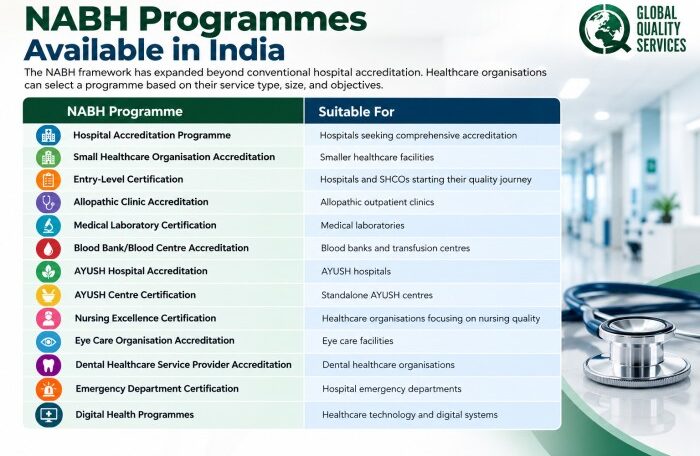
The NABH implements various programmes as per the type and size of healthcare organisation such as hospital accreditation, small healthcare organisation accreditation, clinic accreditation, entry-level certification, medical laboratory certification, blood center accreditation, AYUSH programmes, nursing excellence certification, and many others. Regarding hospitals, the existing NABH programme is upgraded to the 6th Edition of Hospital Accreditation Standards since January 1, 2025.
Why is NABH Accreditation Important for Healthcare Organisations
NABH is designed around patient safety, quality of care, consistent clinical practices, and continuous improvement. It helps healthcare organisations establish a more organised approach to the way services are delivered and managed. Key benefits include:
- Better patient safety and quality of care
- Stronger infection prevention and control practices
- Improved medication management
- Better documentation and medical records
- Clearer patient rights and communication
- Improved staff roles, training, and accountability
- Stronger emergency and safety arrangements
- Better monitoring of quality indicators
- Greater confidence among patients and stakeholders
- Improved organisational credibility
- Stronger readiness for regulatory and external assessments
- A structured foundation for continuous quality improvement
Who Can Apply for NABH Certification or Accreditation in India
NABH is not limited to large hospitals. Different programmes are available for different healthcare settings. Depending on the organisation, NABH programmes cover:
- Hospitals: Hospitals may go for the Hospital Accreditation Programme for comprehensive quality and safety management. As of now, NABH defines this as the flagship hospital programme, which is meant for larger hospitals.
- Small Healthcare Organizations (SHCOs): The small healthcare organizations can opt for the appropriate SHCO programme of NABH.
- Clinics: NABH also offers a specific accreditation programme for allopathic clinics involving aspects like consultation, diagnostics, pharmacy services, minor surgeries, patient safety, and statutory compliance.
- Medical Labs: Medical labs can opt for NABH certification in areas like specimen collection, testing, reporting, quality control, competency of the personnel, and laboratory safety.
- Blood Banks and Blood Centres: NABH offers a specific programme for blood banks and blood centres that includes aspects like donor screening, blood collection, testing, storage, preparation of components, distribution, traceability, and safety measures. NABH
- AYUSH Healthcare Organizations: NABH also provides a programme for AYUSH hospitals and centers for the aspects of Ayurveda, Yoga and Naturopathy, Unani, Siddha, Sowa Rigpa, and Homoeopathy.
NABH Programmes Available in India
The NABH system has gone beyond traditional hospital accreditation. Organizations within the healthcare industry have the liberty to choose the program that best suits their services and goals.
NABH Hospital Standards in India
The current NABH Hospital Accreditation Standards are organised around ten major areas covering patient-centred and organisation-centred functions. international:
- Access, Assessment and Continuity of Care (AAC): Covers how patients access healthcare services, receive assessment, and continue receiving appropriate care.
- Care of Patients (COP): Focuses on safe and appropriate clinical care throughout the patient’s treatment journey.
- Management of Medication (MOM): Addresses medication management, storage, prescribing, dispensing, administration, and monitoring.
- Patient Rights and Education (PRE): Focuses on informed care, communication, consent, patient rights, and education.
- Infection Prevention and Control (IPC): Addresses infection prevention practices and measures used to reduce healthcare-associated infection risks.
- Patient Safety and Quality Improvement (PSQ): Focuses on quality indicators, patient safety, monitoring, measurement, and continual improvement.
- Responsibility of Management (ROM): Defines management responsibilities for maintaining quality, safety, resources, and organisational direction.
- Facility Management and Safety (FMS): Covers infrastructure, equipment, emergency preparedness, fire safety, utilities, and facility-related risks.
- Human Resource Management (HRM): Addresses staffing, qualifications, competency, training, performance, and employee-related requirements.
- Information Management System (IMS): Focuses on healthcare information, medical records, data management, confidentiality, and information availability.
NABH Entry-Level Certification in India
NABH’s Entry-Level Certification Programme, 2nd Edition, is a structured platform that can be used by Small Healthcare Organisations having bed capacity of up to 50 and hospitals having a bed capacity of 51 and above. The programme has been designed with respect to Core, Commitment, and Excellence based on the bed capacity of the organization and certification cycle.
The programme can help healthcare organizations in laying the foundation for implementing quality and safety practices prior to moving towards an accreditation model. There are certain prerequisites defined by NABH for eligibility for the programme.
NABH Accreditation vs NABH Certification
The terms accreditation and certification are often used interchangeably online, but NABH itself operates different programmes.
Accreditation is normally understood to be a programme where the health care provider institution is evaluated against pre-established accreditation standards. The term NABH Certification usually relates to the NABH certification programmes, including the Entry Level Certificate Programme.
The correct terminology therefore depends on the programme applicable to the healthcare organisation. NABH currently separates its offerings into accreditation, certification, and empanelment programmes
NABH Accreditation Requirements in India
Before applying, healthcare organisations need to understand both the NABH standards and the statutory requirements applicable to their facility. Common areas that need attention include:
- Valid hospital or healthcare organisation registration
- Applicable statutory approvals and licences
- Fire safety compliance
- Biomedical waste management
- Pollution control requirements
- Qualified and competent healthcare professionals
- Clinical policies and procedures
- Infection prevention and control systems
- Emergency and disaster management
- Patient rights and consent procedures
- Medical record management
- Equipment maintenance and calibration
- Staff competency and training records
- Quality indicators and monitoring
- Medication management
- Facility safety and risk management
- Internal monitoring and corrective action
Documents Required for NABH Accreditation
Documents are an essential element in ensuring that practices for quality and safety are being performed. Depending on the organization and program, documentation may consist of:
- Hospital registration documents
- Applicable statutory licences
- Fire safety documents
- Biomedical waste records
- Pollution control approvals
- Organisational policies
- Departmental SOPs
- Clinical protocols
- Infection control manual
- Patient consent formats
- Patient rights documents
- Emergency response plans
- Medical records
- Equipment maintenance records
- Calibration records
- Staff qualification documents
- Staff training records
- Competency assessment records
- Quality indicators
- Internal audit reports
- Corrective and preventive action records
- Management review records
NABH Certification Process in India
A well-planned NABH project generally moves through the following stages:
Step 1: Selection of NABH Programmes
Choose the relevant NABH certification/accreditation program depending on the health care facility you represent.
Step 2: Gap Analysis
Carry out the gap analysis in relation to your current practices, documentation, infrastructure, and compliance with the NABH standards.
Step 3: Documentation and Implementation of the Requirements
Create required policies and SOPs and implement the necessary quality and patient safety practices.
Step 4: Internal Audit and Readiness Assessment
Carry out the internal audit and readiness assessment and undertake corrective action prior to the assessment process.
Step 5: NABH Assessment
Submit the application and undertake the NABH assessment based on the relevant standard(s).
Step 6: Corrective Action and Accreditation
Address assessment findings and complete the required process for the NABH certification or accreditation decision.
How Long Does NABH Certification Take
There is no single timeline that applies to every healthcare organisation. The duration depends on:
- Number of beds
- Type of healthcare facility
- Applicable NABH programme
- Current level of compliance
- Existing documentation
- Number of departments
- Staff readiness
- Infrastructure requirements
- Quality indicators
- Internal audit findings
- Corrective actions
- Assessment scheduling
NABH Certification Cost in India
The cost of NABH accreditation depends on the type of programme, size of the organization, bed strength, number of assessment activities, and NABH charges.
For instance, the Entry Level Certification Programme by NABH currently available has different certification costs based on bed strength, among others. The total cost of the project could include:
- NABH application and assessment fees
- Consultancy fees
- Documentation work
- Staff training
- Internal audit support
- Infrastructure improvements
- Equipment and calibration requirements
- Additional compliance work
- Corrective action implementation
NABH and ISO 9001: How Are They Different
NABH is specifically designed for healthcare organisations and focuses heavily on patient safety, clinical care, healthcare operations, and quality of patient services.
ISO 9001, by comparison, is a general quality management system standard applicable across many industries.
A healthcare organisation may use both frameworks where appropriate, but they serve different purposes. NABH provides healthcare-specific requirements, while ISO 9001 establishes a broader quality management framework. For healthcare organisations looking to strengthen their overall quality management system, GQS also provides ISO 9001 Certification consultancy.
Common Mistakes Hospitals Make During NABH Preparation
Many NABH projects become difficult because organisations start with documentation instead of understanding their actual gaps. Common issues include:
- Using outdated NABH standards
- Copying generic SOPs without adapting them
- Preparing documents without implementation
- Ignoring statutory compliance
- Poor medical record practices
- Weak infection control monitoring
- Incomplete staff competency records
- Lack of quality indicators
- Inconsistent department-level practices
- Poor evidence management
- Starting internal audits too late
- Treating NABH as a one-time audit instead of a continuing quality system
Why Choose Global Quality Services for NABH Certification in India
A NABH consultant should not only be someone who is capable of preparing the documentation. The healthcare institution needs a consultant who knows how to implement the quality systems within the healthcare settings and assist the management team in implementing the requirements.
- 26 Years of Consulting Experience: Global Quality Services brings 26 years of consulting experience across quality, compliance, management systems, and accreditation-related assignments.
- Experienced Professional Team: GQS works with qualified professionals, lead auditors, and domain specialists experienced across multiple international standards and compliance frameworks.
- Pan-India Consultancy Support: We provide consultancy support across major Indian locations, including Mumbai, Bengaluru, Chennai, Delhi, Hyderabad, Pune, Ahmedabad, Goa, Mangalore, Vapi, Indore, Hubli, and Belgaum.
- Practical Healthcare-Focused Guidance: The objective is not to overload hospitals with paperwork. GQS focuses on helping teams understand requirements and establish systems that can work within their actual operations.
- End-to-End Project Support: Support can cover gap assessment, documentation, implementation guidance, staff training, internal audit, readiness preparation, and assessment support.
- Clear Communication and Dedicated Support: Healthcare teams need straightforward guidance, quick clarification, and practical recommendations. GQS focuses on maintaining direct communication throughout the assignment.
NABH Certification Support in Mumbai and Across India
Mumbai’s healthcare organisations function within the most competitive healthcare market in India. There are numerous hospitals, multispecialty hospitals, clinics, diagnostic centers, and specialized healthcare services catering to the patients of not just Maharashtra but other regions of the country too.
Global Quality Services offers NABH consultancy services to healthcare organizations in the Mumbai region and adjoining areas such as Andheri, Powai, Bandra, BKC, Goregaon, Thane, Navi Mumbai, and other healthcare centers in the Mumbai Metropolitan Region. We also offer the above consultancy services in other major healthcare markets of India, including:
- Mumbai
- Noida
- Delhi
- Chennai
- Hyderabad
- Pune
- Bangaluru
- Ahemdabad
Frequently Asked Question
1. Is NABH mandatory for all Indian hospitals?
This will depend on the healthcare program in question and its regulatory or institutional needs. Not all healthcare organizations are automatically compelled to undergo NABH accreditation.
2. What NABH Standard is being followed in hospitals today?
The present NABH Hospital Accreditation Standards follow the 6th edition, which took effect on January 1, 2025.
3. Can a small hospital be accredited by NABH?
Yes, as NABH has separate programmes tailored to suit smaller healthcare facilities, such as the Entry Level Certification Programme & SHCO accreditation programmes.
4. Is there NABH certification for clinics?
Yes, as NABH has a separate Allopathic Clinics Accreditation Programme.
5. How long should NABH standards be implemented before assessment?
The applicable programme determines the requirement. For the current Hospital Accreditation Programme, NABH states that organisations should implement the standards for at least three months before submitting the application.