The workforce of India is increasingly becoming linked to the requirements and expectations concerning social protection, worker welfare, and socially responsible employment. Indeed, according to the Ministry of Labour and Employment of India, social security in the country increased from 19% in 2015 to 64.3% in 2025, indicating the increasing attention paid to social protection in India. Hence, the structured approach to the company’s social responsibility is more relevant for business than ever before.
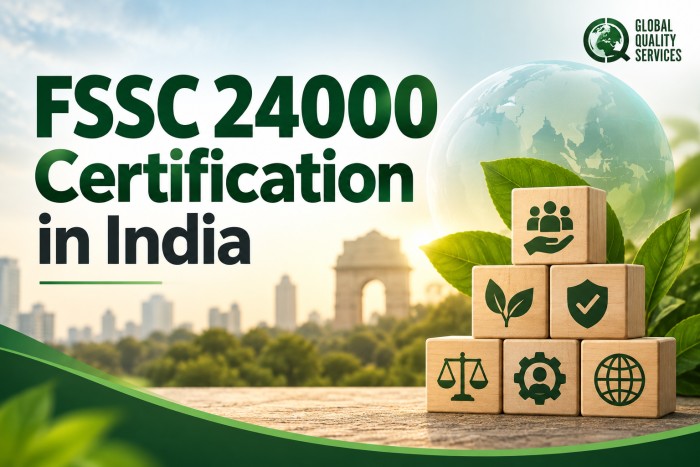
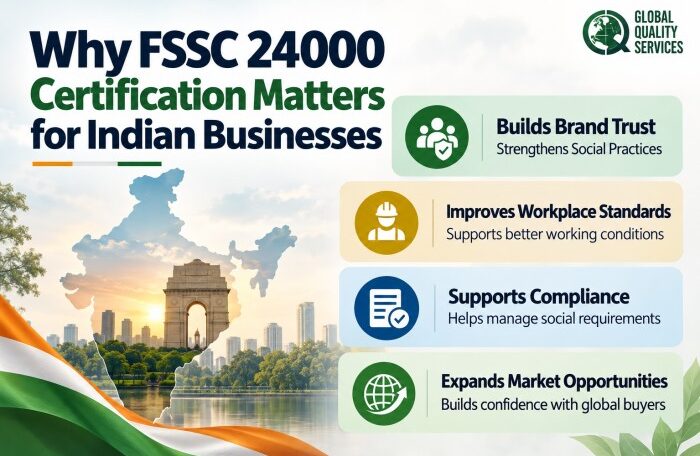
The FSSC 24000 Social Management System Certification allows businesses to implement and document socially responsible practices in the areas of labour conditions, occupational health and safety, human rights, ethics, and social performance. The FSSC 24000 program is based on the ISO management system approach and assists businesses in risk management through documented procedures.
We help businesses receive FSSC 24000 Social Management System Certification by supporting them in developing and implementing social management systems.
What is FSSC 24000 Social Management System Certification?
FSSC 24000 is a social performance certification standard that evaluates how an organisation manages labour rights, equality, workplace conditions, and ethical business behaviour. Designed using ISO management system principles, the certification is intuitive for organisations already implementing ISO 9001, ISO 45001, or similar standards. Unlike quality or environmental management certifications, FSSC 24000 specifically targets responsible labour practices and social impact both internally and across supplier networks. The standard:
- Aligns with globally recognised social responsibility principles.
- Provides a formal structure to assess ethical behaviour in operations.
- Enables organisations to demonstrate responsible sourcing to global buyers.
What FSSC 24000 Certification Covers for Indian Organisations
Here are the things that are covered under FSSC 24000 certification:
- Policy: A clear, written statement from top leadership reflecting the organisation’s commitment to social responsibility. For example, policies may prohibit child labour, enforce equal pay for equal work, and ensure safe working environments.
- Procedure: Step-by-step instructions for staff to implement the policy, such as grievance handling procedures, supplier qualification steps, or workplace safety protocols.
- Objective & KPI: Measurable targets linked to policies, e.g., reducing workplace incidents by 15% in a year or ensuring 100% of suppliers comply with the supplier code of conduct. KPIs track real progress.
- Internal audit: Internal verification to confirm that procedures are being followed, either by company staff or external consultants.
- Nonconformity: Any observed gap between documented procedures and actual operations, which must be corrected and documented for continuous improvement.
Who Should Get FSSC 24000 Certification?
While not mandatory, FSSC 24000 certification is increasingly becoming a prerequisite for businesses that want to participate in global supply chains. Typical organisations in India that pursue certification include:
- Manufacturers and contract producers exporting to markets with high social compliance standards.
- Electronics, apparel, footwear, automotive component manufacturers, and packaging suppliers.
- Large service providers with substantial workforces such as BPOs, logistics providers, and IT/ITES hubs.
- Companies with complex supply chains seeking a single system to manage social risks across suppliers.
FSSC 24000 Requirements for Indian Organisations
FSSC 24000 requirements focus on leadership, governance, risk management, worker rights, and continuous improvement. Auditors expect that policies are implemented, monitored, updated, and backed by evidence.
1. Leadership, governance, and policy
Top management must adopt a formal social responsibility policy and assign clear roles and responsibilities. Leadership review meetings and resource allocation must be documented.
2. Risk assessment and context
Organisations must identify social risks across operations and suppliers, including child labour, forced labour, discrimination, and unsafe working conditions. Risks are prioritised and action plans documented.
3. Worker rights and labour practices
Recruitment practices must prevent forced or bonded labour. Wage and benefits policies must comply with Indian law and, where feasible, reflect living wage principles. Working hours, overtime, freedom of association, and grievance procedures must be properly documented.
4. Health, safety, and well-being
Health and safety risk assessments, control measures, incident reporting, and medical support arrangements are required. Staff must undergo training and participate in safety drills. Personal protective equipment and hazard control records should be maintained.
5. Grievance mechanism and remediation
Workers should have access to a clear, confidential process to raise concerns. Tracking of grievances and follow-up actions must be documented.
6. Supplier management and procurement
Suppliers should be evaluated for social compliance, and contractual obligations must include social responsibility clauses. Ongoing supplier monitoring and corrective action tracking are necessary.
7. Training and competence
Organisations must provide role-specific training for employees and managers, covering workplace safety, anti-harassment policies, and social compliance expectations.
8. Monitoring, measurement, internal audit, continual improvement
KPIs, internal audit schedules, management review minutes, and corrective action logs must demonstrate that the Plan–Do–Check–Act cycle is in operation.
Steps to Implement FSSC 24000 in Your Organisation
Your organization has to evaluate its existing social activities, fill any gaps, implement controls, and demonstrate how the system operates in practice. Here are the key steps:
Step 1: Conduct Gap Assessment
Perform a comparison of your present human resource management, health and safety, human rights, and other related practices with the requirements of FSSC 24000. Find out the gaps you should address.
Step 2: Develop the Social Management System
Develop the necessary policy, procedures, responsibilities, and objectives to handle social risks and to satisfy the FSSC 24000 requirements.
Step 3: Implement the Controls
Put the system into practice in relevant areas, such as worker well-being, grievances, ethics, health and safety, and responsible employment.
Step 4: Audit and Gap Closure
Measure the performance of your system using internal auditing and documentation. Find out the nonconformities and close the gaps prior to the certification audit.
Step 5: Perform the Certification Audit
Carry out the management review. The certification body will evaluate your FSSC 24000 Social Management System for certification purposes.
Documents Required for FSSC 24000 Certification
Here is a list of documents that are required for FSSC 24000 certification:
- Social Responsibility Policy signed by top management
- Organisational chart with defined responsibilities
- Risk assessment reports and mitigation plans
- Supplier Code of Conduct and assessment records
- Employee handbook, HR policies, and payroll samples
- Training plans and attendance records
- Grievance register with resolution documentation
- Incident reports and corrective actions
- Internal audit reports and management review minutes
Common FSSC 24000 Gaps and How to Address Them
Some gaps frequently observed in Indian organisations include:
- Unsigned policies: Have the CEO or MD sign the policy and communicate to the workforce.
- Missing payroll evidence: Keep payslips, bank transfers, or signed receipts for a sample of employees.
- Inaccessible grievance mechanism: Publicise, train staff, and test with mock cases.
- Suppliers not assessed: Issue assessment forms, add social clauses to contracts, and track corrective actions.
- Incomplete training records: Keep attendance sheets, photographs, and post-training assessments.
How the FSSC 24000 Certification Audit Works
Auditors follow a structured approach:
- Opening meeting: Auditors explain the scope and schedule.
- Documentation review: Policies, registers, and audit records examined.
- On-site inspection: Walkthrough of facilities, welfare areas, and dormitories if applicable.
- Worker interviews: Random sampling across shifts and departments.
- Supplier verification: Supplier files and monitoring processes reviewed.
- Closing meeting: Findings presented, including any nonconformities and required corrective actions.
FSSC 24000 Certification Cost in India
Factors influencing costs for FSSC 24000 Social management system Certification include:
- Number of sites and workforce size
- Complexity of the supply chain
- Existing management systems integration
- Consultant involvement vs. in-house implementation
- Auditor time required
Cost reduction can be achieved by preparing internal documentation, conducting internal audits, and addressing obvious gaps before the Stage 1 audit.
Integration with existing systems
FSSC 24000 aligns with ISO management system structures. Organisations holding ISO 9001 or ISO 45001 can integrate social management processes to streamline audits, management reviews, and documentation.
How Global Quality Services Offer Support for FSSC 24000 Certification in India
We at Global Quality Services assist Indian organizations in developing their Social Management System for FSSC 24000 certification. Our consultants will assist your organization in identifying any gaps, developing the system as well as conducting preparation and corrective action activities that would allow you to go through the process with more clarity.
- 26 Years of Certification Expertise: Consultancy Services provided by consultants who have worked for 26 years in the domain of management systems certification and implementation.
- Business-Specific Guidance: Receive solutions that are specific to your business processes, people, and systems for certification.
- Certification Experts: Get help from consulting experts who have practical knowledge of requirements of certification.
- Preparation for Audit: Receive assistance in identifying and closing any gaps in your preparedness for a certification audit.
- Total Certification Solutions: Get complete solutions right from assessment to audit.
Kick-start Your Process to Get Certified Under FSSC 24000
Global Quality Services is one of the leading certification consultants providing services for FSSC 24000 certification. We will help you improve your social management system, close any gaps and compliance issues, prepare the documentation, and be ready for audits. Contact us on our website today.
Frequently Asked Questions
1. Do you really need FSSC 24000 Certification in India?
FSSC 24000 certification is not obligatory, but it can, for example, be an additional factor for companies that want to prove their structured approach to social responsibility towards customers and business partners.
2. What’s the time for the duration of certification to FSSC 24000?
This can vary from organisation to organisation depending on size, existing systems and preparedness. The process can determine the need gap and a realistic timeframe for implementation.
3. Who Performs the FSSC 24000 Certification Audit?
The audit is performed by a third-party certification body that is accredited to review the compliance of your Social Management System to the standard.
4. Will Employees Be Interviewed by the FSSC 24000 Auditor?
Yes, workers and other employees may be interviewed to confirm that social management policies and procedures are implemented in the workplace.
5. How Is The FSSC 24000 Certification Audit Process?
The FSSC 24000 certification body audits your Social Management System, implementation, workplace management systems, and processes to confirm that FSSC 24000 standards are satisfied.