A food safety system will be a key step for food processors who wish to cater to large retailers and export their products worldwide. The certification means you have developed a state-of-the-art food safety system.
Data published by the Ministry of Food Processing Industries shows that Uttar Pradesh supports approximately 65,000 food processing units, employing over 250,000 workers. The Noida industrial belt accounts for a major portion of this production volume. As global buyers demand stricter hygiene protocols, local factories in Noida need recognized compliance systems to secure high-value contracts.
Why Noida Has Become One of North India’s Fastest Growing Food Manufacturing Hubs
Here are the strategic commercial factors that make Noida a top location for setting up food processing units and distribution networks.
- Access via Expressways: The Yamuna Expressway and the Eastern Peripheral Expressway provide access to processing plants from sourcing locations through expressways in northern India.
- Nearness to the Air Cargo Facility: Proximity to the Jewar International Airport allows the quick dispatch of products to foreign markets.
- Access to the NCR Market: Plants located in Noida have easy access to the NCR market through major retail chains and supermarkets.
- Planned Sectors: Sectors like Sector 57, Sector 63, Sector 80, and Sector 138 are specifically zoned industrial areas for food processing and packaging.
Food Businesses in Noida That Should Consider FSSC 22000 Certification
FSSC 22000 applies to organizations of all sizes operating within the food supply chain. The standard combines ISO 22000 requirements with sector-specific prerequisite programs.
- Manufacturers of foods and beverages that manufacture dairy products, baked goods, snacks, drinks, and spices
- Manufacturers of food packaging who manufacture plastics, film, cardboard, and tin for direct contact with food items
- Food logistics and cold storage facilities that store or transport temperature-sensitive food items
- Producers of food additives that manufacture flavors, industrial seasoning, and processing aids
- Manufacturers of animal feeds that manufacture feed formulas for livestock and poultry
Our FSSC 22000 Certification Approach for Noida Businesses
Here is our structured five-step implementation process to help your facility meet all audit criteria without slowing down daily production.
Step 1: Facility Gap Analysis
The team reviews your current facility layout, operations, equipment sanitation, and documentation against the standards set out in FSSC 22000.
Step 2: System Development and Documentation
We support your team in the development of your Food Safety Management System. The system development will consist of the creation of Hazard Analysis and Critical Control Point plans, procedures, and policies for your business operations.
Step 3: Employee Training
We train your employees and management on basic food safety principles. The training includes risk assessment, vulnerability assessment, food defense, and allergen management.
Step 4: Internal Pre-Audit
An internal pre-audit is performed to check your system. This process helps us check your system, resolve nonconformities, and solve technical problems before the actual audit.
Step 5: Final Audit Support
We help you manage your audits for both Stage 1 and Stage 2 certification performed by a certified third-party certification body.
Migration of FSSC 22000 from Version 6 to Version 7
Version 6 became mandatory from April 2024. The system continues to evolve based on new threats, needs of the market, and changes in regulations worldwide. For those upgrading to a new management system, five essential operational aspects need attention:
- Food Safety Culture: Plant managers need to keep records of the measurable food safety practices conducted by workers throughout all shifts.
- Quality Control Management: New regulations state the need for precise monitoring of the weight, volume, and ingredients in order to avoid product mislabeling.
- Equipment Purchase Criteria: There is a requirement to document hygiene criteria during purchases, modifications, and installation of new processing equipment.
- Food Waste Tracking: There should be documented goals on how to reduce food waste while ensuring proper handling of donated food products.
- Allergen Management: There needs to be a separation of allergens, verification of equipment cleaning, and appropriate worker training to prevent food contamination.
FSSC 22000 Version 6 to Version 7 Transition Timeline
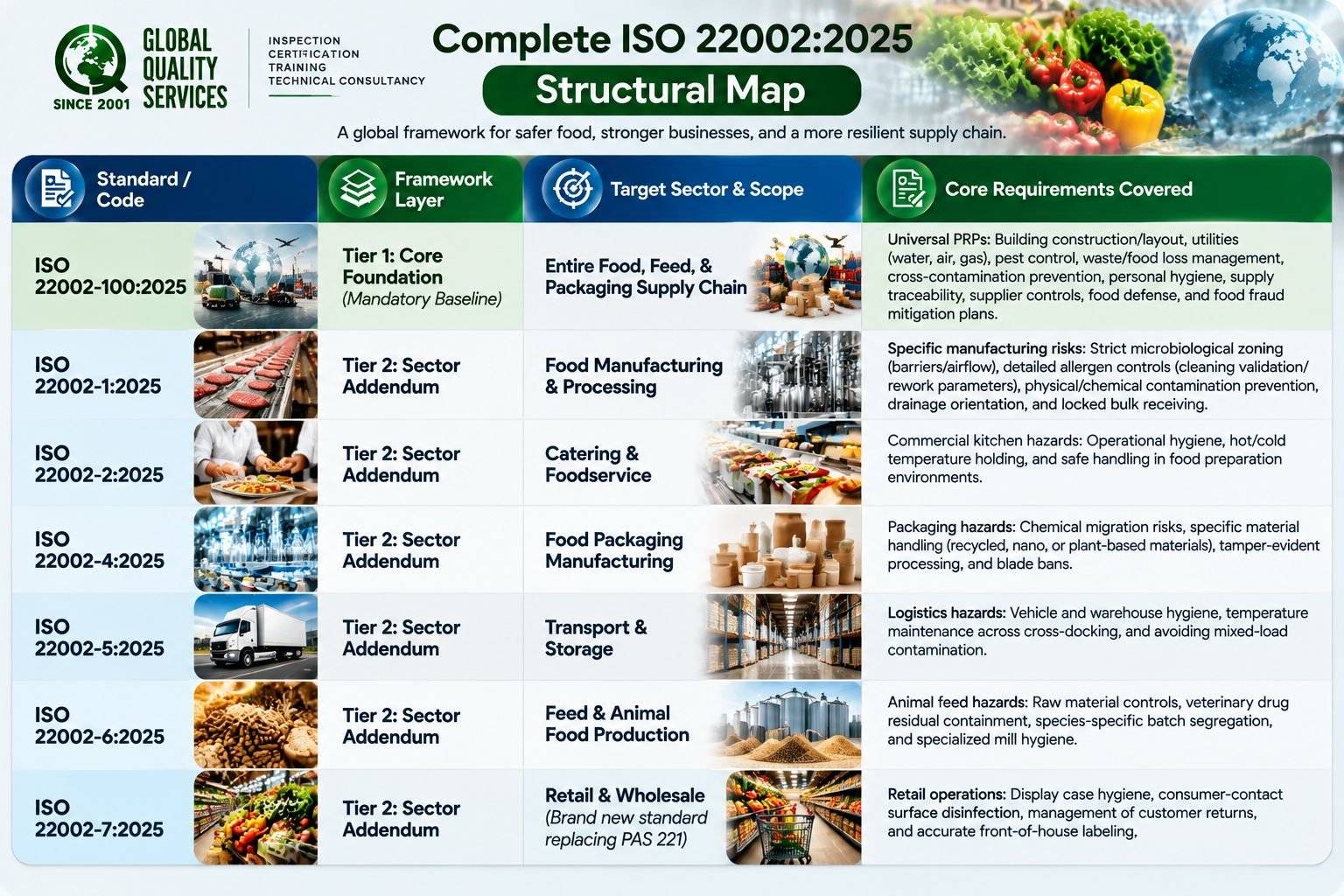
1. ISO 22002-100:2025 – Prerequisite Programs for Food Safety
Provides a common framework of hygiene and food safety controls for organisations operating across food, feed, and packaging supply chains. Its scope includes premises and equipment design, cleaning and sanitation, pest management, employee hygiene, product traceability, and measures to prevent contamination.
2. ISO 22002-1:2025 – Food Manufacturing and Processing
Outlines the essential prerequisite conditions required to maintain food hygiene throughout manufacturing and processing activities. The requirements include hygienic zoning, allergen control, cleaning procedures, contamination risk management, and appropriate handling of raw materials and finished products.
3. ISO 22002-2:2025 – Catering and Foodservice
Sets out the hygiene and food safety practices applicable to catering businesses, institutional kitchens, and commercial foodservice operations. It focuses on hygienic food preparation, temperature monitoring, kitchen sanitation, proper food handling, and controls against cross-contamination.
4. ISO 22002-4:2025 – Food Packaging Manufacturing
Specifies the preventive hygiene measures required in facilities involved in producing materials intended for food packaging. It covers the management of packaging-related contamination hazards, material storage and handling, chemical migration risks, and production controls that safeguard food-contact materials.
5. ISO 22002-5:2025 – Transport and Storage
Establishes the hygiene practices necessary to preserve food safety throughout storage, distribution, and transportation activities. Key areas include warehouse sanitation, vehicle cleanliness, temperature monitoring, prevention of product contamination, and controlled loading and unloading operations.
6. ISO 22002-6:2025 – Feed and Animal Food Production
Defines the hygiene controls and operational practices required for manufacturing animal feed and related products. It includes raw material inspection, prevention of physical and chemical contamination, segregation of production batches, and maintenance of sanitary manufacturing conditions.
7. ISO 22002-7:2025 – Retail and Wholesale
Establishes food hygiene and safety controls for businesses involved in the retailing and wholesale distribution of food products. Its requirements address product display conditions, routine cleaning, disinfection, hygienic product handling, management of returned goods, and correct food labelling.
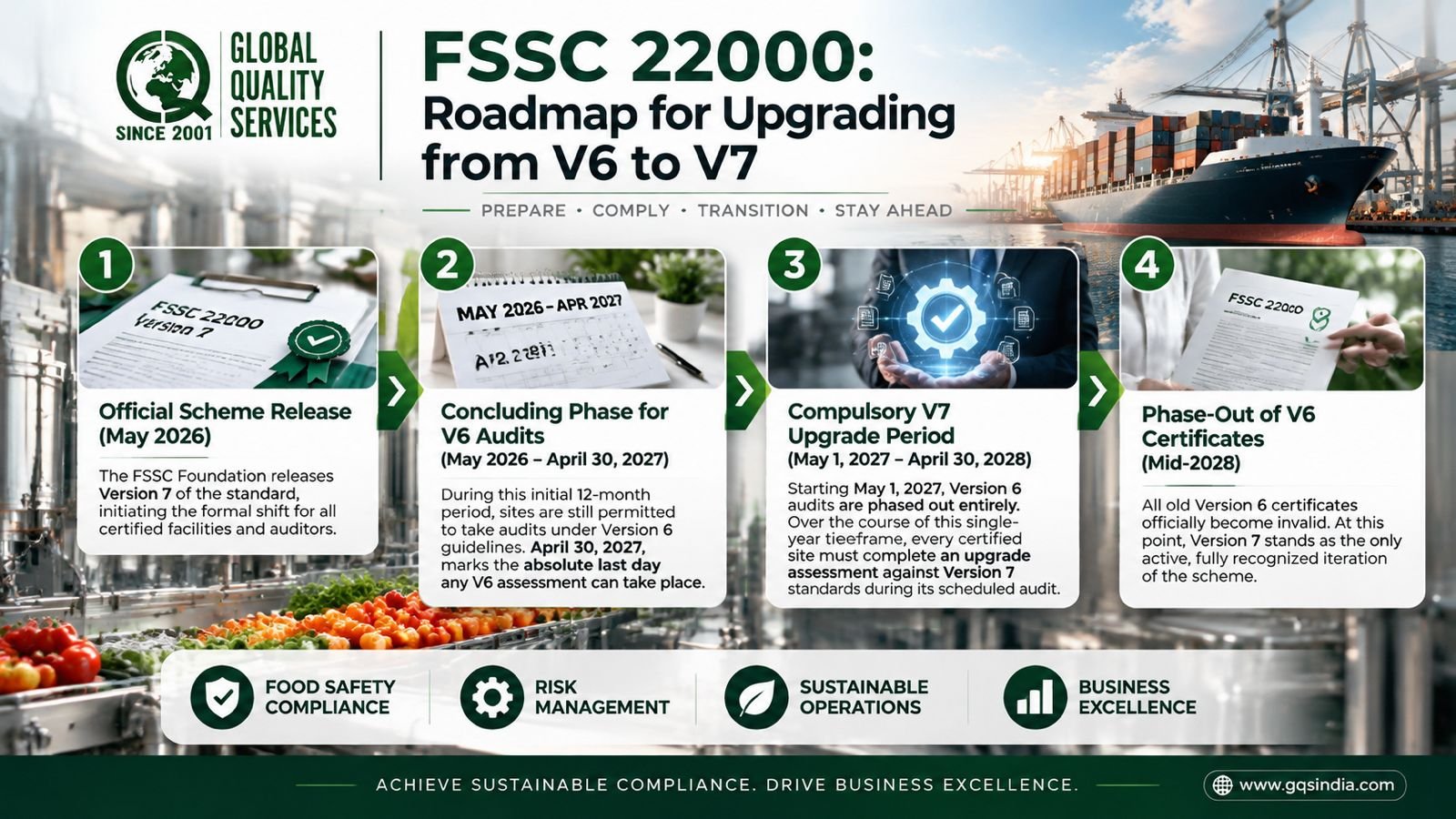
The FSSC 22000 Version 6 to Version 7 transition schedule identifies the important milestones that organisations must follow when moving to the revised food safety certification scheme. Version 7 was released on 1 May 2026, while organisations can continue undergoing Version 6 audits until 30 April 2027. The compulsory upgrade audit window extends from 1 May 2027 to 30 April 2028. All remaining Version 6 certificates are scheduled for withdrawal after 30 June 2028. Businesses should begin transition activities well in advance to address the revised scheme requirements and avoid disruption to their certification status.
Global Quality Services (GQS) brings over two decades of experience in management system consulting and provides support to organisations upgrading from FSSC 22000 Version 6 to Version 7. Our services include evaluating existing food safety systems, conducting gap assessments, reviewing documentation, and identifying changes introduced under the revised scheme. We work with businesses to establish an effective transition roadmap, close identified compliance gaps, and prepare for the Version 7 certification audit. Our approach focuses on practical recommendations that consider each organisation’s current food safety arrangements and applicable certification requirements.
How Does Global Quality Services Support FSSC 22000 Certification Across Noida
Global Quality Services provides direct services to food processing, packaging, and warehousing organizations in Noida. We facilitate the development of audit-friendly management systems that cater to your specific operating circumstances. Our consultants are familiar with the Indian manufacturing environment, such as limitations in plant space, pollution control board regulations, and workforce training requirements.
- Customized HACCP plans designed around your actual processing machinery
- Practical advice on plant layout improvements and contamination control
- Onsite guidance during third-party certification audits
Along with the FSSC 22000 Certification, we also offer consultancy/mentoring in the field of PCQI (Preventive Controls Qualified Individual) training and certification to assist food manufacturers in meeting the FDA FSMA requirements.
Secure Global Buyer Trust with FSSC 22000 Certification
Getting your facility certified proves that your food safety practices meet global requirements. Our team works alongside your workforce to build clear, practical systems that simplify compliance and satisfy vendor audits.
- Tailored Documentation: Get straightforward safety procedures that workers can easily execute on the shop floor.
- Practical Knowledge: Work with experienced lead auditors who know how to address real-world factory issues.
- Complete Audit Support: We manage the full process, including initial risk assessments, staff training, and audit coordination.
Contact our Global Quality Services team today to arrange an on-site facility assessment in Noida and get a custom project quote for your site.
Frequently Asked Questions
1. Difference Between ISO 22000 and FSSC 22000
ISO 22000 is a generic standard for food safety management. FSSC 22000 is based on ISO 22000 but with the addition of sector-specific prerequisite programs and scheme requirements. FSSC 22000 is approved by the Global Food Safety Initiative, and that is why it is more acceptable to large international retail organizations.
2. What is the duration of getting certified with FSSC 22000 in Noida?
It normally takes around two to four months. Actual time may vary depending upon the size of the facility, available operational controls, and speed with which the gaps are rectified.
3. Does FSSC 22000 certification allow export of food products from India?
Yes, FSSC 22000 is recognized in all global export markets of North America, Europe, Asia, and the Middle East. Certification makes it easier for vendors to obtain approvals from international distributors and buyers.
4. Are small or micro food processing companies in Noida able to receive FSSC 22000 certification?
Yes, small firms are able to get FSSC 22000 certification. It applies to any size company that has implemented an effective risk management system.
5. How long is an FSSC 22000 certificate valid?
The certificate is valid for a period of three years. To maintain certification, you must pass surveillance audits each year for the first two years, and then recertification after the third year.