Getting an FSSC 22000 certificate enables food processing industries to enter into business agreements with corporates and export their produce to other countries. In the city of Hyderabad, food production units, packaging industries, and catering establishments must adhere to stringent food safety requirements set by international buyers and retail organizations. As local food safety certification consultants, we assist our clients in establishing effective food safety systems.
Hyderabad is an industrial center in South India with a fast-growing manufacturing sector. Official data from the India Brand Equity Foundation shows that Telangana reached an estimated Gross State Domestic Product of 18.0 trillion rupees, equal to roughly 209.10 billion US dollars. The state processes nearly 25 percent of the regional agricultural yield, making food safety compliance essential for local processors expanding into national and international markets.
The guide highlights the local industry opportunities, auditing problems, certification process, and pricing aspects of firms working in Telangana.
Why Hyderabad is Emerging as a Leading Food Manufacturing Hub in India
Hyderabad uses its transport linkages, industrial parks, and rising consumer demands to facilitate large-scale food manufacturing processes. Here are key reasons:
- Existing Industrial Parks: There are many industrial parks situated in Cherlapally, IDA Mallapur, Patancheru, Jeedimetla, and Pashamylaram that have many food processing and packaging units in operation.
- Pro-Business State Policies: Government systems help in getting permits in local factories and also promote private investment within agri-processing parks.
- Logistics for Agro-Processing: Availability of cold storage facilities and spice parks ensures safe handling and large-scale storage of the raw materials.
- Transportation and Export Facilities: The closeness to main highways, railways, and the international airport of Rajiv Gandhi makes transportation easy both inside the country and outside.
- Growing Demand for Cloud Kitchens in Commercial Areas: Growing demand in commercial locations such as Gachibowli, Madhapur, and Hitec City helps the cloud kitchens expand rapidly.
Which Businesses in Hyderabad Should Consider FSSC 22000 Certification?
FSSC 22000 certification is relevant to businesses of all sizes within the food chain. Below is a list that brings out local business sectors in Telangana State that will benefit most from having this international certification:
Key Industry Sectors
- Spice and Agricultural Exporters: Processing facilities in Cherlapally and Mallapur shipping whole or ground spices to international buyers.
- Dairy and Beverage Bottlers: Commercial plants manufacturing packaged milk, cultured dairy goods, juices, and purified drinking water.
- Processed Food Units: Facilities producing frozen snacks, baked goods, ready-to-eat meals, and edible oils.
- Central Kitchen Networks: Multi-site kitchen hubs supplying organized retail chains, supermarkets, and delivery platforms.
- Food Packaging Suppliers: Manufacturing facilities making plastic films, paper cartons, metal foils, and containers that contact food directly.
- Animal Feed Facilities: Operations producing livestock feed and pet food under controlled hygienic conditions.
Our FSSC 22000 Certification Process for Hyderabad Businesses
Certification is a process that needs a well-thought-out plan that can rectify any facility gaps but will not disrupt daily production. Our team will take you through a successful five-step process.
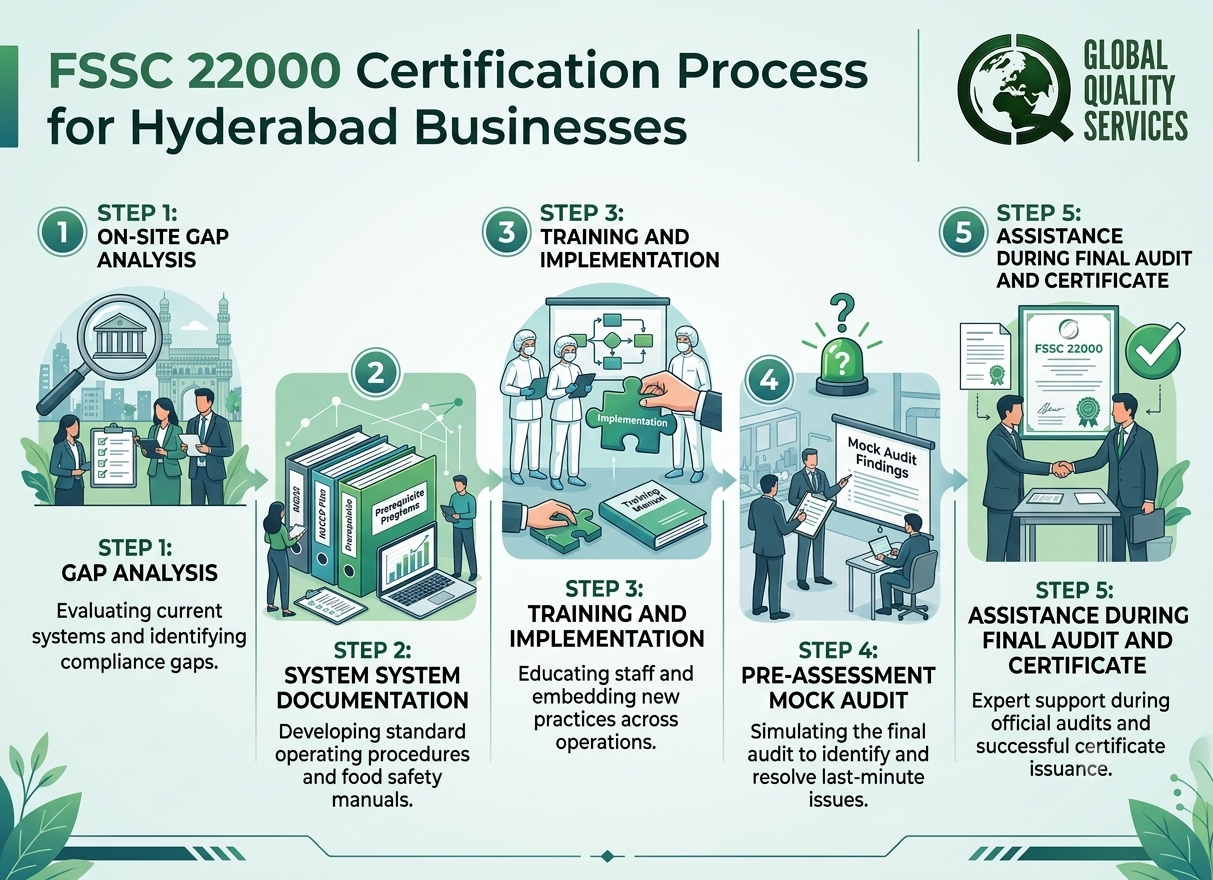
Step 1: On-Site Gap Analysis
We conduct an inspection of the facility’s processes and documents according to the requirements of the FSSC 22000 standard. A report will be delivered to you with details of necessary operational changes that have to be made.
Step 2: System Documentation
We develop custom food safety documentation for your unique plant operations. The documentation includes a HACCP plan, prerequisite program manual, food defense plan, and daily log book.
Step 3: Training and Implementation
We provide training to plant operators, line managers, and hygiene control supervisors on proper handling practices.
Step 4: Pre-Assessment Mock Audit
The auditors conduct a complete mock audit before the actual assessment. This ensures that we are able to detect deficiencies within the operations at an early stage, so that your team can fix them and hold their own internal reviews easily.
Step 5: Assistance During Final Audit and Certificate
We assist your team in Stage 1 and Stage 2 audits, which are carried out by an accredited third-party certification body.
Common Food Safety Challenges Faced by Hyderabad Manufacturers
Operating a food manufacturing plant in Telangana comes with its own operational challenges, which may lead to audit nonconformities if not sorted out at the earliest:
- Managing High Summer Temperatures: Warm regional weather creates storage challenges for temperature-sensitive raw materials and finished items.
- Meeting Updated Scheme Rules: Version 6 standards require explicit tracking of food loss, formal management of food safety culture, and strict hygienic equipment checks.
- Maintaining Raw Material Traceability: Sourcing ingredients across multiple farm suppliers complicates supplier verification and hazard monitoring.
- Upgrading Older Production Facilities: Facilities in legacy industrial zones often require physical upgrades to fix airflow issues, entry points, and cross-contamination risks.
Factors That Influence FSSC 22000 Certification Cost in Hyderabad
Comprehension of the cost variables will assist in budget planning that is realistic in relation to compliance with safety requirements. Costs of certification vary according to several variables of the plant, including:
- Factory Footprint and Processing Lines: Facilities running multiple complex production lines require more audit hours and extended documentation.
- Total Staff Count and Shift Schedules: Plants operating twenty-four-hour shifts with large workforces require broader audit sampling.
- Product Risk Category: High-risk processing like dairy or meat handling involves more detailed assessments than dry paper packaging units.
- Current Plant Readiness: Facilities with functioning quality management systems need fewer consulting hours than startups building records from scratch.
- Selected Certification Body Fees: Third-party registrar audit fees vary depending on which accredited agency you select.
How Does Global Quality Services Support FSSC 22000 Certification Across Hyderabad?
Global Quality Services provides tangible food safety consulting that enables regional producers to attain full compliance. Our goal is to develop clear processes that will pass external audits without overworking your personnel.
Rather than just handing you cookie-cutter form templates, our experts actually hit the shop floor and create processes for you, based on your products.
- Custom Document Drafting: We write site-specific SOPs, safety manuals, and floor logs that match your everyday factory routines.
- On-Site Audit Representation: Our lead consultants stand beside your team during official Stage 1 and Stage 2 audits to answer technical queries.
- Version 6 Upgrades: We help existing operations update their systems to cover food safety culture, equipment design, and waste management requirements.
- Surveillance Support: We provide ongoing annual guidance to help your facility pass mandatory surveillance audits cleanly.
In addition to FSSC 22000 Certification, we also provide consultancy/guidance for PCQI (Preventive Controls Qualified Individual) in Training and Certification to help food manufacturers comply with the U.S. FDA FSMA requirements.
Migration or FSSC 22000 from Version 6 to Version 7
Transitioning to FSSC 22000 Version 7 keeps your food safety management system resilient and aligned with global buyers. Mandatory transition audits take effect on May 1, 2027. Starting your preparation now ensures full compliance long before auditors step through your doors.
Core Shifts in the Version 7 Framework
- Tighter Food Protection Protocols: Version 7 demands stronger leadership involvement, robust food defense strategies, and comprehensive vulnerability assessments to protect your supply chain from fraud.
- Upgraded Hygiene Standards: The framework incorporates the updated ISO 22002:2025 series, modernizing prerequisite requirements and streamlining operational controls across production environments.
- Mandatory Competency Proof: Food safety team leaders, internal auditors, and risk assessment managers must hold documented, verified training credentials tailored to their roles.
- Embedded Environmental Accountability: New criteria focus directly on operational sustainability, requiring measurable practices to lower food waste and improve resource efficiency.
Partner with Global Quality Services to Pass Your FSSC 22000 Audit
Certification must never seem like an intimidating task or interfere with the speed of shipment in any way. Global Quality Services will offer direct assistance in terms of documentation and auditing to ensure that food processing manufacturers, packaging plants, and commercial kitchens in Hyderabad get their certification in one go.
Our local consultants will pay you a personal visit at your plant to find out compliance problems, train your personnel, and get your facility ready for a third-party audit. Contact us now in Hyderabad for an estimate of costs and your first plant visit.
Frequently Asked Questions
1. What is the difference between an FSSAI license and FSSC 22000?
The FSSAI license is a compulsory legal license for manufacturing and distributing food products in India. FSSC 22000 is an internationally recognized certificate that meets the needs of foreign buyers, international supermarket chains, and importers.
2. How much time is required for FSSC 22000 certification?
It usually takes about 60 to 90 days to implement FSSC 22000 in most of the manufacturing units. It actually depends upon the existing level of preparedness of the unit.
3. Can the upgrading of the existing ISO 22000 system to FSSC 22000 be achieved?
Yes, facilities that already have an ISO 22000 system can make the transition easily. The upgrading process includes the introduction of sector-specific prerequisite standards, implementation of FSSC Version 6 scheme rules, and a transition audit.
4. What is the validity period of an FSSC 22000 certificate?
The validity period of an FSSC 22000 certificate is three years. During the first two years, your facility has to pass annual surveillance audits, and in the third year, a recertification audit.
5. Is the certification system FSSC 22000 suitable for food packaging manufacturers?
Yes, the FSSC 22000 standard includes requirements for packaging providers according to ISO/TS 22002-4. The scope covers facilities that manufacture plastic, glass, paper, metal, and aluminum products in contact with food products.