For food manufacturers, packers, and central kitchens located within the Mumbai Metropolitan Region, it is necessary to have effective control over the safety of products. Food safety certifications can bring many benefits, such as the possibility of getting retail orders and exports. With the demands of international purchasers for certification of food safety management systems, food businesses must improve their sanitation procedures beyond the minimum requirements provided by the state license.
The Food Safety System Certification 22000 (FSSC 22000) is a scheme that is accepted by the Global Food Safety Initiative (GFSI). The implementation of this system can show that your business is capable of reaching international standards of hazard analysis, risk assessment, and sanitation.
Data from the Ministry of Food Processing Industries highlights that the region hosts over 10.09 lakh metric tons of cold storage capacity alongside dense industrial belts. Securing FSSC 22000 Certification Services in Mumbai allows local food companies to leverage this industrial base, maintain audit readiness, and expand into premium global markets.
How FSSC 22000 Certification Empowers Mumbai Food Businesses
Here are the primary commercial and operational advantages that local food processing plants, packaging facilities, and logistics hubs gain by earning FSSC 22000 certification.
- Unlocks Global Export Channels: Being GFSI-recognized, FSSC 22000 gives exporters operating near JNPT port immediate acceptance across European, North American, and Middle Eastern markets without redundant client audits.
- Accelerates Modern Retail Vendor Onboarding: Major supermarket chains, hypermarkets, and national cloud kitchen networks require GFSI-level compliance before approving new suppliers. Certification positions your brand as a trusted partner.
- Minimizes Product Recall Risks: Advanced hazard controls and environmental sanitation programs significantly reduce contamination risks, protecting your facility from costly batch recalls and brand damage.
- Streamlines Local FSSAI Compliance: FSSC 22000 requirements cover and exceed FSSAI Schedule 4 hygiene norms, making routine state inspections and regulatory reporting much simpler.
- Protects Against Food Fraud: Built-in food defense and fraud mitigation protocols protect your production lines against raw material adulteration and supply chain tampering.
Which Mumbai Food Businesses Benefit Most from FSSC 22000 Certification
- Food Manufacturers: Production facilities that produce packaged food products, baked goods, dairy products, beverages, spices, or canned foods.
- Packaging Manufacturers: Manufacturing facilities that produce flexible packaging, cartons, bottles, or foils for direct contact with food products.
- Catering and Dark Kitchens: Central production kitchens that deliver food products to retail stores, airline companies, cafeteria institutions, or cloud kitchens.
- Refrigerated Warehousing and Distribution: Warehouse and logistics companies responsible for handling temperature-sensitive ingredients or frozen food products.
- Animal Feed Mills: Production facilities that manufacture commercial feed for animals or pets.
Our FSSC 22000 Certification Approach for Mumbai Businesses
This section outlines our 5-step consulting method that gets your plant fully prepared for its certification audit without disrupting daily production.
Step 1: Onsite Gap Assessment & Facility Audit
Our team arrives at your Mumbai facility to analyze your existing manufacturing process, sanitary practices, and facilities according to current FSSC requirements. We provide you with a thorough gap analysis report.
Step 2: Unique System Design & Documentation Development
We design effective Hazard Analysis Critical Control Points (HACCP) plans and SOPs, and develop prerequisite logs for you. Every manual is custom-made according to your specific factory procedures.
Step 3: Employee Training and Operational Hygiene Integration
We deliver practical training sessions to floor operatives, team managers and hygiene personnel. The training is designed around the topics of personal hygiene, allergen management, equipment cleaning, food safety and fraud prevention.
Step 4: Mock Internal Audit and Management Review
Before you undergo an external audit, we conduct a complete mock audit. This allows us to find any outstanding problems, assist your team in addressing them, and perform an official management review to guarantee audit preparedness.
Step 5: External Certification Audit Assistance
Our experts will accompany your team during Stage 1 and Stage 2 external audits performed by your certification body. We will support your team during the auditor interviews and help conclude audit findings promptly.
Factors That Influence FSSC 22000 Certification Cost in Mumbai
Here are the practical factors that shape the overall cost of setting up and certifying your food safety system.
- Size of Plant: Plants with several production lines or several plants will take more time to be audited, hence affecting the total cost of the consultancy and audit services.
- Total Number of Employees: The total number of employees from all shifts will dictate the size of samples that will be used for training and auditor interviews.
- Level of Risk: Higher risk industries such as meat, dairy, or ready-to-eat food products will take longer hazard analysis compared to low-risk ambient processing.
- Plant Preparedness: Plants that need any changes either in structures, layout, or pest prevention will incur more costs initially.
- Certification Scope: Plants undertaking several activities such as processing of ingredients and manufacture of packaging.
Estimated Timeline for FSSC 22000 Certification
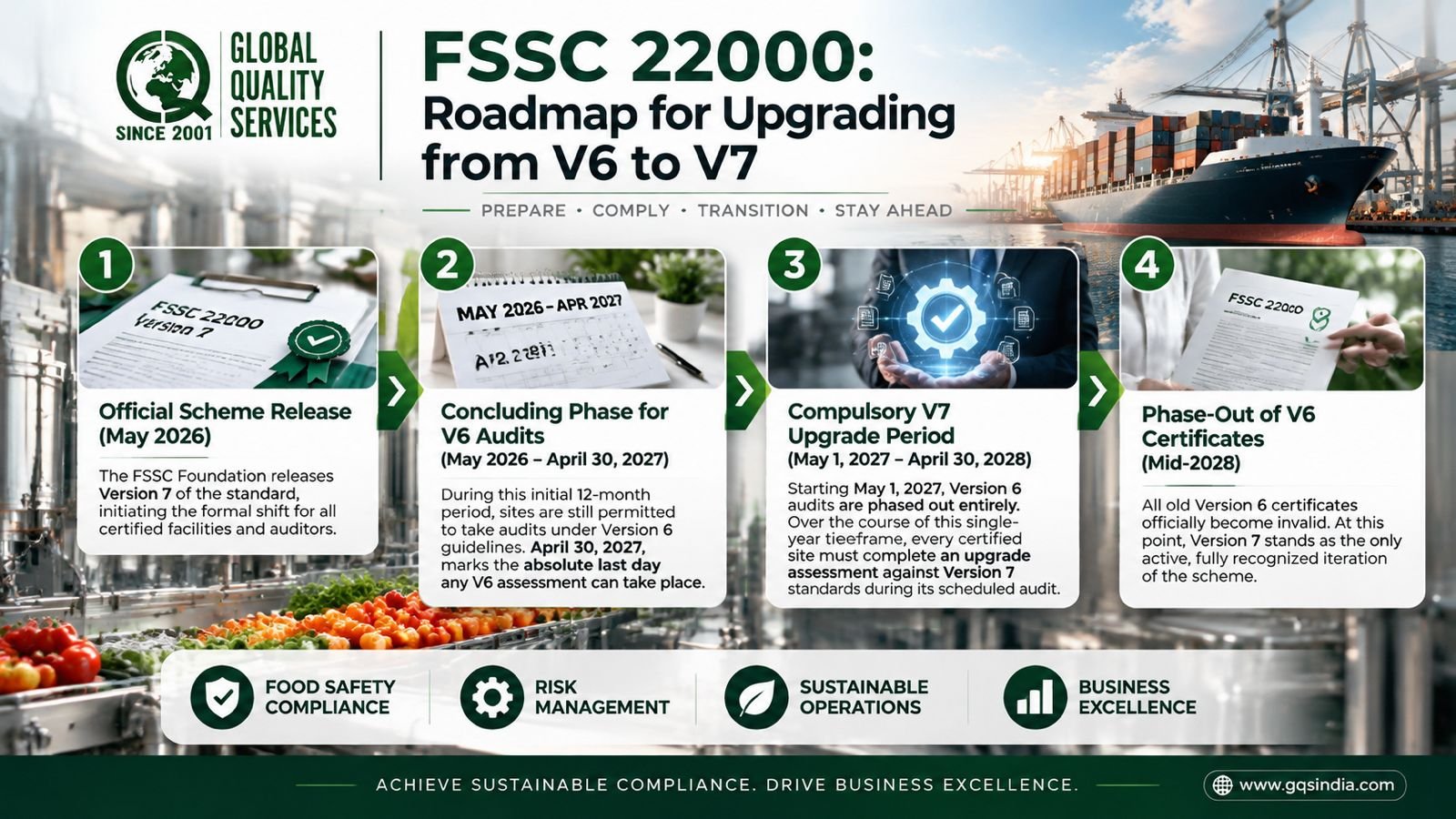
The FSSC Foundation updates the standards to reflect current supply chain risks and changes in GFSI requirements. Version 7 contains updated prerequisite standards from the ISO 22002 series, including ISO 22002-100:2025, and is aligned with the GFSI 2024 requirements. Facilities that are certified according to version 6 may still use the previous version for auditing purposes until April 30, 2027, but all facilities must have version 7 upgraded by April 2028.
- Strengthened Food Safety Culture: Version 7 requires measurable proof of management commitment, clear team communication, and tracked safety culture goals.
- Updated Equipment Sanitary Design: The update sets stricter rules for equipment selection, routine maintenance, and surface sanitation checks.
- Actionable Sustainability & SDG Targets: Facilities must document actionable steps to measure and reduce food waste and manage environmental impacts.
- Competency Mandates for Hazard Analysis: Teams conducting food fraud vulnerability reviews and food defense assessments must show documented training and technical competency.
Migration of FSSC 22000 from Version 6 to Version 7
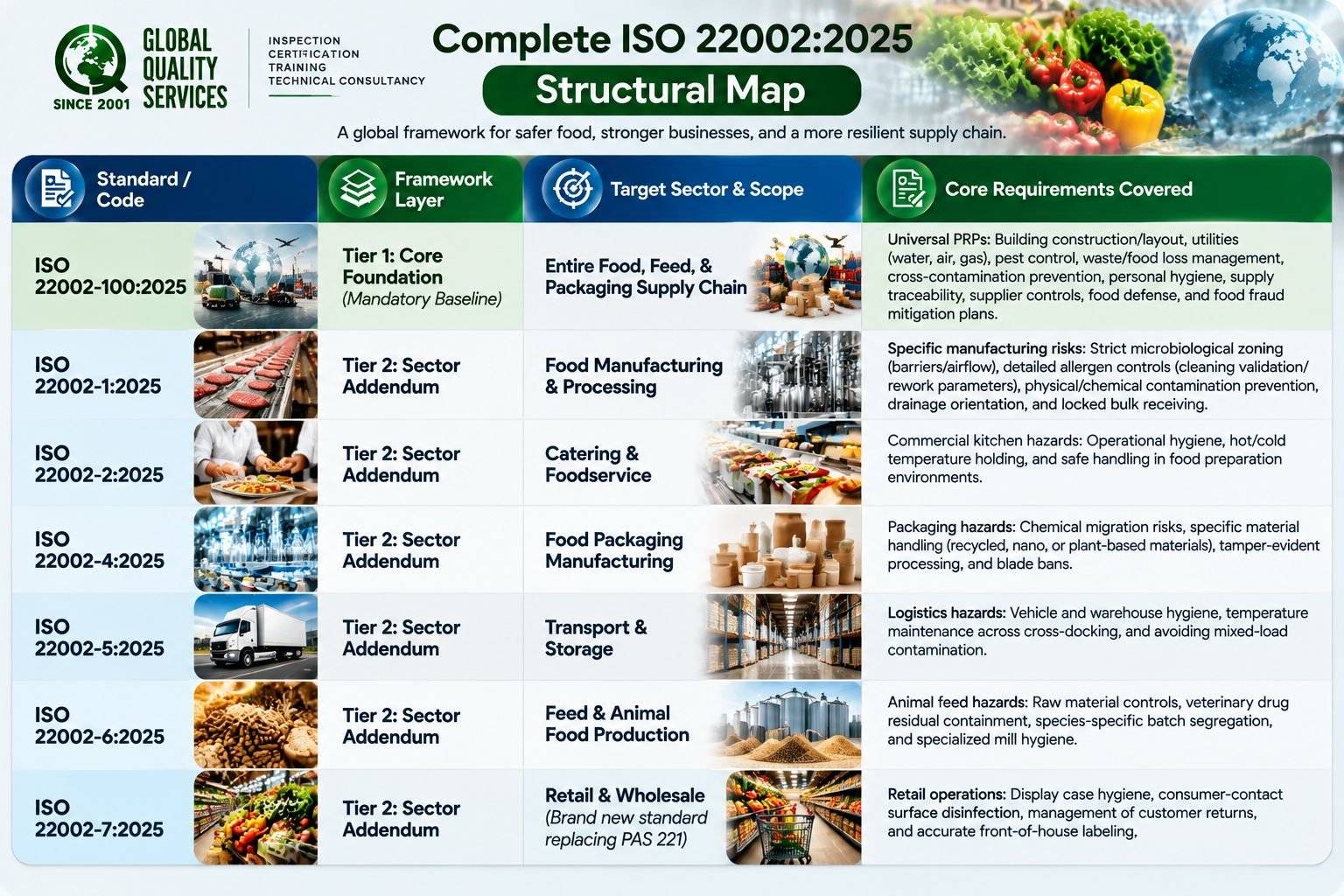
1. ISO 22002-100:2025 – Prerequisite Programs for Food Safety
Lays down the general prerequisite requirements for maintaining food safety and hygiene throughout food, animal feed, and packaging-related operations. These provisions address infrastructure, hygienic conditions, sanitation, pest prevention, workforce hygiene, traceability systems, and controls for minimising contamination risks.
2. ISO 22002-1:2025 – Food Manufacturing and Processing
Provides specific hygiene guidelines for organisations engaged in food production and processing. It focuses on maintaining controlled manufacturing environments through microbiological zoning, allergen prevention, effective cleaning, safe handling of materials, and procedures for reducing contamination hazards.
3. ISO 22002-2:2025 – Catering and Foodservice
Describes the prerequisite food safety measures required by catering providers, restaurants, commercial food preparation units, and other foodservice businesses. The standard covers preparation and serving practices, safe temperature ranges, kitchen hygiene, food storage, and the prevention of cross-contact and contamination.
4. ISO 22002-4:2025 – Food Packaging Manufacturing
Defines the operational hygiene conditions that packaging manufacturers need to maintain when producing materials used in food packaging. It focuses on controlling contamination during production, managing packaging materials, preventing unwanted chemical migration, and maintaining processes that preserve the safety of food-contact packaging.
5. ISO 22002-5:2025 – Transport and Storage
Sets the basic food safety conditions for organisations responsible for storing and moving food products through the supply chain. The requirements include maintaining hygienic transportation equipment and storage facilities, managing product temperatures, preventing contamination between goods, and ensuring safe transfer of products.
6. ISO 22002-6:2025 – Feed and Animal Food Production
Specifies the prerequisite hygiene conditions for businesses involved in the production and processing of animal feed. It addresses the selection and control of incoming raw materials, contamination safeguards, separation of different production batches, and implementation of hygienic production procedures.
7. ISO 22002-7:2025 – Retail and Wholesale
Details the food hygiene practices that retail outlets and wholesale businesses must maintain while handling and distributing food products. The scope includes sanitary product display areas, cleaning schedules, disinfection practices, appropriate storage and handling, returned product management, and compliance with food labelling requirements.
The FSSC 22000 Version 6 to Version 7 migration schedule provides a defined timeframe for certified organisations to adopt the updated food safety management system requirements. Following the publication of Version 7 on 1 May 2026, Version 6 audits will remain available through 30 April 2027. From 1 May 2027, organisations will enter the mandatory Version 7 upgrade audit phase, which continues until 30 April 2028. Certificates issued under Version 6 that have not transitioned are scheduled for withdrawal after 30 June 2028. Timely preparation is important for organisations to complete the necessary system changes within the prescribed transition period.
With over 20 years of management system consulting experience, Global Quality Services (GQS) works with organisations preparing for the transition from FSSC 22000 Version 6 to Version 7. We evaluate existing food safety management arrangements, identify differences between the two scheme versions, and review relevant procedures and records. Based on the assessment, we help businesses prioritise corrective actions, update their food safety documentation, and plan for the revised certification audit. This structured approach allows organisations to understand the changes applicable to their operations and prepare their management systems for the Version 7 requirements.
How Does Global Quality Services Support FSSC 22000 Certification Across Mumbai
Global Quality Services brings technical expertise tailored directly to the industrial environment of the Mumbai Metropolitan Region. Our consultants balance local FSSAI regulatory requirements with international GFSI criteria, helping you secure global market access with confidence.
- Local Technical Team: Our consultants operate directly across Mumbai, Thane, and Navi Mumbai, allowing us to deliver fast on-site evaluations and flexible meeting schedules.
- Practical Documentation: We build clear, easy-to-use documents that eliminate unnecessary paperwork and keep your team focused on daily production quality.
- Complete Audit Support: We guide your company through every step, managing gap reviews, staff training, trial audits, and non-conformity closures until your certificate is issued.
- Broad Sector Experience: From spice processing in Navi Mumbai to packaging plants in Palghar, we deliver practical support across all food industry categories.
Along with the FSSC 22000 Certification, we also offer consultancy/mentoring in the field of PCQI (Preventive Controls Qualified Individual) training and certification to assist food manufacturers in meeting the FDA FSMA requirements.
Partner with Global Quality Services to Build an Audit-Ready Facility for FSSC 22000 Certification in Mumbai
Getting your plant certified should strengthen your business, not slow down your daily operations. Partnering with Global Quality Services gives you a clear path to GFSI alignment with minimal stress and zero production downtime.
- Work directly with experienced food safety auditors who understand your specific industry risks.
- Get HACCP plans and operational controls built directly around your factory routines.
- Benefit from transparent project pricing with no hidden charges or unexpected fees.
- Fast-track your preparation to meet pressing retail onboarding dates or export buyer deadlines.
Ready to secure your compliance and open new commercial markets? Contact our team today to request your on-site gap analysis in Mumbai.
Frequently Asked Questions
1. What certification scope applies to food packaging manufacturers under FSSC 22000?
Food packaging units are certified under FSSC 22000 using the ISO 22000 standard alongside the sector-specific PRP standard for packaging (ISO 22002-4).
2. How do unannounced audits work for FSSC 22000 certified facilities?
FSSC 22000 mandates at least one unannounced surveillance audit during every three-year certification cycle. The certification body executes the audit without prior notice to verify that your facility maintains daily operational hygiene and compliance.
3. What happens if an auditor issues a Major Non-Conformity during our audit?
If a major non-conformity is raised, your company gets a set timeframe (typically 28 days) to submit a root cause analysis and action plan with physical evidence of corrections.
4. Can a multi-site business in Mumbai use a single FSSC 22000 certificate?
Yes, multi-site organizations operating central administrative offices alongside multiple production or storage facilities can seek multi-site certification.
5. Does FSSC 22000 require dedicated software or digital record-keeping?
No, FSSC 22000 does not require specific digital software. You can maintain compliance using paper logs, digital spreadsheets, or specialized enterprise software.