Do you know that the Reserve Bank of India claimed that the value of fraud in banks was on the rise, reaching up to ₹48,000 Crore in 2025 and 2026? Ensuring the safety of consumer payment information is no longer a practice but a must in order to survive in the world of commerce. Businesses are under great pressure to secure their transactions from any kind of digital threats. You need to have a certain standard to gain the trust of consumers and save yourself from huge financial losses. The Payment Card Industry Data Security Standard provides you with that.
This particular standard makes sure that your organization safely processes the data of the cardholders at all levels. Compliance with the standard may be a difficult task for you if done individually. You need experts who know the technicalities of the standard as well as the business environment around you. Read ahead to find out how we make the whole process easier for you.
Understanding PCI DSS Certification
PCI DSS means Payment Card Industry Data Security Standard. It is a global data security standard aimed at protecting payment account information and is applicable to merchants, payment processors, payment gateways, service providers, and other entities that deal with cardholder information or have any impact on the security of the same.
The PCI DSS standard has been developed and is managed by the Payment Card Industry Security Standards Council (PCI SSC). The standard includes technical and operational controls related to the security of payment environments.
In many organizations, the process is referred to as PCI DSS Certification in Hyderabad, though the PCI DSS is not quite similar to ISO Certification. Based on the organization, the validation process may include a Report on Compliance (ROC), Attestation of Compliance (AOC), Self-Assessment Questionnaire (SAQ), along with evidence or ASV scan results.
Why PCI DSS Certification Matters for Businesses in Hyderabad
Hyderabad has a large concentration of technology companies, fintech businesses, online service providers, e-commerce operations, BPOs, and other organizations that rely on digital transactions.
Business activity across areas such as HITEC City, Madhapur, Gachibowli, Kondapur, Financial District, and other commercial hubs means payment environments can involve multiple applications, cloud services, vendors, payment gateways, and remote users. A PCI DSS program helps businesses:
- Protect cardholder and payment account data
- Reduce exposure to payment security risks
- Improve access control and authentication practices
- Strengthen vulnerability management
- Improve security monitoring and testing
- Establish clearer payment data flows
- Meet contractual or payment partner requirements
- Build confidence among customers and business partners
- Maintain better evidence of security controls
- Create a more structured approach to ongoing payment security
The requirement for robust payment security is increasingly coming to light as the use of digital payments continues to grow. Just in August 2026, India conducted more than 24.5 billion UPI payments amounting to nearly ₹29.82 lakh crore, as stated by NPCI. To the businesses of Hyderabad conducting payment services, the rise in such payments calls for increased security in their risk management process.
PCI DSS v4.0.1: What Hyderabad Businesses Need to Know
PCI DSS v4.0.1 is the active version of the standard. PCI SSC published v4.0.1 in June 2024 as a limited revision to v4.0. The revision clarified requirements and corrected issues but did not add or remove requirements. PCI DSS v4.0 was retired on December 31, 2024.
The future-dated requirements introduced with PCI DSS v4.x became effective on March 31, 2025, so organizations preparing for PCI DSS validation today need to consider them as part of their assessment. Important areas of PCI DSS v4.0.1 include:
- Clearer roles and responsibilities
- Targeted risk analysis
- Stronger authentication controls
- Vulnerability management
- Security testing and monitoring
- Payment page security
- Third-party service provider management
- Annual confirmation of PCI DSS scope
- Customized Approach where applicable
- Stronger evidence and documentation expectations
Industries That Require PCI DSS Certification
Businesses in Hyderabad that may need PCI DSS compliance or validation include:
- Fintech and Banking Institutions handling card transactions
- E-commerce and Online Retailers storing customer data
- BPO and IT Companies processing payment information
- Healthcare and Hospitality Organizations accepting card payments
- Payment Gateway Providers and Processors
- SaaS and Technology Companies
What Does PCI DSS Protect?
PCI DSS focuses on protecting payment account data throughout the payment environment. Depending on the organization’s environment, this can involve:
- Primary Account Number (PAN)
- Cardholder name
- Expiration date
- Service code
- Sensitive authentication data where applicable
Sensitive authentication data such as card verification codes, PINs, and full magnetic stripe data has specific storage restrictions under PCI DSS. The important point is that PCI DSS is not limited to the database where card information is stored. The surrounding systems, applications, networks, cloud services, administrative access, security systems, and third-party connections may also affect the scope.
The surrounding systems, applications, networks, cloud services, administrative access, security systems, and third-party connections may also affect the scope.
Understanding PCI DSS Scope in Hyderabad
One of the most important parts of PCI DSS preparation is defining the Cardholder Data Environment (CDE) correctly. A business may assume that only its payment application or database falls under PCI DSS. In reality, connected systems that can influence the security of payment account data may also need to be considered. Depending on the environment, scope can involve:
- Payment applications
- Databases
- Servers
- Network infrastructure
- Firewalls
- Cloud environments
- Workstations
- Administrative systems
- Security systems
- Remote access technologies
- Payment gateways
- Third-party service providers
- SaaS platforms
- Supporting applications
- Employees with relevant access
Global Quality Services helps organizations examine their payment environment and understand what should be included in the PCI DSS scope before moving into detailed compliance work.
PCI DSS Requirements in Hyderabad
PCI DSS contains 12 high-level requirements covering the security of payment account data. The requirements address areas such as:
- Network security controls
- Secure configurations
- Protection of stored account data
- Protection of account data during transmission
- Malware protection
- Secure development and vulnerability management
- Access restriction
- User identification and authentication
- Physical access controls
- Logging and monitoring
- Security testing
- Information security policies and related organizational controls
PCI DSS Certification and Validation: SAQ or QSA Assessment?
Not every organization follows the same PCI DSS validation route. The appropriate approach can depend on factors such as:
- Merchant or service provider status
- Payment processing method
- Transaction environment
- Cardholder Data Environment scope
- Applicable SAQ eligibility
- Acquirer requirements
- Payment brand requirements
- Contractual obligations
Eligible organizations may use a Self-Assessment Questionnaire (SAQ), while others may need an assessment performed by a Qualified Security Assessor (QSA). PCI SSC states that SAQs are intended for eligible merchants and service providers and that the applicable SAQ depends on the organization’s environment.
Step-by-Step Process for PCI DSS Certification in Hyderabad
At Global Quality Services, we follow a systematic yet flexible approach to help businesses achieve certification without disrupting daily operations:
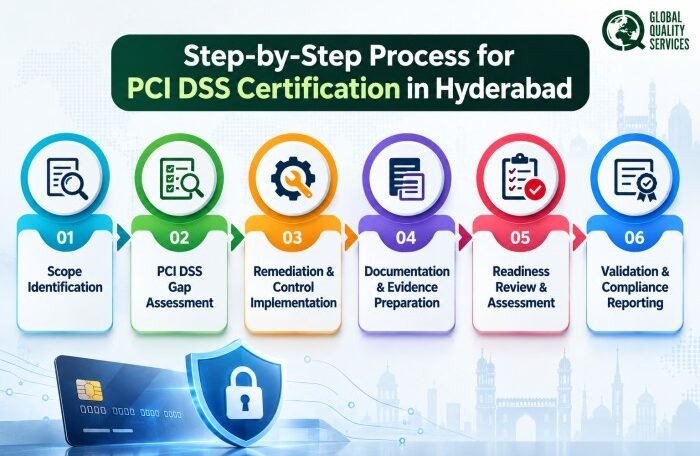
Step 1: Scope Identification
Identify payment flows, cardholder data, systems, applications, networks, cloud platforms, and third-party services that fall within PCI DSS scope. Middlebury
Step 2: PCI DSS Gap Assessment
Review existing security controls against the applicable PCI DSS v4.0.1 requirements and identify compliance gaps.
Step 3: Remediation & Control Implementation
Address identified gaps by strengthening access controls, authentication, vulnerability management, monitoring, data protection, and other applicable security measures.
Step 4: Documentation & Evidence Preparation
Prepare and organize required policies, procedures, technical records, testing reports, and other evidence needed to demonstrate compliance.
Step 5: Readiness Review & Assessment
Conduct a final readiness review and support the applicable PCI DSS assessment, whether through an eligible SAQ process or a formal QSA assessment.
Step 6: Validation & Compliance Reporting
Complete the applicable ROC, SAQ, and AOC documentation and submit the required compliance evidence to the relevant acquirer, payment brand or requesting organization.
Common PCI DSS Gaps Found in Organizations
Many businesses believe that having a firewall, antivirus software, and encryption automatically makes them PCI DSS compliant. In practice, assessments can identify gaps across both technical controls and operational practices. Common issues include:
- Incorrect PCI DSS scope
- Incomplete asset inventories
- Poorly documented payment data flows
- Excessive user privileges
- Weak authentication controls
- Incomplete access reviews
- Missing security logs
- Weak log monitoring
- Delayed vulnerability remediation
- Incomplete penetration testing
- Poor change management
- Unsupported software
- Weak application security
- Incomplete incident response records
- Missing compliance evidence
- Incomplete third-party documentation
- Policies that do not match actual business practices
Key Benefits of PCI DSS Certification in Hyderabad
A well-managed PCI DSS program can provide benefits beyond meeting payment security expectations. Here are the key benefits:
- Improved network and data security
- Reduced risk of financial losses due to breaches
- Increased trust among clients and payment partners
- Easier market access and vendor approvals
- Enhanced brand reputation and competitive edge
- Strengthened business continuity and risk management
How Much Does PCI DSS Certification Cost in Hyderabad
There is no single PCI DSS certification cost that applies to every Hyderabad business. The overall investment can depend on:
- Size of the cardholder data environment
- Number of systems in scope
- Number of applications
- Number of business locations
- Payment processing model
- Cloud infrastructure
- Third-party integrations
- Existing security controls
- Vulnerability scanning requirements
- Penetration testing requirements
- Documentation readiness
- Remediation work required
- Validation method
- QSA involvement, where applicable
How Long Does PCI DSS Certification Take in Hyderabad
There is no fixed PCI DSS timeline for every organization. The duration can depend on:
- Size and complexity of the organization
- Number of systems in scope
- Current security maturity
- Number of identified gaps
- Availability of evidence
- Remediation requirements
- Third-party dependencies
- Required testing
- Applicable validation method
PCI DSS Certification vs ISO 27001
PCI DSS focuses specifically on payment account data and the security of environments involved in payment card processing. ISO 27001, by comparison, provides a broader framework for managing information security across an organization.
For businesses handling payment information, the two frameworks can complement each other. PCI DSS addresses payment-specific security requirements, while ISO 27001 can provide a wider information security management structure.
Why Choose Global Quality Services PCI DSS Certification in Hyderabad
With over 26 years of consulting experience, Global Quality Services (GQS) is a trusted name for compliance and certification support across India. We bring a results-driven approach to every project:
- 26+ Years of Consulting Experience
- End-to-end guidance from assessment to certification
- Customized solutions tailored to your business environment
- Transparent processes and realistic timelines
- Strong Information Security Background
- Ongoing support for continuous compliance
- Pan-India Consulting Capability
PCI DSS for Hyderabad’s Fintech, IT and E-commerce Ecosystem
Hyderabad has developed into a major technology and business hub, with organizations operating across fintech, software, e-commerce, IT services, healthcare, hospitality and digital commerce.
For companies operating from HITEC City, Madhapur, Gachibowli, Kondapur, Financial District, Begumpet and other commercial areas, payment environments may involve multiple applications, cloud platforms, payment gateways, third-party providers and remote access systems. This makes accurate PCI DSS scoping particularly important.
Start PCI DSS Compliance in Hyderabad With Global Quality Services
Protecting payment data requires more than meeting a checklist. It requires the right scope, effective controls, reliable evidence, and a clear path to validation.
Contact Global Quality Services today for a PCI DSS consultation in Hyderabad. Share your business type, payment environment, and current compliance status with our team to discuss the applicable requirements, identify your preparation needs, and plan the next steps toward PCI DSS v4.0.1 compliance and validation.
Call GQS at +91 9845313910 or +91 9845078743, or send your enquiry to discuss your PCI DSS requirements.
Frequently Asked Questions
1. Is the PCI DSS certification applicable to all businesses in Hyderabad?
The PCI DSS is relevant to those entities which are associated with either storing, processing, or transmitting the payment account information, as well as those which possess the capability to influence the security of the cardholder data environment. The specific requirements depend upon the nature of the entity’s involvement and the payment environment.
2. Is PCI DSS v4.0.1 the current version?
Yes. PCI DSS v4.0.1 is the current version. PCI DSS v4.0 has been discontinued as of December 31, 2024.
3. Is PCI DSS applicable if we use a third-party payment gateway?
No, using a third-party payment gateway does not necessarily mean an exemption from PCI DSS compliance.
4. Is PCI DSS compliance required for a SaaS firm based out of Hyderabad?
Yes. Technology and software as a service firms can be included within PCI DSS compliance scope if they impact the security of the customer’s cardholder data environment in some way or another.
5. Does a small business require PCI DSS compliance?
PCI DSS may still apply to a small business in the event that the appropriate validation technique would depend on the payment environment, processing model, and partners involved.