Managing payments today comes with a certain degree of security accountability that organizations ignore at their peril. In the city of Noida, this is especially true, considering the presence of many IT firms, eCommerce outfits, fintech startups, BPOs, digital agencies, and tech ventures targeting the broader Delhi NCR region.
India’s massive digital payment system is one reason why organizations should seriously consider the security of their payment systems. Per the most recent figures published by Business Standard from NPCI, UPI executed 24.07 billion transactions amounting to ₹29.37 trillion in September 2026, with an average daily transaction count of around 802 million.
PCI DSS offers a framework for securing cardholder data environments and enhancing payment security for organizations storing payment card data. However, fulfilling PCI DSS compliance does not mean having well-written policies. You need to implement controls across your entire CDE, applications, network infrastructure, access controls, vendor management, testing procedures, and documentation.
A good PCI DSS consultant can help organizations navigate this challenge effectively. Continue reading below to learn about the PCI DSS compliance requirements, process, cost, relevance to business operations in Noida, and support offered by GQS.
What is PCI DSS Certification
Payment Card Industry Data Security Standard is abbreviated as PCI DSS. PCI DSS refers to an international security standard created to safeguard payment account information processed by any organization involved in storing, transmitting, processing, or impacting cardholder data security.
PCI DSS covers the entire spectrum of payments-related participants, which includes merchants, payment processors, service providers, financial institutions, eCommerce firms, and technology companies dealing with cardholder data. The requirements under PCI DSS revolve around many aspects, such as:
- Security and protection of payment systems and networks
- Restrictions on access to cardholder data
- Protection of stored and transferred payment data
- Management of vulnerabilities
- System monitoring and security events
- Testing of security controls
- User access control
- Security policies and procedures management
- Third-party service providers management
- Protection of payment sites and web applications
Why PCI DSS Certification Matters for Businesses in Noida
Noida has become a key tech and business hub in Delhi NCR. According to the Government of Uttar Pradesh, sectors like IT, ITeS, GCCs, data centers, cloud computing, digital services, and technology businesses form part of key growth areas for the state. The IT and ITeS section on the website of the state government also mentions Noida as a location that will facilitate the growth of IT infrastructure.
Thus, PCI DSS compliance assumes critical significance for organizations in Noida handling customer payments, online payments, payment applications, or any network that stores, processes, or transmits cardholder data. PCI DSS compliance may benefit businesses in several ways.
- Protect cardholder data by implementing strong security controls and encryption.
- Prevent data breaches and financial losses from hacking or malware incidents.
- Meet legal and contractual obligations imposed by payment gateways and acquiring banks.
- Gain customer trust by showing visible proof of secure payment practices.
- Improve operational efficiency through standardized policies and procedures.
- Open new business opportunities with global partners who demand certified compliance.
Who Needs PCI DSS Certification in Noida
The scope of PCI DSS applies to any organization storing, processing, or transmitting payment card information. It also includes businesses whose network systems or services can impact the cardholder data environment. Businesses located in Noida requiring PCI DSS compliance/validation may include:
- E-commerce companies
- Online marketplaces
- Fintech companies
- Payment processors
- Payment gateways
- Banks and financial service providers
- Retail businesses
- SaaS companies handling payment environments
- IT and IT-enabled service providers
- BPO and KPO organizations
- Travel and hospitality businesses
- Healthcare organizations accepting card payments
- Subscription-based businesses
- Digital platforms
- Service providers supporting payment environments
- Businesses processing card payments for domestic or international customers
PCI DSS v4.0.1: What Noida Businesses Need to Know
PCI DSS v4.0.1 is the active version of the PCI DSS standard. PCI Security Standards Council released v4.0.1 as a limited revision containing corrections and clarifications, while the previous PCI DSS v4.0 was retired at the end of 2024.
Businesses preparing for PCI DSS validation should also understand that the future-dated requirements introduced under PCI DSS v4.x became effective on March 31, 2025. PCI SSC identified 64 new requirements in PCI DSS v4.x, with 51 originally designated as future-dated. Important areas strengthened under PCI DSS v4.x include:
- Targeted risk analysis
- Clearly defined responsibilities
- Annual scope confirmation
- Customized approaches where applicable
- Stronger authentication controls
- Vulnerability management
- Payment page security
- Ongoing monitoring
- Third-party service provider management
- Security testing and validation
What Does PCI DSS Protect
PCI DSS is concerned with protecting payment account information throughout its relevant lifecycle. Depending on the environment, this can include information such as:
- Primary Account Number (PAN)
- Cardholder name
- Expiration date
- Service code
- Sensitive authentication data where applicable
Authentication credentials, including CVV numbers, PINs, and full track magnetic stripe data, receive separate treatment under PCI DSS guidelines. But it’s important to realize that this isn’t merely a matter of securing one database with payment data. There may be other environmental factors at play that impact the security of payment data.
PCI DSS Certification Process in Noida
Your exact path through the certification process will vary based on your organization, payment environment, validation requirements, and what your acquiring bank, payment brand, or other accepting party expects from you. With the support of GQS, preparing for the certification process becomes five manageable steps.
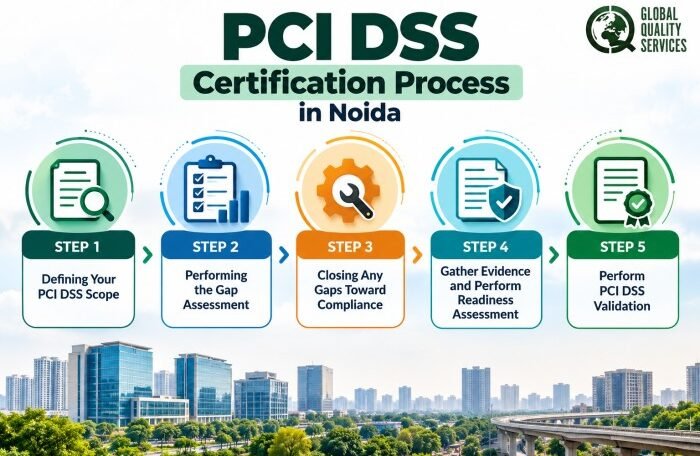
Step 1: Defining Your PCI DSS Scope
Determine which assets, including software applications, personnel, networks, payment paths, cloud infrastructures, and third parties, house, process, transfer, or impact the security of any cardholder data.
Step 2: Performing the Gap Assessment
Compare the relevant requirements within the updated PCI DSS version 4.0.1 against your current controls. The gap assessment allows you to see weaknesses within areas like access control, authentication, vulnerability management, logging and monitoring, security testing, and policies.
Step 3: Closing Any Gaps Toward Compliance
Address the discovered technical or procedural gaps in your controls framework. Based on results from previous steps, this stage could involve improving access control, configuration management, vulnerability management, policy updates, monitoring capabilities, or application security controls.
Step 4: Gather Evidence and Perform Readiness Assessment
Compile the necessary evidence to prove that relevant controls are correctly established and functioning. GQS is capable of reviewing your documentation, logs, test results, and related documents prior to performing the validation process.
Step 5: Perform PCI DSS Validation
Perform the appropriate validation based on organizational needs. If a formal QSA assessment is necessary, the Qualified Security Assessor evaluates the environment and evidence to compile appropriate compliance documentation.
PCI DSS Certification Benefits for Noida Businesses
PCI DSS should not be viewed only as an assessment requirement. A properly managed compliance program can also improve the way a business manages payment security.
- Better Protection for Payment Data: Organizations can strengthen the controls used to protect sensitive payment information from unauthorized access.
- Lower Exposure to Security Weaknesses: Regular testing, monitoring, access reviews, and vulnerability management can help identify weaknesses before they become larger problems.
- Stronger Business Reputation: Customers, partners, and enterprise buyers are more likely to take payment security seriously when a business can demonstrate appropriate compliance.
- Easier Enterprise Vendor Onboarding: Large customers and international partners may ask suppliers to demonstrate security and compliance before signing contracts. PCI DSS validation can help address such requirements where applicable.
- More Organized Security Controls: PCI DSS encourages organizations to document responsibilities, review controls, monitor systems, and maintain evidence rather than treating security as a one-time activity.
- Better Payment Ecosystem Relationships: Demonstrating compliance can make discussions with payment processors, acquiring banks, and other payment stakeholders more straightforward.
RBI Guidelines for Card Payment Security
For organizations in Noida, adhering to RBI (Reserve Bank of India) guidelines is just as essential as PCI DSS compliance. Key RBI requirements include:
- Cardholder and transaction data must not be stored beyond the retention period allowed by RBI regulations for reconciliation and settlement purposes.
- Strong customer authentication, including mandatory two-factor authentication (2FA), is required for all online and card-not-present transactions.
- All sensitive payment data processed by Indian entities must be stored exclusively within India, as outlined in the RBI’s data localization mandate.
- Regular security audits, vulnerability assessments, and penetration testing are compulsory under RBI’s cybersecurity framework for payment system operators.
- Any data breach or fraud incident must be reported to RBI without delay, complying with established notification timelines and protocols.
By incorporating both PCI DSS and RBI guidelines, your organization demonstrates a robust commitment to data security and regulatory compliance, building greater trust with customers and payment partners.
PCI DSS Certification Cost in Noida
The final cost depends on the size and complexity of the payment environment and the amount of preparation required. Important cost factors include:
- Number of systems within scope
- Number of applications
- Number of locations
- Cardholder data flows
- Payment channels
- Cloud infrastructure
- Third-party service providers
- Existing security controls
- Vulnerability scanning requirements
- Penetration testing requirements
- Documentation requirements
- Remediation work
- Employee training
- Assessment and QSA requirements, where applicable
How Long Does PCI DSS Certification Take in Noida
A business with a limited payment environment and mature security controls may require significantly less preparation than a large enterprise with several applications, locations, third-party integrations, and unresolved security gaps. Factors affecting the timeline include:
- Size of the organization
- Number of systems in scope
- Complexity of the Cardholder Data Environment
- Number of applications
- Cloud infrastructure
- Existing security controls
- Number of identified gaps
- Vulnerability and penetration testing requirements
- Evidence availability
- Remediation requirements
- Applicable validation method
Common PCI DSS Challenges Faced by Noida Businesses
PCI DSS compliance can become difficult when organizations approach it as a documentation exercise rather than a security program. Some of the most common challenges include:
- Insufficient PCI DSS Scope Understanding: Organizations may lack a clear comprehension of how cardholder data is accessed, processed, stored, and transmitted through their environment.
- Inadequate Documentation: Policy documentation may exist but fail to align with organizational practices.
- Poor Evidence Management: Control implementation may occur without proper evidence generation during assessments.
- Third-Party Risks: Payment processors, cloud service providers, software providers, managed services providers, and third parties introduce additional risks into the compliance landscape.
- Ineffective Vulnerability Management: Legacy infrastructure, unpatched vulnerabilities, outdated scans, or ineffective remediation tracking may cause issues for the assessment process.
- Public Application Weaknesses: E-commerce sites and payment forms pose unique challenges since any vulnerabilities within publicly accessible web applications can compromise payment environments.
- Lack of Clear Roles & Responsibilities: PCI DSS becomes challenging without defined roles for IT, information security, compliance, human resources, operations, and management.
Factors Affecting PCI DSS Certification Cost and Duration
The cost and timeline for PCI DSS Certification in Noida depend on several factors—primarily the size of your business, the number of systems involved, and the type of payment environment. Smaller businesses that only handle limited card transactions may complete certification in as little as two to three months, while larger enterprises with complex infrastructures could require six months or more.
Cost considerations typically include:
- The scope of systems that handle card data.
- Existing IT and security posture.
- The need for technical remediation (firewalls, encryption tools, access controls).
- Employee training and awareness programs.
- External auditing and QSA fees.
PCI DSS Consultants and QSA Auditors: What Is the Difference
This distinction matters when selecting a PCI DSS services vendor. The role of a PCI DSS consultant is to advise on the requirements, perform gap analysis, enhance control frameworks, document the findings, assemble the evidence base, and get your organization ready for validation.
A Qualified Security Assessor (QSA) refers to an individual certified by the PCI SSC program to undertake relevant PCI DSS assessment activities.
Based on your organization’s validation needs, you will either require a QSA assessment or other forms of validation procedures.
At GQS, we offer advisory services and readiness preparation to ensure proper preparation. If your validation process involves a QSA assessment, then this must be done via a qualified assessor pathway.
PCI DSS Compliance in Noida for Different Business Locations
Noida businesses do not operate from one single commercial zone. Technology and business operations are spread across several sectors and nearby business clusters. GQS can support organizations operating in areas such as:
- Sector 62
- Sector 63
- Sector 64
- Sector 65
- Sector 125
- Sector 126
- Sector 127
- Sector 132
- Sector 135
- Sector 142
- Greater Noida
- Greater Noida West
- Knowledge Park
- Noida Expressway business corridor
- Other Delhi NCR business locations
- Get Started with PCI DSS Certification in Noida
PCI DSS and ISO 27001: How They Can Work Together
PCI DSS focuses specifically on protecting payment account data and meeting applicable payment security requirements.
Organizations looking to strengthen their broader information security management framework may also consider ISO 27001 Certification as a complementary standard.
The two standards serve different purposes, so the appropriate approach depends on the organization’s business objectives, customer requirements, information security risks, and compliance obligations.
Why Choose Global Quality Services for PCI DSS Certification
With over 26 years of experience, Global Quality Services is one of India’s leading consulting firms for information security and management system certifications. Our team of experts delivers practical, business-friendly solutions that align with international standards and local business needs. When you work with GQS, you get:
- End-to-end support from assessment to certification.
- Practical guidance instead of rigid templates.
- Local consultants familiar with the Noida market.
- Post-certification assistance for continuous improvement.
We have helped hundreds of businesses across India achieve PCI DSS Certification efficiently and confidently.
Get Expert PCI DSS Support in Noida and Prepare With Confidence
If your Noida business handles card payments or operates systems that can affect the security of payment card data, now is the right time to review your compliance position. With 26+ years of consultancy experience and support for businesses across India, GQS helps organizations approach PCI DSS with a clear scope, practical controls, organized evidence, and assessment readiness. Get in touch with GQS today to discuss your PCI DSS requirements in Noida and move your payment security program toward formal validation.
Frequently Asked Questions
1. Can GQS help with PCI DSS compliance after the assessment?
Yes. PCI DSS requires continued attention to applicable controls and validation activities. GQS can provide ongoing consulting support for reviews, documentation updates, testing coordination, remediation guidance, and continued compliance activities as required.
2. Does GQS conduct the formal PCI DSS audit?
GQS provides PCI DSS consulting and readiness support. Where an organization requires a formal QSA assessment, the assessment is conducted through the applicable qualified assessor route. GQS can help the business prepare its scope, controls, documentation, evidence, and readiness before the assessment.
3. Does a small business need PCI DSS compliance?
PCI DSS is not limited to large organizations. A small business can also have PCI DSS responsibilities if it stores, processes, transmits, or can affect the security of payment card data. The applicable validation method depends on the organization’s circumstances.
4. Do PCI DSS v4.0.1 future-dated requirements already apply?
Yes. PCI DSS v4.x future-dated requirements went into effect on March 31, 2025. If your company completes validation of any PCI DSS version, it’s important to take these future-dated requirements into account.
5. Can PCI DSS Compliance Help Win New Clients?
Yes. Demonstrating PCI DSS compliance can strengthen trust with customers and business partners, particularly when payment security is part of vendor or client requirements.