Pune has emerged as a hub for IT companies, fintech companies, SaaS companies, e-commerce companies, BPOs, and businesses that rely heavily on online payments. With increasing amounts of transactional activities conducted via websites, applications, gateways, and integrated systems, securing sensitive card data has turned into a corporate responsibility rather than just an IT concern. It makes sense when considering the scope of digital payments happening in India every minute. For instance, NPCI reported 24,508.96 million UPI transactions valued at ₹29,82,355.95 crore in August 2026, which gives us an idea about the vastness of India’s digital payment ecosystem.
PCI DSS offers guidelines and security standards for securing payment account data held by businesses. PCI DSS v4.0.1 is the latest update to this framework. If your Pune-based business needs to meet compliance mandates due to client requirements, payment partner evaluation, QS audit, or internal controls, hiring a consultant could simplify the process considerably. Learn about requirements, procedures, costs involved, and support offered by GQS India towards PCI DSS implementation.
What is PCI DSS Certification
PCI DSS stands for Payment Card Industry Data Security Standard. It is a global security standard developed to protect payment account data and establish consistent technical and operational security practices.
PCI DSS applies to organisations that store, process, or transmit cardholder data, as well as organisations whose systems or services can affect the security of the cardholder data environment. This can include merchants, payment processors, payment gateways, service providers and technology companies.
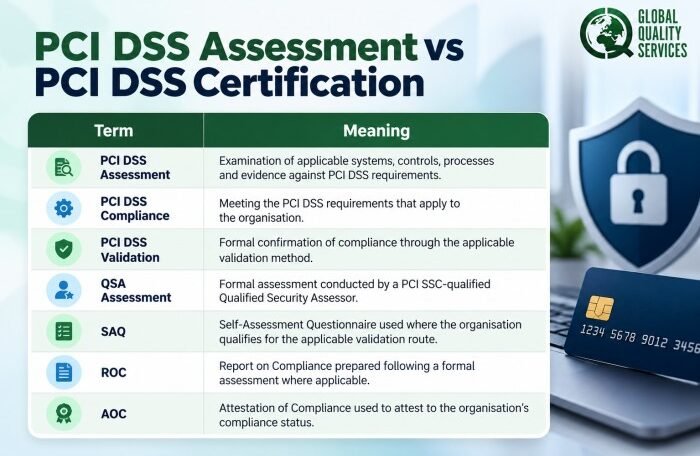
Businesses often use the term PCI DSS Certification when searching for compliance services. Technically, PCI DSS works through assessment and validation rather than an ISO-style certification model. Depending on the organisation and its validation requirements, compliance may involve a Self-Assessment Questionnaire (SAQ), a Qualified Security Assessor (QSA) assessment, a Report on Compliance (ROC), an Attestation of Compliance (AOC), or other applicable validation documents.
Why PCI DSS Compliance Matters for Pune Businesses
There is a lot going on in Pune commercially. You will find IT and software firms coexisting alongside fintechs, e-commerce, automotive, hospitality, healthcare, retail organizations, and even BPOs. Many of these organizations will rely on payment apps, cloud computing, APIs, databases, POS terminals, or third-party processors in carrying out transactions.
Even if card data isn’t kept within the organization itself, the other connected systems may play some part in ensuring secure payments. This is where PCI DSS compliance can help Pune’s organizations tremendously. Protect payment account information from unauthorised access.
- Identify weaknesses across systems connected to the payment environment.
- Improve access control and authentication practices.
- Strengthen vulnerability management and security testing.
- Establish better monitoring and logging practices.
- Prepare evidence required for compliance validation.
- Meet contractual or customer security requirements.
- Demonstrate a structured approach to payment data security.
- Improve confidence among customers and business partners.
Who Needs PCI DSS Certification in Pune?
PCI DSS applies to any organization that stores, processes, or transmits credit/debit card information, including:
- Banks and financial institutions
- Payment processors and gateways
- E-commerce companies
- BPOs and call centers handling card transactions
- SaaS platforms with online payment integrations
- Retail chains and hospitality companies accepting card payments
PCI DSS v4.0.1: What Pune Businesses Should Know
Version 4.0.1 of the PCI DSS framework represents the current standard. The PCI Security Standards Council published version 4.0.1 as a minor update to 4.0, mainly including clarifications and corrections. Some of the things that got more focus when moving to PCI DSS 4.x included:
- Targeted risk analysis.
- Clearly defined roles and responsibilities.
- Annual scope confirmation.
- Authentication requirements.
- Vulnerability management.
- Payment page security.
- Third-party service provider management.
- Ongoing monitoring.
- Customised approaches to meeting certain requirements.
The PCI DSS Certification Process with GQS
At Global Quality Services, our end-to-end approach simplifies compliance for your team and ensures readiness for formal certification.
1. Gap Assessment & Scoping
PCI DSS compliance means understanding the payment environment and card data flows, including identifying the apps, infrastructure, cloud providers, interfaces, and even third parties involved in the process.
2. Risk Assessment & Remediation
Our security experts perform a gap analysis between your current controls and PCI DSS v4.0.1 requirements. This can relate to any aspect of your environment – such as access control, authentication, vulnerability management, auditing, monitoring, networks, applications, documentation, and many others.
3. Policy Development & Documentation
We identify where improvements can be made and then assist your team in implementing necessary changes. This may involve adjustments to policy, procedure, technology, access, monitoring, vulnerabilities, or any other aspect of security practice.
4. Internal Audit & Readiness Review
PCI DSS compliance isn’t just about having controls; it’s also about ensuring that there’s evidence proving these controls exist and function properly. GQS can help prepare that evidence for you.
5. External Audit & Certification
The final step varies depending on the particular validation process that applies to you. We guide your organization through this step, ensuring everything needed is documented and audited properly. If there is a QSA assessment process involved, it is carried out by a qualified QSA organization according to PCI SSC guidelines.
Benefits of PCI DSS Compliance for Pune Businesses
A well-managed PCI DSS programme can provide practical benefits beyond satisfying a customer or payment partner.
- Better Payment Data Protection: Security controls help reduce unnecessary exposure of payment account information.
- Greater Visibility: Scoping and data-flow analysis can help organisations understand where payment information moves and which systems influence its security.
- Stronger Security Controls: PCI DSS covers areas such as access control, vulnerability management, monitoring, network security, and application security.
- Easier Customer and Vendor Reviews: Enterprise customers and payment partners may request evidence of PCI DSS compliance during onboarding or vendor assessments.
- Improved Internal Accountability: Defined responsibilities and documented controls help teams understand who owns different security activities.
- Better Assessment Readiness: Maintaining evidence and controls throughout the year can make future validation work more manageable.
PCI DSS Assessment vs PCI DSS Certification
These terms are frequently used interchangeably, but they describe different parts of the compliance journey:
Key Requirements of PCI DSS
- Install and maintain secure network configurations.
- Protect stored cardholder data.
- Encrypt transmission of cardholder data across open networks.
- Maintain robust access control systems.
- Regularly test and monitor security systems.
- Maintain an information security policy for all employees.
Global Quality Services ensures every one of these elements is addressed systematically to meet full compliance.
Benefits of PCI DSS Certification
-
Enhanced protection of cardholder and transaction data.
-
Strengthened cybersecurity and operational resilience.
-
Greater trust among customers and payment partners.
-
Reduced risk of cyberattacks and internal fraud.
-
Smooth integration with global payment processors.
-
Demonstrated adherence to global data protection standards.
Cost of PCI DSS Certification in Pune
The cost of PCI DSS Certification depends on:
- Business size and IT infrastructure complexity
- Volume of transactions processed annually
- Existing security controls and documentation maturity
- Number of systems and vendors involved
Pune Areas We Serve for PCI DSS Consulting
Global Quality Services provides PCI DSS consulting support to businesses across Pune and nearby commercial and technology hubs, including:
- Hinjewadi
- Wakad
- Baner
- Balewadi
- Kharadi
- Viman Nagar
- Magarpatta City
- Hadapsar
- Kalyani Nagar
- Yerawada
- Koregaon Park
- Shivajinagar
- Pimpri-Chinchwad
- Chakan
- Talegaon
- Bhosari
- Aundh
- Kondhwa
Regardless of whether your business works out of a technology park, corporate office, industrial complex, or commercial hub, PCI DSS compliance needs to be evaluated based on your payment ecosystem, not just geographic location alone.
PCI DSS and ISO 27001: How They Can Work Together
Businesses looking at broader information security controls may also consider ISO 27001 Certification alongside PCI DSS.
PCI DSS focuses specifically on payment account data security, while ISO 27001 provides a broader information security management framework. The two can complement each other where the organisation needs both payment security controls and a wider information security management structure.
Common PCI DSS Gaps Found in Businesses
A business may have strong cybersecurity tools and still have gaps against PCI DSS requirements. Common areas that may require attention include:
- Incorrect PCI DSS scope
- Incomplete asset inventory
- Poorly documented data flows
- Excessive user privileges
- Weak authentication
- Incomplete access reviews
- Missing security logs
- Weak log monitoring
- Delayed vulnerability remediation
- Incomplete penetration testing
- Weak change management
- Unsupported software
- Incomplete third-party documentation
- Missing compliance evidence
- Policies that do not match actual practices
Why Hire Global Quality Services for PCI DSS Certification in Pune
Here are key reasons why to choose Global Quality Services for PCI DSS certification:
- Decades of Experience: GQS is among India’s most trusted names in data security and ISO certification.
- Qualified Experts: Our consultants bring deep technical expertise in PCI DSS, ISO 27001, and IT governance frameworks.
- Local Presence in Pune: Direct access to on-ground consultants familiar with regional industry needs.
- End-to-End Support: From scoping and documentation to training and audit coordination.
- Client-Centric Approach: We design compliance programs aligned with your business operations, not just checklists.
Get PCI DSS Consulting and Assessment Support in Pune
Your PCI DSS project should begin with a clear understanding of what is in scope, which controls apply, and what evidence your organisation needs to maintain. Global Quality Services provides practical PCI DSS consulting support for businesses in Pune, including scope review, gap assessment, documentation assistance, remediation guidance, evidence preparation, and assessment readiness.
Speak with the GQS India team today for a PCI DSS readiness discussion. Share your business type, payment environment, and current compliance requirement with our consultants to receive guidance on the appropriate next steps and a service proposal suited to your organisation.
Frequently Asked Questions
1. When does my organization require a QSA assessment for PCI DSS compliance?
Your company will need to undergo a formal PCI DSS assessment, which requires engagement of a QSA, if the PCI Security Standards Council approves your company as a Qualified Security Assessor organization. Otherwise, there may be alternative routes through self-assessment questionnaires.
2. Is it possible to get help from GQS India in preparing for a QSA assessment?
Certainly. GQS can assist in identifying the scope of PCI DSS application, performing a gap assessment, recommending remediation measures, document drafting, evidence gathering, and other preparatory work prior to validation and the eventual QSA assessment.
3. Is there an applicability of PCI DSS for SaaS companies operating in Pune?
Yes, it is very much possible. If a SaaS provider stores, processes, or transmits any cardholder information or offers services affecting the cardholder data environment, then PCI DSS applies.
4. Can PCI DSS and other security standards be implemented together?
Yes. Organisations may align PCI DSS activities with broader information security and governance programmes where appropriate. The controls and scope should still be mapped carefully so that PCI DSS requirements are not overlooked.
Is PCI DSS only for large companies?
No. PCI DSS applicability is not limited to large organisations. Businesses of different sizes can have PCI DSS responsibilities depending on how they handle payment card data and the requirements applicable to their payment environment.