SaaS startups scale fast, but so do privacy risks. Recent research shows that 28% of organizations experienced a cloud or SaaS-related data breach in the past year, highlighting how exposed modern platforms have become. This growing risk directly impacts customer trust, regulatory scrutiny, and long-term business sustainability. As customer data flows across cloud environments, startups must move beyond basic security and adopt structured privacy frameworks.
ISO 27701 enables this shift by embedding privacy into operations, governance, and product design. However, implementing it correctly requires expertise, making a qualified consultant essential for avoiding gaps and accelerating compliance.
What is ISO 27701 and Why It Matters for SaaS
ISO 27701 is an extension of ISO 27001 that focuses on Privacy Information Management Systems (PIMS). It helps organizations manage personally identifiable information (PII) in line with global privacy regulations like GDPR.
For SaaS startups, this means:
- Structured privacy governance
- Clear accountability for data handling
- Increased credibility with enterprise clients
- Faster security and privacy due diligence
In simple terms: ISO 27701 transforms privacy from a legal burden into a scalable business function.
PIMS Structure for SaaS Startups
A well-defined Privacy Information Management System (PIMS) is the backbone of ISO 27701 compliance.
Key Components of a SaaS PIMS
- Privacy Governance Framework
Define roles, responsibilities, and oversight mechanisms. - Data Mapping and Inventory
Identify where PII is collected, processed, stored, and shared. - Risk Assessment and DPIA
Evaluate privacy risks and conduct Data Protection Impact Assessments. - Policies and Procedures
Create documented processes for data handling, retention, and deletion. - Third-Party Risk Management
Assess vendors and subprocessors handling customer data. - Incident Response Plan
Establish breach notification and response procedures.
Pro Tip: SaaS startups should align PIMS with their DevOps lifecycle to ensure privacy-by-design.
Controller vs Processor: Understanding Your Role
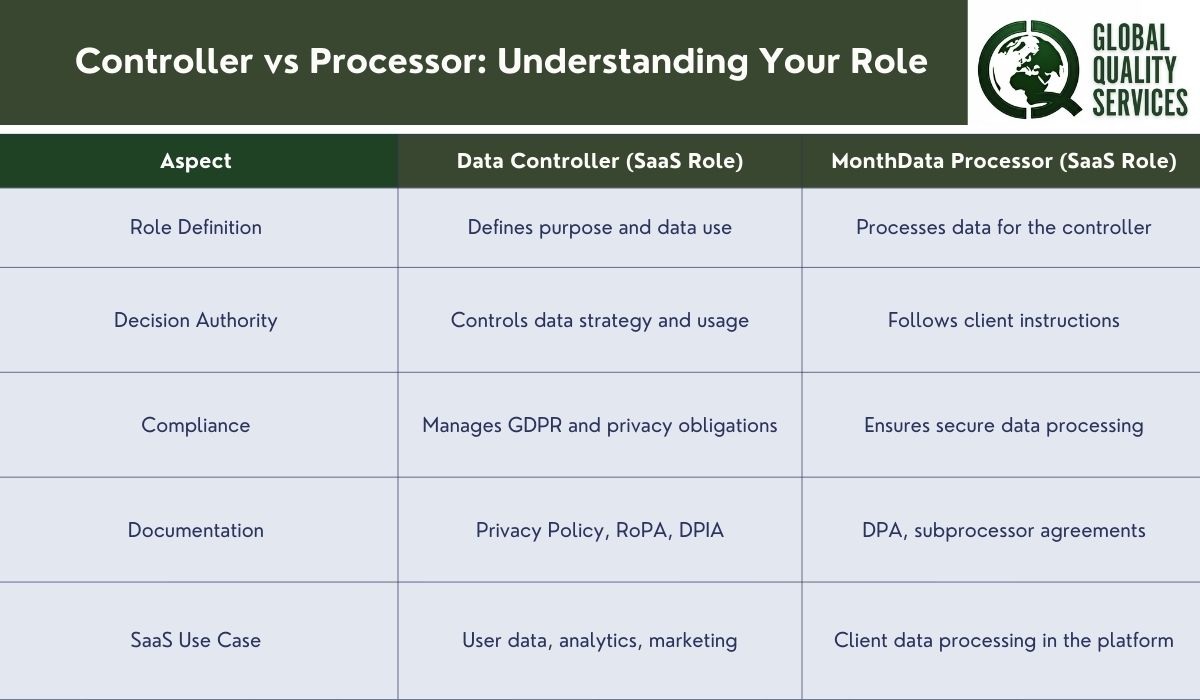
Understanding whether your SaaS startup acts as a controller or processor is essential for compliance. The comparison below clarifies key roles, responsibilities, and privacy obligations.
| Aspect | Data Controller (SaaS Role) | Data Processor (SaaS Role) |
| Role Definition | Defines purpose and data use | Processes data for the controller |
| Decision Authority | Controls data strategy and usage | Follows client instructions |
| Compliance | Manages GDPR and privacy obligations | Ensures secure data processing |
| Documentation | Privacy Policy, RoPA, DPIA | DPA, subprocessor agreements |
| SaaS Use Case | User data, analytics, marketing | Client data processing in the platform |
Privacy Documentation: What You Must Maintain
Documentation is central to ISO 27701 compliance and plays a major role in audits and client trust.
Essential Privacy Documents
- Privacy Policy (external-facing)
- Data Processing Agreements (DPAs)
- Records of Processing Activities (RoPA)
- Data Retention Policy
- Incident Response and Breach Notification Policy
- Vendor/Subprocessor List
- DPIA Reports
Why It Matters
- Demonstrates accountability
- Simplifies audits and certifications
- Speeds up enterprise onboarding
Content Tip: Keep documentation concise, version-controlled, and aligned with actual operational practices.
Client Due Diligence: Winning Enterprise Trust
Enterprise clients conduct rigorous privacy and security due diligence before onboarding SaaS vendors.
Common Due Diligence Requirements
- ISO 27001 and ISO 27701 certification
- Data flow diagrams
- Subprocessor transparency
- Encryption and access control measures
- Incident response capabilities
How ISO 27701 Helps
- Provides structured evidence of compliance
- Reduces back-and-forth during vendor assessments
- Improves win rates in enterprise sales cycles
Strategic Insight: Startups with ISO 27701 certification often close deals faster by eliminating trust barriers early.
Benefits of ISO 27701 for SaaS and Cloud Startups
Implementing ISO 27701 delivers measurable advantages for SaaS and cloud startups by strengthening privacy, improving compliance posture, and enhancing overall business credibility.
- Enhanced Customer Trust – Demonstrates strong privacy practices, increasing confidence among users and enterprise clients.
- Regulatory Compliance Alignment – Helps meet GDPR and global data protection requirements efficiently.
- Faster Enterprise Sales Cycles – Reduces due diligence friction and accelerates client onboarding.
- Improved Data Governance – Establishes clear processes for handling, storing, and managing personal data.
- Reduced Legal and Financial Risks – Minimizes chances of penalties, breaches, and compliance failures.
- Competitive Market Advantage – Positions your SaaS startup as a privacy-first and security-conscious brand.
Implementation Roadmap for SaaS Startups
- Start with ISO 27001 Foundation
ISO 27701 requires an existing ISMS. - Conduct Privacy Gap Assessment
Identify missing controls and documentation. - Define Controller/Processor Roles
Map responsibilities clearly. - Build PIMS Framework
Implement policies, procedures, and controls. - Train Teams
Ensure awareness across engineering, product, and support. - Perform Internal Audit
Validate readiness before certification. - Get Certified
Work with an accredited certification body.
Summary
ISO 27701 helps SaaS startups build a strong privacy foundation while staying compliant with global regulations. It streamlines data governance, builds client trust, and supports faster growth in competitive markets. With the right implementation, it becomes a long-term business asset. Need expert guidance? Contact us today, backed by 26+ years of experience, we’re here to help you get started.
FAQ’s
1. What is ISO 27701 in simple terms?
ISO 27701 is a privacy extension of ISO 27001 that helps organizations manage personal data responsibly through a structured Privacy Information Management System aligned with global data protection regulations.
2. Do SaaS startups need ISO 27701 certification?
Yes, especially if handling customer data. It strengthens trust, meets enterprise requirements, and simplifies compliance with privacy laws, making it highly valuable for scaling SaaS businesses globally.
3. Can a SaaS company be both controller and processor?
Yes, most SaaS startups act as both. They control user data for their platform while processing customer data on behalf of clients, requiring dual-role compliance and documentation.
4. How long does ISO 27701 implementation take?
Typically, it takes 3 to 6 months, depending on organization size, existing ISO 27001 readiness, and complexity of data processing activities within the SaaS environment.
5. What documents are required for ISO 27701?
Key documents include privacy policies, DPAs, RoPA, DPIA reports, incident response plans, and vendor management records, all of which demonstrate structured, compliant handling of personal data.