India’s healthcare technology sector is growing rapidly, and with that growth comes a major responsibility to protect sensitive patient data. Healthcare SaaS companies, telemedicine platforms, medical billing providers, and healthcare outsourcing firms in India are increasingly working with US healthcare organizations that require strict data security practices.
At the same time, cyber threats against healthcare systems continue to rise. India recorded more than 265 million cyberattacks in 2025. In parallel, India’s healthcare cybersecurity market is expected to grow strongly over the coming years as more healthcare operations shift toward cloud platforms and digital patient systems.
For Indian companies handling Protected Health Information (PHI), HIPAA compliance has become an important requirement for working with US healthcare clients, building trust, and reducing security risks.
What is HIPAA Compliance?
The Health Insurance Portability and Accountability Act is a critical piece of legislation enacted in the United States to safeguard Protected Health Information. This includes patient files, clinical records, insurance claims, billing databases, and medical imagery. The framework specifies exactly how this data must be managed, accessed, stored, and sent to prevent unauthorized disclosure.
Achieving complete compliance requires setting up a comprehensive operational system divided into three primary safeguard categories:
- Administrative Safeguards: Appointing corporate privacy officers, designing strict data clearance policies, organizing routine security drill schedules, and deploying mandatory workforce training programs.
- Technical Safeguards: Activating end-to-end encryption protocols, setting unique identity login parameters, deploying automated session terminations, and configuring unalterable system audit logs.
- Physical Safeguards: Restricting physical entry to data centers, installing biometric door access locks, standardizing terminal clean-desk policies, and securing hardware storage areas.
Benefits of HIPAA Compliance in India
HIPAA compliance helps Indian healthcare and technology companies strengthen security practices while improving business credibility with international healthcare clients. Here are the key benefits:
- Stronger Healthcare Data Protection: HIPAA encourages organizations to implement security controls such as data encryption, access management, audit logging, multi-factor authentication, and secure backup systems.
- Improved Client Confidence: US healthcare organizations often assess vendors before sharing patient information. HIPAA compliance helps Indian businesses build trust during vendor onboarding and security reviews.
- Better Risk Management: Healthcare data is highly sensitive and frequently targeted by cybercriminals. HIPAA-focused security practices help organizations identify and reduce operational risks before they become major issues.
- Support for Long-Term Business Growth: Healthcare providers and healthtech companies increasingly prefer vendors with structured security and compliance processes. HIPAA readiness can support long-term partnerships and business expansion opportunities.
- Improved Internal Security Processes: HIPAA compliance helps strengthen internal security by improving access controls, employee awareness, password management, incident response planning, and cloud security practices across the organization.
Who Needs HIPAA Compliance in India?
Many organizations outside hospitals and clinics also require HIPAA compliance support if they handle healthcare data linked to US healthcare operations.
- Healthcare SaaS Companies: Healthcare applications that process patient records, appointment systems, EHR integrations, or healthcare workflows often require HIPAA-aligned security controls.
- Medical Billing and Coding Companies: Medical billing firms regularly process patient and insurance information, making secure data handling essential.
- Telemedicine Platforms: Telehealth platforms manage online consultations, prescriptions, patient communication, and healthcare records that involve sensitive information.
- Healthcare BPO and KPO Providers: Healthcare outsourcing companies often access confidential patient data while supporting US healthcare organizations.
- Healthcare AI Platforms: AI healthcare applications processing medical records, patient analytics, or clinical data require strong security safeguards to reduce exposure risks.
- Cloud and IT Service Providers: Organizations managing healthcare infrastructure, cloud environments, or hosted healthcare systems may also require HIPAA-aligned security practices.
Our HIPAA Compliance Process
We guide your organization through a systematic, frictionless operational pathway to help you align with international regulations without interrupting your daily business operations.
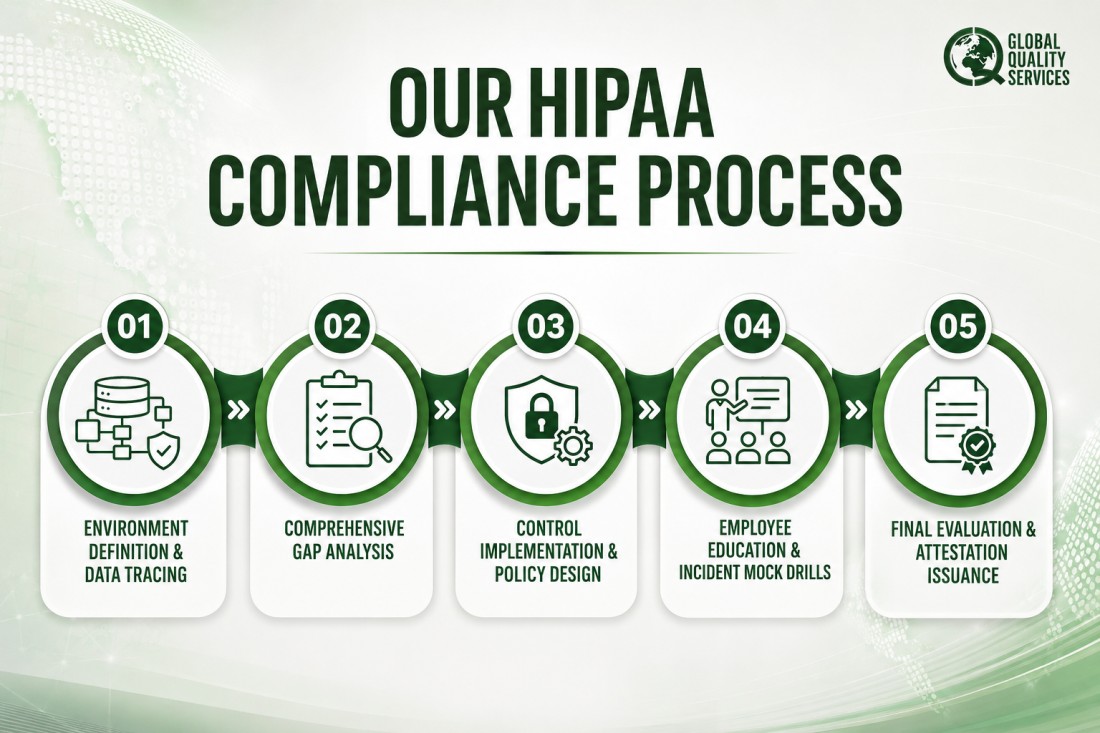
Step 1: Environment Definition & Data Tracing
We chart the comprehensive flow of all incoming and outgoing protected health data across your business networks to construct an accurate baseline compliance boundary.
Step 2: Comprehensive Gap Analysis
Our expert auditors cross-reference your exact administrative, physical, and technical network controls against the official regulations to spotlight latent vulnerabilities.
Step 3: Control Implementation & Policy Design
We work directly alongside your engineering and operations teams to upgrade data encryption engines, implement proper tracking logs, and write corporate security policies.
Step 4: Employee Education & Incident Mock Drills
We deliver practical security training modules tailored to your workforce and coordinate simulated incident responses to test your system defenses.
Step 5: Final Evaluation & Attestation Issuance
Our auditing group conducts a definitive review of your corrected security environment and issues an official Attestation of Compliance report.
Common HIPAA Compliance Gaps We Find
Our localized field assessments across regional technology centers consistently reveal several recurring infrastructure vulnerabilities:
- Residual Profile Privileges: Active user logins and access tokens belonging to former employees remaining valid inside development code repositories.
- Improper Media Disposal: Discarding older corporate workstation drives, backup tapes, or physical medical logs without utilizing certified forensic data destruction methods.
- Outdated Encryption Protocol Arrays: Employing obsolete transport security layers or legacy database configurations that are susceptible to modern system exploits.
- Neglected Downstream Subcontracting: Outsourcing core software testing modules or data storage operations to local vendors without putting a formal BAA in place.
HIPAA Compliance Cost in India
HIPAA compliance costs in India vary depending on the organization’s size, infrastructure, and operational complexity. Several factors influence the overall effort required, including:
- Number of employees
- Existing cybersecurity maturity
- Cloud infrastructure complexity
- Number of applications and systems
- Amount of healthcare data handled
- Third-party integrations
- Existing policies and security controls
Why Choose Global Quality Services for HIPAA Compliance Services in India
Global Quality Services helps healthcare companies, SaaS providers, telemedicine platforms, and healthcare outsourcing firms strengthen their HIPAA compliance posture through structured assessments and practical security recommendations.
Industry Focused Approach
Our assessments are designed around real healthcare workflows, cloud systems, APIs, and healthcare application environments.
Practical Security Guidance
Recommendations are clear, actionable, and aligned with operational realities instead of overly complex compliance language.
Technical and Compliance Expertise
The process combines cybersecurity assessments with compliance-focused reviews to help organizations improve both security readiness and operational trust.
Support for Modern Healthcare Platforms
We support healthcare SaaS platforms, AI healthcare systems, cloud environments, and telemedicine applications handling sensitive healthcare information.
Structured Reporting and Documentation
Organizations receive clear findings, remediation guidance, and documentation support that can assist during client security reviews and vendor onboarding processes.
Build Trust with HIPAA Compliance With Global Quality Services
Accelerate your entry into the lucrative international medical market by turning complex data regulations into a clear competitive business advantage. A verified, professional data security infrastructure satisfies international risk management teams, shortens vendor vetting timelines, and allows your enterprise to sign major commercial agreements with complete confidence.
Reach out to the corporate compliance team at Global Quality Services today to arrange your formal scoping consultation and secure a reliable growth path for your offshore operations.
Frequently Asked Questions
1. Is HIPAA compliance mandatory for Indian healthcare companies?
HIPAA applies when Indian organizations handle Protected Health Information for US healthcare providers, insurers, or healthcare partners. Many US healthcare clients require vendors to follow HIPAA-aligned security practices.
2. Can a healthcare SaaS platform in India become HIPAA compliant?
Yes. Healthcare SaaS platforms can implement HIPAA-aligned safeguards such as encryption, access controls, audit logging, and secure cloud configurations to improve compliance readiness.
3. How long does HIPAA compliance take?
The timeline depends on the organization’s infrastructure, existing security controls, number of systems, and operational complexity. Smaller organizations may complete the process faster than large healthcare outsourcing firms.
4. What security assessments are commonly included in HIPAA compliance projects?
HIPAA compliance projects commonly include vulnerability assessments, risk analysis, cloud security reviews, access control assessments, policy reviews, and security gap analysis.
5. Why do healthcare companies choose structured HIPAA assessments?
Structured assessments help organizations identify security weaknesses, improve healthcare data protection, strengthen vendor trust, and prepare for client security reviews more effectively.