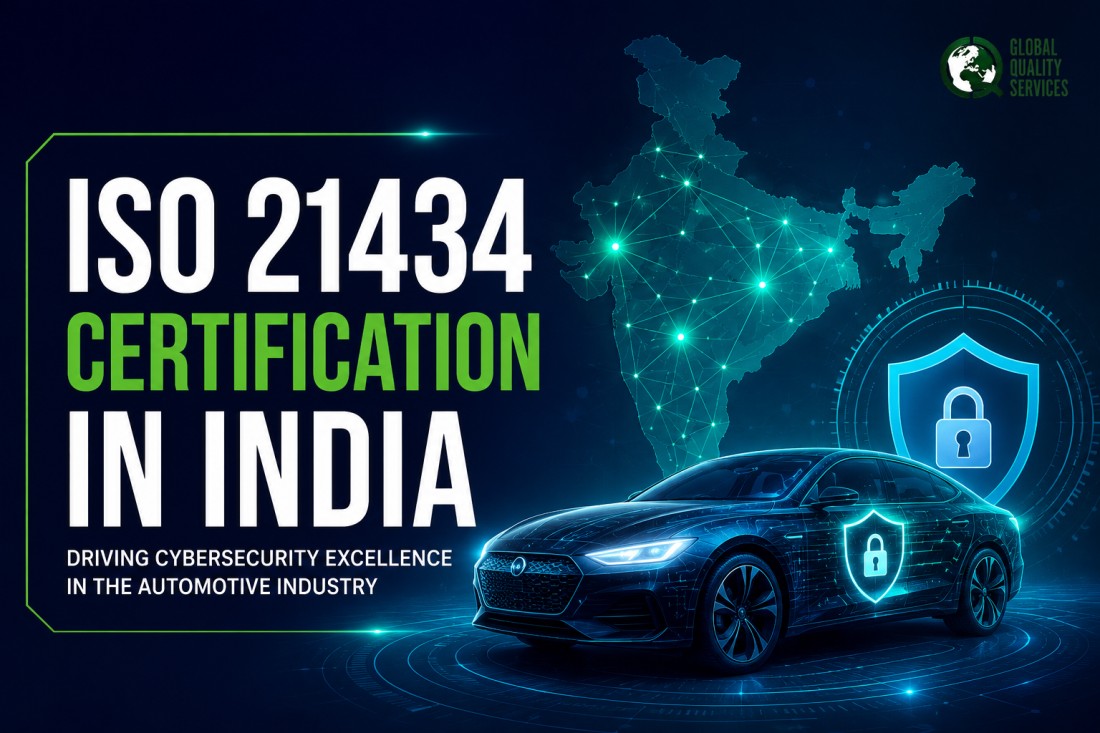
The Indian automotive market is changing fast as digital technology takes over the driving experience. According to CyberMedia Research, connected vehicles are projected to capture 40 to 45 percent of the passenger vehicle market in India by the end of 2026.
While these smart features make driving much easier, they also bring completely new risks. In 2025 alone, the Indian Computer Emergency Response Team reported over 29.44 lakh cyber incidents across the country’s digital networks. Hackers can now target a vehicle just like they target a regular computer. This makes cybersecurity a top priority for all carmakers and auto parts suppliers. ISO 21434 Certification is the global rulebook that helps automotive companies in India build safe and secure vehicles from the ground up.
What is ISO 21434 Certification?
ISO 21434 is an international standard that guides the automotive industry on how to manage cybersecurity risks. It focuses specifically on the electronic systems inside road vehicles. A modern car is basically a moving computer. It has features like GPS navigation, mobile app connectivity, and advanced sensors. All these advanced features require complex software to run properly. But more software means more chances for hackers to find weak spots and enter the system.
This standard tells manufacturers exactly how to protect these electronic systems. It includes the actual manufacturing process in the factory. Also, it covers what happens when the car is on the road being driven by a customer, and even how the car is retired at the end of its life. Unlike regular IT security that protects office computers and data servers, ISO 21434 protects moving physical vehicles.
Why ISO 21434 is Important for the Automotive Industry?
The automotive industry is going through a massive transformation right now. Vehicles no longer just rely on simple engines and mechanical brakes. They rely on millions of lines of complex software code. Because everything is connected to the internet and mobile networks, hackers can find ways to enter the system remotely. Here is why adopting this standard is necessary for your business to survive and grow.
- Protecting Human Lives: Cybersecurity in cars is not just about protecting private data or credit card numbers. It is about physical human safety. If a hacker takes control of the braking system or the steering wheel while a car is on the highway, it can lead to fatal accidents. Keeping the software secure means keeping the passengers alive.
- Preventing Massive Financial Losses: A single security flaw can force a car company to recall thousands of vehicles back to the dealer. Product recalls cost millions of dollars. They also stop your normal production line and hurt your company’s profit margins. Following this standard helps you catch mistakes early in the design phase before they become expensive problems.
- Building Brand Trust: Consumers expect their cars to be completely safe. If the local news reports that your vehicle brand was hacked, buyers will lose their trust instantly. Having this official certification proves to your buyers that you take their safety seriously. It shows you follow the best global engineering practices available.
- Meeting Strict Government Rules: Governments around the world are making cybersecurity a strict legal requirement. In India, the government has introduced new rules like AIS 189, which require strong cybersecurity management systems for all new vehicles starting recently. If you want to sell your auto parts or cars legally, you simply must meet these basic safety requirements.
Who Needs ISO 21434 Certification?
ISO 21434 applies to a wide range of organizations involved in automotive design, development, manufacturing, and software engineering.
- Automotive OEMs: Vehicle manufacturers are developing connected and software-enabled vehicles.
- Electric Vehicle Manufacturers: EV companies manage battery systems, charging connectivity, mobile applications, and cloud-integrated vehicle platforms.
- Automotive Software Development Companies: Organizations developing embedded software, vehicle operating systems, and automotive applications.
- ECU and Embedded Systems Manufacturers: Suppliers responsible for critical electronic components and control systems.
- Automotive Electronics Manufacturers: Companies producing sensors, controllers, communication modules, and smart automotive devices.
- Tier 1 and Tier 2 Suppliers: Suppliers supporting OEM programs where cybersecurity compliance is increasingly becoming a contractual expectation.
- ADAS and Autonomous Technology Providers: Organizations developing advanced driver assistance and autonomous vehicle technologies.
Key Requirements of ISO 21434
To get this certification, your company must change how it handles digital security. The standard demands specific actions at every single level of your business operations. Here are the key requirements:
- Creating a Security Culture: Company management must take the lead. You need to appoint dedicated security leaders within your engineering team. Your staff must get regular training so they understand the latest digital threats in the market. Security must become a core part of your company’s values and daily discussions.
- Continuous Risk Checking: You must regularly check your systems for weak spots. This is done using a specific method called Threat Analysis and Risk Assessment. This process helps you figure out what parts of your system are most likely to be attacked by hackers and how bad the damage could be.
- Secure Product Design: You cannot wait until the product is finished to check for security flaws. You must plan for security during the very first brainstorming phase. Every time your team designs a new feature, they must also design a way to protect that feature from outside hackers.
- Monitoring and Updates: Your responsibility does not end when the car is sold to the customer. Hackers find new ways to attack computer systems every single day. You must monitor the digital landscape for new threats constantly. When a new threat appears, you must be ready to send secure software updates to the vehicles already on the road.
- Managing Your Suppliers: A car is only as secure as its weakest electronic part. If you buy a cheap and insecure sensor from a smaller supplier, your whole vehicle is at risk. You must force all your own suppliers to follow the same strict security rules that you follow in your factory.
Our ISO 21434 Certification Process
Our process makes sure your business meets all the international rules without stopping your daily production work.
Step 1: Finding the Gaps in Your System
We start by looking deeply at how you currently build your products. We compare your current work habits to the official standard rules. This helps us see exactly what is missing and what needs to change immediately.
Step 2: Evaluating the Technical Risks
Our team works directly with your engineers to check your products for security holes. We run a complete Threat Analysis and Risk Assessment together. This gives us a clear and honest map of your biggest digital vulnerabilities.
Step 3: Updating Your Engineering Workflows
We do not just tell you what is wrong and leave. We actually help you fix it. We assist your team in writing new security policies from scratch. We help you create step-by-step guides so your engineers know exactly how to build secure products moving forward.
Step 4: Training Your Staff Properly
A secure process is completely useless if your team does not understand how to use it. We provide detailed training sessions for your employees. We teach your software developers and project managers how to think exactly like security experts.
Step 5: Running a Practice Audit
Before the official inspector arrives at your office, we run a complete mock audit. We act like the real inspectors and check every detail of your documentation and work. If we find a mistake, we fix it together before the real test begins.
Step 6: Full Support During Certification
When the official certification body comes to audit your company, we stand by your side. We help answer their tough technical questions and guide you smoothly through the final approval stage.
Benefits of ISO 21434 Certification
Organizations implementing ISO 21434 gain both compliance and business advantages.
- Improved Cybersecurity Risk Management: The standard helps organizations identify and address cybersecurity risks before they impact products or customers.
- Stronger OEM Confidence: Demonstrating cybersecurity maturity can strengthen relationships with automotive manufacturers and global partners.
- Better Supply Chain Qualification: Many automotive procurement programs increasingly evaluate supplier cybersecurity capabilities.
- Support for Global Market Access: ISO 21434 helps organizations align with international automotive cybersecurity expectations and regulatory requirements.
- Reduced Product Vulnerabilities: A structured cybersecurity lifecycle reduces the likelihood of security weaknesses reaching production environments.
- Enhanced Customer Trust: Strong cybersecurity practices improve confidence among customers, partners, regulators, and stakeholders.
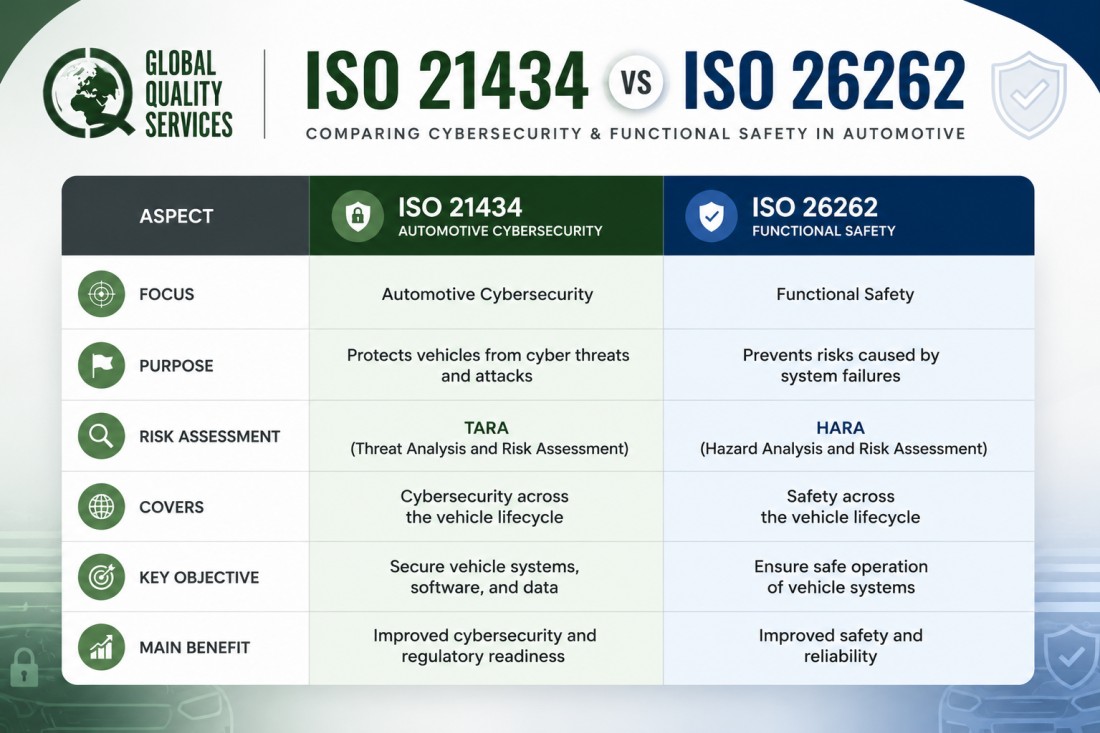
ISO 21434 vs ISO 26262
Here is a clear difference between ISO 21434 and ISO 26262:
Why Choose Global Quality Services for ISO 21434 Certification Support?
Global Quality Services supports organizations through every stage of the ISO 21434 journey with a structured and practical approach:
- Industry-Focused Expertise: Support is aligned with the operational realities of automotive manufacturers, software companies, EV businesses, and component suppliers.
- Risk-Based Implementation: Cybersecurity controls are designed around actual business and technical risks rather than generic compliance checklists.
- End-to-End Certification Support: From readiness assessment to certification preparation, organizations receive guidance throughout the entire process.
- Practical Compliance Approach: Implementation focuses on creating workable processes that integrate with existing development and operational activities.
- Support for Global Automotive Requirements: Guidance helps organizations align cybersecurity efforts with evolving international automotive expectations and supply chain requirements.
Take the Next Step Toward ISO 21434 Compliance
As vehicles become more connected and software-driven, cybersecurity expectations are increasing across the global automotive industry. Organizations that build strong cybersecurity processes today are better positioned to reduce risks, meet OEM requirements, support international compliance goals, and protect long-term business growth. Partner with Global Quality Services to establish a practical ISO 21434 framework that supports secure product development, stronger customer confidence, and future-ready automotive operations.
Frequently Asked Questions
1. Is ISO 21434 certification mandatory in India?
No, ISO 21434 is not currently a mandatory certification requirement in India. However, many OEMs, global automotive programs, and international supply chains increasingly expect suppliers to demonstrate compliance with automotive cybersecurity requirements.
2. How long does ISO 21434 implementation take?
The timeline depends on organizational size, existing cybersecurity maturity, product complexity, and development processes. Most organizations require several months to fully implement and validate the required framework.
3. What is TARA in ISO 21434?
TARA stands for Threat Analysis and Risk Assessment. It is a structured process used to identify cybersecurity threats, assess risks, define security objectives, and determine appropriate protection measures.
4. Can ISO 21434 be implemented alongside ISO 26262?
Yes. Many automotive organizations implement both standards together because cybersecurity and functional safety requirements often overlap during vehicle development.
5. How does an experienced ISO 21434 consulting team support implementation?
An experienced team can help organizations perform gap assessments, establish cybersecurity governance processes, conduct TARA activities, prepare documentation, and improve readiness before certification assessments.