Bengaluru has become one of the most important AI and technology hubs in Asia. From AI SaaS platforms and fintech companies to healthcare technology firms and global capability centers, businesses across the city are building and scaling AI-driven systems faster than ever. At the same time, organizations are facing growing pressure to manage AI responsibly, reduce operational risks, and build trust with customers and enterprise clients.
According to JLL’s India GCC Guide 2026, Bengaluru continues to lead India’s GCC ecosystem with nearly 900 GCC units and around 34–39% of the country’s overall GCC activity. Another 2026 industry report states that Bengaluru holds nearly 50% of India’s AI and machine learning capability, making it the country’s largest deep-tech and AI talent hub.
This rapid AI growth is increasing the need for structured AI governance. Organizations are now expected to show how AI systems are monitored, managed, documented, and controlled. This is where ISO 42001 certification in Bengaluru is becoming important for businesses that want to scale AI responsibly while improving enterprise trust and compliance readiness.
Why AI Companies in Bengaluru Are Moving Toward ISO 42001
Building powerful machine learning models is no longer the sole metric of success for technology companies. Enterprise clients now prioritize data safety, risk mitigation, and systemic accountability before signing multi-year vendor contracts.
- Accelerating Enterprise Procurement: Large corporate buyers in the United States, Europe, and India require exhaustive security and compliance reviews. ISO 42001 certification streamlines vendor onboarding by serving as a globally recognized verification of robust AI data safety protocols.
- Unlocking Global Market Entry: Western jurisdictions are actively enforcing stringent legal structures, including the European Union AI Act. Achieving compliance with ISO 42001 closely aligns an organization with these international requirements, allowing local firms to scale internationally without rebuilding their governance frameworks from scratch.
- Securing Institutional Capital: Venture capital firms and institutional investors are increasingly conducting deeper due diligence on algorithmic liabilities. A certified Artificial Intelligence Management System demonstrates institutional maturity, protecting your business valuation from sudden regulatory or ethical shocks.
- Building Sustainable Public Trust: Demonstrating external validation helps software providers distinguish their systems from market noise and reassure end-users that automated workflows are accurate, safe, and heavily audited.
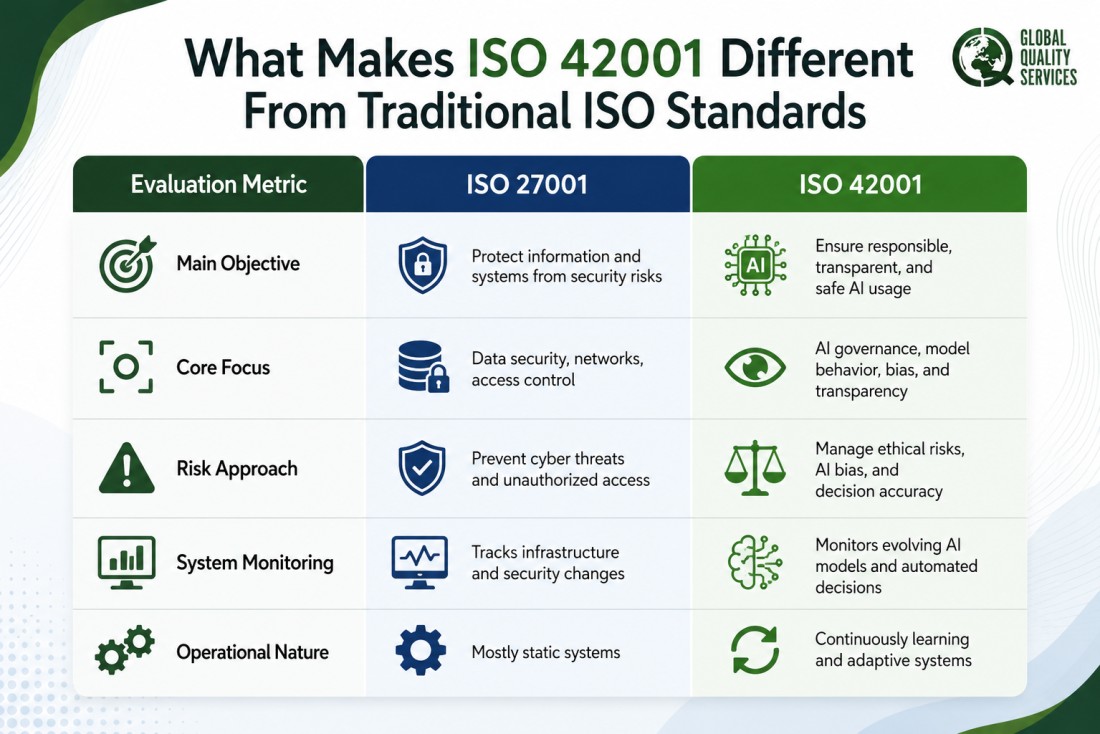
What Makes ISO 42001 Different From Traditional ISO Standards
Traditional ISO standards focus on structured operations and information security. ISO 42001 is different because it is built specifically for AI systems that continuously learn, evolve, and make autonomous decisions.
Common AI Governance Risks Organizations Face
Deploying artificial intelligence systems without a formal management framework exposes a business to severe financial, legal, and operational risks.
Algorithmic Bias and Discrimination
Models trained on unvetted historical data will inevitably institutionalize past human biases. When applied to automated hiring systems, loan underwriting, or healthcare triage, biased models generate discriminatory outputs that invite immediate legal litigation and reputational damage.
Continuous Model Drift
A machine learning model optimized in a controlled staging environment can quickly decay when faced with real-world inputs. Without continuous, systematic tracking, this behavioral drift goes unnoticed, resulting in flawed analytical insights and degraded automated decisions.
Data Provenance and Intellectual Property Liabilities
Utilizing web-scraped data or third-party datasets without explicit, verifiable lineage documentation creates significant legal risk. Businesses risk facing copyright infringement lawsuits, substantial regulatory fines, and the potential forced deletion of core models by enforcement authorities.
Shadow AI Usage
Internal engineering and operations teams frequently integrate external generative interfaces into corporate workflows without explicit security authorization. This unauthorized usage leads to severe corporate IP leaks, as proprietary source codes and sensitive client details are inadvertently uploaded to public systems.
What We Evaluate During ISO 42001 Implementation
Here is what we evaluate during ISO 42001 implementation:
Corporate AI Policy and Organizational Structure
We assist leadership teams in establishing clear organizational accountability. This involves drafting comprehensive AI governance policies, establishing cross-functional risk committees, and defining explicit operational ownership for algorithmic outputs across the entire company.
Operational Lifecycle and System Architecture
Our teams review the end-to-end development journey from initial data ingestion to final system deployment. We evaluate system specifications, verify validation protocols, and check architectural workflows to ensure reproducible performance across all operational environments.
Data Governance and Provenance Audits
We analyze data collection workflows to verify legitimate data acquisition, copyright compliance, and secure storage practices. This step ensures that training datasets are clean, well-documented, and free from structural compliance violations.
Algorithmic Fairness and Risk Assessments
Our experts establish continuous evaluation procedures to actively track bias and prevent model drift. We implement specific statistical tests to confirm that your automated decision engines remain fair, objective, and well-aligned with intended business outcomes.
Transparency and Traceability Controls
We design clear logging mechanisms to ensure that model decisions can be explained, reviewed, and audited by external parties. This step ensures that complex algorithmic workflows remain transparent to clients, auditors, and regulatory bodies.
Who Needs ISO 42001 Certification in Bengaluru
ISO 42001 certification is relevant for organizations developing, deploying, managing, or using AI systems.
- B2B SaaS and Enterprise Software Providers: Software companies building proprietary automation platforms, intelligent agents, or predictive analytics suites for international enterprises.
- Global Capability Centers (GCCs): International corporate hubs operating in tech corridors like Whitefield, Electronic City, and Outer Ring Road that oversee centralized AI engineering and data science operations for global parent firms.
- Fintech Platforms: Financial technology firms using deep learning models for algorithmic credit scoring, automated fraud detection, and automated customer underwriting workflows.
- Healthcare and Healthtech Innovators: Firms developing AI-powered diagnostic tools, automated patient triaging solutions, and computerized drug discovery platforms where high precision is vital.
- E-commerce and Logistics Providers: Scale-ups deploying complex machine learning models to manage supply chain predictive systems, automated pricing engines, and warehouse delivery workflows.
Why Bengaluru Organizations Choose Global Quality Services for ISO 42001
Managing AI governance can be complex. Global Quality Services simplifies the process with practical support that turns complex standards into clear and workable business processes.
- Deep Specialized Expertise: Our advisory teams blend comprehensive information security experience with a practical understanding of machine learning workflows, data pipelines, and MLOps infrastructure.
- Tailored Implementation Frameworks: We reject generic compliance checklists. Our consultants design custom risk management frameworks that match your specific operational footprint, tech stack, and long-term business goals.
- End-to-End Advisory Support: We manage the entire compliance journey, assisting your teams from initial gap analysis and documentation drafting through staff training and final certification audit coordination.
- Efficient Process Optimization: Our proven framework focuses on building practical corporate controls, minimizing internal operational disruption while ensuring your engineering teams maintain development velocity.
Build Stronger AI Governance for Long-Term Growth
AI adoption is moving quickly across Bengaluru’s technology ecosystem. Businesses that invest early in structured AI governance are better prepared for enterprise growth, regulatory expectations, and long-term operational trust.
Whether your organization is building AI products, using internal AI systems, or supporting global AI operations, ISO 42001 certification can help create a stronger governance framework around AI usage and risk management.
Global Quality Services helps organizations across Bengaluru implement ISO 42001 with a practical and business-focused approach that supports compliance readiness, governance maturity, and responsible AI operations.
Frequently Asked Questions
1. How long does ISO 42001 certification take?
The timeline depends on the size of the organization, the complexity of AI systems, and the current governance maturity. Many organizations complete implementation and certification within a few months.
2. Can companies without AI products still apply for ISO 42001?
Yes. Organizations using AI internally for automation, analytics, HR processes, or operational support can also implement ISO 42001.
3. Does ISO 42001 apply only to large enterprises?
No. Startups, SaaS companies, mid-sized businesses, and GCCs can also implement ISO 42001 if they use or manage AI systems.
4. What is the biggest challenge during ISO 42001 implementation?
Many organizations struggle with visibility into how AI tools are used across departments. Governance responsibilities and documentation processes are also common gaps.
5. Does ISO 42001 replace ISO 27001?
No. ISO 27001 focuses on information security, while ISO 42001 focuses on AI governance and AI lifecycle management. Both standards can work together.