Unexpected operational shocks strike businesses without warning. Power grids fail, cyberattacks freeze servers, supply chains lock up, and extreme weather halts office operations. In fact, according to the 2026 ETS Human Progress Report, 86 percent of professionals in India experienced major workplace and operational disruptions over the past year—a rate significantly higher than the global average of 67 percent.
For Indian companies, keeping operations running is no longer optional. It is a strict market requirement. ISO 22301 Certification in India gives your business a clear framework to prepare for, respond to, and recover from severe operational interruptions. It proves to your clients, regulators, and investors that your organization can handle critical incidents without losing data, revenue, or customer trust.
What is ISO 22301 Certification?
ISO 22301:2019 is the international standard for Business Continuity Management Systems (BCMS). It sets out clear requirements to plan, establish, implement, operate, monitor, review, and continuously improve a documented management system for your business.
The standard focuses on operational resilience rather than simple emergency reaction. Instead of reacting after a crisis damages your business, ISO 22301 helps your company map vital operations, find weak links, set target recovery times, and test emergency plans before a disruption happens.
Why ISO 22301 Certification Matters for Businesses
Indian companies operate in a fast-paced environment where downtime costs add up within minutes. Whether you run a tech startup or a manufacturing plant, a certified BCMS protects your income and keeps your business standing strong.
- Protects Profitability: System outages and work halts lead to lost sales, contract penalties, and expensive emergency fixes.
- Ensures Regulatory Compliance: Regulators in India are tightening rules on operational risk. For example, the Reserve Bank of India (RBI) mandates operational resilience guidelines that require financial institutions to maintain uninterrupted service.
- Meets Global Vendor Risk Requirements: Overseas clients in North America and Europe often require Indian IT and BPO providers to hold ISO 22301 certification before awarding enterprise contracts.
- Safeguards Business Reputation: Showing enterprise clients that you have audited plans to keep services going during crises builds long-term trust.
Which Industries in India Can Benefit from ISO 22301 Certification
While any organization can benefit from continuity planning, certain sectors face immediate risks from downtime and work under strict regulatory requirements. The primary industries benefiting from certification include:
- Information Technology and Cloud Services: Tech exporters, SaaS companies, and Global Capability Centers (GCCs) in cities like Bengaluru, Hyderabad, and Pune use ISO 22301 to ensure non-stop operations for global clients.
- Banking, Financial Services, and Insurance (BFSI): Banks, payment platforms, and fintech firms in Mumbai and GIFT City require reliable continuity setups to protect financial transactions and satisfy banking rules.
- Manufacturing and Automotive: Industrial units across Gujarat, Maharashtra, and Tamil Nadu rely on BCMS frameworks to shield production lines from supply issues and power cuts.
- Healthcare and Pharmaceuticals: Hospitals and drug manufacturers use the system to keep medical equipment running and drug distribution moving during unexpected events.
- Telecommunications: Helps organizations prepare for network, infrastructure, and service disruptions.
- Logistics and supply chain: Supports continuity when transportation, suppliers, warehouses, or distribution networks are affected.
- BPO and KPO organizations: Helps maintain customer services when workforce, technology, facilities, or communication systems are disrupted.
- Government and public service organizations: Provide a structured approach to maintaining important services during emergencies.
How to Get ISO 22301 Certification in India
Getting certified involves a clear, step-by-step path. You begin by reviewing your current setup and finish with an independent audit by an accredited certification body. Here is a step-by-step process:
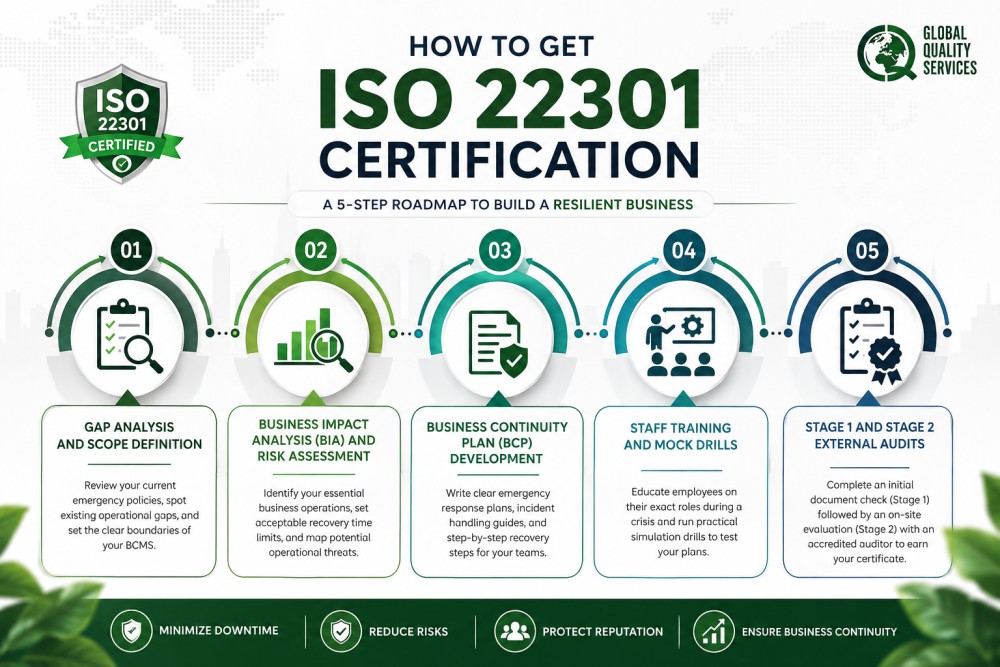
- Gap Analysis and Scope Definition: Review your current emergency policies, spot existing operational gaps, and set the clear boundaries of your BCMS.
- Business Impact Analysis (BIA) and Risk Assessment: Identify your essential business operations, set acceptable recovery time limits, and map potential operational threats.
- Business Continuity Plan (BCP) Development: Write clear emergency response plans, incident handling guides, and step-by-step recovery steps for your teams.
- Staff Training and Mock Drills: Educate employees on their exact roles during a crisis and run practical simulation drills to test your plans.
- Stage 1 and Stage 2 External Audits: Complete an initial document check (Stage 1) followed by an on-site evaluation (Stage 2) with an accredited auditor to earn your certificate.
How Much Does ISO 22301 Certification Cost
The cost of ISO 22301 certification in India varies based on your actual business size and setup. There is no single price tag because every organization runs differently.
Your overall investment depends on your total employee count, the number of office locations, the complexity of your daily operations, and the specific accreditation body chosen (such as NABCB, ANAB, or UKAS). A small single-office team needs a modest budget, while a multi-city enterprise with data centers or factories requires a larger investment. Overall costs generally include consultancy support, internal team training, and final audit fees paid to the certification body.
Major Benefits of Obtaining ISO 22301 Certification
Setting up a certified BCMS changes how your business handles unexpected emergencies. It moves your team from reactive guesswork to organized action. Here is how getting certified improves your daily business operations and long-term stability.
- Faster Recovery Times: Sets clear recovery goals so your staff knows exactly how to bring core systems back online without delay.
- Stronger Supply Chains: Helps you find weak supplier points early so you can set up backup vendors before a crisis halts your work.
- Better Win Rates on Bids: Gives your business a solid edge when competing for big corporate contracts or government tenders.
- Clear Team Action: Replaces panic with clear instructions, designated roles, and simple steps during an unexpected disruption.
Why Choose Global Quality Services for ISO 22301 Certification Support in India?
Setting up a Business Continuity Management System takes practical work, not just theoretical advice. Global Quality Services provides clear consulting, documentation help, team training, and audit support designed around your actual daily operations. Why Indian businesses choose to work with our team:
- Customized BCMS Setup: We build Business Impact Analysis frameworks and continuity plans that match how your business actually works instead of using generic templates.
- Pan-India Support: Our team provides hands-on help across key commercial and industrial centers including Bengaluru, Mumbai, Delhi NCR, Hyderabad, Chennai, and Pune.
- 100% Audit Guidance: We work alongside your team through internal reviews, mock drills, and final certification audits.
- Practical Regulatory Knowledge: We ensure your continuity plans meet international ISO standards alongside local Indian rules like RBI, SEBI, and DPDP mandates.
Get ISO 22301 Certification Support with Global Quality Services
Do not wait for a major system failure or power cut to test if your business can survive. Protect your income, meet regulatory demands, and build real trust with enterprise clients through a certified Business Continuity Management System.
Partnering with Global Quality Services gives you access to skilled lead auditors and consultants who make the compliance path simple. We handle the heavy lifting of gap checks, process mapping, policy writing, and staff training so your team can focus on running your business.
Contact Global Quality Services today to request your customized ISO 22301 proposal.
Frequently Asked Questions
1. What is the main difference between ISO 27001 and ISO 22301?
ISO 27001 focuses on Information Security Management Systems (ISMS) to safeguard digital data privacy and security. ISO 22301 covers broader Business Continuity Management Systems (BCMS), ensuring all business operations—including physical facilities, teams, and daily workflows—stay running during any disruption.
2. How long is an ISO 22301 certificate valid in India?
An ISO 22301 certificate remains valid for three years from the date it is issued. To keep your certificate active, your company must pass annual surveillance audits during Year 1 and Year 2, followed by a recertification audit at the end of Year 3.
3. What do RTO and RPO mean in ISO 22301 compliance?
Recovery Time Objective (RTO) is the maximum acceptable time your business can stay offline after a disruption. Recovery Point Objective (RPO) is the maximum data loss, measured in time, that your business can tolerate. You determine both numbers during your initial Business Impact Analysis.
4. Can ISO 22301 be integrated with our existing ISO 9001 or ISO 27001 systems?
Yes. ISO 22301 uses the standard High-Level Structure common to major ISO standards. It fits neatly alongside ISO 9001 for quality and ISO 27001 for security, letting you run a single combined management system with shared paperwork and joint audits.
5. How long does the ISO 22301 certification process take for a small or mid-sized company?
For a small to mid-sized business with one or two offices, the entire project usually takes between 4 and 8 weeks. This timeline covers the initial gap check, process mapping, writing your continuity plans, staff training, testing mock drills, and completing the final audit.