Gujarat continues to lead India in healthcare production. According to the KNN India Bureau, the state approved 183 new allopathic drug manufacturing plants in FY 2024–25 alone, driving an estimated total investment of ₹12,000 crore.
A huge share of this manufacturing boom is located right here in Ahmedabad. Industrial areas like Changodar, Vatva, Sanand, Naroda, and Odhav host hundreds of operating units.
For local factory owners, Good Manufacturing Practice (GMP) is not optional. It is a compulsory legal standard enforced by the Gujarat Food and Drugs Control Administration (FDCA) and the Central Drugs Standard Control Organization (CDSCO). Obtaining your GMP certificate proves that your plant produces safe, consistent products while keeping your business fully eligible for domestic tenders and global exports.
Why GMP Compliance Matters for Manufacturers in Ahmedabad
Meeting statutory manufacturing standards protects your business from sudden legal actions while opening doors to higher-paying markets. Here is how GMP certification matters for manufacturers in Ahmedabad:
- Avoid License Suspensions: Gujarat FDCA inspectors perform strict routine audits. Full compliance keeps your plant operating without unexpected shutdown notices.
- Meet Revised Schedule M Rules: India now enforces updated Schedule M norms. Manufacturing units must update their risk assessment methods, digital logs, and cleanroom air controls.
- Unlock Global Export Markets: A valid WHO-GMP certificate helps you secure a Certificate of Pharmaceutical Product (COPP), allowing you to ship goods to markets across South America, Africa, and Southeast Asia.
- Win Government and B2B Tenders: Government healthcare buyers and major brand owners require verified GMP records before allowing companies to submit commercial bids.
- Reduce Costly Material Waste: Standardized batch routines and calibrated equipment prevent product contamination, saving money on rejected product batches.
Which Industries in Ahmedabad Need GMP Certification or GMP Compliance?
Different product types require specific regulatory frameworks. Here are the primary sectors in Ahmedabad that require formal GMP compliance:
- Allopathic drug formulations including tablets, capsules, liquids, and injectables
- Active Pharmaceutical Ingredients (APIs) and bulk intermediates
- Ayurvedic, Siddha, and Unani products under Schedule T rules
- Medical devices and diagnostic kits under Medical Devices Rules
- Cosmetics and skin care items under Cosmetics Rules
- Nutraceuticals, dietary supplements, and food processing units under FSSAI Schedule 4
- Primary pharmaceutical packaging and container manufacturing facilities
GMP Certification Process in Ahmedabad
Getting your facility certified involves a clear series of operational steps. We walk your plant team through every stage to make sure your plant meets all state and central requirements. Below are the steps that show how a facility moves from an initial gap review to official inspection approval:
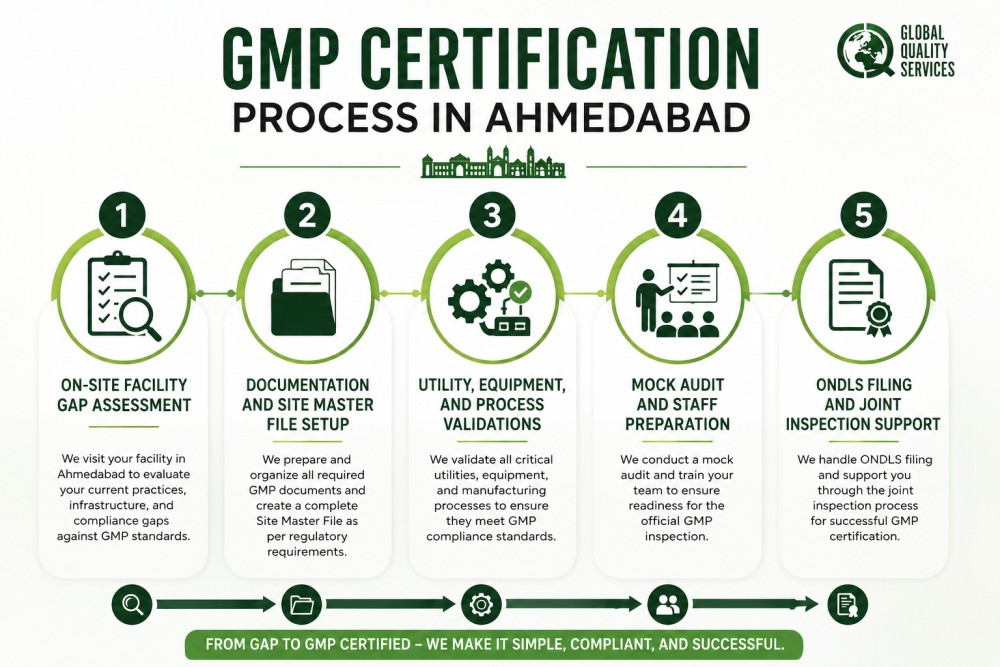
Step 1: On-Site Facility Gap Assessment
Our technical specialists visit your plant to inspect cleanroom layouts, air handling units (HVAC), water systems, and current record books. We identify every gap that needs fixing before an official inspection.
Step 2: Documentation and Site Master File Setup
We help write your Standard Operating Procedures (SOPs), Validation Master Plans, and your updated Site Master File (SMF). Every file matches your actual shop floor work rather than using generic templates.
Step 3: Utility, Equipment, and Process Validations
We guide your staff through installation, operational, and performance qualifications (IQ/OQ/PQ) for production machinery. This step includes checking airflow balances, testing purified water loops, and setting up stability testing schedules.
Step 4: Mock Audit and Staff Preparation
We run a complete practice audit at your facility. We train your production managers, lab technicians, and operators on how to answer auditor questions calmly and produce requested batch files quickly.
Step 5: ONDLS Filing and Joint Inspection Support
We assist with filing your application on the CDSCO Online National Drugs Licensing System (ONDLS) portal. Our senior team stays present during joint audits by Gujarat FDCA and CDSCO officers to help address any inspection questions.
Common GMP Compliance Gaps Found in Ahmedabad Manufacturing Facilities
GMP problems are often caused by gaps between written procedures and what actually happens on the production floor. A facility may have good documentation but still face issues if employees do not consistently follow those procedures. Common areas that need attention include:
- Incomplete SOPs: Procedures may not cover important manufacturing or quality activities clearly enough.
- Poor recordkeeping: Missing signatures, dates, approvals, or incomplete records can create concerns during an inspection.
- Weak cleaning controls: Cleaning schedules, methods, responsibilities, and records may not be properly controlled.
- Equipment calibration gaps: Equipment used for production or testing needs appropriate control and calibration records.
- Insufficient employee training: Employees should understand the GMP procedures relevant to their responsibilities, with training properly recorded.
- Poor material movement: Uncontrolled movement of raw materials, personnel, or finished products can create avoidable risks.
- Incomplete batch records: Production activities need to be recorded accurately and at the appropriate stage of the process.
- Weak deviation handling: Manufacturing problems should be recorded, investigated, and addressed rather than simply corrected informally.
- Incomplete corrective actions: Audit findings require proper action and evidence that the underlying issue has been addressed.
- Inconsistent document control: Employees should be using current and approved versions of procedures and forms.
Why Choose Global Quality Services for GMP Certification Support in Ahmedabad?
Passing regulatory audits requires practical engineering knowledge and clear documentation. Global Quality Services offers direct technical guidance tailored to local manufacturing conditions in Gujarat.
Our team works directly with plant owners and quality managers across Changodar, Vatva, Sanand, and Naroda. We convert complex government rules into straightforward daily instructions for your floor staff.
- Experienced Technical Team: Our consultants understand air handling systems, water loops, and cleanroom setups alongside core documentation requirements.
- Local Regulatory Focus: We stay up to date on how Gujarat FDCA and CDSCO inspectors evaluate facilities during joint audits.
- Hands-on Execution: We stay involved through every step of the project, from early layout reviews to final inspection responses.
- Practical System Design: We build quality management systems that fit your actual plant size and machinery, avoiding overly complex paperwork.
Secure Your Gujarat FDCA and WHO-GMP Approval with Global Quality Services
Delaying facility upgrades or using incomplete documentation can lead to unexpected audit failures, license delays, and lost customer contracts. Taking a structured approach to compliance protects your investment and keeps your plant running smoothly.
Global Quality Services provides complete end-to-end consulting to help your facility pass government inspections without stress. Contact our technical team today to arrange your on-site facility gap assessment in Ahmedabad.
Frequently Asked Questions
1. What is the main difference between Schedule M and WHO-GMP in Gujarat?
Schedule M is a mandatory legal requirement under Indian law for selling pharmaceutical products domestically. A WHO-GMP certificate follows international standards, is issued jointly by state and central drug authorities, and is required if you plan to export medicines to foreign markets.
2. How long does the entire certification process take for an Ahmedabad plant?
If your facility infrastructure is already compliant and only needs updated documentation and training, the process takes about 8 to 12 weeks. If your facility requires structural changes, new HVAC equipment, or water loop modifications, execution takes 4 to 6 months.
3. Can a private third-party ISO GMP certificate replace a Gujarat FDCA license?
No. Private certificates issued by commercial ISO agencies have no legal standing with state drug inspectors. Gujarat FDCA and CDSCO regulators accept only statutory licenses issued under Schedule M, WHO-GMP, or official Medical Devices Rules.
4. What essential details belong in a plant Site Master File?
A Site Master File must include your plant layout, air cleanroom classifications, HVAC drawings, water system flow charts, organizational charts, staff qualification records, equipment calibration schedules, and your main quality policy documents.
5. How long does a WHO-GMP certificate remain valid after issuance?
WHO-GMP certificates are valid for three years from the date of issuance. To maintain valid status, your facility must maintain continuous compliance records and undergo periodic renewal inspections by Gujarat FDCA officers.