
Delhi’s business environment is becoming increasingly dependent on digital systems. Government-facing services, financial platforms, professional services, healthcare organisations, technology companies, educational institutions and businesses handling customer information all rely on interconnected networks and Internet-based applications.
As this dependence grows, cybersecurity cannot be limited to protecting office computers or maintaining antivirus software. Organisations also need to consider what happens when their websites, cloud applications, online portals, networks, APIs or external service providers interact with the wider Internet.
ISO 27032 Certification in Delhi is a commonly used term for adopting and assessing the cybersecurity and Internet-security guidance provided by ISO/IEC 27032. Global Quality Services (GQS) helps organisations understand the standard, assess their existing cybersecurity arrangements, and establish practical processes for managing Internet security risks.
The current standard is ISO/IEC 27032:2023 – Cybersecurity — Guidelines for Internet security. ISO explains the relationships among Internet security, web security, network security, and cybersecurity, identifies relevant stakeholders, and provides high-level guidance on addressing common Internet security issues.
Important: ISO/IEC 27032:2023 is a guideline standard. It should not be presented as identical to a conventional certifiable management system standard, such as ISO/IEC 27001. Organisations should understand whether they require ISO 27032 implementation and assessment, or certification against a separate certifiable standard.
Understanding ISO 27032 in the Delhi Business Environment
Cybersecurity risks are no longer confined to large data centres. A Delhi organisation may depend on cloud email, SaaS platforms, online payment systems, customer portals, remote employees, third-party applications and external hosting providers.
This creates a connected security environment.
A compromised employee account could provide access to a cloud application. An insecure API could expose customer information. A vulnerable website could become an entry point into internal systems. A compromised supplier could create risks for several connected organisations. ISO/IEC 27032 encourages organisations to understand these connections instead of treating every security problem as an isolated technical issue.
This makes the guidance relevant to Delhi businesses that operate across multiple digital channels and interact with a wide network of customers, suppliers, service providers and technology platforms.
What Does ISO/IEC 27032:2023 Cover?
The current edition of ISO/IEC 27032 focuses on Internet security and explains how it relates to other areas of cybersecurity. According to the official ISO description, the standard addresses four important areas:
Internet Security
Organisations need to understand the risks created by connecting their systems and services to the Internet. This includes considering how information, users, applications and networks interact with external environments.
Web Security
Websites and applications can expose organisations to risks if authentication, access controls, software components or configurations are not properly managed. For Delhi businesses operating customer portals, e-commerce websites or online service platforms, web security can therefore become a significant part of their overall cybersecurity strategy.
The Government of India’s Guidelines for Indian Government Websites and Apps provide detailed security guidance covering areas such as authentication, encryption, access control, secure coding, logging, patching and network protection. These guidelines are specifically intended for government websites and applications, but they provide useful reference material for understanding good website security practices.
Network Security
Internet-connected networks require appropriate controls to prevent unauthorised access and limit the potential impact of security incidents. Organisations may need to consider network architecture, access permissions, secure configurations, monitoring and separation of critical systems.
Cybersecurity Cooperation
Modern cyber incidents often involve several parties. A cloud provider, software vendor, hosting company, Internet service provider and customer may all be connected to the same digital ecosystem.
ISO 27032 therefore takes into account stakeholder roles and the need for cooperation when addressing Internet security issues.
ISO 27032 vs ISO 27001
ISO 27032 and ISO 27001 are related but should not be treated as the same standard. ISO 27001 Certification focuses on establishing and maintaining an Information Security Management System. It provides an organisational framework for identifying information security risks, applying controls, and continually improving information security.
ISO/IEC 27032:2023 has a narrower focus on Internet security. It explains how Internet security relates to web security, network security and broader cybersecurity.
For example, a Delhi SaaS company could use ISO 27001 to establish its overall information security management system while using ISO 27032 guidance to strengthen its management of Internet-facing applications and connected digital services. This means the two approaches can complement one another rather than compete.
Why Should Delhi Businesses Consider ISO 27032?
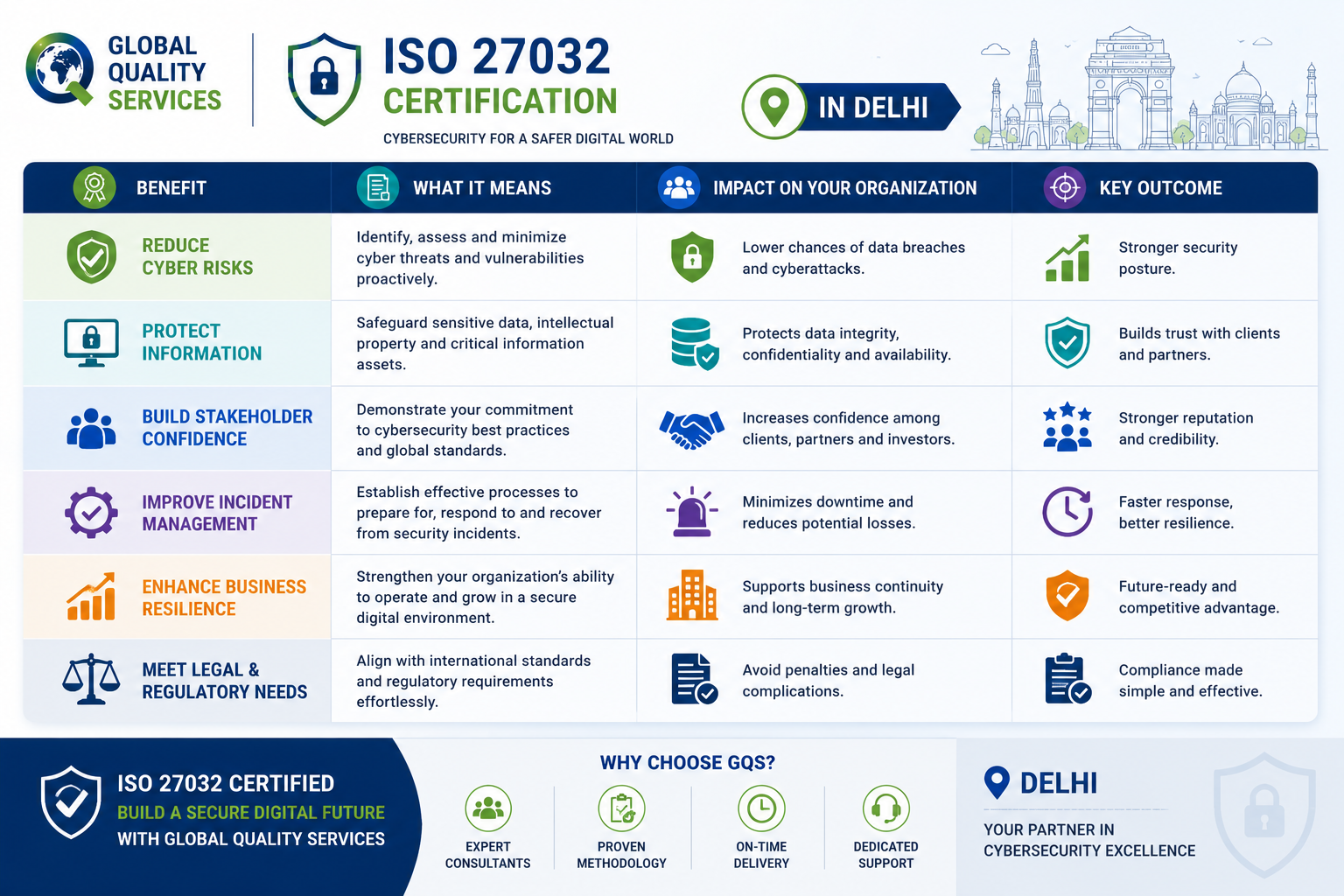
A cybersecurity incident can have consequences beyond the immediate technical problem. A successful attack may interrupt services, expose confidential information, affect customers, create contractual problems and damage an organisation’s reputation. For businesses operating in Delhi’s competitive digital economy, having a structured cybersecurity approach can therefore support both operational resilience and stakeholder confidence.
ISO 27032 can help organisations:
- Understand Internet-related cybersecurity risks.
- Identify weaknesses in Internet-facing services.
- Improve coordination between technical and business teams.
- Strengthen web and network security practices.
- Clarify cybersecurity responsibilities.
- Improve incident-preparedness processes.
- Consider risks created by external stakeholders.
- Build a more coordinated cybersecurity strategy.
The value comes from applying the guidance to the organisation’s actual technology environment rather than treating the standard as a collection of documents.
ISO 27032 Consultancy in Delhi
GQS provides consultancy support for organisations seeking to strengthen their cybersecurity practices and understand how ISO 27032 applies to their operations. The work starts with the organisation’s technology environment rather than a generic checklist. Consultants need to understand which systems are connected to the Internet, what information is handled, who has access, and which external providers are involved.
Based on this assessment, GQS can help identify gaps and develop a practical improvement plan. Organisations that need broader information-security governance can also consider ISO 27001 consultancy and certification as part of their overall cybersecurity programme. For organisations that handle large volumes of personal information, ISO 27701 privacy management can also be considered alongside information security controls.
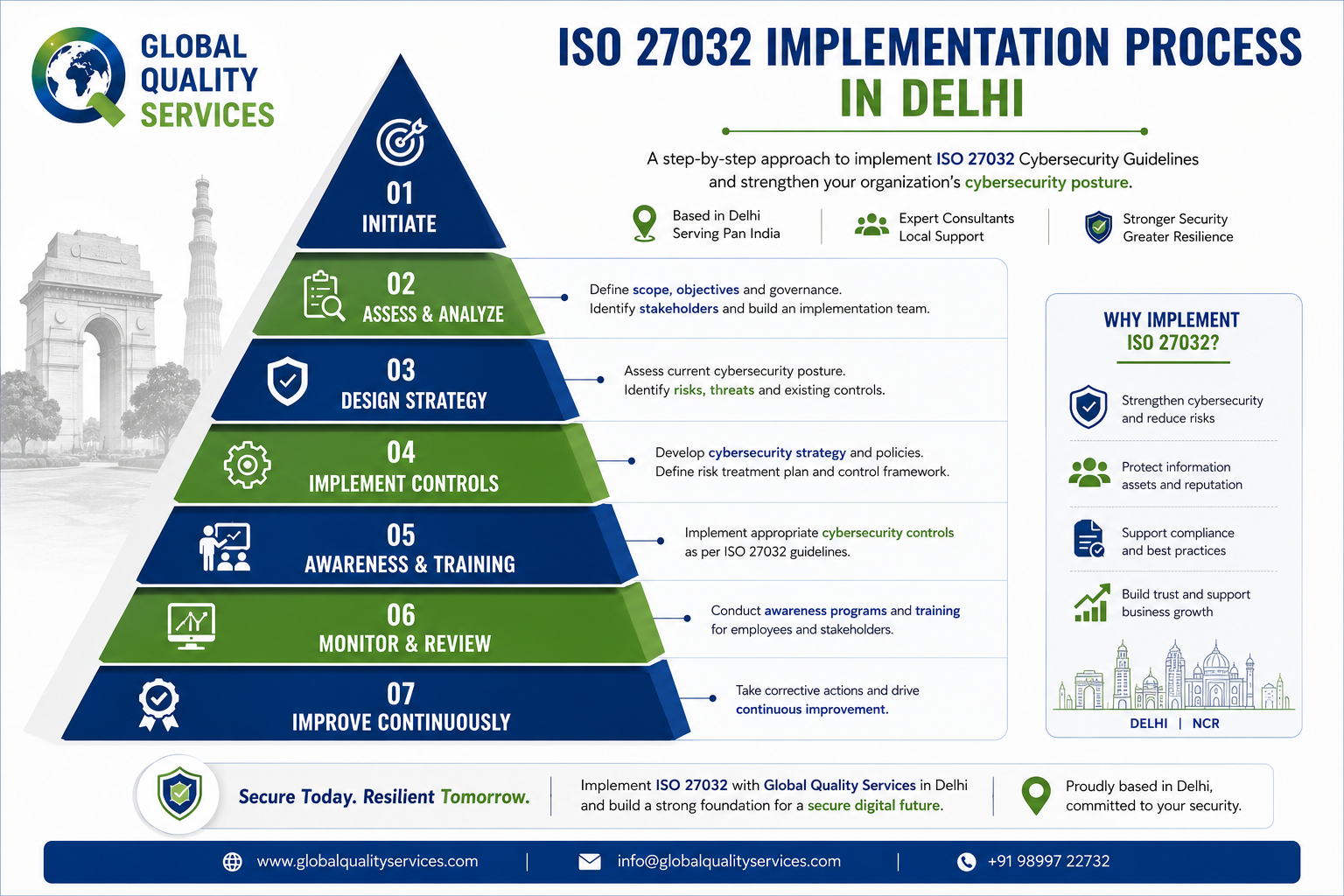
ISO 27032 Implementation Process in Delhi
Step 1: Understand the Digital Environment
The first stage is to identify the organisation’s important Internet-connected assets. This may include websites, applications, APIs, cloud systems, remote-access platforms, online portals and services provided by external technology partners. The purpose is to establish a realistic picture of the organisation’s digital exposure.
Step 2: Define the Cybersecurity Scope
Once the environment is understood, the organisation determines which systems, processes, locations, users and third parties should fall within the cybersecurity programme. A clearly defined scope prevents important Internet-facing services from being overlooked.
Step 3: Identify Internet-Security Risks
The organisation then examines possible threats and vulnerabilities. This can include weaknesses in authentication, access permissions, network configurations, applications, third-party services, remote access and security monitoring. The assessment should also consider the potential business impact if a particular system is compromised.
Step 4: Develop an Improvement Roadmap
Not every cybersecurity weakness requires the same level of attention. GQS can help organisations prioritise improvements based on the likelihood of an incident, the importance of the affected system and the potential consequences to the business. This creates a practical roadmap instead of attempting to change everything simultaneously.
Step 5: Strengthen Policies and Controls
Relevant policies and procedures can then be developed or improved. Depending on the organisation, these may cover access management, incident response, secure application development, network security, third-party security, monitoring and cybersecurity responsibilities. The documentation should reflect how the organisation actually operates.
Step 6: Implement and Monitor
Security measures need to work in practice. Teams may need to strengthen authentication, review access privileges, improve monitoring, update vulnerable systems, secure applications and establish better procedures for reporting cybersecurity incidents. Continuous monitoring is important because Internet threats and technology environments change over time.
Step 7: Internal Review
An internal review provides an opportunity to determine whether the planned security practices have actually been implemented. Findings can be recorded, responsibilities assigned and corrective actions followed up. For organisations also pursuing ISO 27001 certification in Delhi, this stage can form part of a wider ISMS readiness programme.
Step 8: External Assessment or Certification Route
Where a formal certification is required, the organisation should establish which certifiable standard and assessment route applies. ISO/IEC 27032 itself is published by ISO as a guideline for Internet security, so businesses should avoid assuming that it operates in exactly the same way as ISO 27001 certification. The current 2023 edition replaced the withdrawn ISO/IEC 27032:2012 edition. GQS can help organisations understand the appropriate route based on their business objectives.
Cybersecurity and Indian Regulatory Requirements
Implementing ISO 27032 guidance does not automatically make an organisation compliant with Indian cybersecurity or data-protection laws. Delhi organisations should separately assess the legal and regulatory requirements applicable to their activities.
One important reference is the CERT-In Cyber Security Directions issued under Section 70B of the Information Technology Act, 2000. CERT-In states that the directions relate to information-security practices, procedures, prevention, response and reporting of cyber incidents.
Where personal data is involved, organisations should also consider India’s data-protection framework. The Ministry of Electronics and Information Technology published the Digital Personal Data Protection Rules, 2025 in November 2025, together with information concerning the implementation timeline and Data Protection Board of India.
The Digital Personal Data Protection Act, 2023 provides the underlying legislative framework for processing digital personal data in India. ISO 27032 can support stronger cybersecurity practices, but organisations should assess statutory obligations independently and obtain appropriate legal or regulatory advice where necessary.
Who Can Use ISO 27032 Guidance in Delhi?
ISO 27032 can be relevant to many organisations that depend on Internet-connected systems.
IT and Software Companies
Software developers and IT service providers often manage applications, cloud platforms, APIs and customer environments. Internet-security guidance can help them identify risks across these interconnected services.
Fintech and Financial Services
Digital financial services handle valuable information and depend on continuously available online platforms. Strong cybersecurity governance can therefore be an important business priority.
Healthcare Organisations
Hospitals, health-tech companies and other healthcare businesses may use connected systems to manage sensitive information and provide digital services.
E-commerce Businesses
Online retailers depend on websites, payment integrations, customer accounts, APIs and third-party platforms. A weakness in one component can affect the wider customer journey.
Professional and Business Services
Consulting firms, legal businesses, accounting organisations and other professional-service companies increasingly use cloud platforms and digital communication to handle sensitive client information.
Educational and Digital Platforms
Universities, training providers and EdTech businesses may manage large numbers of user accounts, online portals and digital learning environments.
Benefits of ISO 27032 for Delhi Organisations
A More Connected View of Cybersecurity
One of the main advantages of ISO 27032 is that it encourages organisations to look at the relationships between Internet, web, network and cybersecurity rather than managing them as completely separate areas.
Better Understanding of Internet Exposure
Organisations can identify which systems and services are exposed to external threats and determine whether the associated security measures are appropriate.
Stronger Coordination
Cybersecurity involves more than the IT department. Business leaders, employees, vendors, cloud providers and other stakeholders may all influence the security environment. A coordinated approach can make responsibilities clearer.
Improved Incident Readiness
Organisations cannot assume that preventative controls will stop every cyber incident. Preparing responsibilities, communication processes and response procedures can improve the organisation’s ability to react when something goes wrong.
Better Third-Party Risk Awareness
Modern organisations frequently depend on external providers. Assessing how suppliers and technology partners connect to business systems can reveal risks that may otherwise remain unnoticed.
Supports Customer Confidence
Demonstrating a structured commitment to cybersecurity can help organisations respond to security expectations from customers, partners and enterprise buyers.
Complements Other Security Frameworks
ISO 27032 can sit alongside other cybersecurity and compliance initiatives. For example, GQS also provides SOC 2 assessment services for organisations seeking independent evaluation of controls related to customer data and security. An organisation can therefore develop a broader compliance strategy rather than relying on a single standard for every security objective.
Why Choose GQS for ISO 27032 in Delhi?
Global Quality Services has more than 26 years of experience in ISO certification and compliance consulting, according to its current website. GQS works across information security, cybersecurity, quality, environmental, and other management system requirements.
For cybersecurity-focused organisations, GQS’s service portfolio includes ISO 27001, SOC-related services and other compliance frameworks. GQS’s approach can help organisations move from understanding cybersecurity requirements to implementing practical processes.
Support can include:
- Initial cybersecurity consultation
- Scope identification
- Gap assessment
- Cyber-risk assessment
- Policy and procedure development
- Implementation guidance
- Employee awareness
- Internal review
- Corrective-action planning
- External assessment preparation
- Support for applicable certification programmes
The approach should be adapted to the organisation’s size, technology architecture, industry requirements and risk profile.
ISO 27032 Certification in Delhi – FAQs
Is ISO 27032 certification mandatory in Delhi?
No. ISO/IEC 27032:2023 is not a mandatory legal requirement for businesses in Delhi. It is a set of guidelines for Internet security. Organisations may adopt its principles voluntarily to strengthen cybersecurity and meet customer, contractual or internal security expectations.
Is ISO 27032 the same as ISO 27001?
No. ISO 27001 establishes requirements for an Information Security Management System, whereas ISO 27032:2023 provides guidance focused on Internet security. The standards can complement one another when an organisation needs both broad information-security governance and stronger Internet-security practices.
What is the current version of ISO 27032?
The current edition is ISO/IEC 27032:2023. ISO lists the 2012 edition as withdrawn and the 2023 edition as the published current standard.
Can ISO 27032 help a Delhi company meet CERT-In requirements?
ISO 27032 can support an organisation’s broader cybersecurity practices, but it does not automatically establish compliance with CERT-In requirements. Applicable organisations must separately assess the CERT-In Cyber Security Directions and any other requirements relevant to their operations.
Can ISO 27032 be used with ISO 27001?
Yes. ISO 27001 can provide the organisation-wide information-security management framework, while ISO 27032 can help address Internet-security considerations. Using both can be useful for organisations whose operations depend heavily on websites, cloud services, applications and connected networks.