
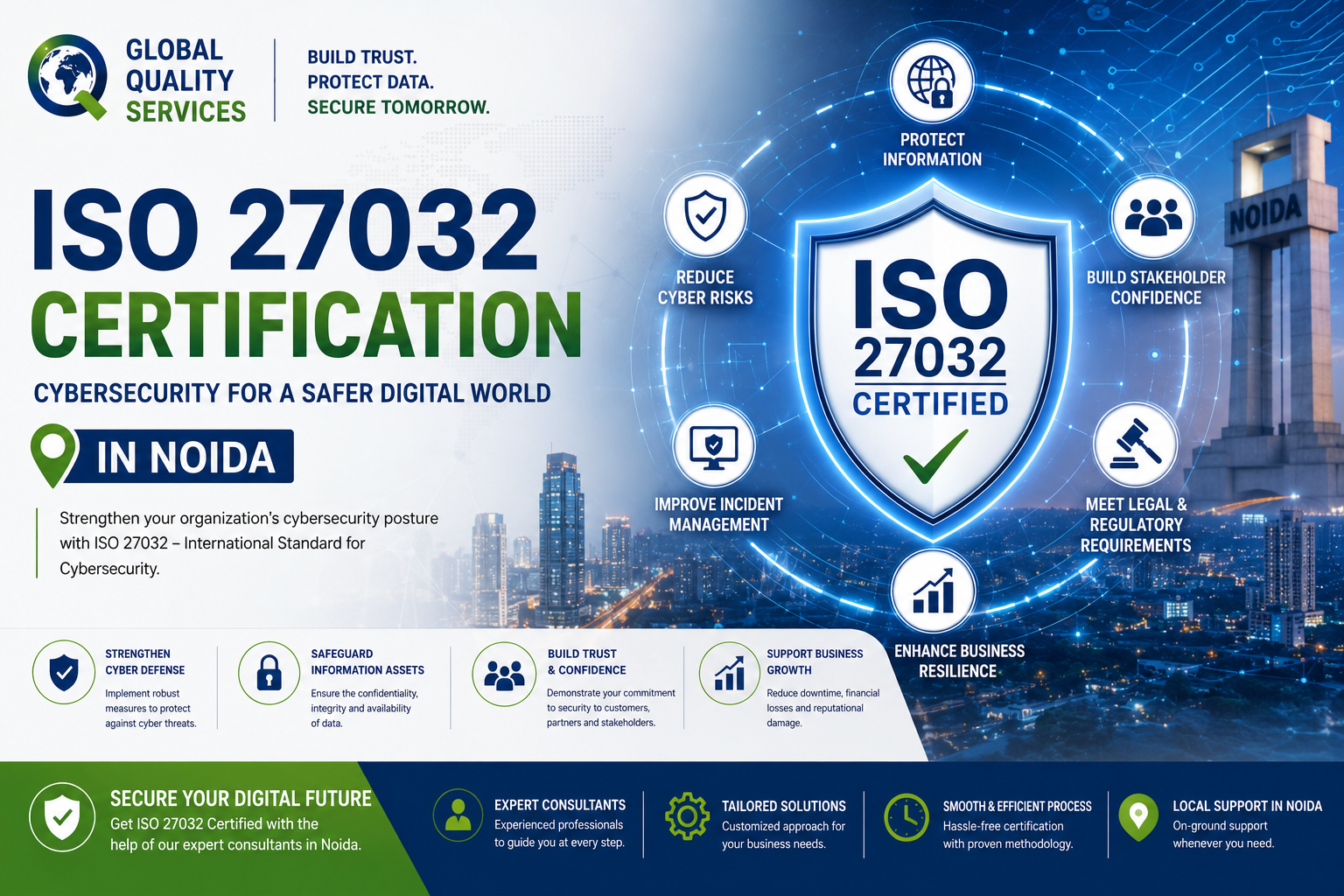
As businesses in Noida become increasingly dependent on cloud platforms, websites, mobile applications, APIs, remote work systems, and connected networks, cybersecurity has become a business priority rather than merely an IT concern. A weakness in one Internet-facing system can affect customer information, business operations, suppliers and connected third-party services.
ISO 27032 Certification in Noida commonly refers to the adoption and assessment of the ISO/IEC 27032 cybersecurity guidance to strengthen Internet security. Global Quality Services (GQS) helps organisations understand the standard, assess existing practices, identify security gaps and develop a more structured approach to protecting Internet-connected environments.
ISO/IEC 27032:2023 is the current edition of the standard. ISO describes it as “Cybersecurity — Guidelines for Internet security,” with guidance covering the relationship among Internet security, web security, network security, and cybersecurity.
Important: ISO/IEC 27032:2023 is a guideline standard rather than a conventional certifiable management-system standard such as ISO/IEC 27001. Organisations should therefore clearly distinguish between implementing ISO/IEC 27032 guidance and obtaining certification to a certifiable standard.
What Is ISO 27032?
ISO/IEC 27032 provides organisations with guidance on addressing common Internet security issues. It is intended for organisations that use the Internet and helps them understand how different areas of security are connected.
Internet security cannot always be managed by protecting an organisation’s internal network alone. Websites, cloud applications, APIs, online portals, connected devices, third-party platforms and remote users can all introduce additional risks.
The standard provides a broader view of cybersecurity by explaining the relationship between:
- Internet security
- Web security
- Network security
- Cybersecurity
- Different stakeholders involved in protecting Internet-connected environments
For organisations in Noida, this approach can be particularly useful because many businesses operate across interconnected digital environments rather than within a single physical IT infrastructure.
Companies looking for a formal Information Security Management System can also consider ISO 27001 Certification. ISO 27001 establishes requirements for an ISMS, while ISO 27032 provides more focused guidance around Internet security.
Why Is ISO 27032 Important for Businesses in Noida?
Noida has a large concentration of IT companies, software businesses, BPOs, technology startups, e-commerce organisations, manufacturers, healthcare businesses and other digitally connected enterprises.
Many of these organisations exchange information with customers, suppliers, employees, cloud providers and other external parties every day. This creates a wider digital environment in which security weaknesses can spread beyond a single system.
For example, a business may have strong internal security but still face exposure through an insecure web application, compromised credentials, an improperly configured cloud service or an unprotected API. ISO 27032 encourages organisations to look at Internet security as a connected ecosystem. A structured approach can help organisations:
- Identify Internet-facing security risks.
- Understand how different security domains interact.
- Strengthen protection for websites and online applications.
- Improve network-security practices.
- Clarify cybersecurity responsibilities.
- Improve coordination between internal and external stakeholders.
- Strengthen incident-prevention and response practices.
- Support customer and business-partner confidence.
The purpose is not simply to install additional security products. The objective is to establish security practices appropriate to the organisation’s risks, technology, and business activities.
ISO 27032 and ISO 27001 – What Is the Difference?
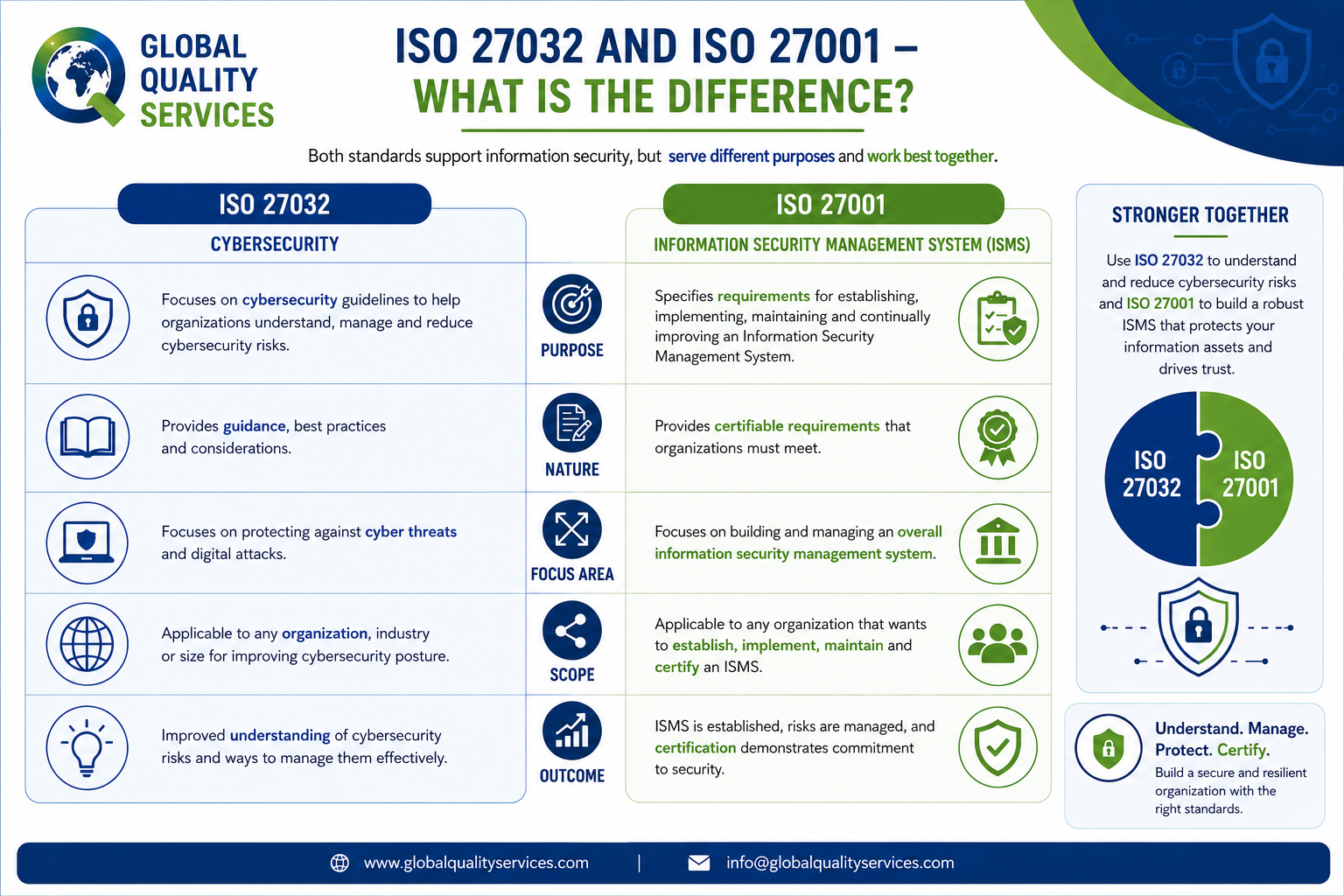
Although both standards belong to the ISO/IEC 27000 family, they have different purposes.
ISO/IEC 27001 provides requirements for establishing, implementing, maintaining and continually improving an Information Security Management System. It focuses on managing information-security risks systematically across an organisation.
ISO/IEC 27032:2023 focuses specifically on Internet security and provides guidance concerning the relationship between Internet, web, network and cybersecurity. ISO’s official description confirms that the standard provides an overview of Internet security, identifies relevant stakeholders, and offers high-level guidance on common Internet security issues.
This means the two can complement each other.
For example, an organisation could establish its overall information-security management framework using ISO 27001 consultancy and certification support while using ISO 27032 guidance to strengthen Internet-facing security.
What Does ISO 27032 Address?
Internet Security
Internet-connected systems expose an organisation to threats originating outside its physical boundaries. Organisations need to understand how external connectivity affects their information, systems and operations. This includes considering how users, networks, applications, service providers and other stakeholders interact with Internet-connected resources.
Web Security
Websites and web applications can become important attack surfaces. Weak authentication, insecure coding, poor configuration, vulnerable components and inappropriate access permissions can expose systems to attack.
The Government of India’s Guidelines for Indian Government Websites and Apps (GIGW 3.0) emphasise that website security should be considered from design and coding through implementation, testing and deployment. The guidance also covers areas such as secure authentication, encryption, access control, logging, secure coding, patching and network segmentation. These principles are also useful reference points for organisations seeking to strengthen their Internet-facing security practices.
Network Security
Internet security is closely connected with network security. Organisations need to understand how systems communicate and where unauthorised access could affect business operations. Appropriate network architecture, access restrictions, monitoring, segmentation and secure configurations can help limit the impact of a security incident.
Cybersecurity Coordination
A cybersecurity incident can involve multiple parties. For example, a cloud provider may host an application while another supplier manages network infrastructure and an internal team manages customer information. Clear responsibilities and communication channels therefore become important. ISO 27032 encourages organisations to understand the roles of relevant stakeholders and consider how cybersecurity activities can be coordinated.
ISO 27032 Certification Consultancy in Noida
GQS provides consultancy support to organisations seeking to understand and apply ISO cybersecurity standards in line with their business environment. The consultancy begins with understanding the organisation’s technology infrastructure, Internet-facing services, information flows and existing security practices. Rather than applying a generic checklist, the organisation’s actual risks and operational requirements should be considered. A software company, a manufacturing organisation, and a healthcare provider may all have different cybersecurity priorities.
GQS can assist with areas such as gap assessment, cybersecurity documentation, risk assessment, implementation support, employee awareness, internal audits and preparation for applicable external assessments.
GQS also provides ISO 27001 Certification and consultancy for organisations that require a formal information-security management framework.
ISO 27032 Consultancy Process in Noida
Let us explore the process of ISO 27032 Certification in Noida in detail:
1. Initial Consultation and Scope Definition
The process begins with understanding the organisation’s business activities and digital environment. The scope may include websites, applications, cloud platforms, networks, APIs, remote-access systems, online portals and relevant third-party services. Defining the scope properly is important because cybersecurity risks cannot be assessed effectively without understanding what systems and services are actually connected to the Internet.
2. Gap Assessment
GQS reviews the organisation’s existing cybersecurity arrangements and compares them with the applicable ISO 27032 guidance. The assessment can examine areas such as Internet-facing applications, access management, network security, incident management, monitoring, third-party relationships and security responsibilities. The result is a clearer picture of what is already working and where improvements may be required.
3. Cybersecurity Risk Assessment
Once the gaps are understood, the organisation can assess its major cybersecurity risks. This involves identifying important assets, potential threats, vulnerabilities and possible business consequences. Risk assessment helps management prioritise security improvements rather than attempting to address every issue simultaneously.
4. Policy and Process Development
The next stage involves developing or improving relevant cybersecurity policies and procedures. Depending on the organisation, this may include information-security policies, access-control procedures, incident-management processes, secure-development practices, third-party security requirements and monitoring procedures. Documentation should reflect actual business operations rather than simply being prepared for an assessment.
5. Implementation of Security Practices
Policies need to be translated into day-to-day practices. This may involve strengthening authentication, access management, network segmentation, secure communications, logging, monitoring, vulnerability management, secure coding or third-party security controls.
The Government of India’s GIGW cybersecurity guidance, for example, highlights measures such as encrypted communications, multi-factor authentication, role-based access control, secure coding, logging, network segmentation and timely patching.
6. Employee Awareness
Technology alone cannot eliminate cybersecurity risk. Employees who use business applications, email, cloud platforms and remote-access systems can influence the organisation’s security posture. Awareness programmes can therefore cover secure password practices, phishing awareness, access control, data handling, incident reporting and responsible use of company systems.
7. Internal Assessment
An internal audit or readiness assessment helps the organisation determine whether its cybersecurity processes are actually being followed. Gaps identified during the assessment can be documented and corrective actions assigned to responsible personnel. This stage is particularly useful before an organisation undergoes an external assessment related to a certifiable standard such as ISO 27001.
8. External Assessment and Certification Support
Where an organisation is pursuing certification to a certifiable standard, GQS can provide preparation and coordination support for the relevant certification process. For ISO/IEC 27032 itself, organisations should use accurate terminology because the current standard is published by ISO as a guideline for Internet security rather than an ISO management-system certification standard.
Government Cybersecurity Requirements in India
ISO 27032 should not be considered a substitute for Indian laws, regulations or cybersecurity directions. Organisations operating in Noida should assess the requirements that apply to their industry, systems and data.
The CERT-In Cyber Security Directions issued under Section 70B of the Information Technology Act address information security practices, prevention, response, and reporting of cyber incidents. CERT-In is the Indian Computer Emergency Response Team under the Ministry of Electronics and Information Technology.
Where applicable, organisations must also consider India’s data-protection framework. The Ministry of Electronics and Information Technology has published the Digital Personal Data Protection Rules, 2025, together with information concerning the enforcement timeline and the Data Protection Board of India.
These legal requirements should be assessed separately. ISO 27032 can support better cybersecurity practices, but following ISO guidance does not automatically establish compliance with Indian law.
Benefits of ISO 27032 Consultancy
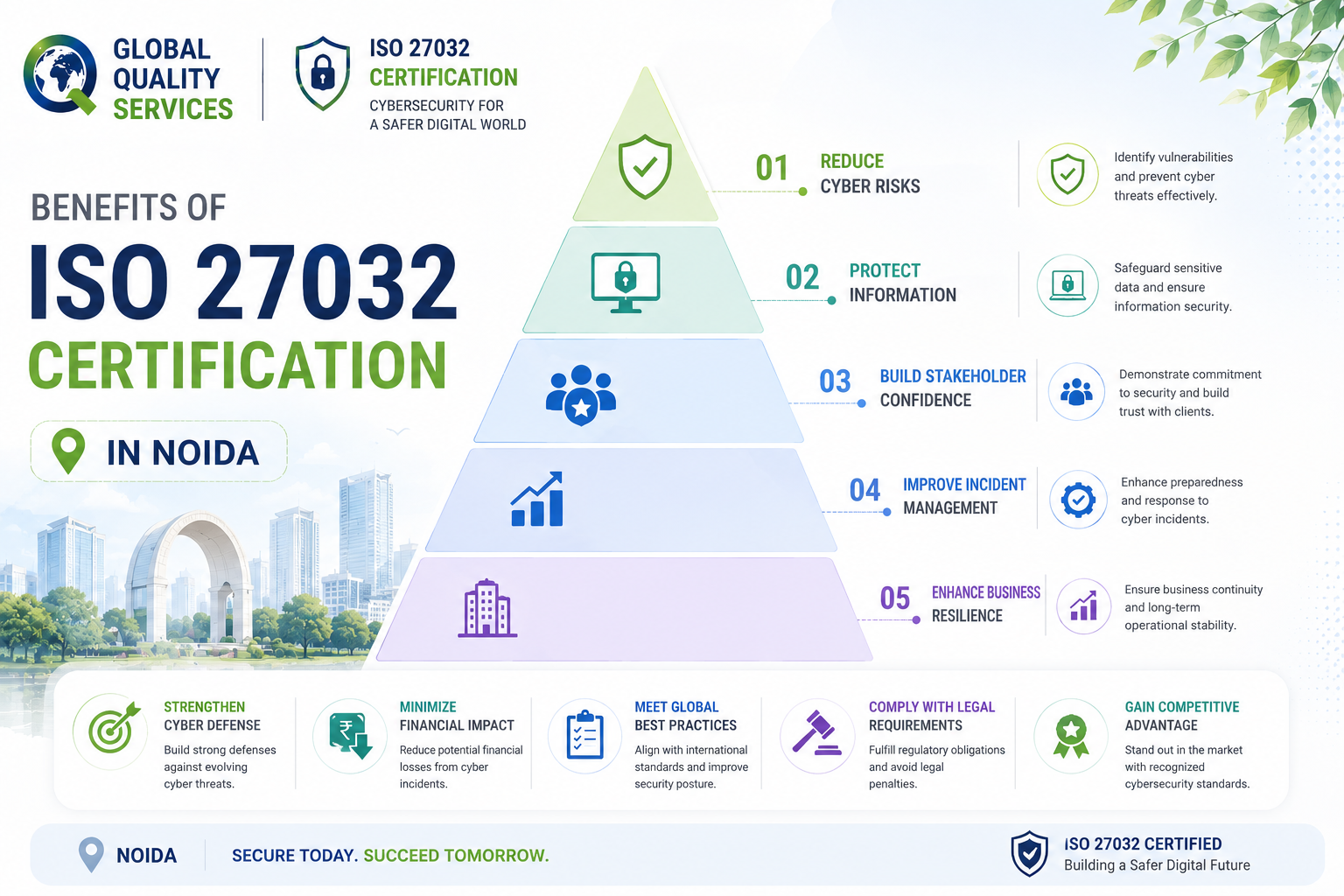
Here are the benefits of ISO 27032 certification in Noida:
Better Visibility of Internet Security Risks
Organisations often have limited visibility into the risks associated with Internet-facing systems. A structured assessment helps identify vulnerabilities and areas that require management attention.
Stronger Web and Application Security
Businesses that depend on websites, portals, and online applications can use the guidance to strengthen security across their application environments.
Improved Network Protection
A broader understanding of Internet and network security can help organisations identify inappropriate access, weak configurations and unnecessary exposure.
Better Incident Preparedness
A security incident requires a coordinated response. Clearly defined responsibilities and procedures can help organisations identify, report and respond to incidents more effectively.
Improved Third-Party Coordination
Cloud providers, software vendors, hosting companies and other external parties can form part of an organisation’s digital environment. Understanding their roles can improve coordination and security oversight.
Increased Customer Confidence
Customers and business partners increasingly want evidence that organisations take cybersecurity seriously. A structured security programme can strengthen confidence in the organisation’s ability to protect information and digital services.
Supports an Integrated Security Framework
ISO 27032 can be considered alongside ISO 27001 and other relevant standards.
Organisations handling personal information may also consider ISO 27701 privacy management, while organisations using artificial intelligence may need to consider ISO 42001 AI management as part of a wider governance strategy.
Who Can Benefit from ISO 27032 in Noida?
ISO 27032 guidance can be particularly relevant to organisations that depend heavily on Internet-connected systems.
These may include:
- IT and software development companies
- SaaS and cloud service providers
- BPO and IT-enabled service organisations
- E-commerce businesses
- Fintech companies
- Healthcare and health-tech organisations
- Digital platforms
- Telecommunications businesses
- Manufacturing companies using connected technologies
- Technology startups
- Organisations operating customer-facing web applications
- Businesses managing sensitive digital information
The level of implementation should be proportionate to the organisation’s size, technology environment, risks and business objectives.
Why Choose GQS for ISO 27032 in Noida?
Global Quality Services (GQS) provides consultancy and compliance support across information security, cybersecurity, privacy, and other management system standards.
GQS’s existing ISO 27001 services demonstrate its focus on information security management, while its broader quality certification and consultancy services span multiple ISO and compliance frameworks.
For organisations in Noida, GQS can help translate cybersecurity requirements into practical processes that fit the organisation’s technology and operational environment.
Support can include:
- Initial consultation
- Scope definition
- Gap assessment
- Cybersecurity risk assessment
- Policy and procedure development
- Implementation support
- Employee awareness
- Internal audit support
- Corrective-action planning
- External assessment preparation
- Certification support for applicable certifiable standards
ISO 27032 Certification in Noida – Frequently Asked Questions
Is ISO 27032 a certification standard?
ISO/IEC 27032:2023 is published by ISO as Cybersecurity — Guidelines for Internet security. It is a guideline standard rather than a conventional certifiable management-system standard. Organisations should therefore clarify whether a provider is offering ISO 27032 implementation/assessment or certification to another applicable standard such as ISO 27001.
What is the difference between ISO 27032 and ISO 27001?
ISO 27001 specifies requirements for an Information Security Management System, while ISO 27032 provides guidance focused on Internet security. ISO 27032 can therefore complement an organisation’s broader ISO 27001-based information-security framework.
Can a Noida startup implement ISO 27032 guidance?
Yes. The guidance can be adapted according to an organisation’s size, technology environment and cybersecurity risks. A startup with cloud applications and Internet-facing services can use the principles to strengthen its security practices without assuming that every control used by a large enterprise will be necessary.
Does ISO 27032 guarantee protection against cyberattacks?
No cybersecurity framework can guarantee that an organisation will never experience an attack. ISO 27032 can help organisations understand Internet-security risks and establish stronger preventive and coordinated security practices, but cybersecurity requires continuous monitoring, improvement and adaptation.
Does ISO 27032 make an organisation CERT-In compliant?
No. ISO 27032 does not automatically establish compliance with CERT-In requirements. Applicable organisations must separately assess the CERT-In Cyber Security Directions and other relevant Indian legal and regulatory requirements.