
Ahmedabad’s business ecosystem combines manufacturing, pharmaceuticals, engineering, financial services, technology, healthcare, education, and a growing digital services sector. As organisations across these industries move more operations online, their exposure is no longer limited to the systems inside their offices. Websites, cloud applications, remote access, digital payment systems, APIs, connected devices and third-party platforms all form part of the modern business environment.
This makes ISO 27032 Certification in Ahmedabad an important consideration for organisations looking to strengthen their approach to Internet security and cybersecurity.
Global Quality Services (GQS) helps organisations understand ISO/IEC 27032, evaluate their current cybersecurity practices and develop controls and processes suited to their digital environment. The current ISO standard is ISO/IEC 27032:2023 – Cybersecurity — Guidelines for Internet security. It explains the relationship among Internet security, web security, network security, and cybersecurity, and provides high-level guidance for addressing common Internet security issues.
One clarification is important. ISO/IEC 27032:2023 is a guideline standard rather than a conventional certifiable management system standard such as ISO/IEC 27001. Therefore, organisations should distinguish between implementing ISO 27032 guidance and obtaining certification to a certifiable standard.
Why Internet Security Matters for Ahmedabad Organisations
Cybersecurity requirements vary considerably between industries.
A pharmaceutical company may need to protect research information and connected manufacturing systems. A financial technology business may depend on secure online transactions and APIs. An engineering organisation may exchange technical information through cloud platforms, while an e-commerce business may rely on customer accounts, payment gateways and third-party applications.
Despite these differences, they all share one challenge: their systems increasingly interact with the Internet.
A security weakness in one area can create consequences elsewhere. For example, compromised credentials may allow access to a cloud platform, an insecure application may expose customer information, or a compromised third-party service may create a route into a connected business environment.
ISO 27032 provides a way to view these relationships rather than treating Internet, web, and network security as completely separate subjects.
What Is ISO/IEC 27032:2023?
ISO/IEC 27032:2023 provides guidance for organisations that use the Internet. The official ISO description identifies four important aspects of the standard:
- Understanding the relationship between Internet security, web security, network security and cybersecurity.
- Providing an overview of Internet security.
- Identifying interested parties and their roles.
- Offering high-level guidance for common Internet-security issues.
The standard is therefore broader than simply protecting a company’s website. It encourages organisations to consider how people, applications, networks, information and external service providers interact within a connected digital environment.
The previous ISO/IEC 27032:2012 edition has been withdrawn and replaced by the 2023 edition. Organisations developing a new programme should therefore work from the current version rather than relying on older cybersecurity terminology.
ISO 27032 and ISO 27001: Understanding the Difference
ISO 27032 is often discussed alongside ISO 27001 Certification in Ahmedabad, but the two standards have different roles.
ISO 27001 establishes requirements for an Information Security Management System. It provides an organisation-wide framework for identifying information security risks, establishing controls, and continually improving the ISMS.
ISO 27032 is specifically concerned with Internet security and the relationship between different areas of cybersecurity. An Ahmedabad organisation could therefore use ISO 27001 as its broader information-security management framework while applying the guidance in ISO 27032 to areas involving Internet-connected services. This can be particularly relevant for organisations that have moved from traditional on-premises systems towards cloud computing, online customer platforms and distributed work environments.
Key Areas Covered by ISO 27032
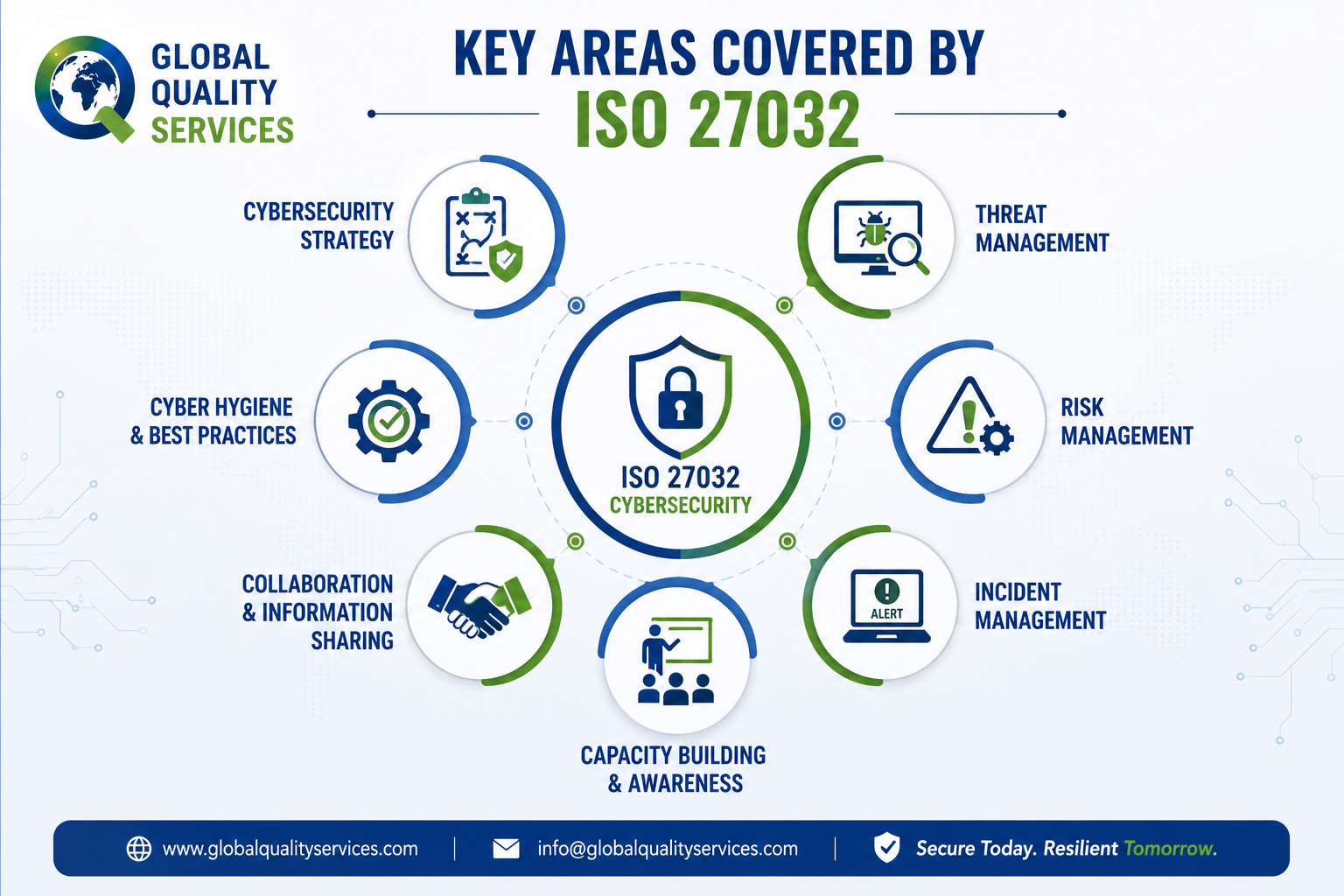
Internet-Facing Assets
Organisations first need to understand what is exposed to the Internet. This can include public websites, applications, APIs, cloud services, remote-access platforms, email systems, customer portals and other externally accessible services. Knowing what is connected is an essential starting point, as an organisation cannot manage an Internet security risk it has not identified.
Web and Application Security
Web applications often connect customers, employees, suppliers and internal systems. Security needs to be considered throughout their lifecycle, including development, deployment, configuration, authentication, access management and maintenance.
The Government of India’s Guidelines for Indian Government Websites and Apps provide extensive guidance on website and application security, including secure coding, authentication, encryption, access controls, logging, patching and related practices.
Although GIGW is intended for Indian government websites and applications, its security guidance can provide useful reference points when organisations review their own Internet-facing environments.
Network Protection
Internet security is closely connected with the way networks are designed and managed. Organisations may need to review who can access particular systems, how different environments communicate, whether critical assets are appropriately separated and whether unusual activity can be detected. Network controls should be based on the organisation’s actual architecture and risk rather than being implemented simply because they appear in a generic security checklist.
Stakeholder Responsibilities
Cybersecurity frequently involves more than the organisation itself. A cloud provider may host an application. A software vendor may maintain a platform. An external service provider may process information. Employees may access systems remotely. ISO 27032 recognises the importance of understanding the roles of different parties and coordinating security responsibilities across the connected environment.
ISO 27032 Consultancy in Ahmedabad
GQS approaches ISO 27032 from a practical cybersecurity perspective. The starting point is the organisation’s actual environment: what systems it uses, what information it handles, which services are Internet-facing and where external dependencies exist.
This allows the organisation to identify security priorities based on its own circumstances. GQS can assist with cybersecurity gap assessment, risk evaluation, documentation, implementation support, internal review and preparation for relevant external assessments.
For organisations requiring a formal management system for information security, GQS also provides ISO 27001 certification and consultancy. Where privacy management is a significant concern, organisations can also explore ISO 27701 privacy management alongside their information-security framework.
How ISO 27032 Consultancy Works
Rather than treating cybersecurity as a one-time certification exercise, the process should help an organisation understand and manage its digital exposure over time.
1. Business and Technology Review
The first step is to understand how the organisation operates digitally. GQS can review the organisation’s Internet-facing systems, applications, networks, cloud services, remote-access arrangements and relevant external dependencies. The objective is to establish a practical picture of the organisation’s digital environment.
2. Identify Security Exposure
Once the environment is mapped, potential areas of exposure can be identified. This may include publicly accessible systems, weak authentication, excessive user privileges, outdated components, insecure configurations or gaps in monitoring. The assessment should focus on meaningful business risks rather than generating a long list of technical issues without prioritisation.
3. Assess Cybersecurity Risks
The organisation then evaluates the likelihood and potential impact of identified threats. For an Ahmedabad manufacturer, the priority may be connected operational technology. For a fintech company, it could be customer-facing applications and transaction systems. For an IT services provider, cloud environments and client access may require greater attention. This risk-based approach helps determine where resources should be directed first.
4. Establish Security Measures
The organisation can then develop or strengthen appropriate controls. Depending on the findings, these may involve access management, authentication, secure application practices, network protection, monitoring, incident handling, third-party controls and employee awareness. The aim is to make security part of normal business operations rather than creating documentation that sits separately from day-to-day work.
5. Build Awareness
Employees interact with the organisation’s digital environment every day. Training and awareness can help staff recognise phishing attempts, use authentication mechanisms correctly, handle information responsibly and report suspicious activity promptly. A technically strong system can still be weakened by poor user practices, which is why cybersecurity awareness should form part of the wider programme.
6. Test and Review the Controls
Once controls have been implemented, the organisation needs to determine whether they are working as intended. Internal reviews can identify weaknesses, missed responsibilities and areas where procedures are not being followed. Where the organisation is also pursuing ISO 27001, this review can support its wider ISMS audit and continual-improvement activities.
7. Prepare for the Appropriate Assessment
At this point, the organisation can determine which external assessment or certification route is applicable. This distinction matters because ISO/IEC 27032:2023 is a guideline standard. If a business specifically needs an internationally recognised, certifiable information-security management system, ISO 27001 may be the appropriate certification framework, with ISO 27032 used as complementary guidance on Internet security.
Cybersecurity Regulations Relevant to Ahmedabad Businesses
Implementing ISO 27032 should not be confused with meeting India’s statutory cybersecurity requirements. Organisations need to assess the laws and regulatory directions that apply to their industry, systems and data.
The CERT-In Cyber Security Directions issued under Section 70B of the Information Technology Act, 2000 address information security practices, prevention, response, and reporting of cyber incidents. CERT-In’s official page also provides the directions and related FAQs.
Businesses handling personal data should also monitor India’s evolving privacy requirements. The Ministry of Electronics and Information Technology has published the Digital Personal Data Protection Rules, 2025 along with information on the enforcement timeline and the establishment of the Data Protection Board of India.
These requirements operate independently of ISO 27032. ISO guidance can strengthen an organisation’s security practices, but following the standard does not automatically establish legal or regulatory compliance.
Which Ahmedabad Businesses Can Benefit?
ISO 27032 can be relevant to organisations across Ahmedabad’s diverse commercial landscape.
Technology and IT Services
Software companies, SaaS providers and IT service organisations often manage multiple Internet-facing systems and customer environments. A structured Internet-security approach can help them manage risks across these interconnected services.
Pharmaceutical and Healthcare Businesses
Pharmaceutical and healthcare organisations may handle valuable research, patient or business information while using connected applications and digital platforms.
Financial and Fintech Organisations
Digital financial services rely heavily on secure applications, online communication, APIs and customer authentication. Internet-security weaknesses can have significant operational and reputational consequences.
Manufacturing and Engineering
Modern manufacturing increasingly involves connected equipment, enterprise applications, remote monitoring and supplier networks. Cybersecurity therefore extends beyond traditional office IT.
E-commerce and Digital Businesses
Online businesses depend on customer accounts, websites, payment integrations, cloud services and third-party applications. Protecting each connection is important for maintaining a reliable digital service.
Professional Services
Law firms, consultancies, accounting organisations and other professional-service providers frequently handle confidential client information through email, cloud applications and digital collaboration platforms.
Benefits of Applying ISO 27032 Guidance
Let us have a look at the benefits of ISO 27032 certification:
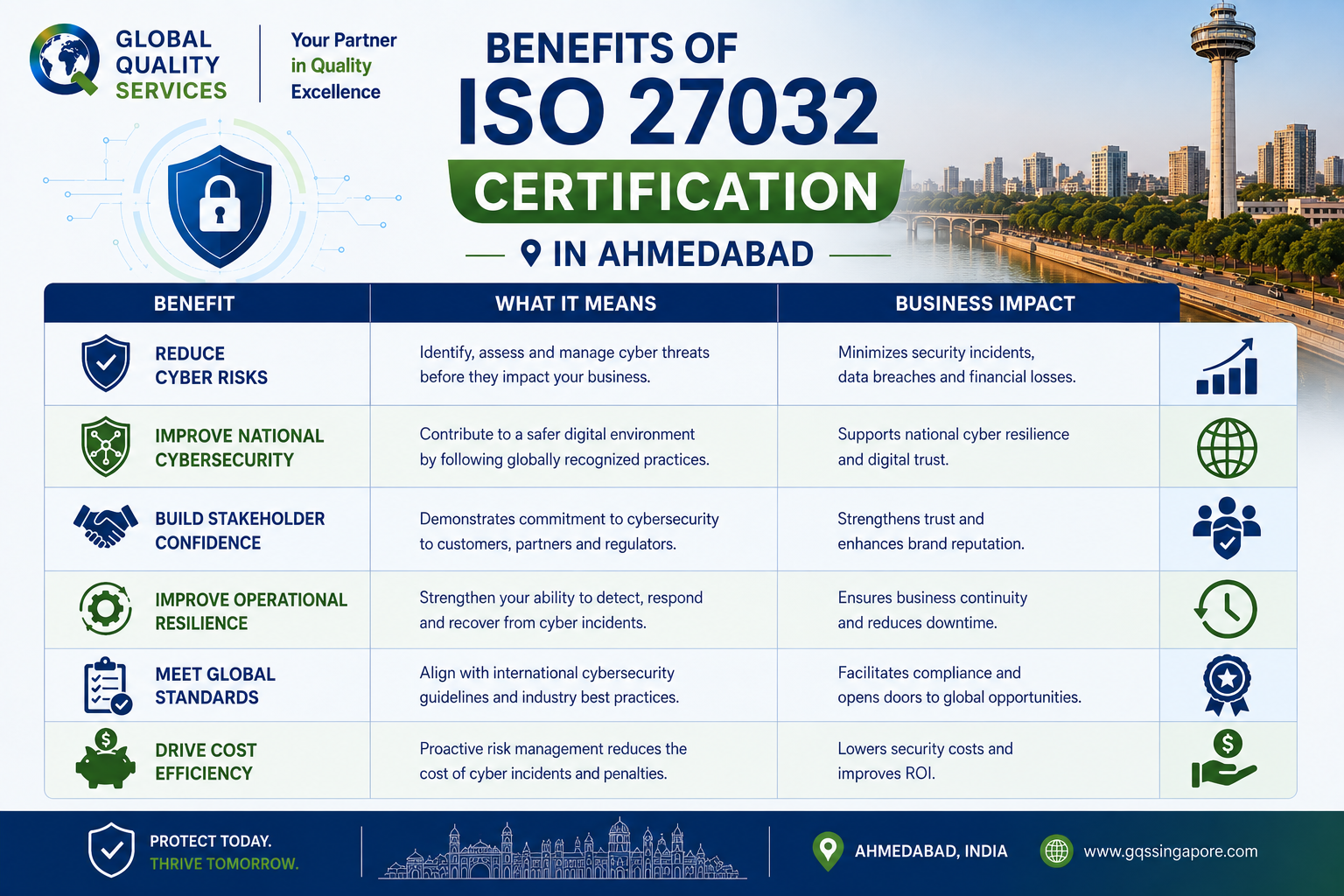
Understand the Organisation’s Digital Attack Surface
A structured review helps management see where the organisation interacts with the Internet and where security exposure may exist.
Connect Different Security Functions
Internet security often overlaps with network, application and information security. ISO 27032 encourages organisations to understand these relationships rather than managing each area in isolation.
Improve Security Prioritisation
Risk assessment allows organisations to focus on vulnerabilities that could have the greatest effect on important systems and business operations.
Strengthen Collaboration
Security responsibilities can extend across IT teams, management, employees, vendors and technology providers. Defining these relationships can improve coordination.
Improve Incident Readiness
Having established responsibilities and communication procedures can make it easier to respond when suspicious activity or an actual cybersecurity incident occurs.
Support Business Relationships
Customers and enterprise buyers increasingly ask suppliers how they protect digital information and online services. A structured cybersecurity programme can help demonstrate that security is being actively managed.
Complement Broader Compliance Programmes
ISO 27032 does not need to operate in isolation. It can form part of a broader programme alongside ISO 27001, privacy frameworks and other security assessments. For organisations providing cloud-based services, GQS also offers SOC 2 assessment services, which can provide another layer of assurance around security controls.
Why Choose GQS for ISO 27032 in Ahmedabad?
Global Quality Services has more than 26 years of experience in certification consulting and works across a range of ISO and compliance frameworks. Its current portfolio includes information security, privacy, AI governance, and other management system services. GQS can help Ahmedabad-based organisations understand how ISO 27032 fits within their existing cybersecurity programme, rather than treating it as an isolated exercise.
The support can include:
- Cybersecurity scope assessment
- Gap analysis
- Risk assessment
- Policy and procedure development
- Security-control planning
- Implementation support
- Employee awareness
- Internal review
- Corrective-action planning
- Preparation for relevant external assessments
- Guidance on integrating cybersecurity with other ISO frameworks
The approach can be adapted to the organisation’s industry, technology infrastructure, size and security objectives.
Frequently Asked Questions
What is ISO 27032 Certification in Ahmedabad?
ISO 27032 Certification in Ahmedabad generally refers to consultancy, implementation and assessment activities based on ISO/IEC 27032. The current ISO/IEC 27032:2023 standard provides guidelines for Internet security. It is important to distinguish this from certification to a certifiable management-system standard such as ISO 27001.
Is ISO 27032 mandatory for companies in Ahmedabad?
No. ISO/IEC 27032 is not a mandatory certification requirement for businesses in Ahmedabad. Organisations may adopt its guidance to improve Internet security practices, meet customer expectations, or strengthen their wider cybersecurity programme.
How is ISO 27032 different from ISO 27001?
ISO 27001 provides requirements for an Information Security Management System, while ISO 27032:2023 focuses on Internet security and its relationship to the web, networks, and cybersecurity. The two can be used together where appropriate.
Can manufacturing companies in Ahmedabad use ISO 27032?
Yes. Manufacturing organisations increasingly depend on connected systems, cloud applications, remote access and digital supply chains. ISO 27032 guidance can help them consider Internet security risks within this broader connected environment.
Does ISO 27032 make a company compliant with CERT-In?
No. ISO 27032 does not automatically establish compliance with CERT-In requirements. Organisations must separately assess the CERT-In Cyber Security Directions and any other laws or regulatory requirements applicable to their activities.