
Mumbai is one of India’s most digitally connected business centres, with financial institutions, fintech companies, e-commerce businesses, media organisations, logistics providers, IT companies and global service firms operating across the city. As more business activity moves through websites, cloud platforms, APIs, mobile applications and connected networks, cybersecurity becomes an important part of everyday business operations.
ISO 27032 Certification in Mumbai helps organisations establish a structured approach to Internet security and strengthen their ability to identify, manage and respond to cybersecurity risks. Global Quality Services (GQS) provides consultancy and implementation support to organisations seeking to align their cybersecurity practices with ISO/IEC 27032 and related information security frameworks.
What Is ISO 27032?
ISO/IEC 27032:2023 is an international standard titled Cybersecurity — Guidelines for Internet security. It explains the relationship among Internet security, web security, network security, and broader cybersecurity, while providing high-level guidance on common Internet security issues. The current edition was published in June 2023.
One important point to understand before pursuing ISO 27032 Certification in Mumbai. ISO/IEC 27032:2023 is a guideline standard rather than a conventional certifiable management system standard such as ISO/IEC 27001. Organisations can therefore use it to structure and improve their cybersecurity practices, while formal certification claims should be considered carefully in light of the applicable assessment or certification arrangement.
GQS helps businesses understand this distinction and build a cybersecurity programme that can work alongside established standards such as ISO 27001, ISO/IEC 27701, SOC 2 and PCI DSS.
Why ISO 27032 Matters for Mumbai Businesses
Mumbai businesses operate in an environment where a cybersecurity incident can affect more than just an IT system. A compromised customer account, exposed database, fraudulent transaction, unavailable website or attacked cloud platform can interrupt operations and damage customer confidence.
This is particularly relevant for Mumbai’s financial and professional-services ecosystem. Banks, fintech companies, insurance businesses, payment-related organisations and financial technology providers handle large volumes of sensitive information and depend heavily on online systems.
The same concern applies to e-commerce and digital businesses. Customer portals, payment gateways, APIs, mobile applications, cloud infrastructure and third-party platforms create multiple points that need to be assessed.
ISO/IEC 27032 provides a useful cybersecurity perspective for bringing these interconnected areas together rather than treating network security, application security and Internet security as completely separate activities.
ISO 27032 and Mumbai’s Financial & Digital Ecosystem
For a financial technology company, cybersecurity is closely connected with customer trust. For an e-commerce business, it affects transactions and customer accounts. For a logistics organisation, it can influence tracking systems, supply-chain communication and operational availability.
A practical ISO 27032 programme can help organisations examine areas such as:
- Internet-facing applications and services
- Network and communication security
- Authentication and access management
- Protection of sensitive information
- Cybersecurity risk identification
- Security monitoring and incident response
- Web and application security
- Third-party and interconnected systems
- Employee cybersecurity awareness
- Coordination between business and technology teams
Rather than implementing controls simply because they appear on a checklist, organisations should connect cybersecurity measures with actual business risks.
How ISO 27032 Works Alongside ISO 27001
ISO 27032 and ISO 27001 serve different purposes.
ISO/IEC 27001 provides requirements for establishing, implementing, maintaining and continually improving an Information Security Management System (ISMS). It gives an organisation a management framework for identifying information-security risks and selecting appropriate controls.
ISO/IEC 27032, on the other hand, concentrates specifically on Internet security and the relationship between different areas of cybersecurity.
For a Mumbai organisation with a mature information-security programme, using both approaches can provide broader coverage. GQS can also support organisations exploring ISO 27001 Certification as a wider information-security management framework.
For organisations handling significant amounts of personal information, privacy can be addressed through ISO/IEC 27701:2025, while companies providing technology services to customers may also consider SOC 2 assessment.
Our ISO 27032 Consultancy Process in Mumbai
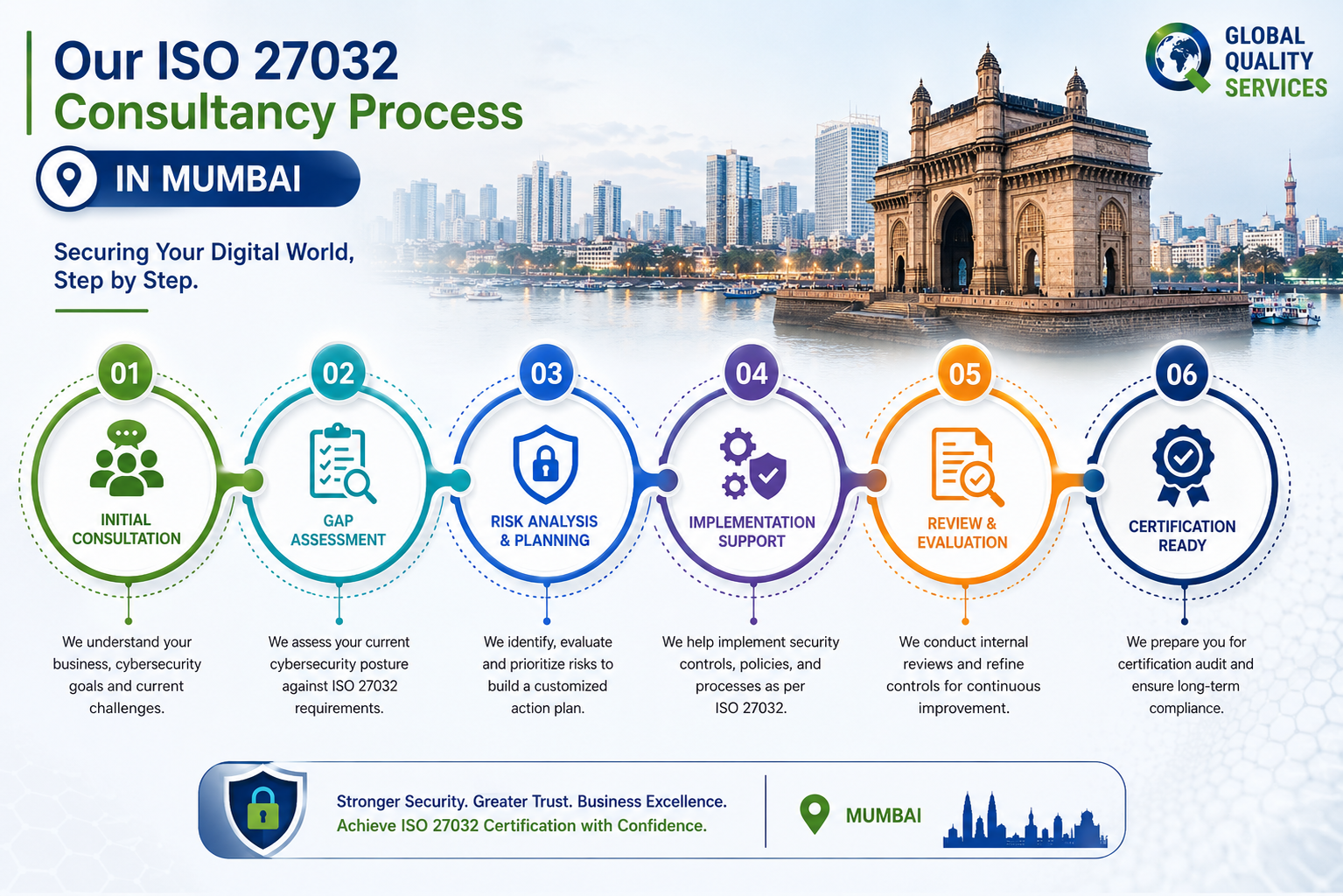
A useful cybersecurity programme begins with understanding the organisation rather than immediately preparing documents. GQS follows a structured approach to help businesses identify where ISO/IEC 27032 principles can strengthen their existing security practices.
1. Initial Cybersecurity Assessment
The first stage involves understanding your organisation’s technology environment, Internet-facing services, business processes and existing cybersecurity controls. This helps identify the areas requiring greater attention.
2. Scope and Risk Identification
Next, GQS helps define the relevant scope. This can include websites, applications, networks, cloud environments, remote-access systems, databases and connected services. Cybersecurity risks are then assessed based on their potential impact on business operations, information, and customers.
3. Gap Analysis
Existing practices are compared with the relevant ISO/IEC 27032 guidance and the organisation’s cybersecurity objectives. Gaps may relate to access control, monitoring, incident handling, application security, documentation or employee awareness.
4. Documentation and Control Development
Once gaps are identified, appropriate policies, procedures, responsibilities and security controls can be developed or improved. The objective is to create documentation that reflects how the organisation actually operates.
5. Implementation Support
GQS assists the organisation in putting agreed cybersecurity practices into operation. Teams may need to improve monitoring, access management, incident response, security awareness or controls around Internet-facing systems.
6. Internal Review and Readiness
Before an external assessment or other conformity evaluation, the implemented practices are reviewed. This gives management an opportunity to address weaknesses and ensure that relevant evidence is available.
7. Assessment and Continual Improvement
Cybersecurity should not end after an assessment. Threats, technologies and business processes change continuously. Organisations should periodically review their controls, incidents and risks and improve their security programme accordingly.
Cybersecurity Compliance Considerations in India
Mumbai organisations should also consider applicable Indian cybersecurity and data-protection requirements alongside voluntary international frameworks.
The Indian Computer Emergency Response Team (CERT-In) has issued directions under Section 70B of the Information Technology Act, 2000 covering information-security practices, cyber-incident prevention, response and reporting. Organisations can review the applicable requirements through the official CERT-In directions.
Data privacy is another important consideration. The Ministry of Electronics and Information Technology (MeitY) published the Digital Personal Data Protection Rules, 2025, along with an enforcement timeline and related notifications.
For businesses processing personal information, cybersecurity and privacy should therefore be considered together rather than managed as completely separate responsibilities.
Who Can Benefit from ISO 27032 in Mumbai?
ISO/IEC 27032 guidance can be useful for organisations whose operations depend heavily on Internet-connected systems, including:
- Banks and financial institutions
- Fintech and payment technology companies
- Insurance organisations
- E-commerce companies
- IT and software businesses
- SaaS providers
- BPO and knowledge-process organisations
- Media and digital-content companies
- Logistics and supply-chain businesses
- Healthcare and health-tech organisations
- Professional-services firms
- Organisations operating customer-facing digital platforms
The exact scope should depend on the organisation’s technology environment, business model and cybersecurity risks.
Benefits of ISO 27032 Alignment
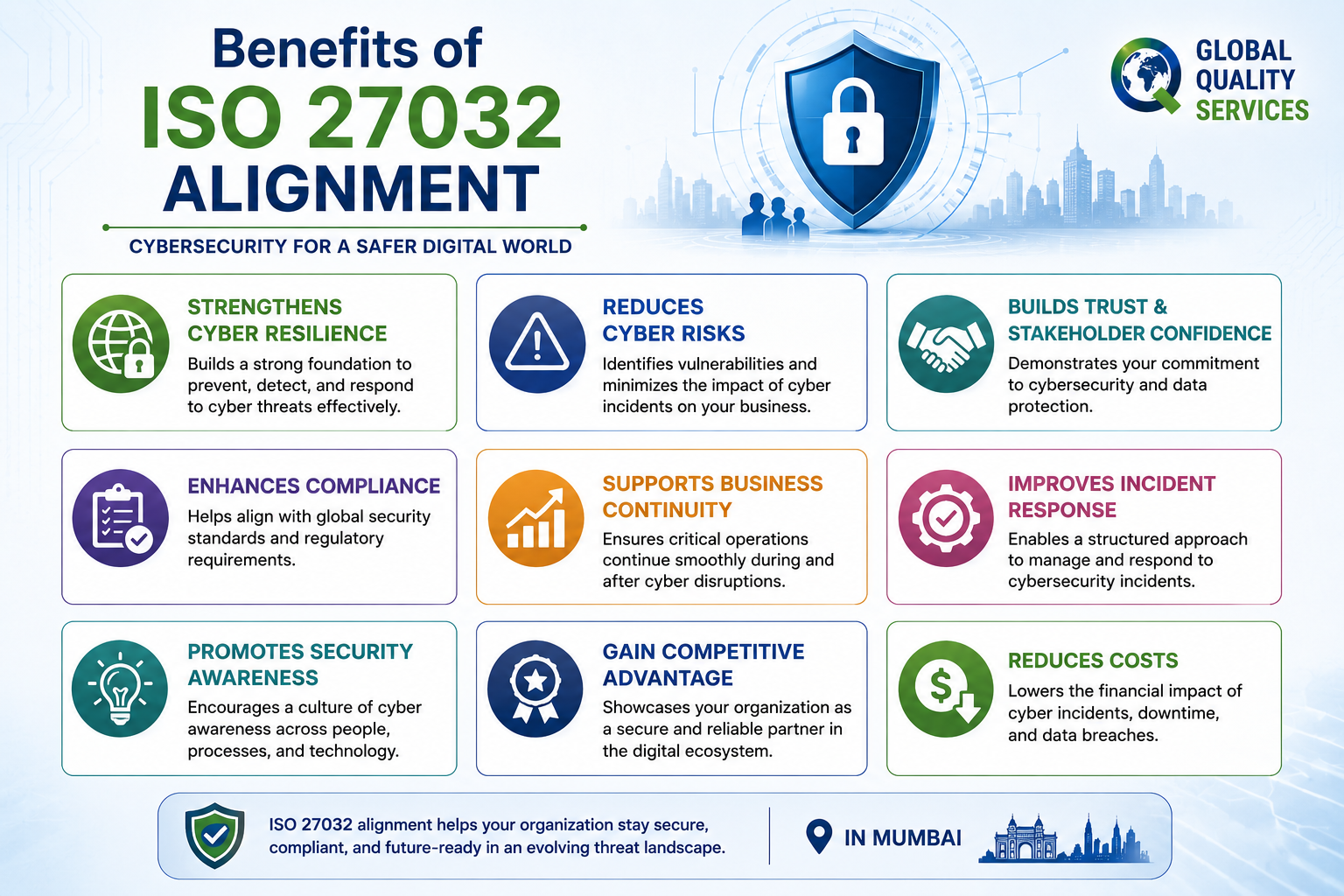
A structured approach based on ISO/IEC 27032 can provide practical business benefits.
Better visibility of Internet-related risks: Organisations gain a clearer understanding of vulnerabilities across websites, networks, applications and connected services.
Stronger coordination: Cybersecurity often involves IT, security, management, vendors and business teams. A structured framework can help clarify responsibilities.
Improved incident preparedness: Organisations can establish clearer approaches for identifying, handling and responding to cybersecurity incidents.
Greater customer confidence: Demonstrating a structured approach to cybersecurity can support trust among customers, partners and other stakeholders.
Better integration with other frameworks: ISO/IEC 27032 can complement broader information security and privacy programmes, including ISO 27001 and ISO/IEC 27701.
Support for continual improvement: Cybersecurity risks change constantly. Regular reviews help organisations adapt their controls as technologies and threats evolve.
Why Choose GQS for ISO 27032 Consultancy in Mumbai?
Global Quality Services has experience supporting organisations across information security, compliance, and management system frameworks. Its current service portfolio includes ISO 27001, SOC 1, SOC 2, PCI DSS and other cybersecurity-related services, allowing organisations to consider ISO/IEC 27032 within a wider security programme rather than in isolation.
For Mumbai businesses, cybersecurity is closely connected with customer trust, operational continuity and digital growth. ISO/IEC 27032 provides useful guidance for organisations seeking a more coordinated approach to Internet security. GQS can help your organisation understand the framework, assess its current cybersecurity position and develop practical improvements suited to its technology environment and business risks.
Contact GQS today to discuss ISO 27032 consultancy in Mumbai and identify the right cybersecurity approach for your organisation.
Frequently Asked Questions
1. Is ISO 27032 certification mandatory in Mumbai?
No. ISO/IEC 27032:2023 is a guideline standard for Internet security and is not a mandatory certification requirement for businesses in Mumbai. Organisations can adopt its guidance to strengthen their cybersecurity practices.
2. Is ISO 27032 the same as ISO 27001?
No. ISO 27001 provides requirements for an Information Security Management System, while ISO/IEC 27032 provides guidance focused on Internet security and its relationship with wider cybersecurity.
3. Who should consider ISO 27032 in Mumbai?
It can be particularly useful for fintech companies, banks, e-commerce businesses, SaaS providers, IT companies, BPOs, digital platforms and other organisations that depend heavily on Internet-connected systems.
4. Can ISO 27032 be used with ISO 27001?
Yes. The two standards address different areas and can complement one another. ISO 27001 provides the broader information-security management framework, while ISO/IEC 27032 adds focused guidance around Internet security.
5. How can GQS help with ISO 27032 in Mumbai?
GQS can help organisations assess their existing cybersecurity practices, identify gaps, develop or improve relevant policies and controls, support implementation, and prepare for an appropriate assessment or conformity-evaluation process.