

Building verified cloud security is essential for technology companies across India. As businesses move critical applications to shared infrastructure, proving that their cloud environment is secure has become a standard requirement for closing business deals. According to Gartner’s industry market forecasts, end-user spending on public cloud services in India is projected to grow 28.1% to $17.5 billion in 2026.
The Delhi NCR region is growing into one of the main bases of operation for software exporters, fintech companies, and managed service providers. As cloud adoption continues to grow at a fast pace, the need to follow certain standards, such as ISO 27017, ensures that the data is protected.
ISO 27017 is an international code of practice that was developed particularly for cloud security. It adds some controls to the already existing framework of the ISO 27001 Information Security Management System.
Why Delhi NCR’s IT Hubs Require ISO 27017 Compliance
This section explains the commercial pressures and market demands that make ISO 27017 certification necessary for technology businesses across Delhi NCR. Technology companies operating in Delhi, Gurgaon, and Noida face increasing scrutiny from global buyers and internal procurement teams. The following factors drive the demand for ISO 27017 across the region:
- Passing Enterprise Vendor Security Reviews: International clients require documented proof of cloud controls before signing contracts. ISO 27017 serves as a recognized benchmark that speeds up vendor risk assessments.
- Meeting Strict Data Privacy Expectations: India enforces data protection rules under the DPDP framework. ISO 27017 provides the operational controls needed to secure customer data stored on the cloud.
- Addressing Cloud-Specific Security Gaps: Standard ISO 27001 policies focus broadly on general information security. ISO 27017 fills specific gaps related to virtual machines, cloud data deletion, and shared customer responsibilities.
- Qualifying for Government and Corporate Tenders: Public sector contracts and corporate RFPs frequently specify ISO 27017 compliance as a mandatory qualification requirement.
- Strengthening Software Export Credibility: Software providers in Delhi NCR use ISO 27017 to reassure overseas buyers that hosted applications meet international security standards.
Which Delhi Industries Benefit the Most from ISO 27017 Certification
Here are the main business sectors in Delhi NCR that achieve the highest return on investment from implementing ISO 27017.
- SaaS and Cloud Software Platforms: Businesses running applications via Amazon Web Services (AWS), Microsoft Azure, or Google Cloud implement ISO 27017 for demonstrating isolation, availability, and secure data deletion.
- Fintech and Digital Payment Systems: Firms offering fintech services that store transaction details in cloud servers utilize ISO 27017 controls for data protection and system resilience.
- IT Management and BPO Exporters: Business Process Outsourcing firms that manage third-party infrastructures apply ISO 27017 controls to prove that their operational controls align with international expectations.
- Healthtech Providers: Digital healthcare service providers that keep patient records in cloud servers leverage ISO 27017 controls for securing medical data from any unauthorized access.
- Logistics and E-Commerce Platforms: Large-volume e-commerce platforms need resilience on the cloud to avoid downtime and protect the payment information of customers.
ISO 27017 Certification Process for Delhi Organizations
Achieving ISO 27017 certification requires a practical approach that integrates cloud security controls directly into your daily technical operations. Here is how the process works:
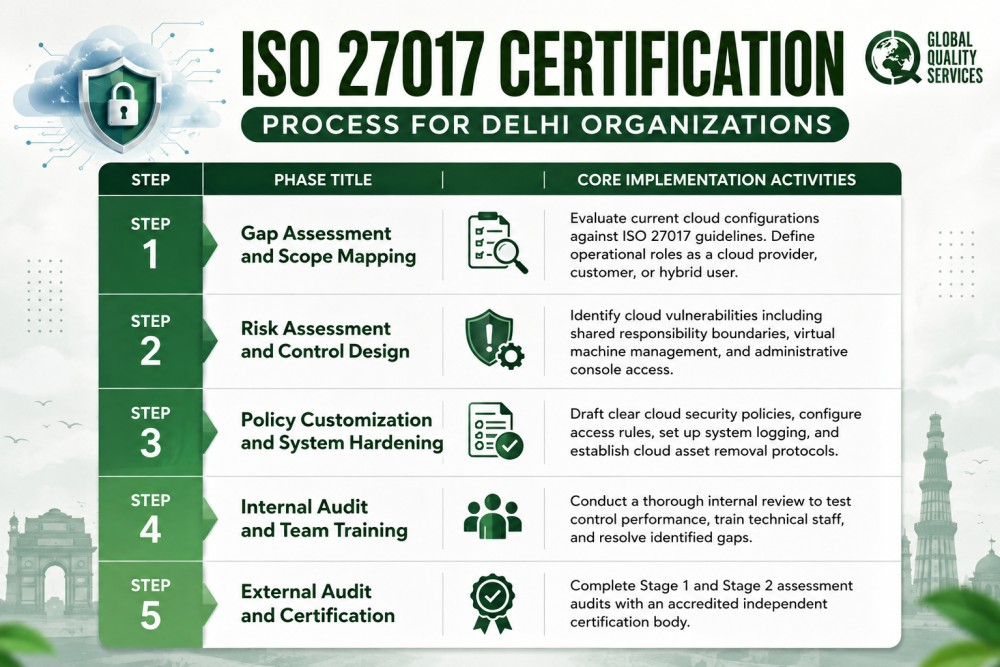
Common Cloud Security Challenges Faced by Delhi Organizations
Using cloud infrastructure involves special security factors that are beyond consideration in traditional IT models. The firms in Delhi commonly face the following operational issues:
- Ambiguity of Shared Responsibility Model: IT staff often believe that security concerns are taken care of by cloud service providers; thus, they remain ignorant about application security, encryption, and authentication.
- Poor Isolation of Virtual Machines: Improper isolation of multi-tenant virtual machines makes users vulnerable, as mistakes in server configurations can disclose confidential information of other customers.
- Lack of Security Controls over Administrative Accounts: The problem of excessive console access and poor administration credentials management raises major security problems.
- Failure to Implement Secure Data Deletion Processes: Leaving any residual customer data and their configuration backup after expiration of a contract poses high security risks.
- No Cloud Monitoring System: Without comprehensive cloud monitoring, it is difficult to track down any security anomaly.
How Does Global Quality Services Support ISO 27017 Certification Across Delhi
Global Quality Services provides consultancy, gap analysis, and audit preparation for technology firms located in Delhi NCR. The implementation experts collaborate with your engineering and security teams in designing security controls that help secure your infrastructure without interfering with the development process of software. The consultants will concentrate on incorporating ISO 27017 guidelines within your ISO 27001 management structure. Major support activities involve:
- Gap assessment of cloud infrastructure in AWS, Azure, Google Cloud, and on-premises environment.
- Setting up a well-defined shared responsibility matrix based on your unique cloud infrastructure setup.
- Preparation of an easy-to-understand cloud security policy, access control guide, and incident response plan.
- Training of cloud architects, DevOps engineers, and system administrators regarding ISO 27017 requirements.
- Management of internal audits and assistance to your management team during the final external audit.
Start Your ISO 27017 Certification Journey in Delhi-
ISO 27017 compliance offers your business an undeniable edge in selling to enterprise clients. There is a need for tangible evidence showing that your cloud services provide protection against security threats to their sensitive information. Engaging the services of seasoned consultants helps ensure that your company achieves compliance without experiencing unnecessary interruptions. Why technology leaders choose Global Quality Services:
- Customized Implementation: Security controls designed around your active tech stack, cloud architecture, and development workflows.
- Practical Engineering Focus: Clear policies written by consultants who understand modern cloud infrastructure and DevOps practices.
- Complete Audit Support: Direct assistance from initial scoping through to successful external audit completion.
Take control of your cloud security today. Contact our team to schedule your ISO 27017 gap assessment and receive a transparent project proposal.
Frequently Asked Questions
1. Is ISO 27001 required before getting ISO 27017 certification?
Yes. ISO 27017 is an extension standard built on the ISO 27001 framework. It cannot stand alone and must be implemented alongside or added to an existing ISO 27001 system.
2. How long does ISO 27017 certification take for a tech firm in Delhi?
If your organization already maintains an active ISO 27001 system, implementation and audit readiness take six to eight weeks. Starting both standards together typically takes three to five months.
3. What is the difference between ISO 27017 and ISO 27018?
ISO 27017 covers general cloud security controls and shared responsibility guidelines. ISO 27018 focuses specifically on protecting Personally Identifiable Information within public cloud environments.
4. Can fully remote or hybrid tech companies in Delhi NCR get certified?
Yes. ISO 27017 audits evaluate cloud console configurations, access permissions, identity management, and virtual security parameters, making it fully applicable to distributed teams.
5. Does ISO 27017 apply to companies that use cloud services rather than host them?
Yes. ISO 27017 provides distinct guidelines for Cloud Service Customers as well as Cloud Service Providers, helping users configure third-party cloud environments safely.