Hyderabad has grown into a major commercial engine for the country. The city region is the primary driver of Telangana’s Gross State Domestic Product, which climbed to an impressive 17.82 lakh crore during the 2025-2026 fiscal year. As business footprints widen across our massive industrial parks, IT corridors, and pharmaceutical hubs, companies face a vital shift in how corporate operations are evaluated.
The International Organization for Standardization is launching its highly anticipated update with the ISO 9001:2026 standard. This update marks a significant change from standard documentation drills. For local enterprises that want to pitch to international clients, secure high-value government contracts, or clean up operational waste, waiting around is no longer a viable strategy.
Why Hyderabad Businesses Must Prepare for ISO 9001:2026
ISO 9001:2026 is expected to place greater emphasis on business resilience, digital transformation, performance monitoring, and risk management. Businesses that prepare early can make the transition smoothly and avoid last-minute compliance challenges.
Key reasons to prepare for ISO 9001:2026 include:
- Strengthening customer confidence
- Improving process consistency
- Reducing operational errors
- Enhancing supplier management
- Supporting tender and contract eligibility
- Improving employee accountability
- Building a culture of continuous improvement
- Increasing readiness for global business opportunities
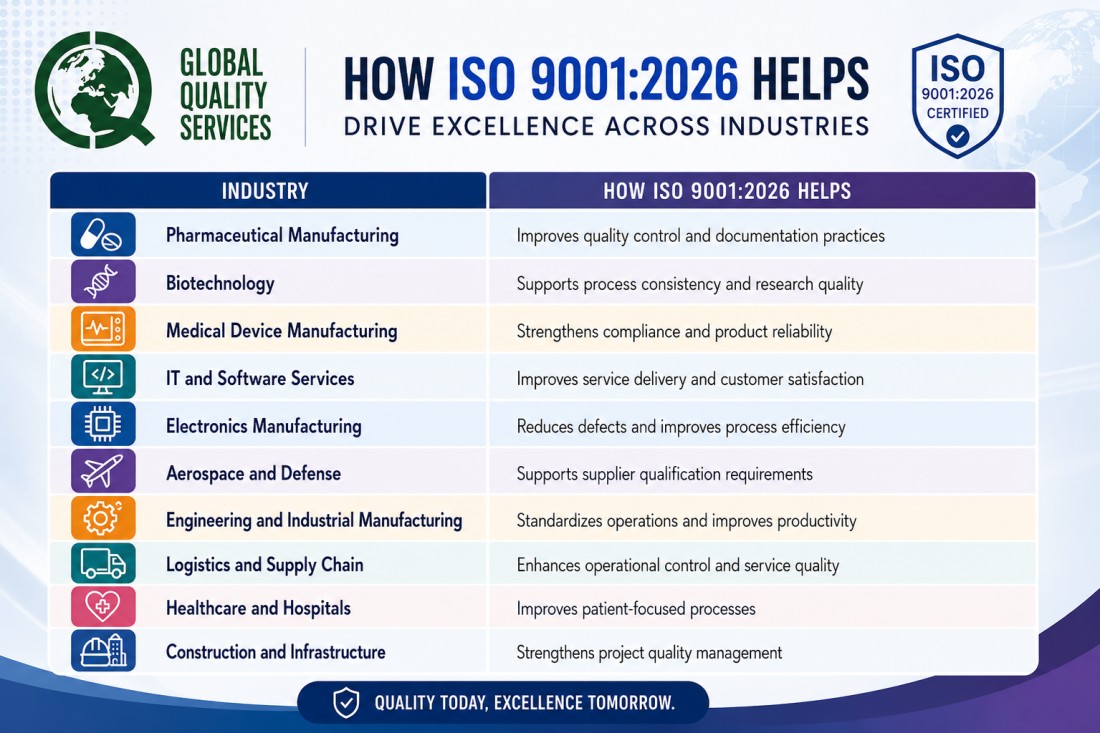
Industries in Hyderabad That Benefit Most from ISO 9001:2026
Implementing this updated framework offers clear competitive advantages to several major corporate sectors across the regional economy. Here is the list of industries that benefit from the ISO 9001:2026.
ISO 9001:2026 Certification Process in Hyderabad
Earning your official quality certification follows a clear, predictable path. By breaking down the compliance journey into logical milestones, your organization can successfully navigate the registration process without disrupting daily production schedules.
Step 1: Initial Gap Assessment
Your leadership team compares current workplace routines against the updated 2026 clauses. This step identifies specific operational gaps related to new requirements, such as quality culture metrics and climate impact risks.
Step 2: Documentation and System Upgrades
We help you update core organizational documentation. This includes revising standard operating procedures, quality manuals, and key performance tracking indicators to match the 2026 guidelines without adding bloated paperwork layers.
Step 3: Workplace Training and System Rollout
Staff members across all key departments undergo straightforward training. This step ensures that managers and ground teams actively practice the updated quality policies during their daily routines, making compliance a natural part of company culture.
Step 4: Internal Auditing and Verification
Trained internal auditors conduct a trial assessment of your systems. This mock run identifies hidden process bottlenecks, validates corrective actions, and confirms your team is ready for the external registrar.
Step 5: Registrar Review
An accredited external auditor performs a thorough desktop review of your formal written manuals. The goal is to verify that your documented quality frameworks structurally line up with every ISO mandate.
Step 6: Main Audit
The external auditor conducts an on-site evaluation at your Hyderabad facility. They observe active operations, interview key personnel, and review live tracking files. Once they verify that your workforce lives up to the standard daily, they issue your official certification.
Implementation Roadmap for ISO 9001:2026 Registration
Transitioning your systems requires clear timelines to keep your daily business moving forward without disruptions. This structural schedule shows what to expect during a typical rollout.
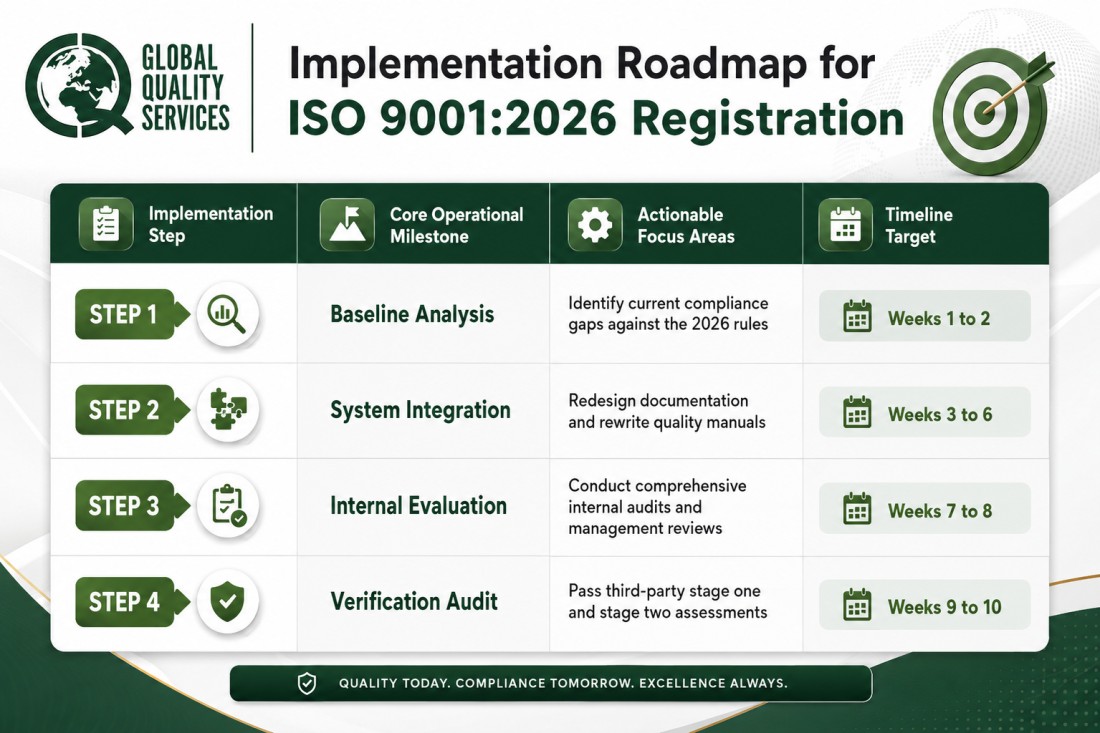
A clear implementation roadmap helps organizations move through each stage in a practical and organized manner, from assessing current systems to preparing for the final certification audit. By following a structured approach, businesses can minimize disruptions, address compliance gaps early, and build a quality management system that supports long-term growth and continuous improvement. Here is what the clear roadmap looks like:
Common ISO 9001 Implementation Challenges for Hyderabad Businesses
Upgrading corporate management systems can bring up noticeable internal bottlenecks that create friction for leadership teams.
- Treating Compliance as a Paperwork Chore: A frequent misstep is viewing the certification path as a secondary administrative task. When departments look at quality guidelines as simple administrative tasks rather than tools to improve profit margins, they create heavy, slow corporate systems that get in the way of actual production speeds.
- Internal Resistance to Transparent Reporting: Transitioning to a true quality culture requires managers and team leads to openly record production errors and address operational failures. If employees feel that highlighting process mistakes will negatively impact their individual performance scores, they will hide valuable data, which creates significant non-conformance risks during your final third-party review.
- Overcomplicating the Documentation Structure: Many businesses try to document every single minor workflow in extreme detail. This leads to massive, confusing instruction manuals that staff members cannot easily follow or apply in real time, causing team operational fatigue.
- Role-Vague Training Sessions: Generic, high-level overviews of the ISO standard rarely translate to the shop floor. If a software team or a pharmaceutical production group is taught abstract clauses instead of specific, role-based quality checks, they struggle to connect the compliance requirements to what they actually do every day.
- Failing to Track Clear KPIs: Without defining measurable quality objectives and clear Key Performance Indicators, leadership teams find it difficult to evaluate whether their management system is actually performing effectively or delivering genuine financial and operational improvements.
How does Global Quality Services support ISO 9001:2026 Certification Across Hyderabad?
Global Quality Services provides end-to-end assistance throughout the certification journey, helping organizations develop effective Quality Management Systems that align with ISO 9001:2026 requirements and business objectives.
Our support includes:
- Initial gap assessment and readiness review
- Documentation development and review
- Process mapping and implementation guidance
- Employee awareness and training programs
- Internal audit support
- Management review assistance
- Certification audit preparation
- Post-certification compliance support
Take the Next Step Toward ISO 9001:2026 Certification
A practical quality management framework protects your market presence and builds lasting trust with enterprise buyers. Companies ready to modernize their corporate workflows can leverage expert guidance to remove process overlap, build internal team capabilities, and clear complex regulatory audits easily.
- Receive straightforward gap evaluations designed around your exact facility layout
- Deploy simple documentation systems that improve team speed without added corporate fluff
- Prepare your internal teams to clear yearly surveillance reviews with total clarity
Connect with Global Quality Services to secure a transparent project plan and a clear cost estimate built for your business size.
Important Notice – Standard Under Development
The content on this page relates to ISO 9001:2026, which is currently under development and has not yet been officially published by the International Organization for Standardization (ISO).
The steps, requirements, and guidance provided here are based on draft information, anticipated changes, and professional interpretation of the evolving standard. They are intended for informational and preparatory purposes only.
This content will become fully applicable only upon the official publication of ISO 9001:2026 by ISO. Until then:
- Requirements and clause structures may change before final publication
- Certification bodies will not audit against this standard until it is formally released
- Organizations should continue to maintain compliance with the currently published version, ISO 9001:2015, until transition timelines are announced
GQS will update this content to reflect the final published standard as soon as it becomes available.
Frequently Asked Questions
1. What is the final deadline for upgrading a current ISO 9001:2015 certificate to the 2026 version?
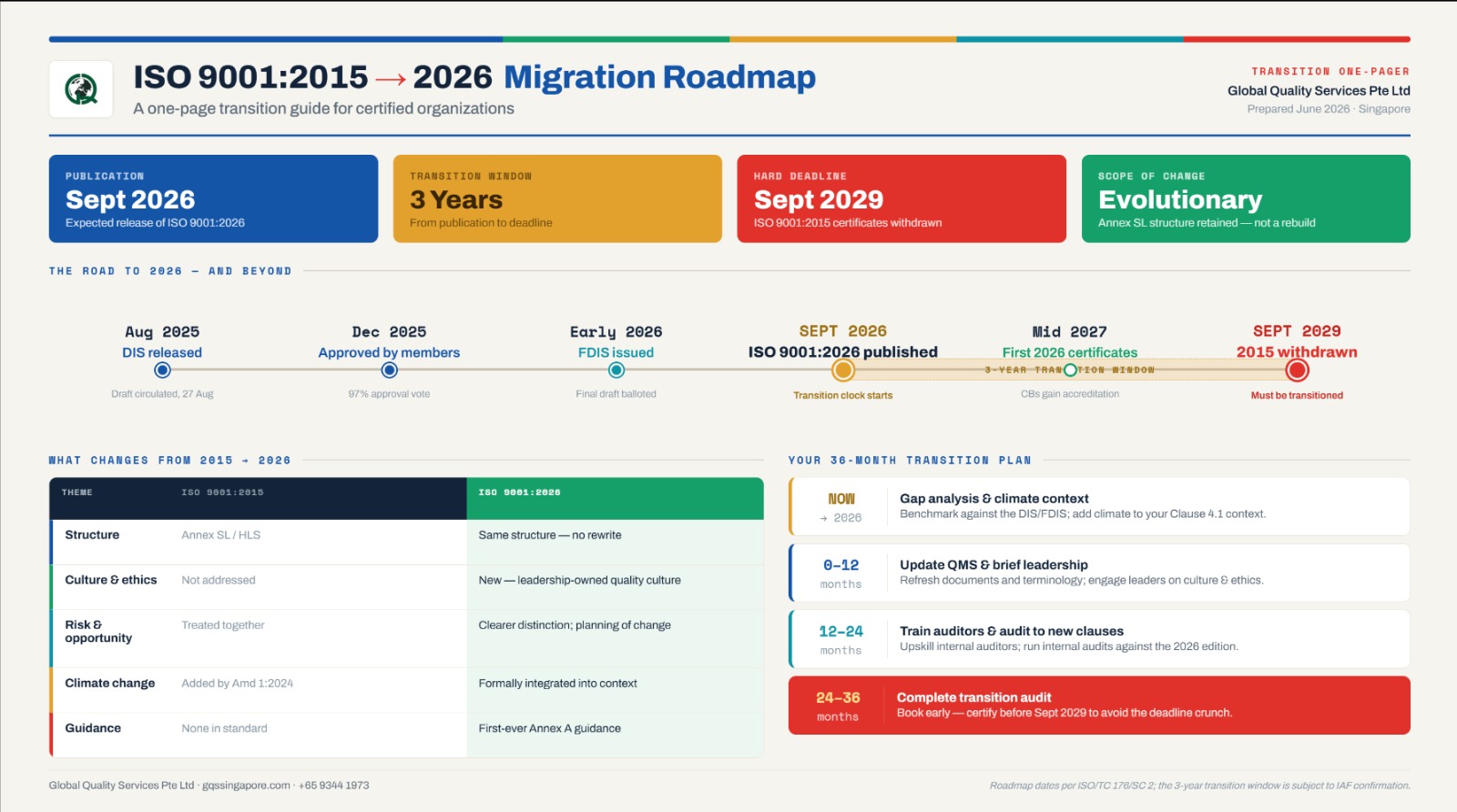
Businesses generally get a standard three-year transition window from the moment the updated standard is officially published. For the 2026 revision, certified companies will have until September 2029 to transition their active quality systems during their routine annual surveillance audits.
2. Are certification audits done by local auditors in Telangana recognized by global buyers?
Yes, your certificate holds full international weight as long as your registrar is accredited by a globally recognized body such as the National Accreditation Board for Certification Bodies or the United Kingdom Accreditation Service, which operate under international validation treaties.
3. How do auditors evaluate the new quality culture clause during an on-site visit?
Auditors will move away from just checking corporate documents. They will actively speak with employees across multiple departments to verify that your staff understands company values, follows ethical procedures, and knows how to report process defects safely.
4. Can a technology firm with several branches across Hyderabad get a single corporate certificate?
Yes, organizations can choose a multi-site certification plan. The central corporate office establishes the primary quality management protocols, and the external registrar runs regular sample assessments across different branch locations to confirm cross-site alignment.
5. What steps should our company take if the external auditor issues a non-conformance notice?
Your management team will have a specific window, usually ranging from thirty to ninety days, to submit a verified corrective action plan. Once you pinpoint the root cause, fix the operational error, and show documented proof to the auditor, the flag is cleared, and your registration moves forward.